You have solved your share of 5x5 Zip puzzles. The serpentine pattern feels familiar now, almost automatic. Corners no longer trap you. The checkpoint sequence clicks into place without much struggle.
And yet. That 6x6 grid is staring back at you, its eight checkpoints scattered in what seems like deliberate chaos. You have tried three different approaches, and each time the path dies somewhere around cell 28, leaving a pocket of unreachable cells mocking your effort. The serpentine that served you so well on smaller grids has become a liability—too predictable, too inflexible for this new complexity.
If this frustration sounds familiar, you are exactly where you need to be. The leap from 5x5 comfort to 6x6 competence is not about trying harder—it is about thinking differently.
Watch the Tutorial
Prefer watching? This tutorial covers the basics of Zip to get you started.
Prerequisites: This guide assumes you are comfortable with basic Zip rules (start at 1, visit checkpoints in order, fill every cell, end at highest checkpoint, orthogonal moves only, no crossing). If you need a refresher, check out our Complete Beginner's Guide to Zip Puzzles first.
The Checkerboard Secret: Understanding Parity
Here is a technique that will fundamentally change how you analyze Zip puzzles. It feels almost like cheating—a mathematical shortcut that reveals truths about paths before you draw a single line.
Parity is simply the idea that things alternate in a predictable pattern.
Imagine painting your Zip grid like a checkerboard, alternating between light and dark squares. The top-left cell is light, its neighbors are dark, their neighbors are light again, and so on.
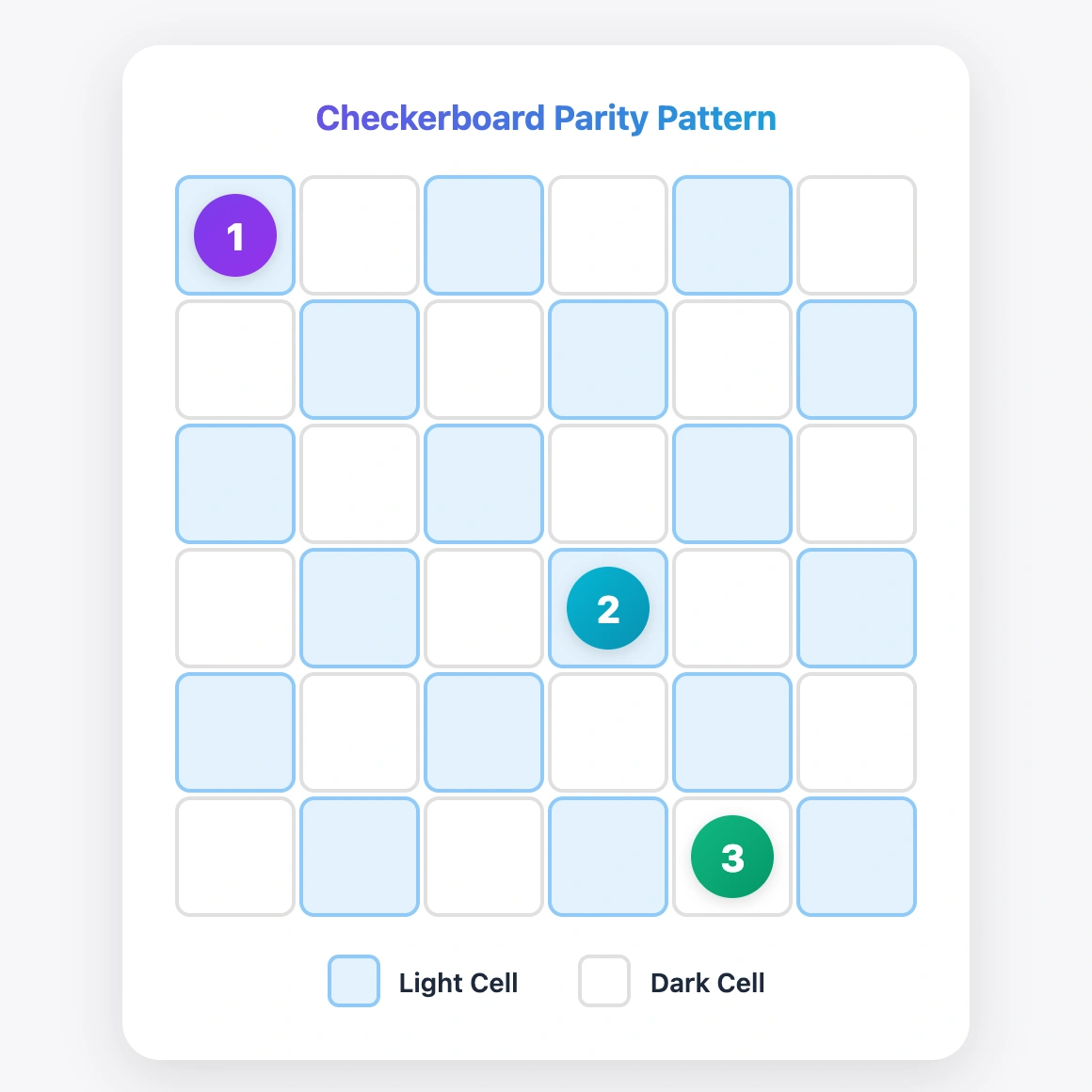
The checkerboard pattern: Light and dark cells alternate diagonally
Now here is the magic: every legal move in Zip—up, down, left, right—takes you from a light cell to a dark cell, or from a dark cell to a light cell. You can never move from light to light or dark to dark. Your path must alternate colors with every single step.
Why Parity Matters
Think of it like dancing—you and your partner must end on opposite feet after a waltz, same feet after a two-step. The number of moves determines who is where. In Zip, the number of steps determines your cell color.
If you start on a light cell and take one step, you land on dark. Two steps: light again. Three steps: dark. The parity of your step count determines your cell color.
Now consider a 6x6 grid: 36 cells total, exactly 18 light and 18 dark. If checkpoint 1 (your starting cell) is light, then after visiting all 36 cells, your 35th step lands you on... a dark cell. The math is unavoidable.
This means your final checkpoint MUST be on the opposite color from your starting checkpoint.
Let me show you a configuration that is impossible before you even begin:
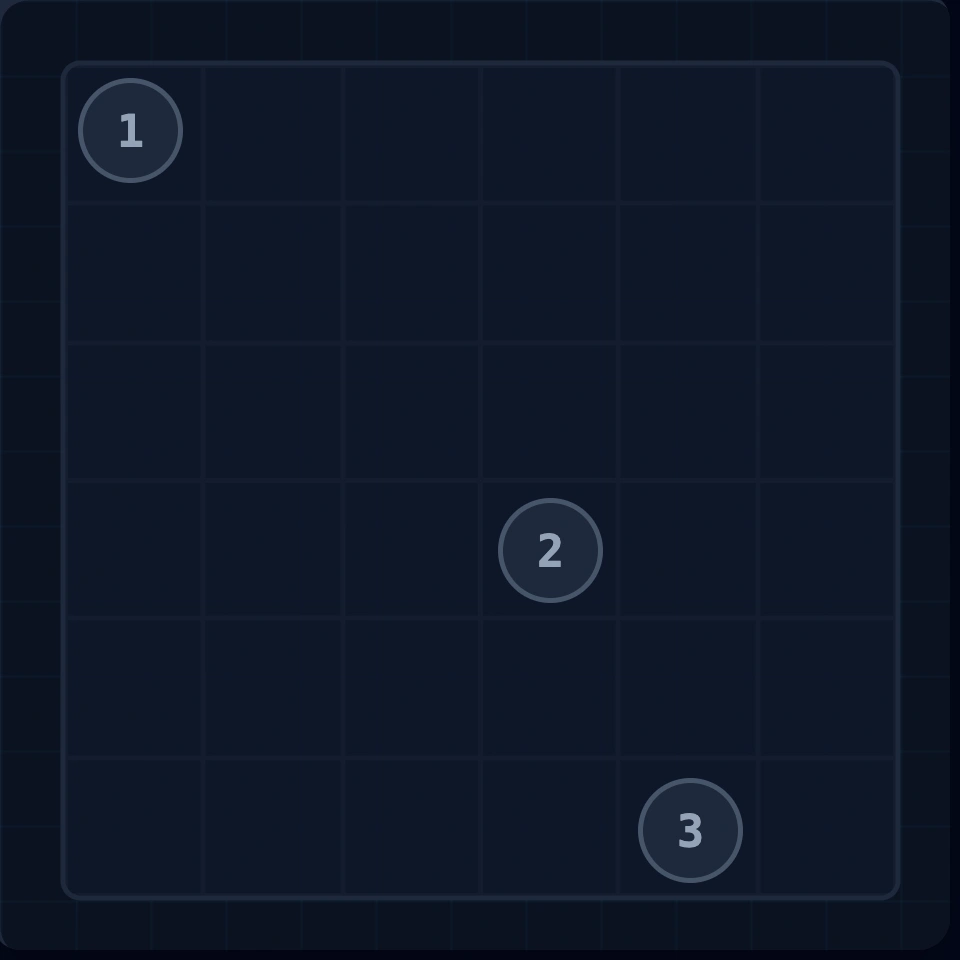
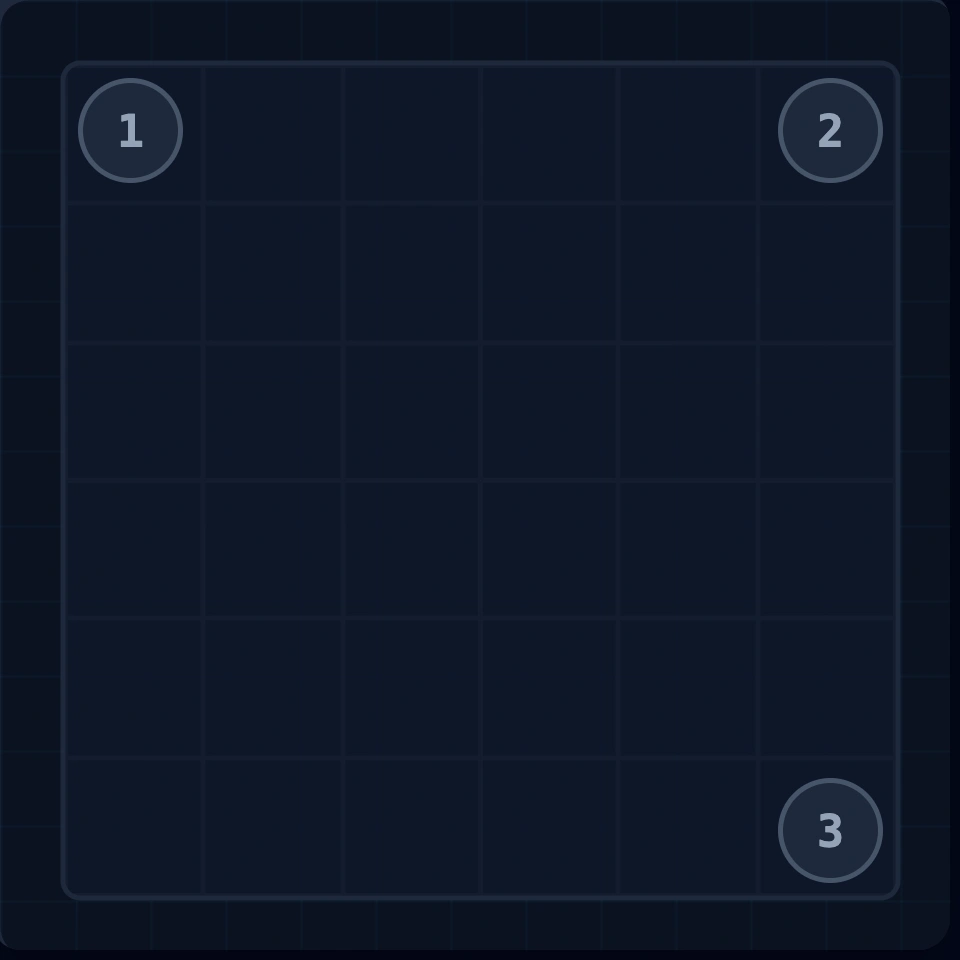
Impossible parity: Both endpoints on the same color
In this 6x6 puzzle, checkpoint 1 sits at (0,0)—a light cell. Checkpoint 3 sits at (5,4)—also a light cell. Both endpoints are the same color! On a 36-cell grid, any path starting on light must end on dark after 35 steps. This puzzle cannot be solved.
Parity for Path Planning
Say you need to travel from checkpoint 2 (on a light cell) to checkpoint 3 (on a dark cell), and you have identified a region of 8 cells that you must fill along the way.
Here is the question parity answers: can you start on light, end on dark, and visit exactly 8 cells?
Let us count. Starting on light, after 7 steps you land on dark. That is 8 cells visited (including your starting cell). Light to dark in 7 steps—it works.
But what if that region had 9 cells? After 8 steps from light, you would land on... light again. Same color as where you started. You cannot end on dark. The path is impossible.
| Endpoint Colors | Required Steps | Cell Count |
|---|---|---|
| Same color (Light→Light, Dark→Dark) | EVEN steps | ODD cell count |
| Different colors (Light→Dark, Dark→Light) | ODD steps | EVEN cell count |
Mnemonic: "Same needs odd cells, different needs even." Say it three times and it sticks.
Key Takeaway: Before committing to a path through any region, do a quick parity check. Count the cells, note the start and end colors, and verify the math works. This 10-second calculation prevents 10-minute dead ends.
Checkpoint Distance Analysis: The Cell Budget
Here is a deceptively simple question that many intermediate solvers forget to ask: "Do I have enough cells between these checkpoints?"
Every stretch of path between consecutive checkpoints must fill a certain number of cells. If the grid does not have enough cells available in that region, no amount of clever pathing will save you.
Minimum Distance Calculation
The absolute minimum number of cells between two checkpoints is the Manhattan distancebetween them—the number of horizontal steps plus the number of vertical steps. Think of it as how a taxi would drive in a city with a perfect grid of streets—no diagonals allowed.
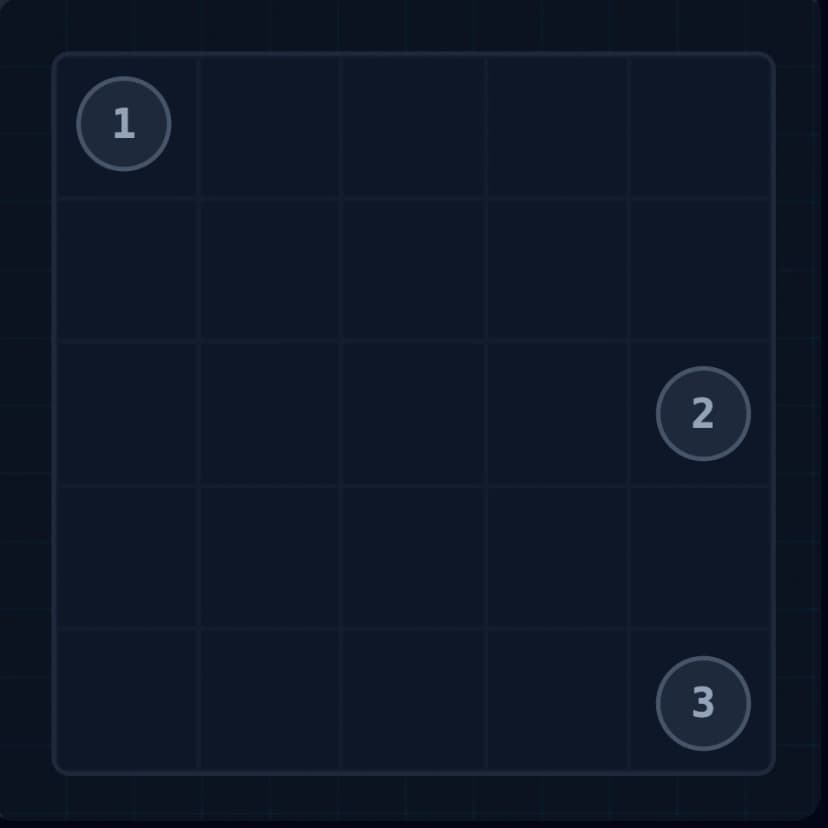
Manhattan distance: The minimum straight-line path between checkpoints
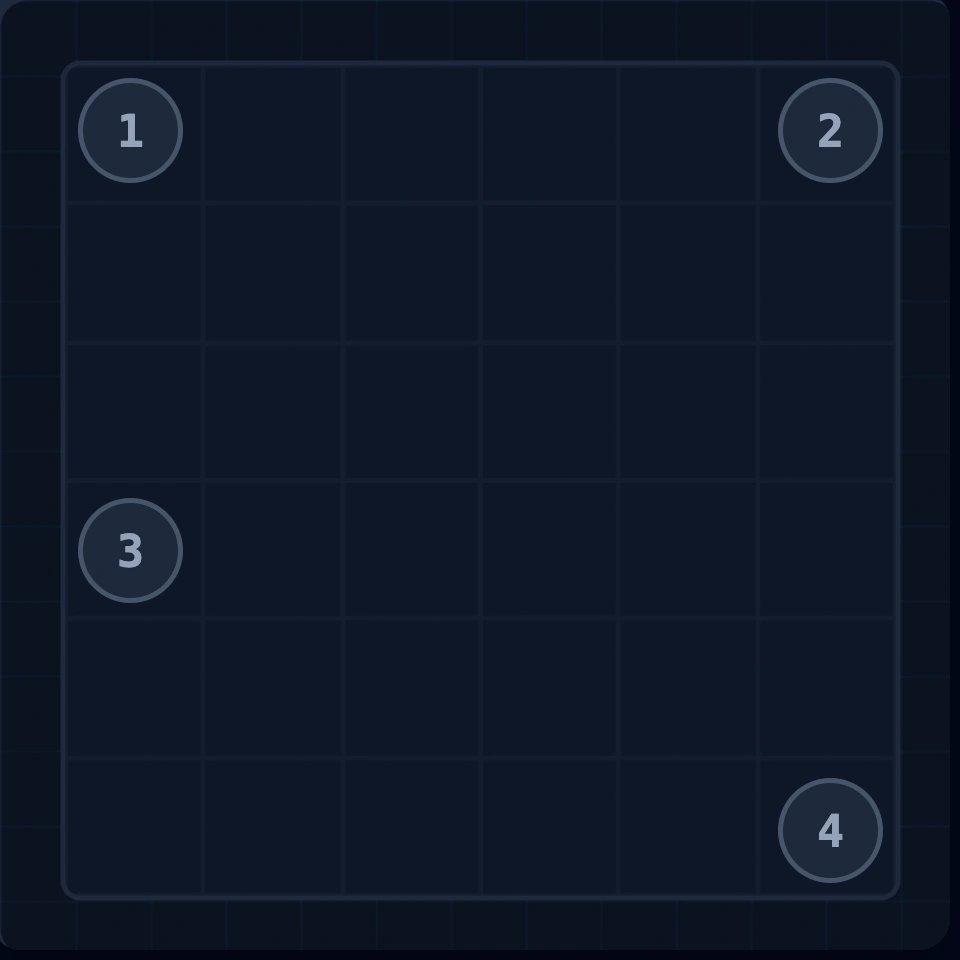
From checkpoint 1 at (0,0) to checkpoint 2 at (2,4): that is 2 rows down and 4 columns right, for a Manhattan distance of 6. This means you need at least 7 cells (including both endpoints) for this segment, since 6 steps connect 7 cells.
Maximum Distance Constraint
The flip side of minimum distance is the maximum available cells. Count how many unfilled cells exist in the region between your two checkpoints. If this count is less than what you need to traverse while hitting intermediate cells, you have a problem.
When checkpoints are close, path options become constrained
The Cell Budget Method
Here is a systematic approach for larger puzzles:
- List your checkpoint pairs in order: (1 to 2), (2 to 3), (3 to 4), etc.
- Calculate Manhattan distance for each pair
- Estimate available cells in the region each pair must traverse
- Compare and adjust: if available cells barely exceed minimum distance, that segment is constrained; if available cells far exceed minimum, you have flexibility
Key Takeaway: Treat cells as a budget. Each checkpoint-to-checkpoint segment has a minimum cost (Manhattan distance) and a maximum allocation (available cells in that region). When the budget is tight, your path through that segment is nearly forced. When the budget is generous, you have options—but also room for mistakes.
Region Isolation: The Art of Divide and Conquer
Large grids become manageable when you stop seeing them as one overwhelming puzzle and start seeing them as several connected smaller puzzles. This is region isolation—the technique of mentally partitioning your grid into sections that can be analyzed semi-independently.
How Checkpoints Create Natural Regions
Checkpoints are not just waypoints—they are region boundaries. The path between checkpoint 2 and checkpoint 3 creates a distinct segment with its own requirements. Each segment can be treated as a mini-puzzle: "How do I travel from here to there while filling these specific cells?"
Checkpoints naturally divide the grid into distinct regions
Forced Region Sequences
Some checkpoint configurations create forced sequences—regions where the path order is essentially determined by the checkpoints alone.
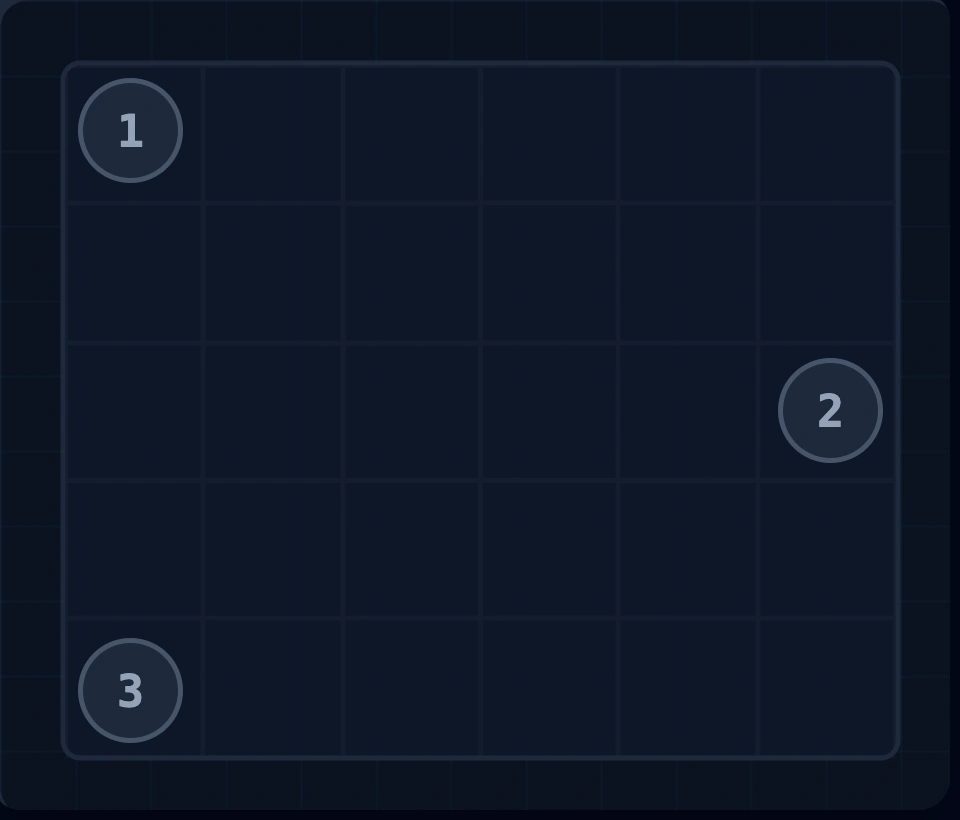
Checkpoints in a zigzag force a specific sweep pattern
Here, the checkpoints march from top-left to right-center to bottom-left, forming a zigzag. The path MUST sweep right for segment 1-to-2, then sweep left for segment 2-to-3. There is no other geometry that works.
Key Takeaway: Mentally divide larger grids along checkpoint boundaries. Solve each region as a mini-puzzle, but always verify that your solution for one region leaves valid entry/exit points for adjacent regions. The interfaces between regions are where most failures occur.
The Last Cell Problem: Engineering Your Ending
This is perhaps the most common failure mode for intermediate solvers: you have filled 35 of 36 cells, the path looks beautiful, and then you realize the final cell is not checkpoint N.
The last cell problem is really about endings. Your path does not just need to visit every cell—it needs to visit every cell AND terminate at a specific location. These two requirements can conflict in subtle ways.
The Approach Analysis
For every checkpoint N, perform this analysis before committing to any path:
- List the neighbors of checkpoint N
- Determine which neighbor must be your second-to-last cell
- Trace backwards: can you reach that neighbor while filling all other cells?
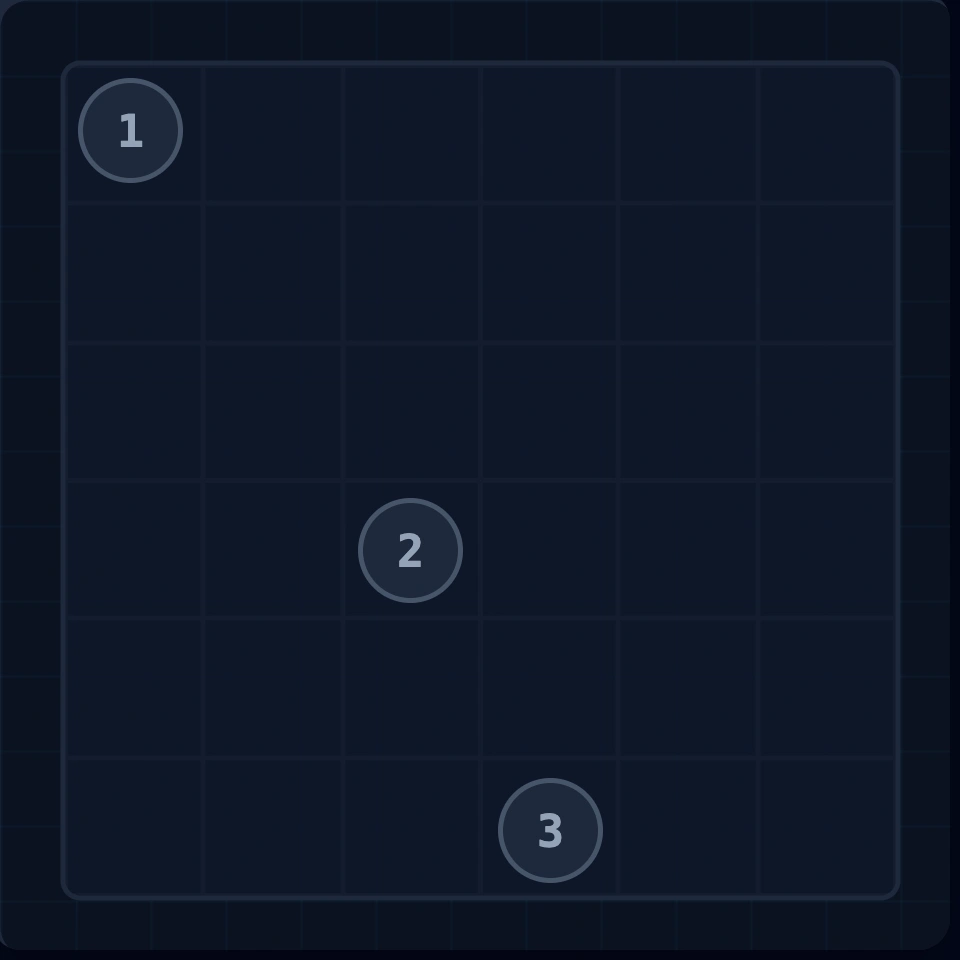
Analyze which neighbor you must approach from
Pre-Solving the Ending
Here is an advanced technique: solve the last 5-8 cells of your path FIRST, before touching the rest of the grid.
Seriously. Identify checkpoint N, determine its valid approach cells, then figure out how those approach cells connect to the final region of the grid. This "ending skeleton" constrains your earlier path construction in useful ways.
Key Takeaway: The ending is not something that "works out" if you fill cells correctly. You must engineer your ending deliberately. Analyze checkpoint N's neighbors, verify the approach parity, and consider pre-solving the final segment before filling the middle.
Forced Moves: When Logic Leaves No Choice
The most powerful technique in any constraint puzzle is recognizing situations where exactly one option is valid. Forced moves are not guesses; they are certainties.
Recognizing Forced Moves in Zip
Several patterns create forced moves:
The Corner Capture: If an unvisited corner cell has only one unvisited neighbor (because your path already claimed the other), you MUST visit that corner immediately. Delay, and it becomes unreachable.
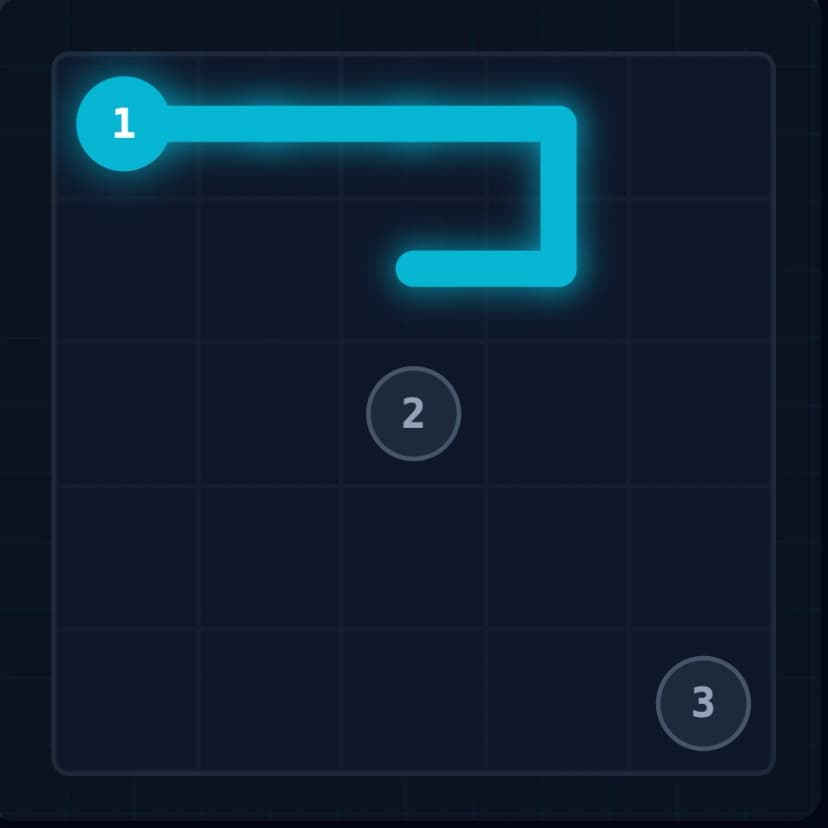
A corner with only one unvisited neighbor must be captured immediately
The Single-Entry Region: When a group of unvisited cells connects to the rest of the grid through only one passage, the path must enter that region at that passage.
The Checkpoint Funnel: Sometimes a checkpoint's position creates a funnel effect where the only way to reach it (while filling required cells) is through one specific path.
Chaining Forced Moves
The real power emerges when forced moves chain together. Recognizing that move A is forced reveals that move B is also forced, which reveals C, and suddenly you have solved half the puzzle through pure deduction.
Key Takeaway: Before making any uncertain move, scan the entire grid for forced moves. A forced move is never wrong, so executing all forced moves first simplifies your decision space. Look especially at corners, region boundaries, and checkpoint approaches.
Speed-Solving Techniques: From Minutes to Moments
Once the strategic foundations are solid, you can start optimizing for speed. Speed-solving Zip is about pattern recognition and efficient decision-making.
Pattern Library: Common Configurations
Expert solvers do not analyze every position from scratch—they recognize patterns they have seen before.
- The Edge Sweep: When checkpoints are positioned at opposite corners or along opposite edges, the serpentine sweep often works with minor modifications.
- The Central Block: Checkpoints clustered in the center force you to visit outer regions first, then spiral inward.
- The Diagonal March: Checkpoints arranged diagonally across the grid often require a zigzag pattern that covers one corner region, then the next.
The Two-Phase Approach
Fast solvers often divide their solving into two phases:
Phase 1: Structure (30 seconds)
Analyze checkpoint positions, identify forced moves, determine rough path skeleton, verify parity.
Phase 2: Execution (remaining time)
Fill in the path without second-guessing. Follow the structure you determined in Phase 1.
Visual Chunking
Instead of seeing 36 individual cells, train yourself to see chunks: "the top row," "the bottom-left corner region," "the cells between checkpoint 2 and 3."
Chunks reduce cognitive load. You are no longer tracking 36 positions—you are tracking 6-8 chunks and how they connect.
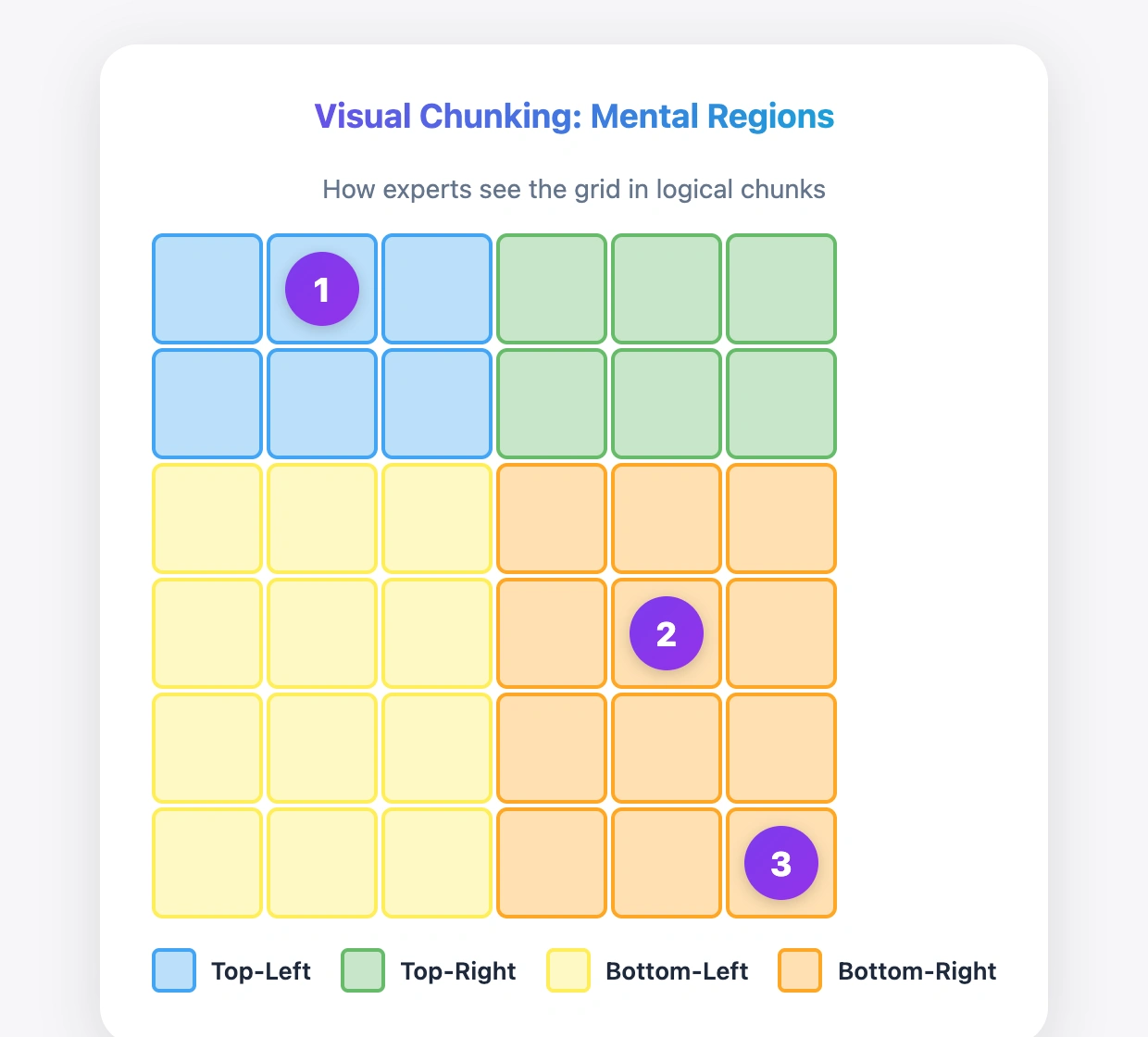
Mental chunking: See the grid in logical regions, not individual cells
Speed-Solving Checklist
- Parity check: Do endpoints match required colors? (2 seconds)
- Forced moves: Are any cells already determined? (5 seconds)
- Chokepoints: Where are the tight constraints? (5 seconds)
- Pattern recognition: Have I seen this configuration before? (3 seconds)
- Execute: Follow the plan, do not second-guess
Key Takeaway: Speed comes from preparation, not rushing. Build a library of common patterns, separate analysis from execution, and learn to see the grid in chunks rather than individual cells.
Challenge Yourself: Practice Puzzles
Ready to apply these techniques? Here are three progressively challenging configurations to try.
Warm-Up (6x5)
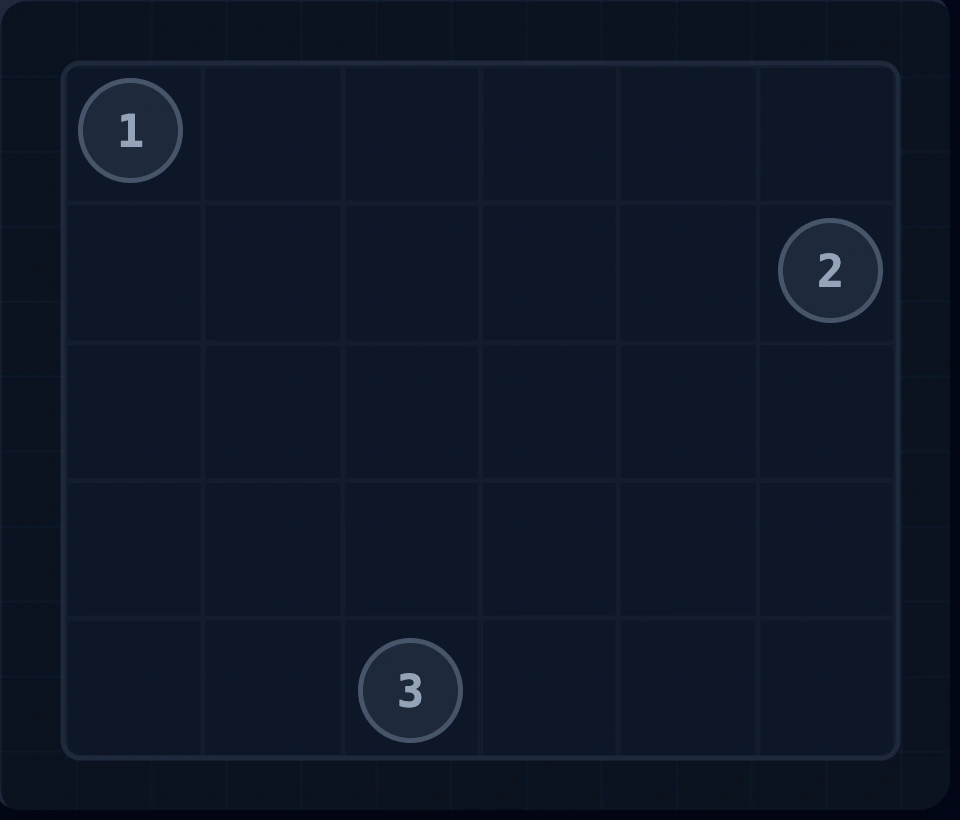
Focus on: Parity check, region isolation between three checkpoints
Standard (6x6)
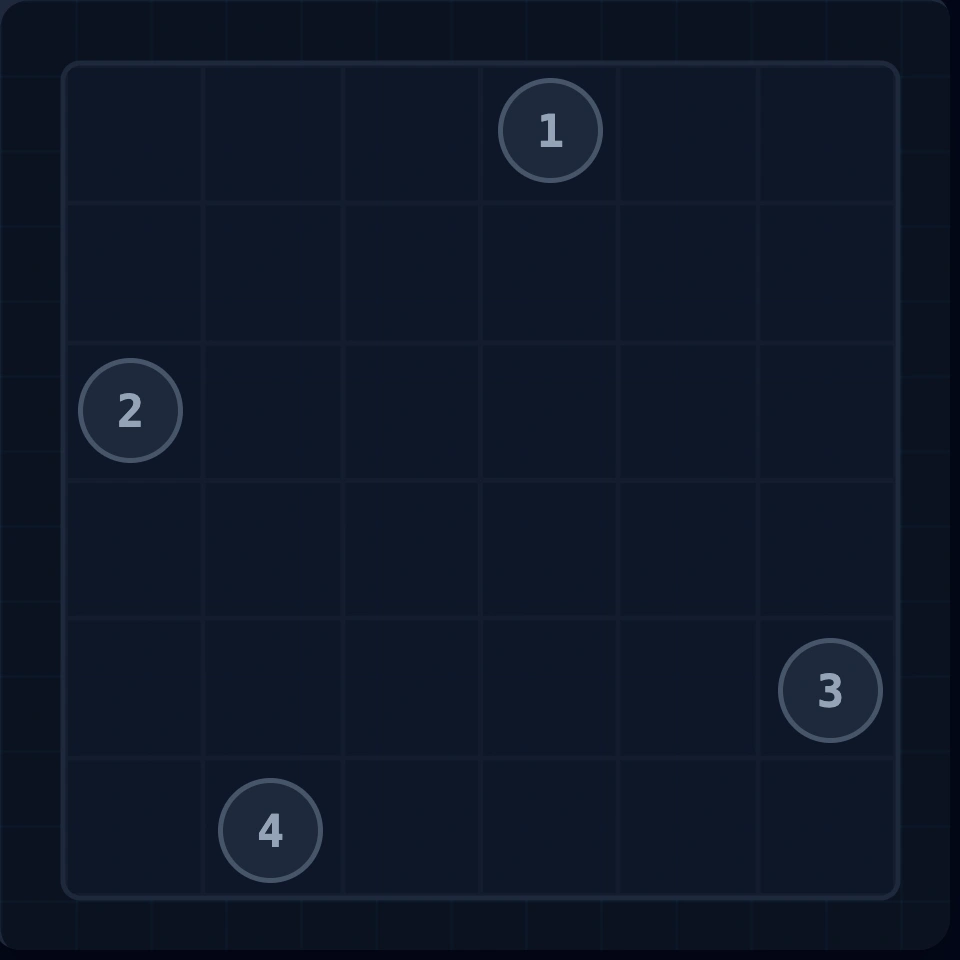
Focus on: Last cell analysis for checkpoint 4, forced moves near corners
Advanced (7x6)
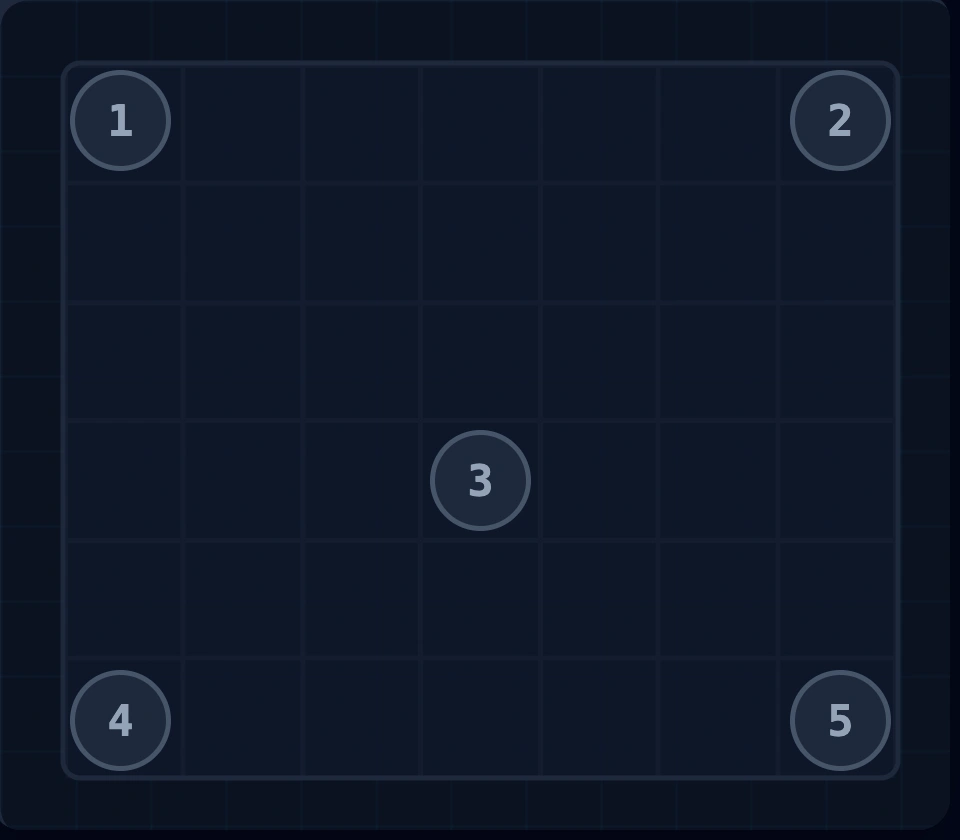
Focus on: Full toolkit—parity, distance budgets, region boundaries, approach planning
Wrapping Up
With parity analysis, cell budgets, region isolation, and forced move recognition in your toolkit, those 6x6 grids that once felt overwhelming become structured problems with clear entry points. Each technique narrows the search space so you spend less time guessing and more time deducing.
Start by applying one technique at a time until it becomes second nature, then layer them together. The strategies compound: a quick parity check eliminates impossible endings, a cell budget highlights the tightest segments, and forced moves chain together to solve large sections automatically.