
Imagine you are a delivery driver with a peculiar route. Your GPS insists you visit every single street in the neighborhood exactly once. Oh, and you must hit specific addresses in a precise order: first the bakery, then the post office, then the florist, and finally the pharmacy. Miss a street? Fail. Visit one twice? Fail. Hit the florist before the post office? Believe it or not, also fail.
Welcome to Zip, where your path is your puzzle.
Zip belongs to a fascinating family of puzzles based on what mathematicians call "Hamiltonian paths"—routes that visit every point exactly once. The twist? Numbered checkpoints scattered across the grid that you must visit in strict sequence. Your job is to weave a single continuous path that touches every cell while threading through these waypoints in order.
The rules take thirty seconds to learn. The satisfaction of watching your path snake through an entire grid, hitting every checkpoint in perfect sequence? That takes slightly longer to achieve—but this guide will get you there.
Let us zip through the basics.
Watch the Tutorial
Prefer watching? This short video walks you through the rules and key strategies.
What Exactly Is a Zip Puzzle?
A Zip puzzle presents you with a rectangular grid peppered with numbered checkpoints. Your mission: draw a continuous path that starts at checkpoint 1, visits every single cell in the grid exactly once, passes through all checkpoints in ascending order (1, 2, 3... N), and ends at the highest-numbered checkpoint.
Each Zip puzzle has exactly one valid path—your job is to discover it.
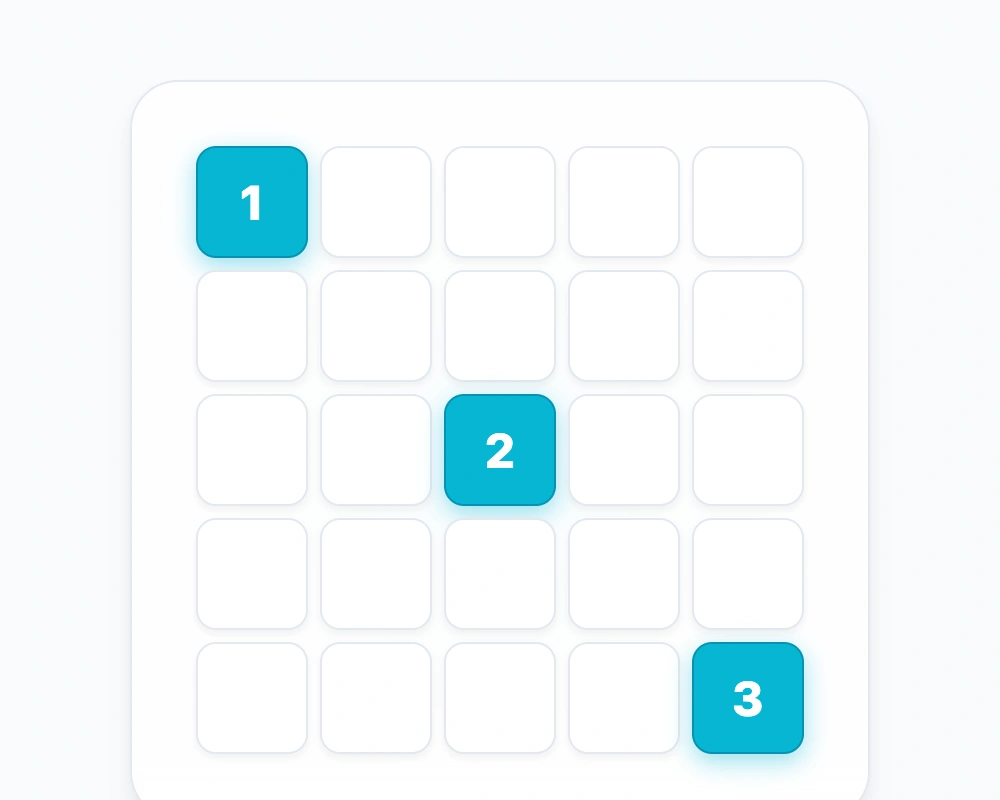
A 5x5 Zip puzzle with three checkpoints—your path must visit every cell
Think of it as connecting the dots, except you must also fill in every space between the dots. Or imagine a snake game where you are told exactly which apples to eat and in what order, but you must cover the entire board by the time you reach the last apple.
The beauty of Zip lies in its elegant constraint: you have complete freedom in how you draw your path, as long as you obey the checkpoint sequence and visit every cell. This freedom is also what makes Zip challenging—too many possibilities can paralyze decision-making until you learn to recognize the patterns that narrow your options.
The Complete Rules of Zip
Six rules govern every Zip puzzle. They are simple individually, but their interaction creates surprisingly deep logical challenges.
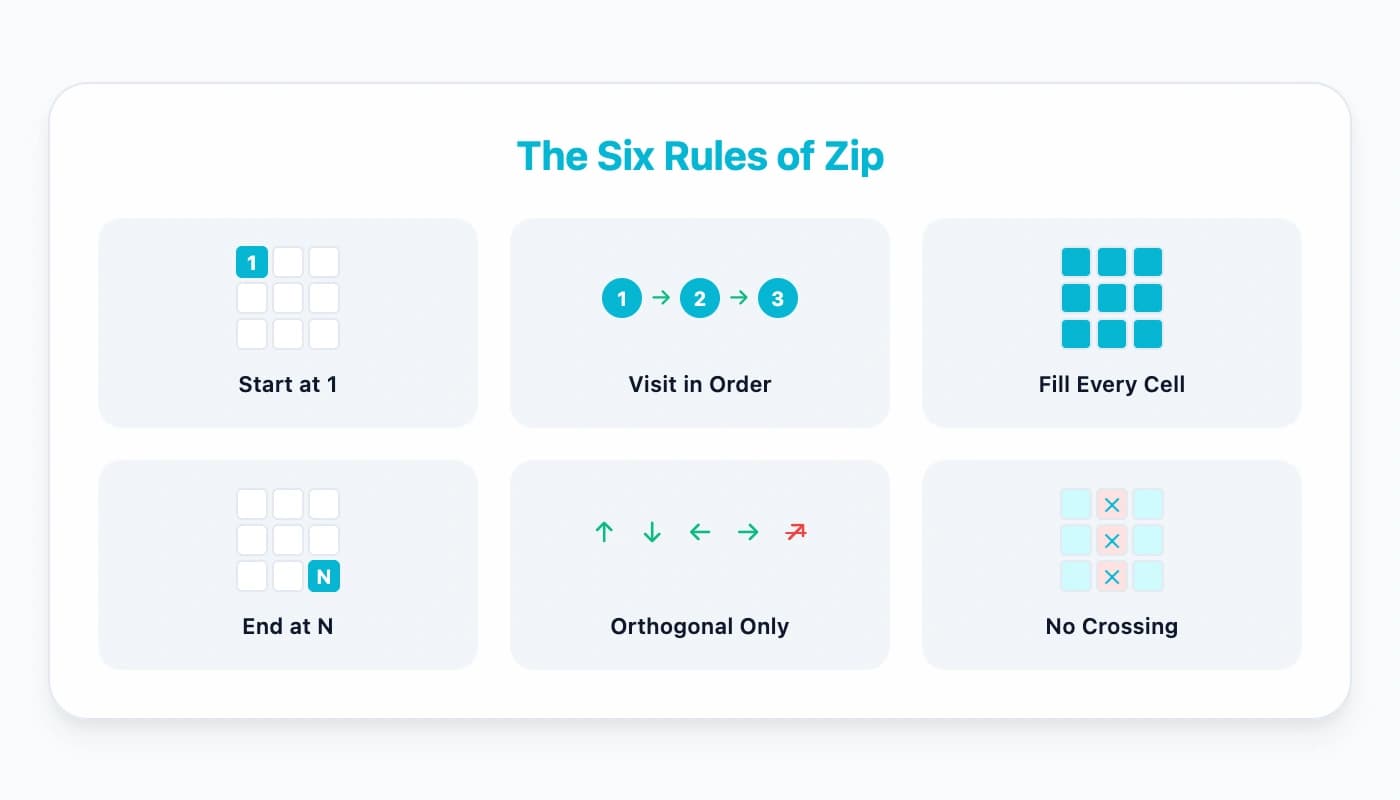
- Rule 1: Start at Checkpoint 1 — Your path must always begin at the cell containing the number 1. This is your starting point, your origin, your home base. No exceptions.
- Rule 2: Visit Checkpoints in Order — After leaving checkpoint 1, you must visit checkpoint 2 before checkpoint 3, checkpoint 3 before checkpoint 4, and so on. The sequence is sacred.
- Rule 3: Fill Every Cell — Here is what separates Zip from a simple connect-the-dots puzzle: your path must occupy every single cell in the grid. No empty cells allowed.
- Rule 4: End at the Highest Checkpoint — Your path must terminate at the highest-numbered checkpoint (let us call it N). You cannot end anywhere else. Checkpoint N is your finish line.
- Rule 5: Move Orthogonally Only — You can only move horizontally or vertically between adjacent cells—up, down, left, or right. No diagonal movement. No jumping over cells.
- Rule 6: No Crossing or Revisiting — Each cell can be visited exactly once. Your path cannot cross itself, loop back, or revisit any cell. Once you leave a cell, it is closed forever.
That is everything. Six rules, pure path-finding logic.
Your First Solve: A Visual Walkthrough
Theory is helpful, but watching a puzzle unfold is where understanding truly develops. Let us solve a beginner puzzle together, and I will explain every decision along the way.
The Starting Grid
Here is our practice puzzle: a 5x5 grid with three checkpoints—a perfect training ground for new Zip solvers.
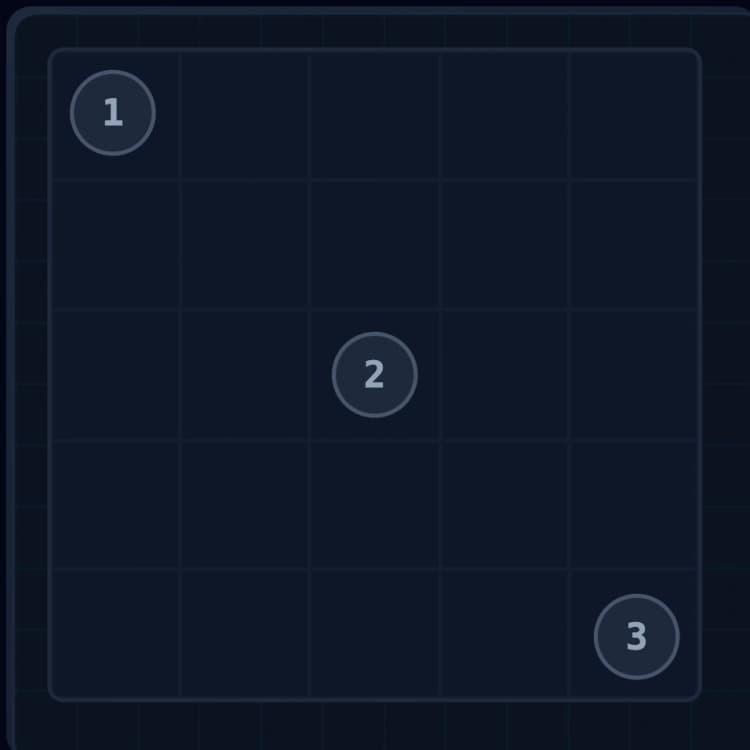
Our practice puzzle—checkpoint 1 at (0,0), checkpoint 2 at (2,2), checkpoint 3 at (4,4)
We will use (row, column) notation where (0,0) is the top-left corner, row numbers increase going down, and column numbers increase going right.
Take a moment to study this grid. Checkpoint 1 sits in the top-left corner at (0,0). Checkpoint 2 occupies the exact center at (2,2). Checkpoint 3—our destination—waits in the bottom-right corner at (4,4).
Step 1: Assess the Landscape
Before drawing anything, let us analyze. This is the most important habit in Zip solving.
Corner cells are special. The four corners can only connect to two neighbors. Our checkpoint 1 is in the top-left corner, meaning our path can only go right to (0,1) or down to (1,0).
Checkpoint 3 is also in a corner. The bottom-right corner at (4,4) is where we must end. Like checkpoint 1, it only has two neighbors: the cell above it (3,4) and the cell to its left (4,3).
Here is a crucial insight: since we start in one corner and end in the diagonal opposite corner, a serpentine (snake-like) path naturally suggests itself.
Step 2: Start from Checkpoint 1 and Sweep the Top
We begin at (0,0). Let us try sweeping across the top row first—a classic opening move that clears an entire edge early.
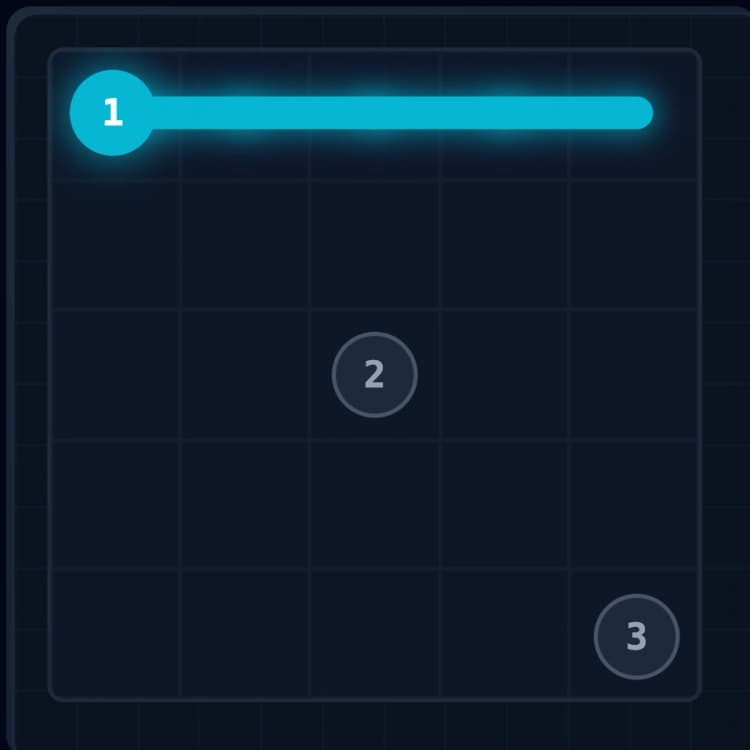
Step 2: Path sweeps across the top row from (0,0) to (0,4)
From (0,0), we moved right through (0,1), (0,2), (0,3), arriving at (0,4)—the top-right corner. We have cleared the entire top row: 5 cells down, 20 to go.
Step 3: Serpentine Through Row 2
From (1,4), we sweep left across the second row, creating our first "snake turn."
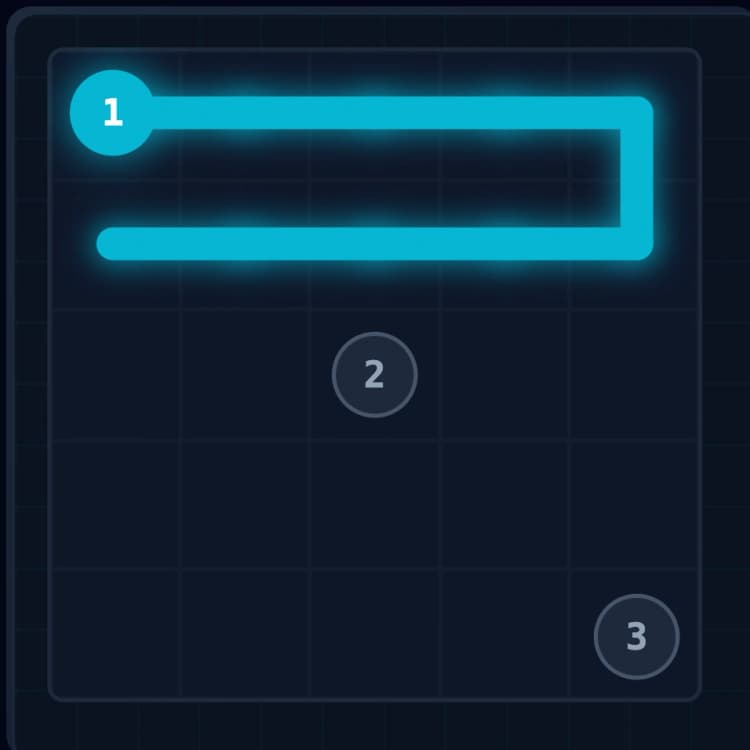
Step 3: The serpentine pattern begins—two rows complete
We traveled from (1,4) through (1,3), (1,2), (1,1), arriving at (1,0)—the left edge. That is 10 cells visited, 15 remaining.
Step 4: Navigate Through the Center and Hit Checkpoint 2
This is where things get interesting. Row 3 contains checkpoint 2 at (2,2). Watch how our serpentine naturally threads through it.
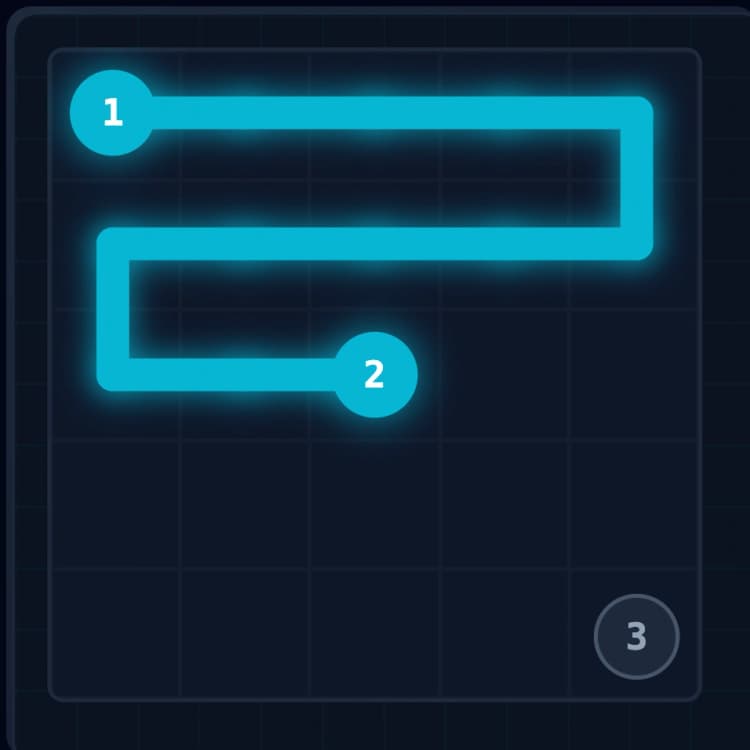
Step 4: Checkpoint 2 reached! The serpentine flows naturally through the center
From (2,0), we moved right through (2,1) and arrived at (2,2)—checkpoint 2. We have now visited 13 cells and successfully passed through checkpoint 2 in sequence.
Step 5: Continue the Snake Pattern
From checkpoint 2 at (2,2), we continue right to complete row 3, then serpentine down through rows 4 and 5.
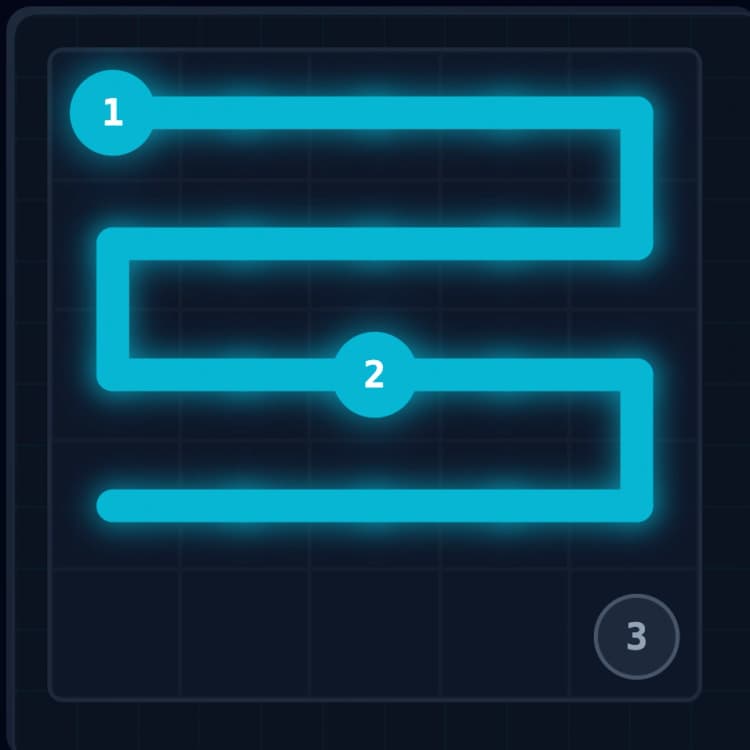
Step 5: Four rows complete, only the bottom row remains
That is 20 cells visited. Only the bottom row remains: (4,0), (4,1), (4,2), (4,3), and (4,4)—which is checkpoint 3!
Step 6: Complete the Path
One final serpentine turn. From (3,0), we go down to (4,0) and sweep right across the bottom row to our destination.
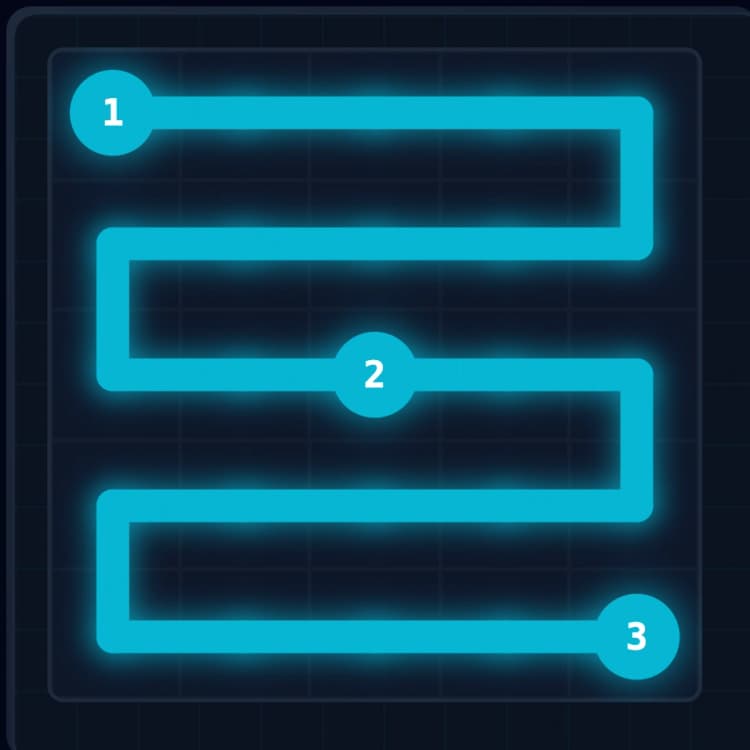
Solved! All 25 cells visited, all checkpoints hit in order
Solved! All 25 cells visited. All three checkpoints hit in order. One beautiful, unbroken path from corner to corner.
What This Walkthrough Reveals
- The serpentine pattern is powerful—when checkpoints allow it, a snake-like path efficiently covers rectangular grids
- Start with analysis—we spent time understanding checkpoint positions before drawing
- Corners are constraining—starting and ending in opposite corners naturally suggested sweeping across rows
- Checkpoints create structure—knowing checkpoint 2 was in the center told us our path needed to pass through row 3's middle
- Confidence comes from planning—notice we did not need to backtrack once
Try It Yourself
Ready to apply what you have learned? Here is a 5x5 puzzle with a different checkpoint arrangement. Take a moment to study the positions, plan your approach, then try solving it before reading on.
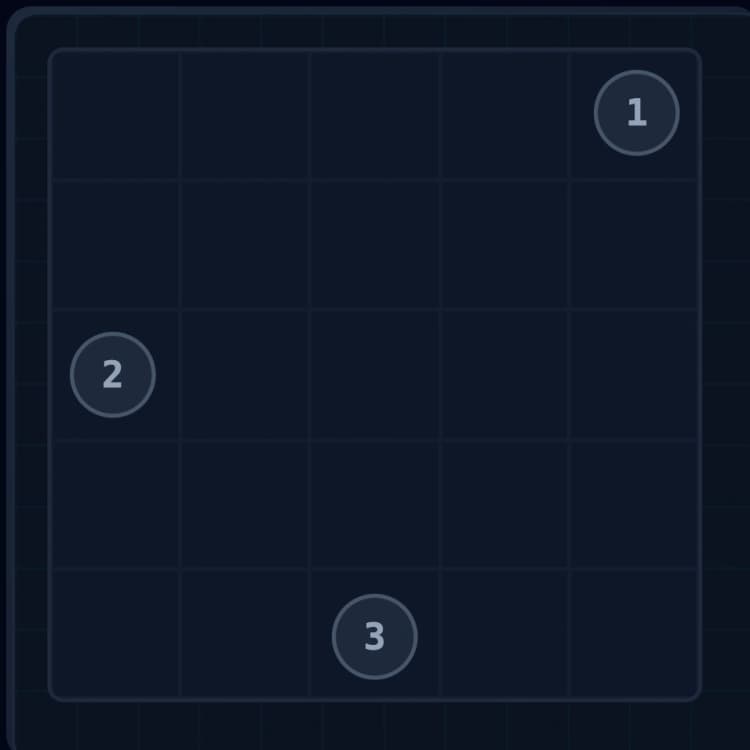
Try this! Start at (0,4), pass through (2,0), end at (4,2)
This puzzle starts in the top-right corner (0,4), passes through checkpoint 2 on the left side at (2,0), and ends in the middle of the bottom edge at (4,2). Notice how the checkpoints create a different flow than our walkthrough example—you will need to think carefully about which direction to begin and how to approach that final checkpoint without trapping cells.
Essential Beginner Strategies
Now let us formalize the solving techniques that will serve you on every Zip puzzle.
Strategy 1: Plan Your Route Before Committing
Before drawing a single line, study the checkpoint positions. Ask yourself: Are any checkpoints in corners? Are checkpoints clustered together? Does a serpentine pattern naturally connect the checkpoints? Spending 30 seconds planning saves minutes of backtracking.
Strategy 2: Use Corners Wisely
Corner and edge cells are bottlenecks—they have limited entry and exit points. Corner cells have only 2 neighbors. Edge cells have 3 neighbors. Interior cells have 4 neighbors. The golden rule: do not trap yourself by leaving corner cells isolated.
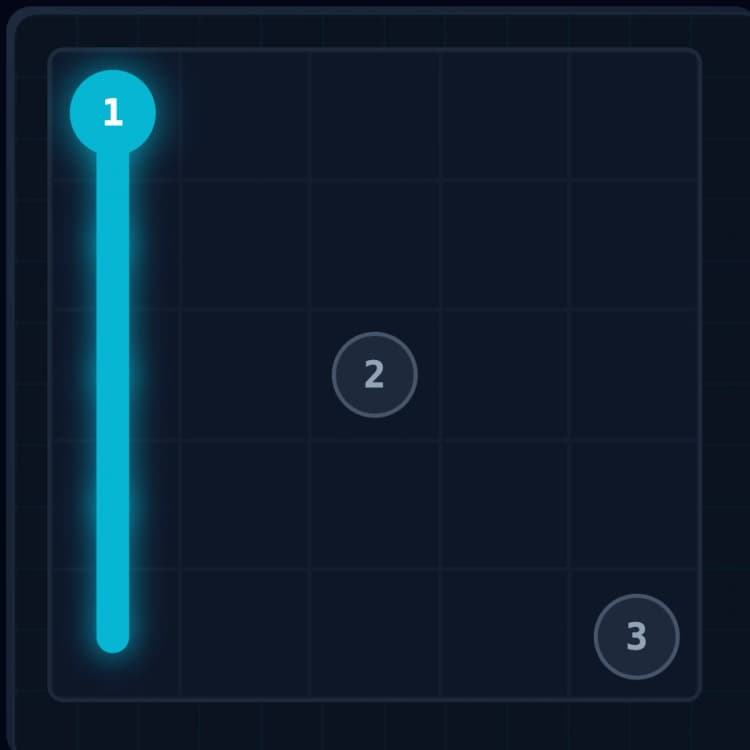
Corners have only 2 neighbors—plan your approach carefully
Strategy 3: Do Not Trap Yourself
The most common Zip mistake is creating isolated cells that become unreachable. This happens when your path "cuts off" a region of the grid. Warning signs: A cell with only one unvisited neighbor, a group of cells connected to the rest by only one passage, or your path forming a barrier that splits the grid.
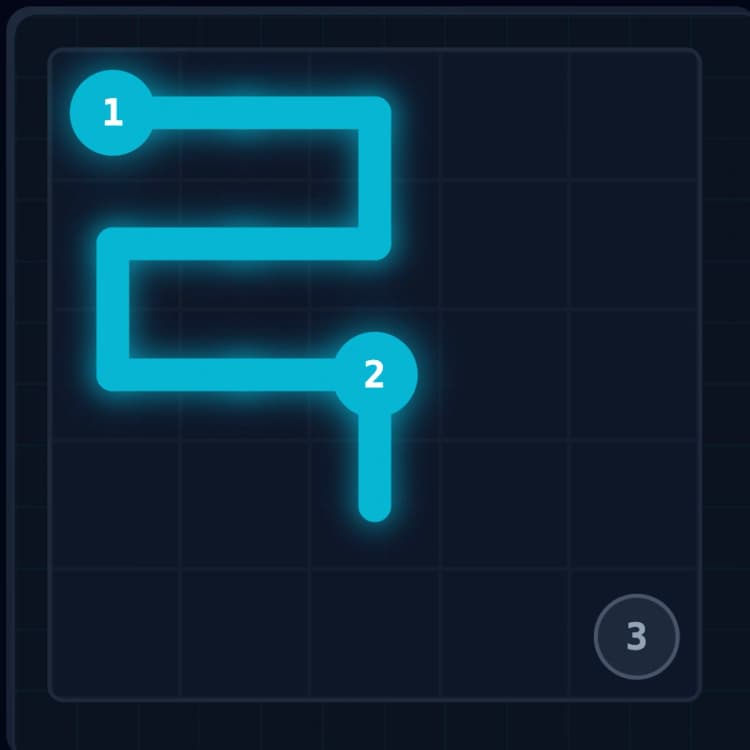
Trapped corner—cell (0,3) is isolated
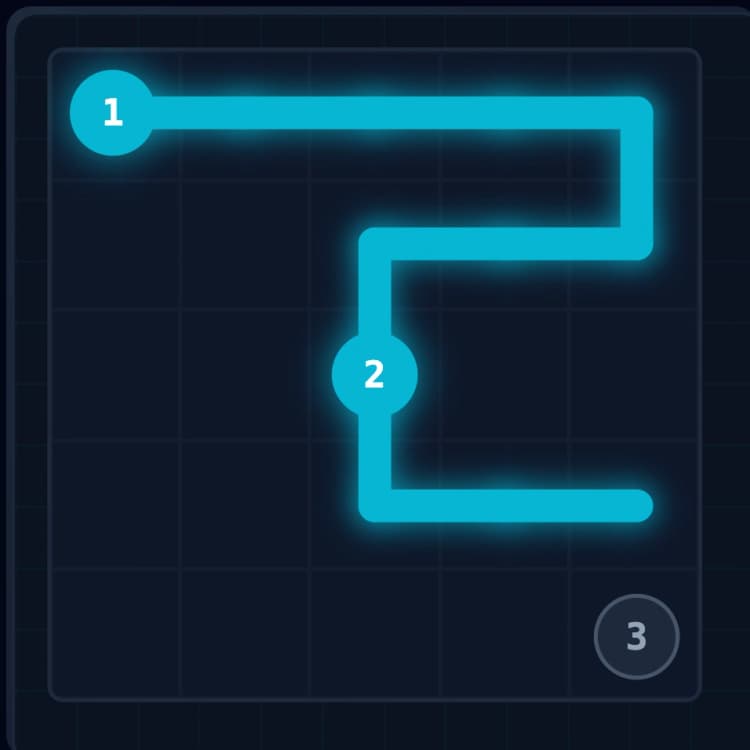
Trapped edge—cell (2,4) is cut off
Strategy 4: Work Backwards Sometimes
If you are stuck approaching checkpoint N, try thinking in reverse. Start from checkpoint N and ask: "What paths could possibly reach this cell while filling everything?" Working backwards is especially useful when checkpoint N is in a corner (heavily constrained ending).
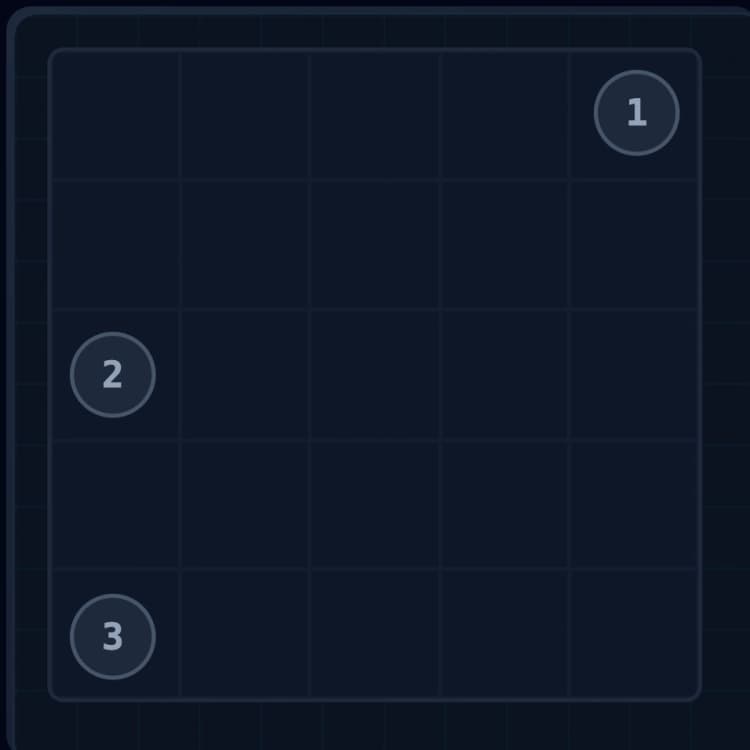
Checkpoint 3 in the bottom-left corner—work backwards to find the approach
Strategy 5: Fill Dense Areas First
When multiple checkpoints cluster in one area, tackle that region early while you have maximum path flexibility. Dense checkpoint regions require precise paths with little room for error. Solving them first ensures you do not accidentally use up the cells you need.
Pro Tips for Consistent Success
Look for Chokepoints
A chokepoint is a cell or narrow passage that your path MUST pass through to reach a later checkpoint. Identifying chokepoints early structures your entire solve. Look for checkpoints that can only be reached through a limited number of cells.
Divide Larger Grids into Sections
On 6x6 or larger grids, the complexity can feel overwhelming. Break it down: (1) Identify checkpoints and group them by region, (2) Plan the path through each region independently, (3) Figure out how to connect the regions while hitting checkpoints in order.
Grid Sizes and What to Expect
Common Mistakes and How to Avoid Them
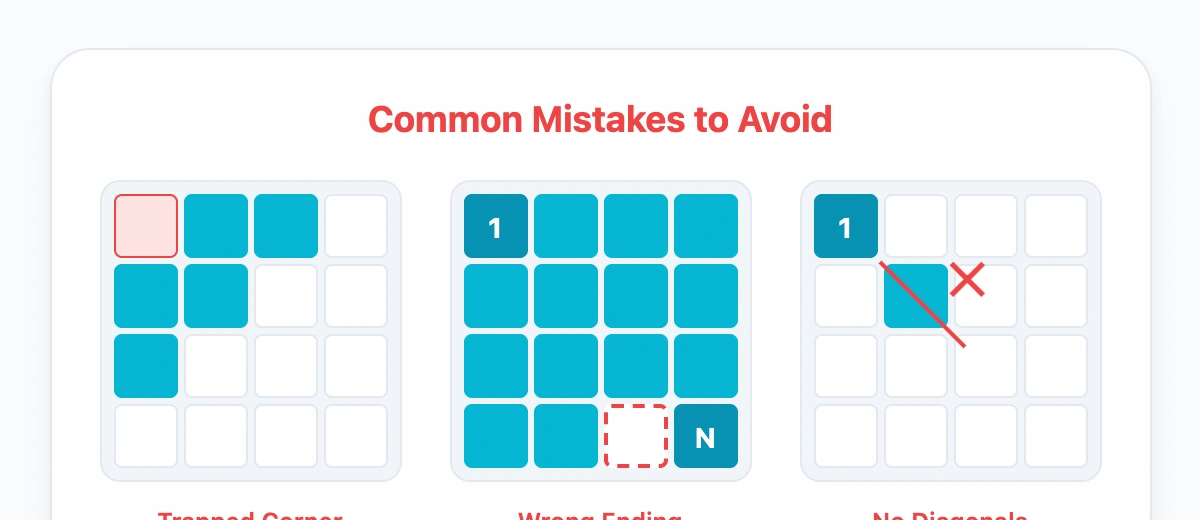
Mistake 1: Rushing to the Next Checkpoint
You beeline straight for checkpoint 2, ignoring all the cells between checkpoints. Fix: Remember Rule 3—every cell must be filled. Plan paths that visit ALL cells between checkpoints, not just the shortest route.
Mistake 2: Trapping Corner Cells
You draw your path carelessly and realize too late that a corner cell has become isolated. Fix: Constantly monitor corner and edge cells. If any unvisited cell has only one unvisited neighbor, consider visiting it immediately.
Mistake 3: Forgetting the Endpoint
You fill the entire grid successfully but end on a random cell instead of checkpoint N. Fix: Always keep the final checkpoint in mind. Plan your approach to checkpoint N as carefully as your departure from checkpoint 1.
Mistake 4: Trying Diagonal Moves
You attempt to move diagonally because it seems like the obvious connection between cells. Fix: Orthogonal only—up, down, left, right. No diagonals ever. Internalize this until it becomes automatic.
Mistake 5: Giving Up Too Early
You hit a dead end after several attempts and assume the puzzle is too hard. Fix: Remember that every Zip puzzle is constructed to be solvable—the solution exists. Backtrack and try different choices at earlier decision points. Use undo freely.
The Joy of the Complete Path
There is a particular satisfaction in Zip that other puzzles do not quite match.
It is the moment when your path clicks into place—when you realize the checkpoints are not random obstacles but carefully placed guideposts that reveal exactly one perfect route through the grid. That "lightbulb moment" when the checkpoint sequence suddenly illuminates the only possible path is pure puzzle magic.
And then there is the visual reward. When your path finally works—when it starts at 1, weaves through every cell, threads through each checkpoint in perfect sequence, and terminates exactly where it must—you have created something beautiful. A single unbroken line that covers an entire grid. No gaps. No crossings. No wasted cells.
Every cell accounted for. Every checkpoint honored. A complete tapestry woven from corner to corner.
That is the Zip feeling. And once you experience it, you will understand why solvers come back for more.