Arrow Maze Puzzle:
A Complete Beginner's Guide to Directional Paths
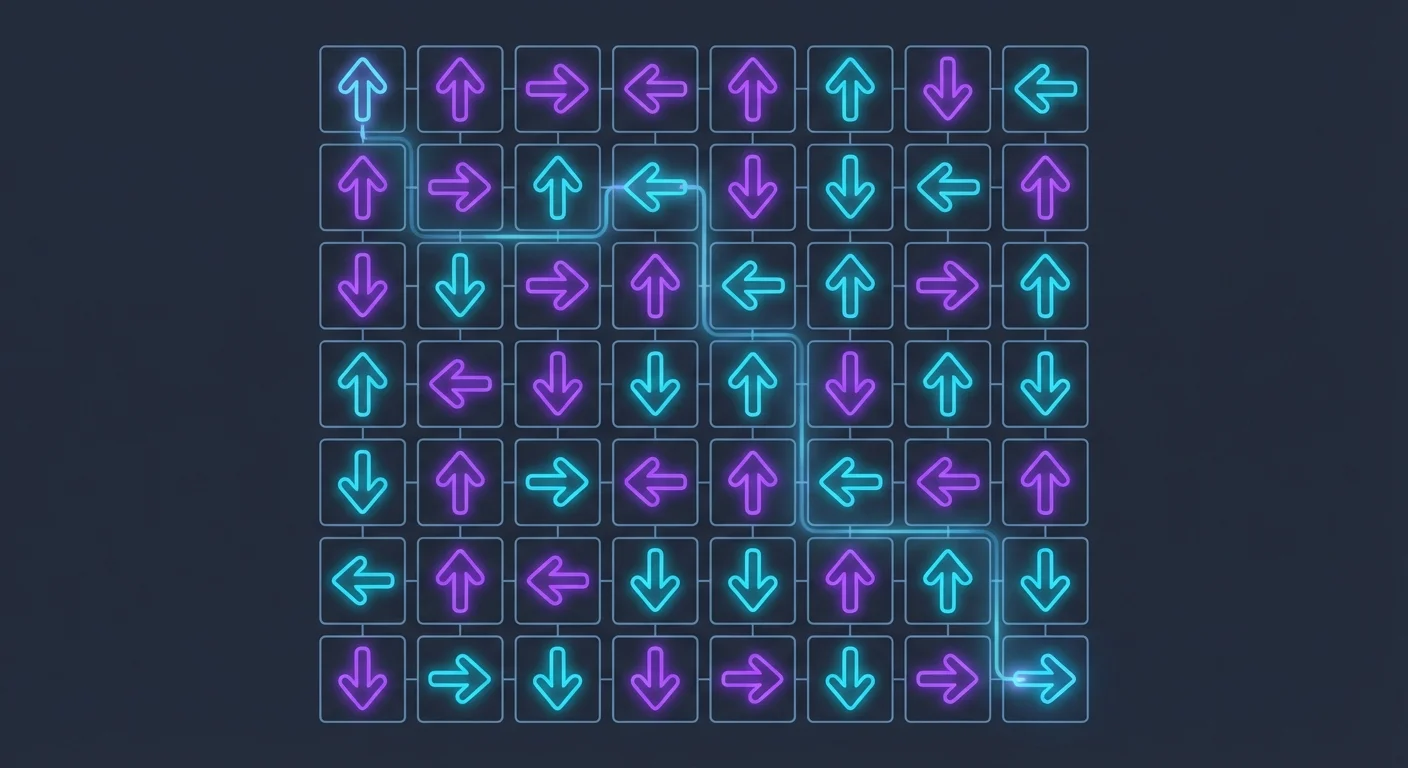
Imagine being dropped into a forest where every tree has a sign pointing in a single direction. Go left. Go up. Go right. Each sign tells you the direction you must travel--but not how far. You could walk past one tree, or two, or five, as long as you keep moving in the direction the sign commands. Your mission? Find the exact sequence of stops that leads you from the entrance to the exit.
That is the essence of Arrow Maze.
Unlike traditional mazes where walls block your path, Arrow Maze constrains you with directions. Every cell contains an arrow, and when you step onto a cell, you must travel in the direction it points--but you choose how many cells to travel. Move one cell or leap across the entire row. The walls are invisible, built entirely from the logic of permitted movement. The challenge is deciding how far to travel at each step to land on cells that eventually connect start to goal.
There is something deeply satisfying about the moment you trace a successful path through an Arrow Maze. You follow an arrow right, then down, then right again, and suddenly--there it is, the goal cell. The path existed all along, hidden in plain sight among dozens of misleading arrows. Your job was simply to see it.
Watch the Tutorial
Prefer watching? This quick tutorial walks you through the rules and your first solve.
What Exactly Is an Arrow Maze Puzzle?
An Arrow Maze presents you with a square grid where every cell contains an arrow pointing in one of four cardinal directions: up, down, left, or right. Two special cells are marked: a start position (often shown in green or marked with "A") and a goal position (often shown in red or marked with "X").
Your mission: trace a path from start to goal, moving only in the direction each cell's arrow permits. The arrow fixes your direction, but you choose how far to travel--one cell, two cells, or more. The puzzle is deciding the right distance at each step so that you land on cells whose arrows eventually guide you to the goal.
The Rules: Simple Yet Constraining
Arrow Maze has just three rules. Master these, and you understand the entire puzzle.
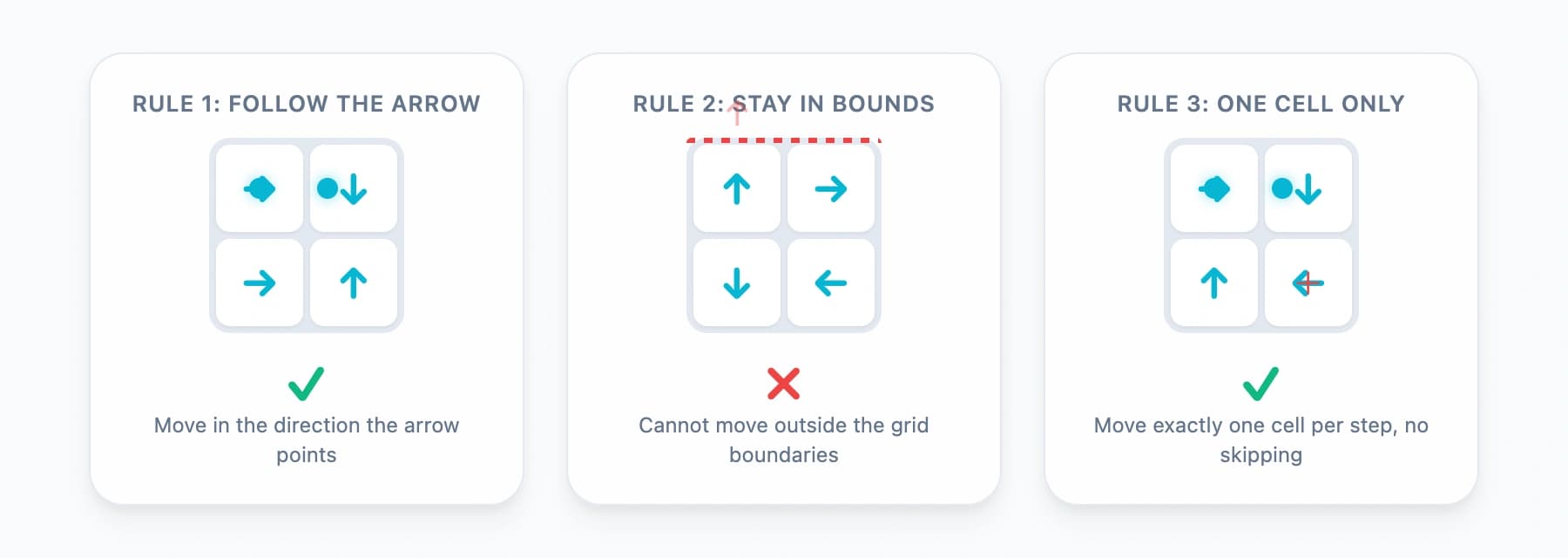
Rule 1: Follow the Arrow's Direction
When you occupy a cell, you must move in the direction that cell's arrow points. An arrow pointing right means you move right. An arrow pointing up means you move up. The direction is non-negotiable--but how far you travel is your choice.
Rule 2: Choose Your Distance
You choose how far to travel in the arrow's direction--one cell, two cells, or more, as long as you stay within the grid. A right-pointing arrow lets you land on any cell to your right in that row. This distance choice is where the puzzle's decision-making lives.
Rule 3: Stay Within the Grid
You cannot move outside the boundaries of the grid. If an arrow points toward the edge and there is no cell in that direction, that path is blocked--you cannot continue from that cell.
That is everything. Three rules: a fixed direction, a distance choice, and grid boundaries. Pure directional logic.
Your First Solve: A Visual Walkthrough
Let us solve a puzzle together. I will show you exactly how to trace paths and identify the correct route from start to goal.
The Starting Grid
Here is our practice puzzle: a simple 4x4 grid designed to teach path-tracing fundamentals.
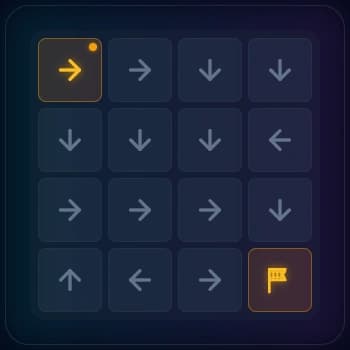
The green cell at position (0,0) is our start. The red cell at position (3,3) is our goal.
Let me describe the arrow layout. Reading left to right, top to bottom:
- Row 0: Right, Right, Down, Down
- Row 1: Down, Down, Down, Left
- Row 2: Right, Right, Right, Down
- Row 3: Up, Left, Right, Right
Take a moment to study the grid. Can you spot a path from start to goal? Remember: you can only move where each arrow points.
Step 1: Begin at the Start
We begin at position (0,0), the top-left cell. This cell contains a right-pointing arrow. Following Rule 1, we must move right. We could jump to (0,1), (0,2), or (0,3)--but let us start with (0,1), just one cell over, and see where that leads.
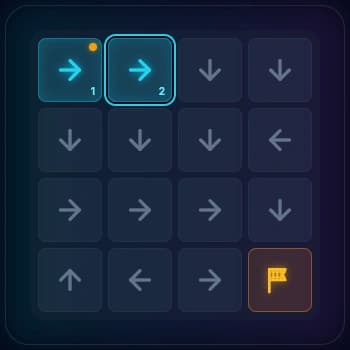
Step 2: Follow the Chain Rightward
Position (0,1) also points right. We choose to move one cell to (0,2). Notice how consecutive arrows pointing the same direction create a natural corridor across the top of the grid. These arrow chains are worth watching for.
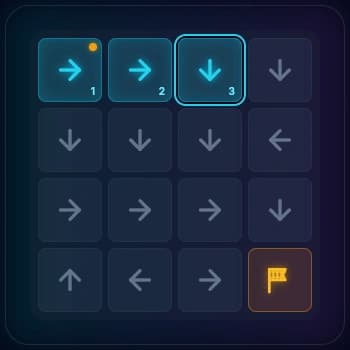
But at (0,2), the chain breaks. This arrow points down. We descend to position (1,2).
Step 3: Navigate the Descent
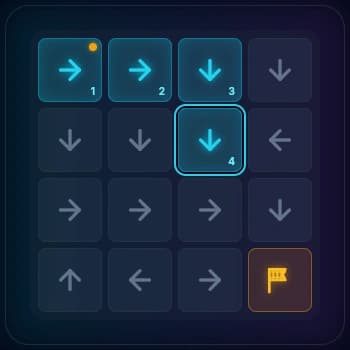
Position (1,2) also points down. Another chain--this time vertical. We continue to position (2,2). We are now in the right half of the grid, exactly where the goal lives. The arrows have been steering us well.
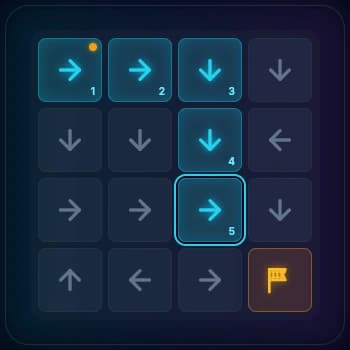
Step 4: The Final Approach
Position (2,2) points right, sending us to (2,3)--the cell directly above our destination. Can you feel it? One cell away. The goal is right there.
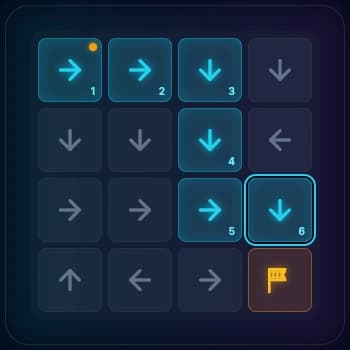
Step 5: Victory
Position (2,3) points down. We move to position (3,3)--the goal!
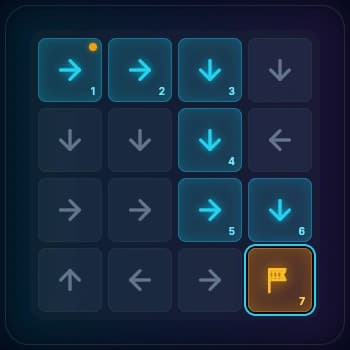
Path: (0,0) → (0,1) → (0,2) → (1,2) → (2,2) → (2,3) → (3,3). Six moves, one solution, pure arrow logic.
The route was hiding in plain sight--we just had to trace it.
Understanding Dead Ends
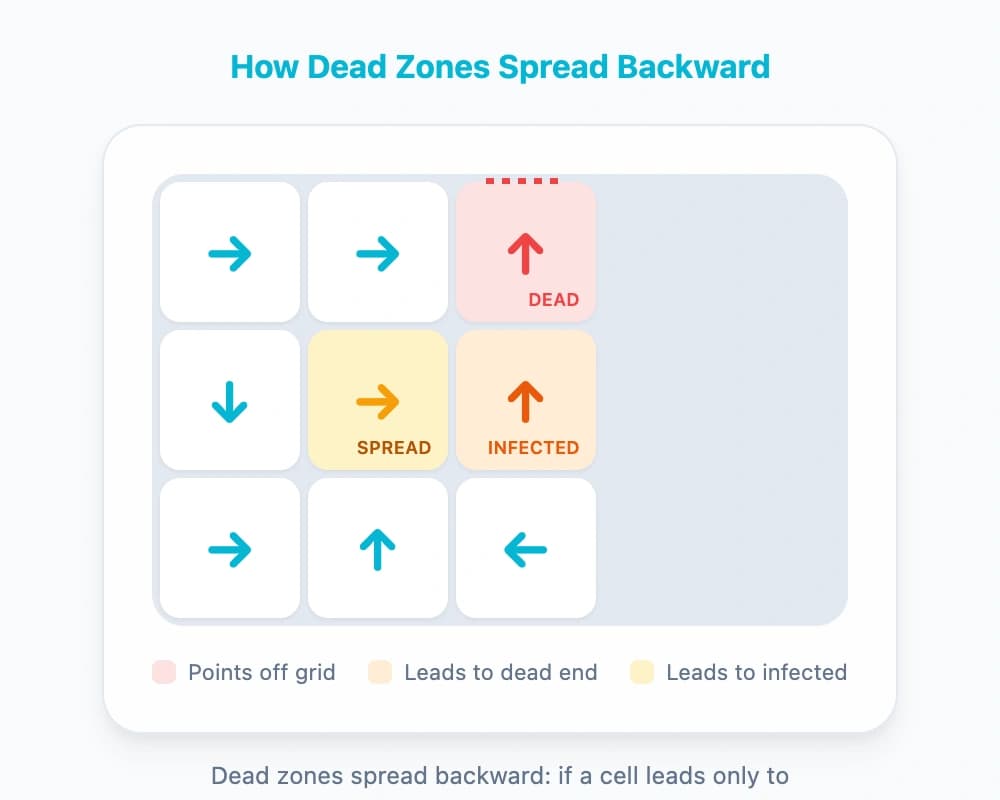
What would have happened if we had started on a different cell? Some cells lead to the goal, others lead to dead ends--arrows pointing off the grid. Your job is to find which sequence from the start reaches the finish.
Key Insights from This Walkthrough
- 1. Arrows fix direction, you choose distance. The arrow tells you which way; you decide how far.
- 2. Dead ends are common. Many distance choices lead nowhere. This is expected, not failure.
- 3. Working backward helps. Identifying which cells can reach the goal narrows your search.
- 4. The solution hides in plain sight. Every arrow is visible from the start--the challenge is choosing the right distances.
Essential Beginner Strategies
You have traced your first successful path through an Arrow Maze. But that was a carefully designed teaching puzzle--real Arrow Mazes will challenge you more. Here are the techniques that will help you navigate any Arrow Maze.
Strategy 1: Trace from Start
Begin at the start and try different distances at each arrow until you either reach the goal or hit a dead end. This exploratory approach works well on small grids.
Strategy 2: Work Backward
Identify which cells have arrows pointing toward the goal and could reach it at some distance. Those are "one step away" cells. Then find cells that could reach those. Continue until you connect back to start.
Strategy 3: Identify Dead Zones
Mark cells pointing toward the grid edge as dead ends. Then mark any cells leading only to dead ends. This elimination reveals which paths are worth exploring.
Strategy 4: Look for Arrow Chains
Spot sequences of adjacent arrows that flow in the same direction: right, right, right. If you land on any cell in this chain, you will continue moving right no matter which distance you pick. These chains are highways through the grid--predictable and often part of the solution.
Strategy 5: Use Grid Boundaries
Cells along the edges have fewer escape options. A corner cell has only two possible arrow directions that stay in bounds. Use this constraint to quickly classify edge cells as useful or dead.
Common Mistakes and How to Avoid Them
Every Arrow Maze solver has made these mistakes. Learning to recognize them is half the battle.
Mistake 1: Ignoring the Arrow Direction
The goal is tantalizingly close--just one cell to the right--and your brain screams "just go right!" But the arrow points down. You move right anyway, because surely the puzzle will forgive you just this once.
It will not. The arrow always wins.
Mistake 2: Trying to Move Diagonally
The grid looks like a chess board, and if you have ever played chess, diagonal movement feels instinctive. But Arrow Maze is not chess.
Fix: Think in compass directions--north, south, east, west. No diagonals exist.
Mistake 3: Giving Up Too Early
You hit one dead end and assume the puzzle is unsolvable. But one dead end simply eliminates one distance choice.
Fix: Backtrack and try a different distance at a previous step. Landing one cell further or closer can open an entirely new route. The solution is hiding.
Practice Tips for Rapid Improvement
Start with 5x5 grids. Small grids let you see everything at once. You can experiment with distance choices mentally without losing your place.
Practice working backward. On every puzzle, try finding the solution backward first. Which cells can reach the goal at some distance? This skill becomes essential on harder puzzles.
Time yourself. Once comfortable with mechanics, add time pressure. Arrow Maze is often about pattern recognition speed.
Visualize the flow. Imagine water flowing from the start, branching at each cell because the arrow allows multiple landing spots. Now imagine water flowing backward from the goal. The solution path is where these two rivers meet.
Ready to Follow the Arrows?
You now understand everything needed to solve Arrow Maze puzzles. The rules are minimal. The strategies are logical. The satisfaction of tracing a successful path through a field of misdirecting arrows is waiting for you.
Arrow Maze strips navigation to its purest form. No walls to see, no complex rules to remember--just arrows telling you which direction to travel and your judgment deciding how far. The puzzle is not following directions; anyone can do that. The puzzle is choosing the right distance at each step so the chain of arrows carries you to the goal.
Now go find your path.
Ready to Follow the Arrows?
The techniques are in your head. The arrows are pointing the way. All that's left is to find your path from start to goal.
Start Solving Arrow MazePut it into practice
Ready to solve Arrow Maze?
Open a free puzzle and turn the ideas from this guide into your next solve.