Pipes Puzzle:
A Complete Beginner's Guide to Network Logic
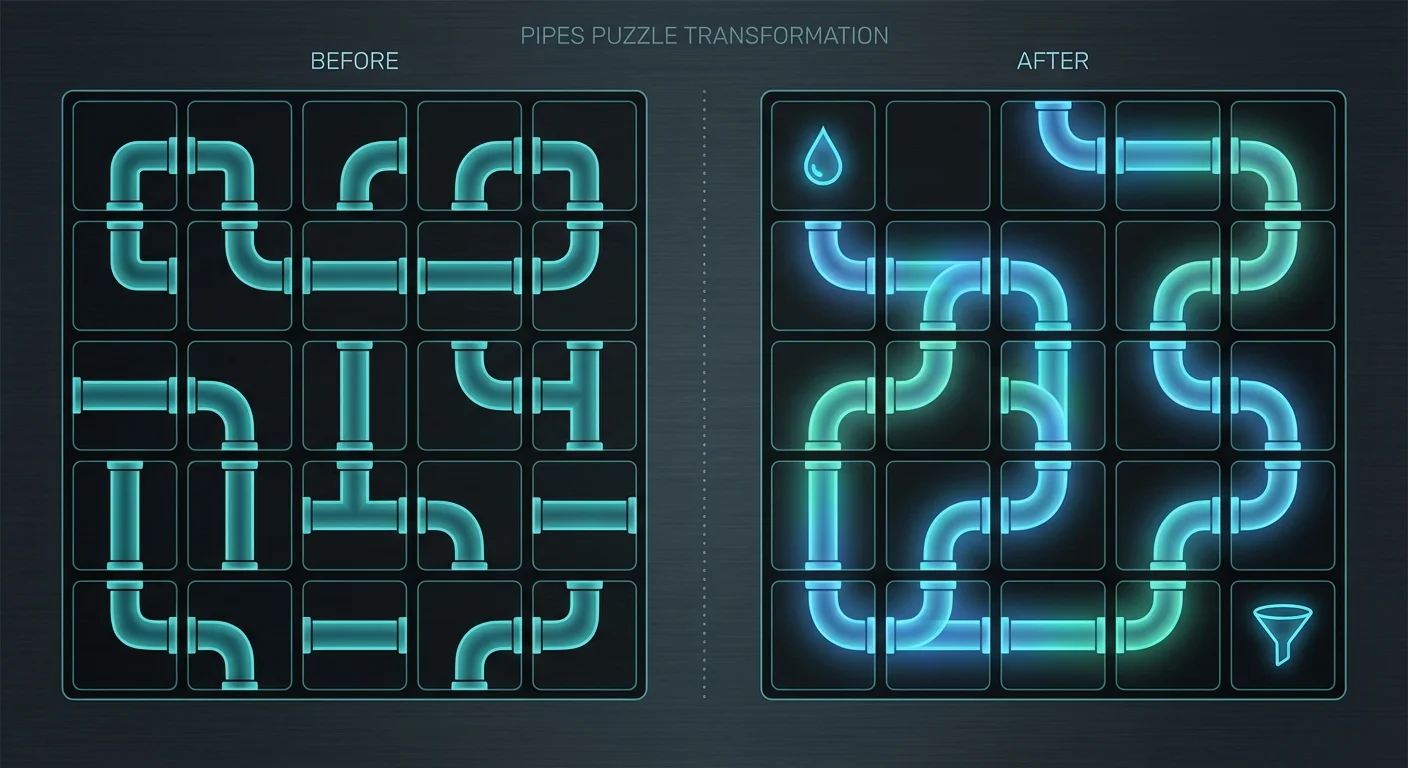
There is a moment in every Pipes puzzle when chaos becomes clarity. You've been clicking tiles, rotating pipes seemingly at random, watching water symbols flicker on and off. Then something shifts. One pipe connects to another. That connection triggers a chain reaction. Suddenly, water flows through your entire network like a river finding its path through a canyon.
That moment—when a jumbled mess of disconnected segments transforms into one beautiful, flowing network—is why people become addicted to this deceptively simple puzzle.
Pipes (also known as Net, Plumber, or FreeNet) belongs to a family of connection puzzles that have captivated solvers since the early days of computer gaming. The rules take thirty seconds to learn. This guide will transform you from confused beginner to confident solver—with strategies that work whether you're tackling a gentle 5x5 warm-up or an ambitious 12x12 brain-bender.
Watch the Tutorial
Prefer watching? This short video walks you through the rules and key strategies.
What Exactly Is a Pipes Puzzle?
Pipes presents you with a grid of tiles, each containing a pipe segment. Your mission: rotate the tiles until every pipe opening connects to another pipe, forming a single continuous network with no loops and no dead ends (except for designated end pieces).
Think of it like untangling a garden hose, except the hose is cut into segments and each segment is stuck in its own little box. You cannot move the segments—only spin them in place until everything lines up.
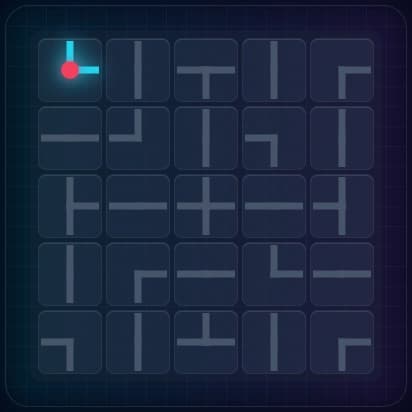
Before: Scrambled
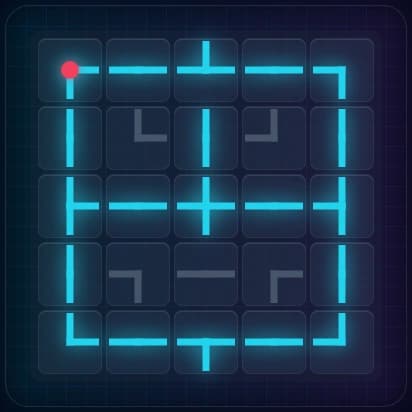
After: Connected!
The Complete Rules of Pipes
Five rules govern every Pipes puzzle. Master these, and you're ready to tackle any grid.
Rule 1: All Pipes Must Connect as a Single Network
When finished, every pipe segment must be part of one continuous network. You should be able to trace a path from any pipe to any other pipe by following connections. No isolated groups. No orphaned segments. One unified plumbing system.
Rule 2: No Closed Loops Allowed
Your network must form a tree structure—branching is fine, but the branches can never reconnect to form a cycle. Think of it like a river system: water flows from source to many endpoints, but the streams never circle back on themselves.
Rule 3: Every Pipe Opening Must Connect
Each pipe has one or more openings. Every single opening must connect to the opening of an adjacent pipe. No openings can face the edge of the grid. No openings can face the back of another pipe. If a pipe opens to the right, there must be a pipe to its right that opens to the left.
Rule 4: Tiles Can Only Be Rotated, Not Moved
Each pipe segment is fixed in its grid position. You can spin it to face different directions, but you cannot swap it with another tile or remove it from the grid. The puzzle is about orientation, not arrangement.
Rule 5: A Source Position Marks the Origin
One cell in the grid is marked as the source—where the water originates. All pipes must ultimately connect back to this source. The source helps you verify your solution: when complete, water should flow from the source to every pipe in your network.
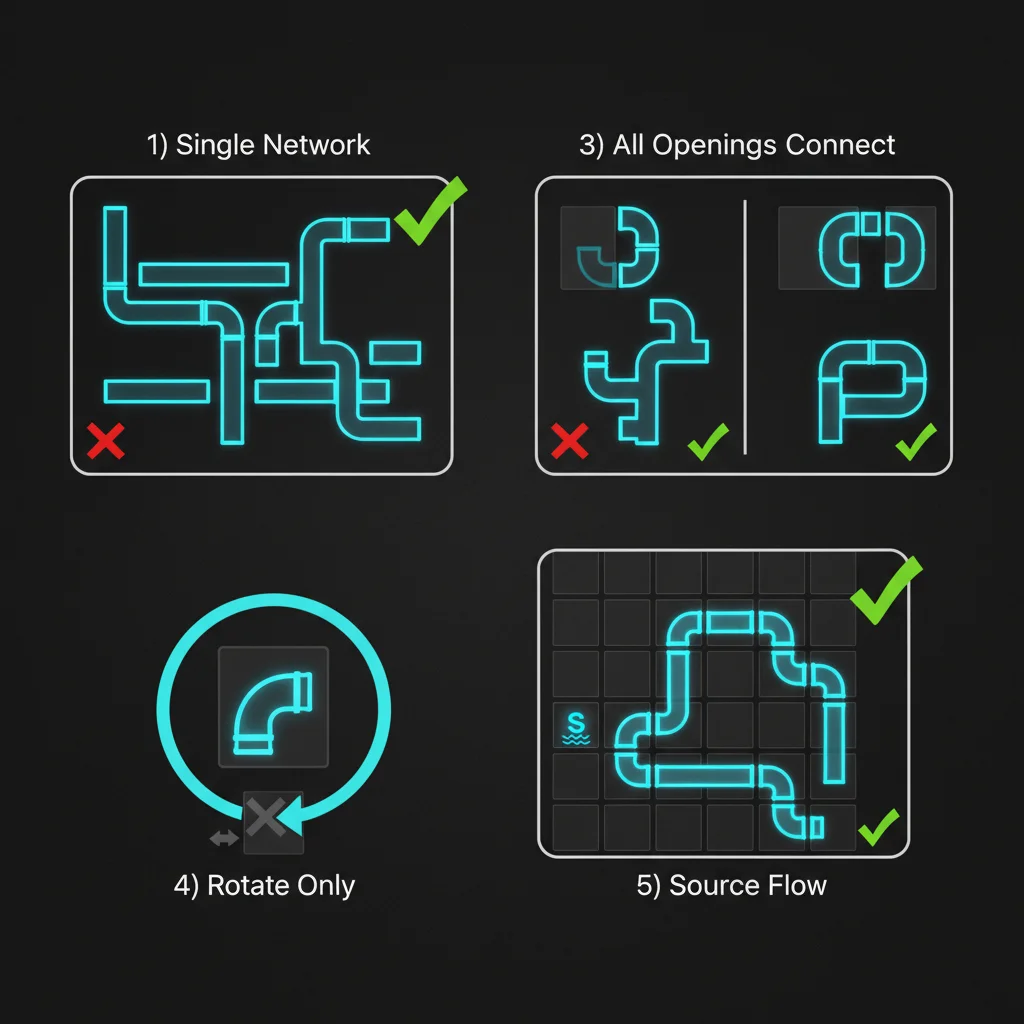
The five rules of Pipes—simple constraints that create satisfying logical puzzles.
Understanding Pipe Types
Before we solve our first puzzle, you need to recognize the six types of pipe segments. Each type has a specific number and arrangement of openings.
End Pipe (Dead End)
1 opening — Terminates the network like a faucet at the end of a plumbing line. Highly constrained: the single opening MUST connect to something.

Straight Pipe
2 opposite openings — Passes straight through. Water enters one side and exits the other. Creates the highways of your network.

Corner Pipe (Elbow)
2 adjacent openings at 90° — Changes direction of flow. The workhorses of Pipes puzzles, appearing frequently with four distinct orientations.

T-Junction Pipe
3 openings — Like a T intersection in a road. One side is blocked while three are open. Allows your network to branch.

Cross Pipe (Hub)
4 openings — Opens in all directions. Must connect to four adjacent pipes. Cannot sit on edges or corners since it would have openings facing out.

Empty Cell
0 openings — Dead space, no pipe. Pipes cannot connect to empty cells, so adjacent pipes cannot have openings facing that direction.

Your First Solve: A Visual Walkthrough
Let's solve a puzzle together. I'll show you exactly what to look for and why each move is logically certain—no guessing involved.
The Starting Grid
Here's our practice puzzle: a 4x4 grid designed to teach essential solving techniques. Before reading ahead, can you spot any pipes that have only one valid orientation?
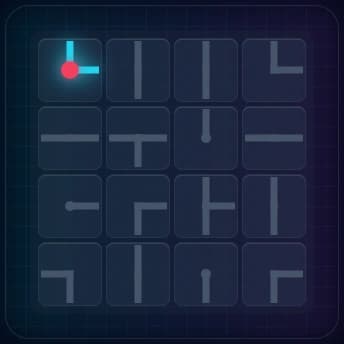
Our practice puzzle—look at the corners! What happens when a pipe is trapped with limited options?
Step 1: Analyze the Corners
Corners are your best friends in Pipes puzzles. A corner cell can only connect in two directions, which severely limits valid orientations. The top-left corner pipe can only open rightward and downward—those are the only adjacent cells. If it opens upward or leftward, it would face the grid edge, violating Rule 3.
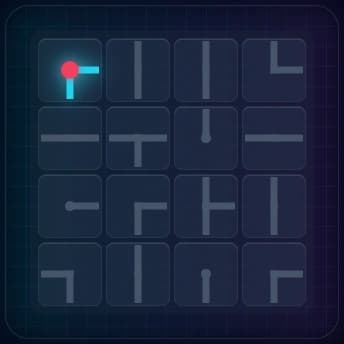
Step 1: The corner pipe can only face inward—one valid orientation!
Step 2: Apply Corner Logic to All Corners
The same logic applies to every corner. Top-right must open left and down. Bottom-left must open right and up. Bottom-right must open left and up. If any corner contains a corner pipe, it has exactly ONE valid orientation.
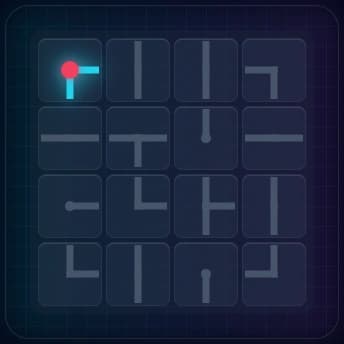
Step 2: All corners solved—four anchor points that constrain the entire grid.
Steps 3-4: Edges and Chain Reaction
Edge cells can only connect in three directions—they cannot connect outward past the grid boundary. With corners solved, interior pipes become constrained. If the corner opens toward a neighbor, that neighbor MUST have an opening facing back. This eliminates orientations and often solves pipes completely.
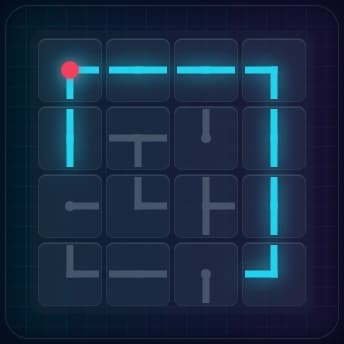
Step 3: Edges
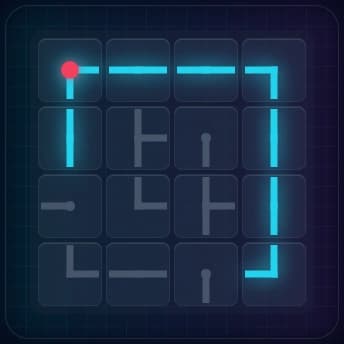
Step 4: Chain reaction
Complete the Network
With corners locked, edges constrained, and the no-loop rule eliminating false paths, the remaining pipes often have only one valid orientation. When the final pipe clicks into place, water flows from the source through your entire network!
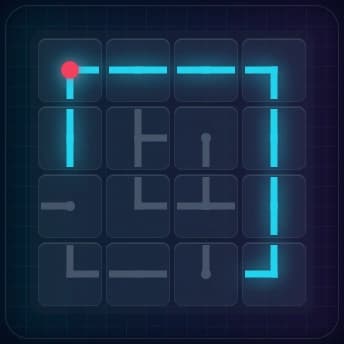
The completed puzzle—one beautiful, branching tree of pipes!
Key Principles
- Start with corners — they have the fewest valid orientations
- Work the edges next — one direction is always forbidden
- Propagate constraints — each solved pipe constrains its neighbors
- Watch for loops — eliminate orientations that would create cycles
Essential Beginner Strategies
Strategy 1: Corner-First Approach
Always start with corner cells. A corner pipe in a corner cell has exactly one valid orientation. Solving corners gives you anchor points that constrain the entire grid.
Strategy 2: End Pipe Analysis
End pipes with their single opening are extremely constrained. On an edge, they cannot face outward. In a corner, exactly one valid direction. Find all end pipes first and determine their constraints.
Strategy 3: Edge Exclusion
For any pipe on the grid edge, eliminate the outward direction. Top edge pipes cannot open upward. This immediately halves possibilities for many edge pipes.
Strategy 4: Connectivity Propagation
Once you solve a pipe, check its neighbors. If Pipe A opens toward Pipe B, then Pipe B MUST open toward Pipe A. Propagate this information systematically.
Strategy 5: Loop Detection
Before committing to an orientation, trace potential connections. Ask: "Would this complete a cycle?" If yes, choose a different orientation.
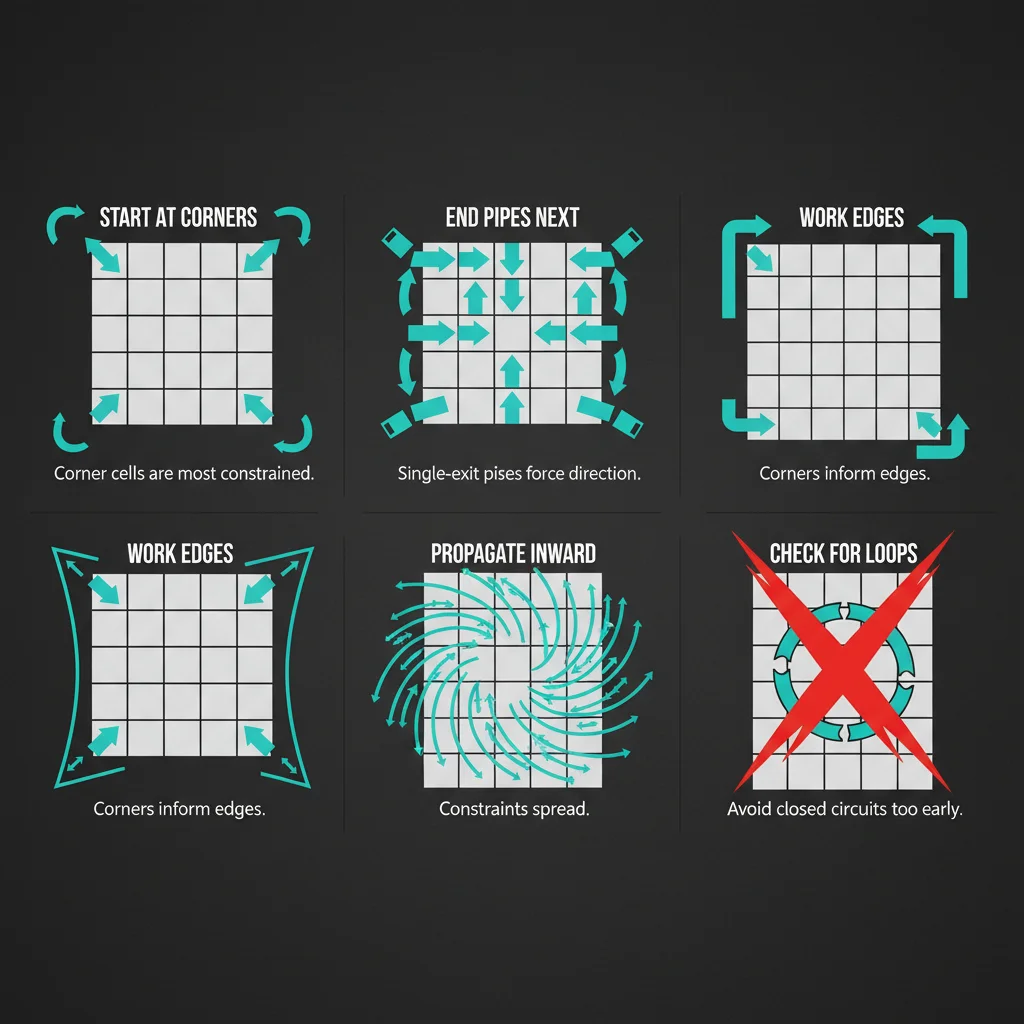
The systematic solving approach—corners first, then ends, then edges, then propagate inward.
Strategy Quick Reference
- 1. Corners first — corner pipes have exactly one valid orientation
- 2. End pipes next — single openings are maximally constrained
- 3. Work the edges — pipes cannot open toward grid boundaries
- 4. Propagate constraints — each solved pipe tells you about its neighbors
- 5. Check for loops — no cycles allowed (tree structure only)
- 6. Lock solved pipes — right-click to prevent accidental changes
- 7. Stay systematic — corners → ends → edges → interior
Common Mistakes and How to Avoid Them
Mistake 1: Ignoring Corners
You start solving from the middle or randomly click tiles. Fix: Always begin with corners—they're the most constrained cells and give you guaranteed progress.
Mistake 2: Creating Loops
You connect pipes into a satisfying-looking ring, then realize loops are forbidden. Fix: Before each rotation, mentally trace: "Would this complete a cycle?"
Mistake 3: Random Clicking
You get frustrated and start randomly rotating, hoping something works. Fix: Stop. Reset if needed. Return to corners and edges. There's always a logical deduction available.
Difficulty Progression
Your Network Awaits
Solve the four corners first -- each has exactly one valid orientation. Then work the edges, where one direction is always blocked. By the time you reach interior pipes, most will already be constrained by their solved neighbors. Start with a 5x5 grid and work up from there.
Ready to Connect Your First Network?
The strategies are in your head. The rules are crystal clear. All that's left is to start rotating pipes and watch the water flow.
Start Solving PipesPut it into practice
Ready to solve Pipes?
Open a free puzzle and turn the ideas from this guide into your next solve.