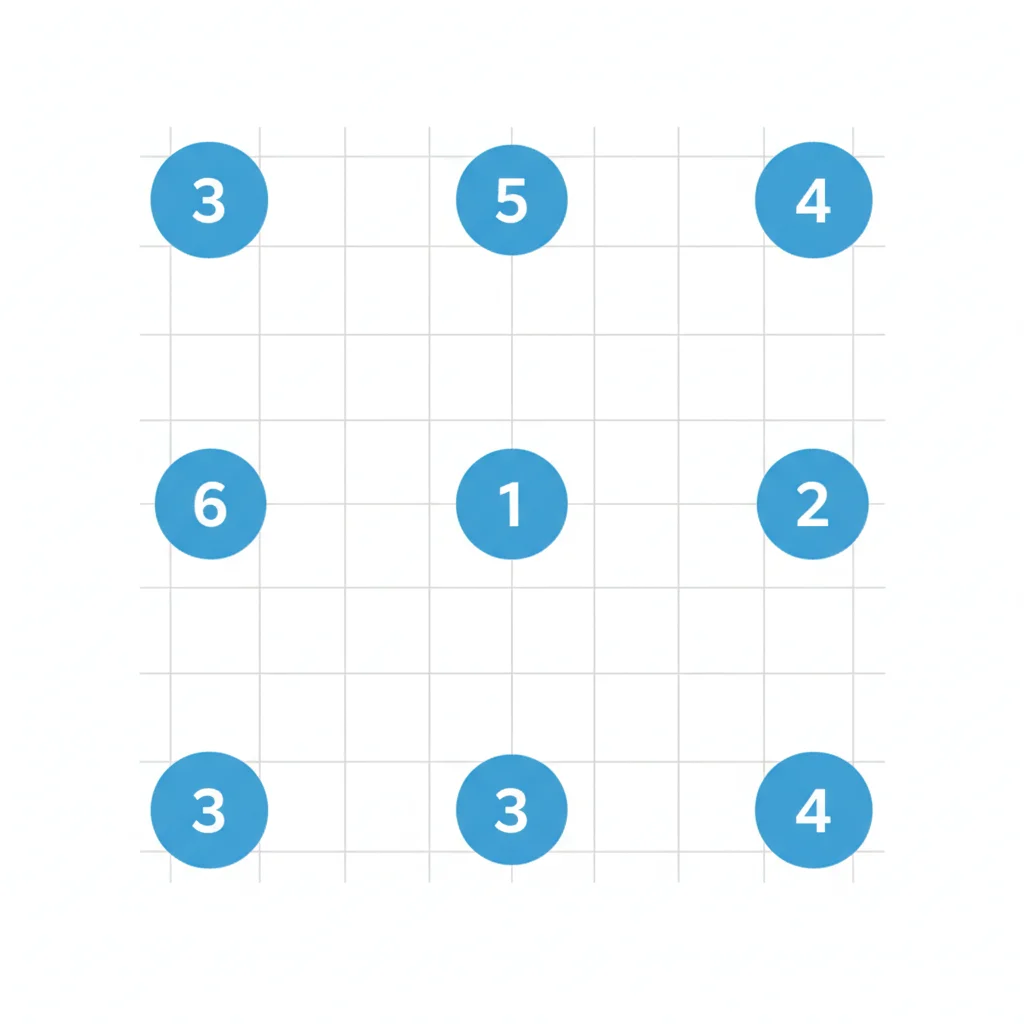
There's a moment—usually around your third or fourth Hashi puzzle—when everything shifts. You're staring at a numbered island, and suddenly you see it: that "3" in the corner with only two neighbors. It needs three bridges, but it can only send two in each direction. Which means... it must use both directions. The deduction clicks into place like a key turning in a lock.
That feeling is why people get hooked on this puzzle.
Hashi—short for Hashiwokakero, also known as Bridges—first appeared in Nikoli puzzle magazine in the 1980s. It spread worldwide because it offers something rare: a logic puzzle where every single move can be proven correct. No guessing. No "let's try this and see." Just the satisfying certainty of airtight deduction.
The rules take sixty seconds to learn. This guide will take you from knowing nothing to solving your first puzzle confidently—with strategies you can use forever.
Let's build some bridges.
Watch the Tutorial
Prefer watching? This short video walks you through the rules and key strategies.
What Exactly Is a Hashi Puzzle?
Hashi presents you with a grid containing numbered circles—these are your islands. Each number tells you exactly how many bridges must connect to that island. Your mission: draw bridges between islands until every number is satisfied and all islands form one connected network.
The beauty lies in the constraints. Bridges can only run horizontally or vertically. They can't cross each other. And you can place at most two bridges between any pair of islands. These simple restrictions create puzzles where every bridge placement is a logical certainty—if you know where to look.
The Complete Rules of Hashi
Five rules govern every Hashi puzzle. Master these, and you're ready to solve.
- Bridges run horizontally or vertically — Never diagonally. Every bridge forms a clean straight line between exactly two islands.
- Each island gets its exact number of bridges — The number inside tells you precisely how many connections it needs. A "3" requires exactly three bridges.
- Maximum two bridges between any two islands — You can connect a pair with one bridge (single line) or two (double line), but never more.
- Bridges cannot cross each other — Once a bridge exists, it blocks any bridge that would cross its path. Planning ahead becomes essential.
- All islands must be connected — When finished, every island must be reachable from every other by following bridges. No isolated groups.
That's everything. Five rules, endless puzzles.
Your First Solve: A Visual Walkthrough
Let's solve a puzzle together. I'll show you exactly what to look for and why each move is logically certain—no guessing involved.
The Starting Grid
Here's our practice puzzle: a 5x5 grid with six islands arranged to teach key solving techniques.
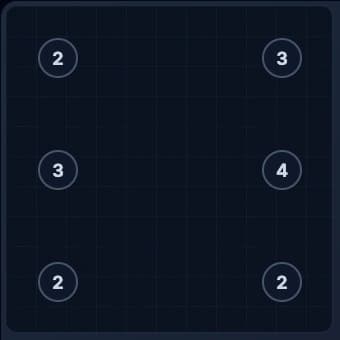
Our practice puzzle - before reading ahead, can you spot any forced moves?
I'll use coordinates (column, row) to reference positions—so (1,1) is the top-left corner and (5,5) is the bottom-right.
The islands: (1,1): "2" in top-left corner • (5,1): "3" in top-right corner • (1,3): "3" on left edge • (5,3): "4" on right edge • (1,5): "2" in bottom-left corner • (5,5): "2" in bottom-right corner
Take a moment to study it. Can you spot any islands where the math forces a specific move?
Step 1: Analyze the Corners
Start with the corners—they have the fewest options, making deductions easier.
Top-right "3" (position 5,1): Can connect left to the "2" at (1,1) and down to the "4" at (5,3). Maximum possible: 2 + 2 = 4. Needs 3.
💡 First Breakthrough!
The "3" needs 3 bridges but only has 2 neighbors. Maximum is 4. Since 3 is more than half of 4, at least one bridge must go in each direction. We can't place all 3 bridges using just one neighbor (max would be 2).
Step 2: Apply the Minimum Bridge Rule
Let's place those certain bridges: one bridge from (5,1) → (1,1) horizontal, and one bridge from (5,1) → (5,3) vertical. The "3" needs one more bridge—we'll determine which direction later.
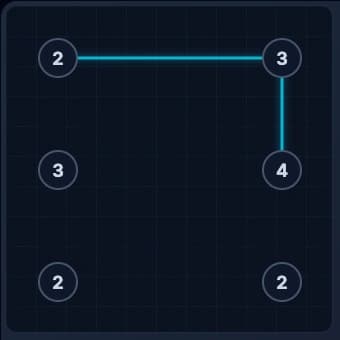
Step 2: The corner "3" reveals forced connections.
Steps 3-5: Chain Reactions
The top-left "2" just received one bridge. It needs one more, and its only other neighbor is the "3" at (1,3) below. Forced move: One bridge from (1,1) down to (1,3).
Here's where the action shifts: look at the bottom corners. The "2" at (5,5) can only connect up (to the "4") or left (to the "2" at 1,5). Two neighbors, needs 2 bridges. This is a forced situation!
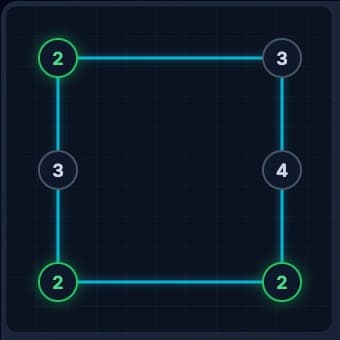
Step 5: The corner islands reveal the lower half of the solution.
Step 6: Finish the Puzzle
Taking inventory: the "3" at (1,3) needs 1 more bridge, and the "4" at (5,3) needs 2 more. The "3" at top-right still needs 1. The math works out perfectly: one bridge from (1,3) → (5,3) horizontal, and one more bridge from (5,1) → (5,3) vertical (making it a double bridge).
All islands satisfied. All connected. Solved!
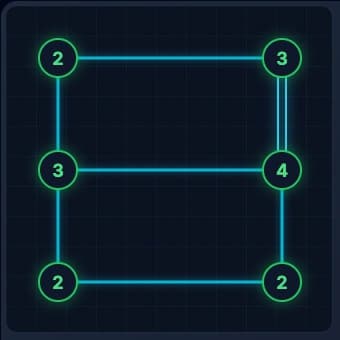
The completed puzzle - notice the double bridge between the "3" and "4" on the right side.
What This Walkthrough Teaches
- Start with corners and edges—fewer neighbors means easier deductions
- The minimum bridge rule is powerful—when required > half of maximum, every direction gets at least one bridge
- Chain reactions matter—one certain bridge often forces another
- Track your counts—always know how many bridges each island still needs
- Connectivity resolves ambiguity—when stuck, verify all islands can still potentially connect
Essential Beginner Strategies
Now that you've seen these techniques in action, let's name them so you can apply them deliberately to any puzzle.
Strategy 1: The Maximum Bridge Rule
When an island's required bridges equals its maximum possible, you can fill every connection immediately—no deduction required. How to calculate maximum: Count neighbors, multiply by 2.
Strategy 2: The Minimum Bridge Rule
When required bridges exceed half the maximum, at least one bridge must go in every available direction. We used this exact technique on the top-right "3" in our walkthrough!
Strategy 3: The Isolation Check
Before you declare victory, ask yourself: can I travel from any island to any other by following bridges? If your solution creates two separate networks that don't touch, you've made an error somewhere.
Strategy 4: The "1" Island Advantage
Islands labeled "1" are secretly your friends. They connect to exactly one neighbor with exactly one bridge. If a "1" has only one possible neighbor, that single bridge is immediately forced.
Strategy 5: Work Outside-In
Edges and corners have fewer options than center islands. Start there. As you place perimeter bridges, you constrain interior options, making those central islands progressively easier to solve.
Common Mistakes and How to Avoid Them
Mistake 1: Forgetting Connectivity
All numbers match, but two separate networks exist that don't connect. Fix: Periodically trace: "Can I reach every island from here?"
Mistake 2: Blocking Future Paths
A bridge cuts off another island's only route to its required connections. Fix: Before placing bridges, scan perpendicular paths.
Mistake 3: Guessing Instead of Deducing
Two options exist, you pick one, and later hit a contradiction. Fix: Only place bridges you can prove. When uncertain, find islands where you CAN be certain.
Practice Tips for Rapid Improvement
- Start Small, Then Graduate: Begin with 5x5 grids. Once comfortable, move to 7x7, then 10x10+.
- Daily Consistency: Three small puzzles daily builds skill faster than weekly marathon sessions.
- Analyze Mistakes: When wrong, ask: What did I assume without proof? Which island did I miscount?
- Verbalize Logic: Narrate your reasoning to catch sloppy shortcuts.
- Time Yourself (Eventually): Once mechanics feel natural, timing reveals hesitation points.