Slitherlink Puzzle:
A Complete Beginner's Guide to Drawing Loops
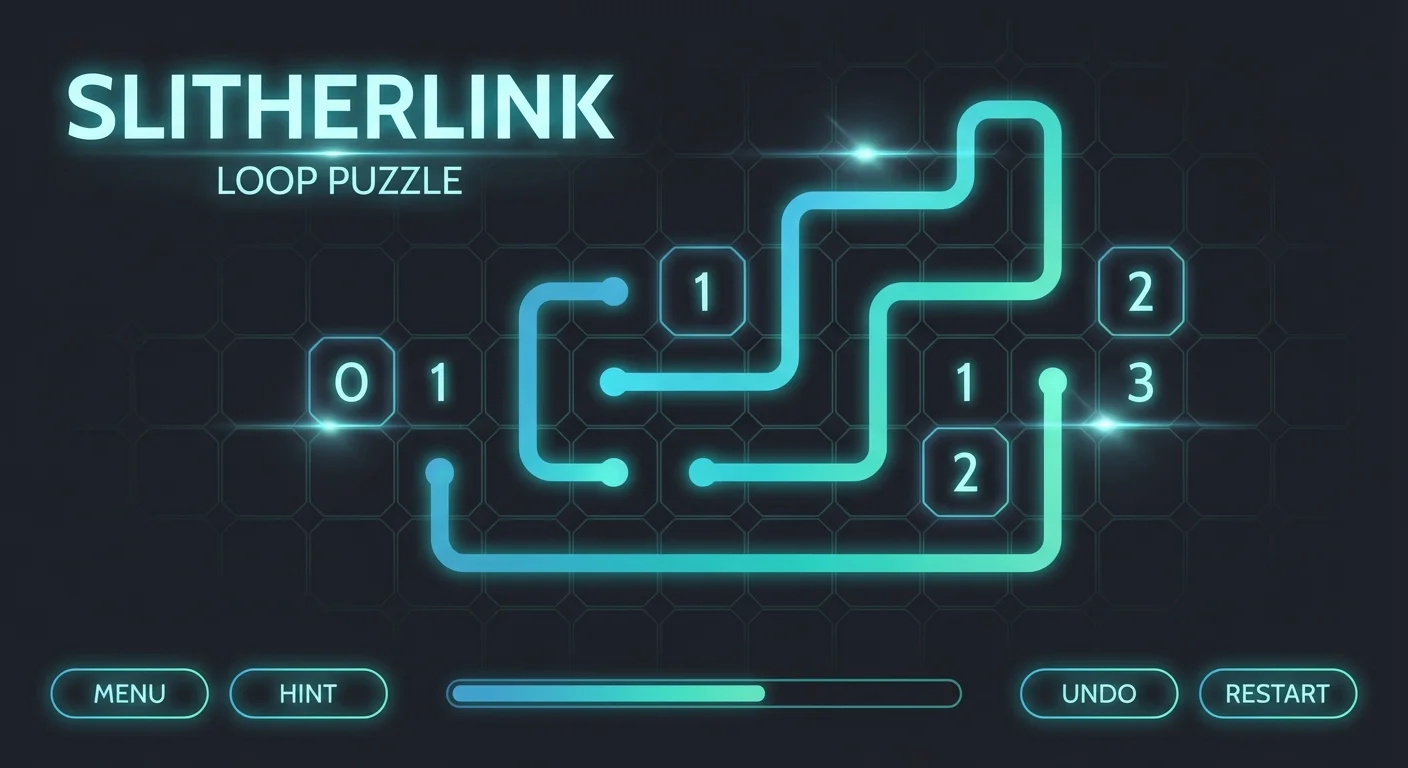
There's a moment in every Slitherlink puzzle when the chaos transforms into clarity. You've been drawing careful line segments, avoiding dead ends, respecting the numbers. Then you lean back, trace the path with your eyes, and watch it happen: your fragmented lines suddenly flow together into one continuous, elegant loop that weaves through the entire grid like a river finding its way to the sea.
That moment of completion—when the loop closes and every number is satisfied—delivers a satisfaction unlike any other puzzle. It's the joy of creating something whole from scattered constraints, of watching order emerge from pure deduction.
Slitherlink (also called Fences, Loop the Loop, or Takegaki) was created by the legendary Japanese puzzle publisher Nikoli in 1989. The rules take sixty seconds to learn. This guide will transform you from complete beginner to confident solver—with patterns and strategies that work whether you're tackling a tiny 5x5 grid or an ambitious 20x20 masterpiece.
Watch the Tutorial
Prefer watching? This short video walks you through the rules and key techniques.
What Exactly Is a Slitherlink Puzzle?
Slitherlink presents you with a grid of dots with numbers scattered in the cells between them. Your mission: connect the dots with line segments to form a single continuous loop. The numbers tell you exactly how many of the four edges around that cell are part of your loop.
The beauty of Slitherlink lies in how the numbers constrain each other. A "3" demands three edges, while a "0" forbids all four. These constraints ripple outward, forcing logical conclusions across the entire grid. When you finally close the loop, every segment you drew was mathematically inevitable—proven through pure deduction.
The Complete Rules of Slitherlink
Four rules govern every Slitherlink puzzle. Once these click, you'll never forget them.
Rule 1: Draw a Single Closed Loop
Your solution must be one unbroken loop—a path that eventually returns to its starting point. Imagine drawing without lifting your pencil: you travel along edges, and at some point, you arrive back where you began. No separate pieces. No loose ends.
Rule 2: The Loop Cannot Cross or Branch
At every intersection (dot), exactly zero or two line segments can meet. Zero means the loop doesn't pass through that point. Two means the loop enters and exits—continuing its journey. You'll never have three or four lines meeting at a point; that would create a branch or crossing, which is forbidden.
Rule 3: Numbers Indicate Edge Count
Each number tells you exactly how many of the four edges surrounding that cell are part of the loop. A "3" means three of its four edges have lines. A "1" means exactly one edge. A "0" means none of its edges are used—the loop stays completely away from that cell.
Rule 4: Empty Cells Have No Constraint
Cells without numbers can have anywhere from 0 to 4 edges as part of the loop. They're flexible—the loop can wrap around them, pass through them, or avoid them entirely. Don't assume anything about empty cells except what you can prove from neighboring constraints.
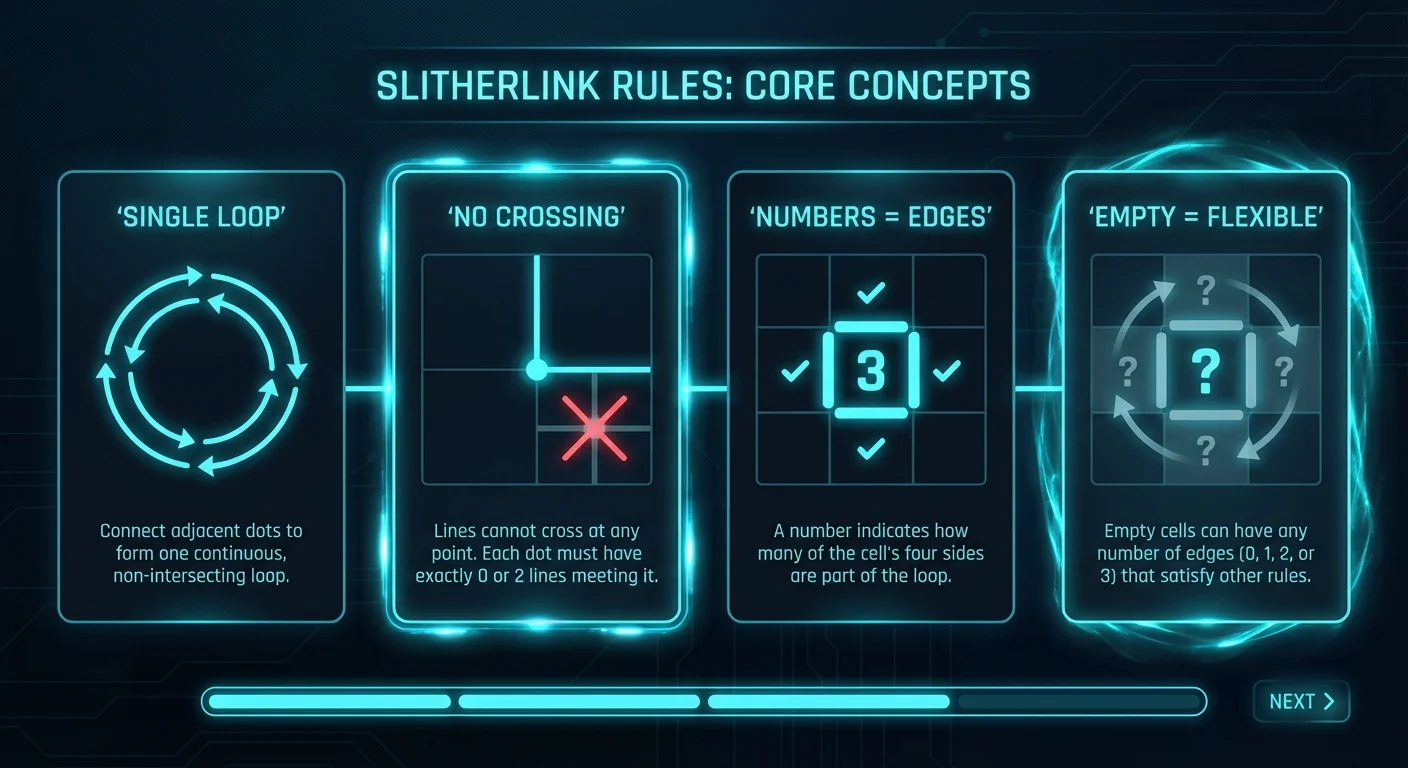
The four rules of Slitherlink—simple constraints that create elegant puzzles.
Your First Solve: A Visual Walkthrough
Let's solve a puzzle together. I'll show you exactly what to look for and why each move is logically certain—no guessing involved.
The Starting Grid
Here's our practice puzzle: a 4x4 grid designed to teach essential patterns. Before reading ahead, study the grid. Can you spot any cells where the constraints force immediate conclusions?
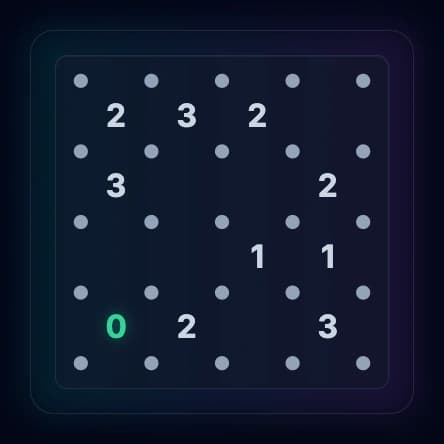
Our practice puzzle—before reading ahead, can you spot the forced moves around the 0 and corner 3?
Step 1: Handle the "0" Cell
The "0" cell in the bottom-left tells us something definitive: none of its four edges can be part of the loop. Zero means zero—no lines touch this cell at all. Many solvers use small X marks on edges they've eliminated. This negative information is just as valuable as positive line placements.
Step 2: Apply the Corner 3 Pattern
Now look at the "3" in the bottom-right corner. This is your first essential pattern: a "3" in a corner. A corner cell has only two outer edges (along the grid border). Since excluding either outer edge makes reaching 3 impossible, both outer edges must be part of the loop.
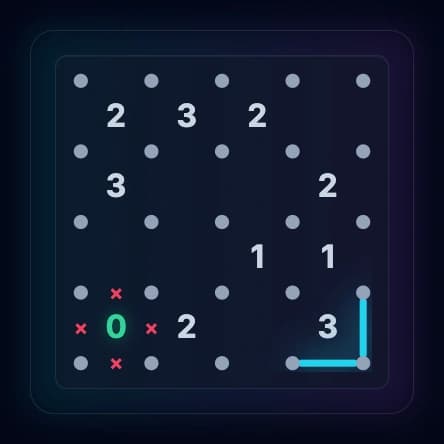
Step 2: The "0" eliminates edges while the corner "3" forces two lines.
Steps 3-4: Extend the Loop
The corner dot now has exactly two lines meeting at it. Remember Rule 2: each dot must have exactly 0 or 2 lines. This dot is complete. From the corner "3", trace where the loop must go. The "2" cell next to the "0" helps us here—since the "0" eliminates the shared edge, the "2" must get both its edges from its other three sides.
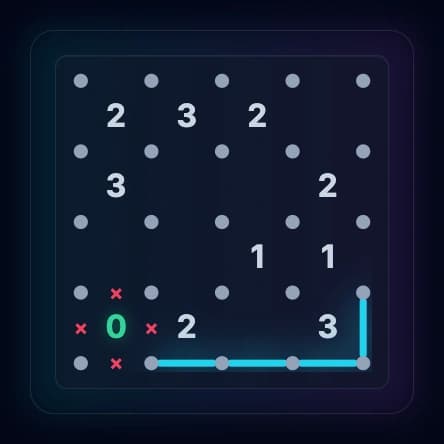
Step 4: The loop extends and turns, respecting the 0's forbidden zone.
Step 5: Work the Top Section
The "3" on the left edge provides our next anchor. As you apply the dot rule—checking that each dot has 0 or 2 lines—the possibilities narrow. Every line you draw creates two endpoints that each need exactly one more connection.
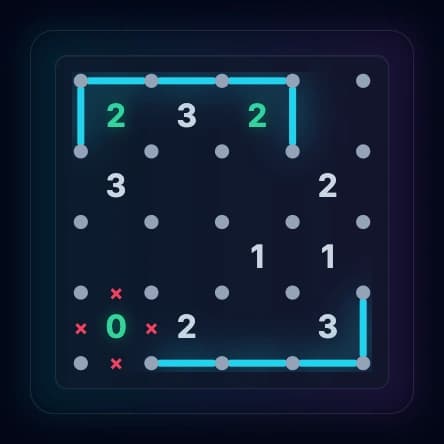
Step 5: The loop takes shape as constraints cascade through the grid.
Step 6: Close the Loop
With most edges determined, the remaining moves become clear. Each numbered cell must have exactly its count satisfied. Each dot must have 0 or 2 lines. The loop must be continuous with no branches. Follow these constraints to their logical conclusion, and the loop closes itself.
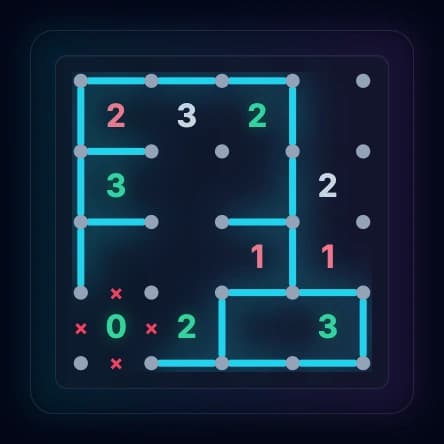
The completed puzzle—one elegant loop satisfying every constraint through pure logic!
Key Principles
- Start with "0"s — they eliminate edges immediately
- Corner and edge "3"s are powerful — border constraints force immediate conclusions
- Dot logic is essential — every dot must have 0 or 2 lines
- Eliminate before you draw — knowing where the loop ISN'T helps as much as knowing where it IS
Essential Beginner Patterns
Pattern recognition is the heart of Slitherlink mastery. These patterns will become second nature with practice, letting you solve puzzles with speed and confidence.
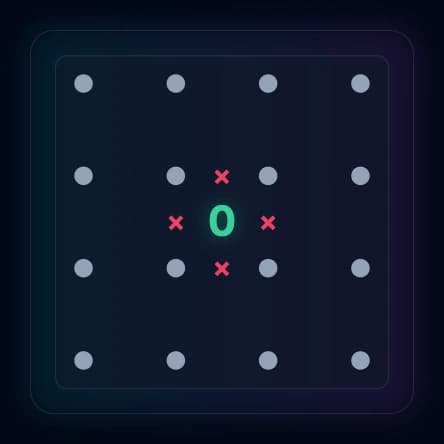
Pattern 1: The Zero Cell
A "0" means no edges can be part of the loop. Mark all four edges around any "0" as eliminated immediately. This is always your first move in any puzzle.
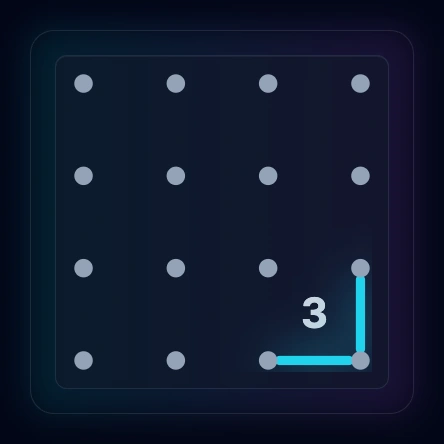
Pattern 2: Corner 3
A "3" in a corner of the grid has only two outer edges. Since excluding either makes reaching 3 impossible, both outer edges must be part of the loop.
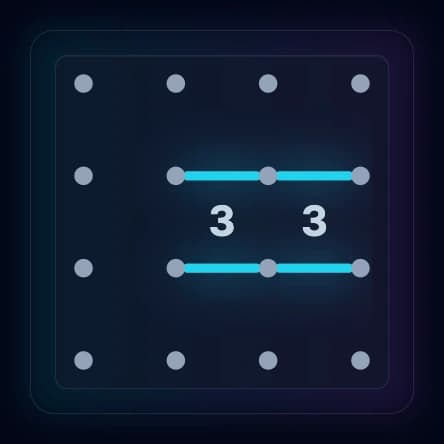
Pattern 3: Adjacent 3s
Two "3"s sharing an edge create a forced pattern. The outer edges parallel to their shared boundary must both be part of the loop.
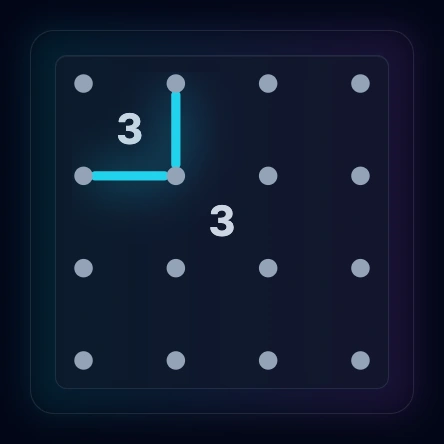
Pattern 4: Diagonal 3s
Two "3"s touching at a corner (diagonally adjacent) force the two edges meeting at their shared corner to be part of the loop.
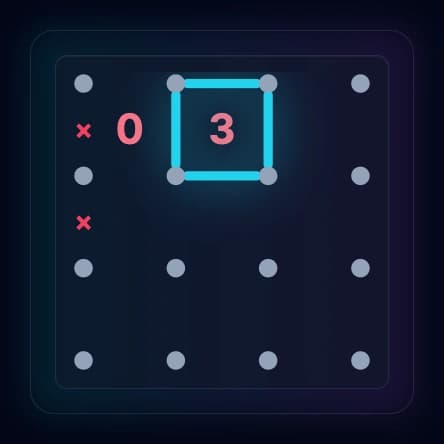
Pattern 5: 0 Next to 3
A "0" adjacent to a "3" eliminates their shared edge. The "3" must then use all three of its remaining edges.
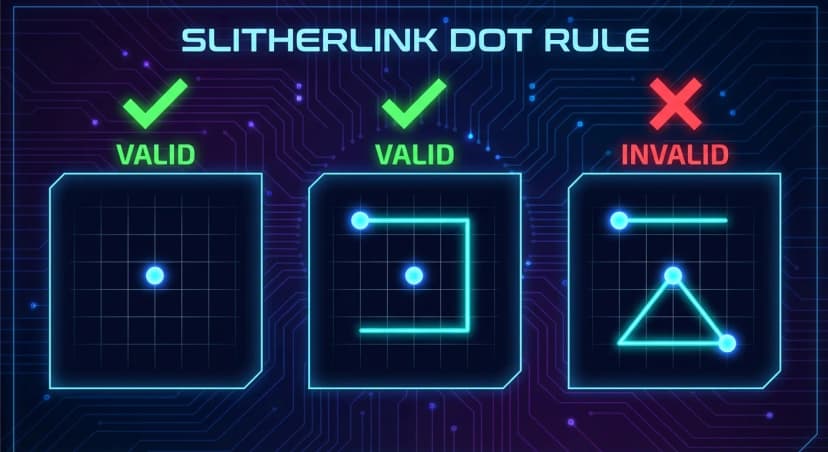
Pattern 6: The Dot Rule
At every dot, either 0 lines or exactly 2 lines meet. Never 1 or 3. Use this to extend lines and eliminate dead ends.
Common Mistakes and How to Avoid Them
Mistake 1: Creating Closed Sub-Loops
You draw a small loop that closes on itself before the entire puzzle is complete. Fix: Constantly ask: "Can this line segment still connect to the rest of the grid?"
Mistake 2: Creating Dead Ends
A line segment reaches a dot where it can't continue. Fix: Use the dot rule proactively. When you draw a line, immediately check if that dot can have exactly two connections.
Mistake 3: Miscounting Edges
You think a "2" is satisfied with 3 edges, or a "3" with 2. Fix: After completing an area, verify counts by literally counting the edges around each numbered cell.
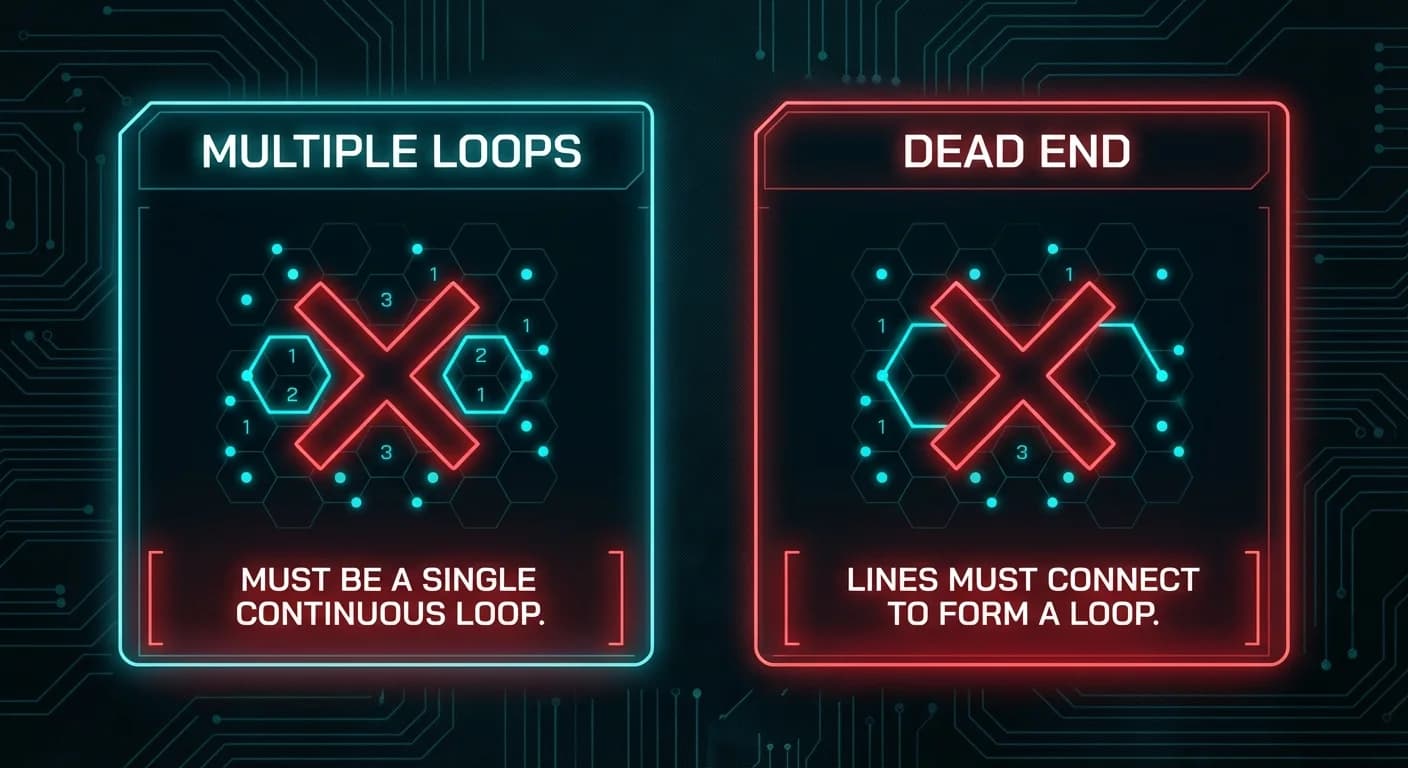
Common mistakes—always maintain one continuous path with no dead ends.
Practice Tips for Rapid Improvement
Start with Smaller Grids
Begin with 5x5 or 7x7 grids. These contain all the essential patterns in manageable doses. Master the patterns on small puzzles before tackling 10x10 or larger grids.
Hunt for "0"s and Corner "3"s First
Always start every puzzle by: 1) Marking all edges around every "0", 2) Drawing the forced edges around corner "3"s, 3) Looking for edge "3"s and adjacent "3"s. This often solves 30-50% of the puzzle immediately.
Use Elimination Marks
Mark eliminated edges with small X symbols. Negative information is just as valuable as positive line placement. Seeing where the loop CANNOT go often reveals where it MUST go.
Trace Your Loop Regularly
Every few moves, trace your partial loop from end to end. Verify it's still one continuous path with no accidental closures. This catches mistakes early when they're easy to fix.
Your First Loop Awaits
With these patterns--zeros, corner threes, diagonal threes, and the dot rule--you have the foundation for solving any Slitherlink puzzle. Start with smaller grids to build confidence, then work your way up.
Quick Reference Checklist
- Start with "0"s and corner "3"s—they're always forced
- Use the dot rule to extend lines and eliminate dead ends
- Watch for adjacent and diagonal 3s patterns
- Mark eliminated edges just as carefully as drawn ones
- Trust the logic—every segment is provable
Ready to Draw Your First Loop?
The patterns are in your head. The rules are crystal clear. All that's left is to put pencil to paper—or finger to screen—and watch the loop emerge.
Start Solving SlitherlinkPut it into practice
Ready to solve Slitherlink?
Open a free puzzle and turn the ideas from this guide into your next solve.