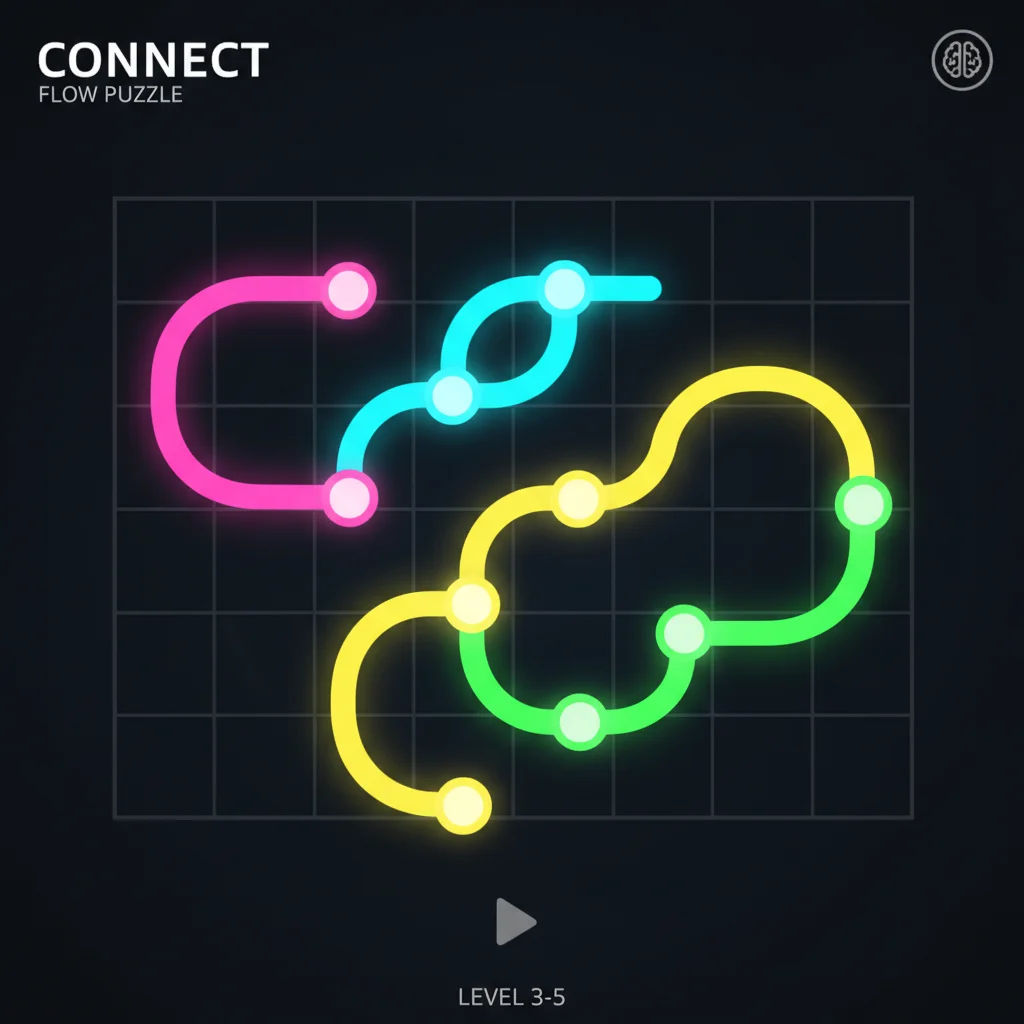
There's a moment in Connect puzzles that changes everything. You're staring at a tangle of colored dots, mentally tracing paths that seem impossible to fit together. Your brain is working hard, rejecting route after route. Then suddenly—click. That yellow dot in the corner. It can only escape one way. Trace it along the edge and... yes. Yes. Everything else dominoes into place in seconds.
The satisfaction is almost physical—like peeling the protective film off a new screen or hearing that perfect lock-cylinder thunk when you turn the key. That feeling of watching chaos transform into elegant, flowing lines is why millions of people are hooked on this puzzle.
Connect—known by many names including Flow Free, Numberlink, and Arukone—traces its origins to Japanese puzzle magazines in the 1980s. It exploded into mainstream consciousness with mobile apps in the 2010s, introducing a generation to the pure joy of logical deduction. The appeal is timeless: a puzzle where every single path can be proven correct. No guessing. No "let's try this and see." Just the satisfying certainty of airtight reasoning.
The rules take thirty seconds to learn. This guide will take you from knowing nothing to solving your first puzzle confidently—with strategies you can use forever.
Let's draw some paths.
Watch the Tutorial
Prefer watching? This short video walks you through the rules and key techniques.
What Exactly Is a Connect Puzzle?
Connect presents you with a grid containing pairs of colored dots. Each color appears exactly twice. Your mission: draw a continuous path connecting each pair of matching dots, filling every cell in the grid without any paths crossing or overlapping.
The beauty lies in the constraints. Paths can only move horizontally or vertically—never diagonally. They cannot cross each other or share cells. And crucially, every single cell must be filled when you're done. These simple restrictions transform what looks like a casual doodling exercise into puzzles where every line placement is a logical certainty—if you know where to look.
The Complete Rules of Connect
Five rules. That's it. Once these click, you'll never forget them—and you'll spot opportunities that less experienced solvers miss.
- Connect matching colors — Each colored dot has exactly one partner of the same color. Draw a continuous path linking them together.
- Paths move only horizontally or vertically — Think of it like navigating city blocks: you can only travel along the streets, never cutting through buildings.
- Paths cannot cross, overlap, or share cells — They're jealously territorial, like cats with adjacent food bowls. Think of each path as a solid pipe—pipes don't merge or pass through each other.
- Every cell must be filled — Think of it like Tetris in reverse—you're not dropping pieces, you're growing paths until they perfectly fill every gap.
- Paths start and end at matching endpoints — Each path must begin at one colored dot and end at its matching partner.
That's everything. Five rules, endless puzzles.
Your First Solve: A Visual Walkthrough
Let's solve a puzzle together. I'll show you exactly what to look for and why each move is logically certain—no guessing involved.
The Starting Grid
Here's our practice puzzle: a 5x5 grid with five color pairs, designed to teach key solving techniques.
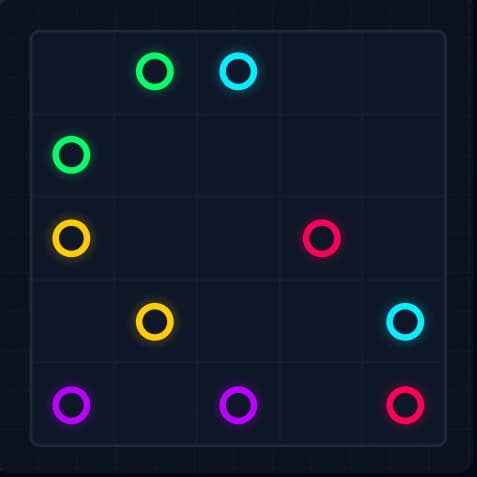
Our practice puzzle - before reading ahead, can you spot any forced moves?
I'll use coordinates (column, row) to reference positions—so (1,1) is the top-left corner and (5,5) is the bottom-right.
The endpoint pairs: Red at (5,5) and (4,3) • Cyan at (3,1) and (5,4) • Yellow at (1,3) and (2,4) • Purple at (1,5) and (3,5) • Green at (1,2) and (2,1)
Take a moment to study it. Can you spot any paths where the starting move is absolutely forced?
Step 1: Find the Forced Moves
Start by scanning for dots with severely limited options. Look for corners, edges, and adjacent pairs.
Green dots at (2,1) and (1,2): These are diagonally adjacent in the top-left area. The green at (2,1) is on the top edge—can only go left, right, or down. Going left to (1,1) then down to (1,2) is the only path that works!
Cyan dots at (3,1) and (5,4): Cyan at (3,1) is on the top edge. Going right along the top edge, then down the right side to (5,4) creates a clean L-shaped path.
Step 2: Place the First Two Paths
Red's path is the longest—it snakes from (5,5) through the middle to reach (4,3): (5,5) → (4,5) → (4,4) → (3,4) → (3,3) → (2,3) → (2,2) → (3,2) → (4,2) → (4,3). This 10-cell path claims significant territory through the center.
Cyan's path runs along the top and right edges: (3,1) → (4,1) → (5,1) → (5,2) → (5,3) → (5,4).
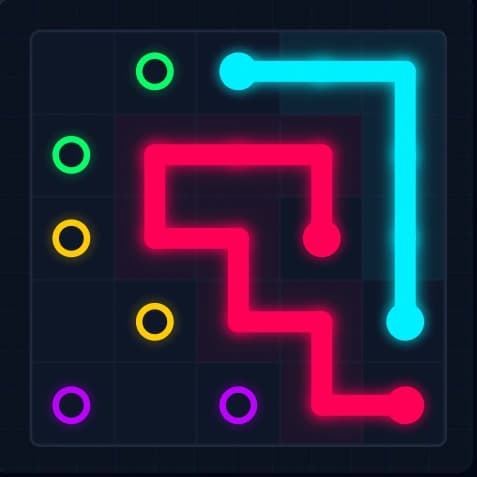
Step 2: Red claims the center, Cyan hugs the edges.
Sixteen cells filled, nine to go. Notice how these two paths have divided the remaining space into distinct regions.
Step 3: Yellow Falls Into Place
💡 Pause Here!
Look at the yellow endpoints at (1,3) and (2,4). With Red and Cyan already placed, what's the only way to connect them?
Yellow endpoints: (1,3) on the left edge and (2,4) nearby. The path is short and forced.
Yellow's path: (1,3) → (1,4) → (2,4). Three cells along the left side.
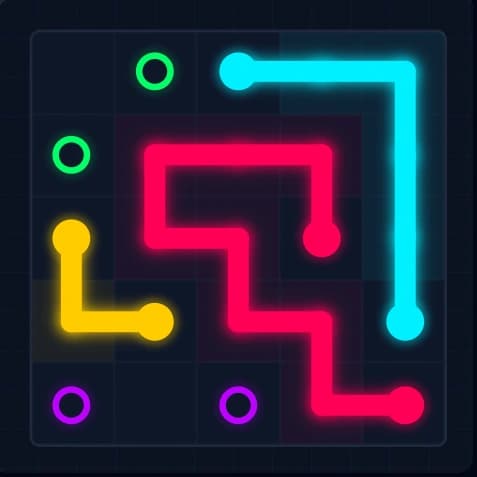
Step 3: Yellow connects with a simple L-shape.
Step 4: Purple Connects
Purple endpoints: (1,5) and (3,5) — both on the bottom row.
With yellow taking (1,4), purple must go straight across the bottom.
Purple's path: (1,5) → (2,5) → (3,5). Three cells along the bottom edge.
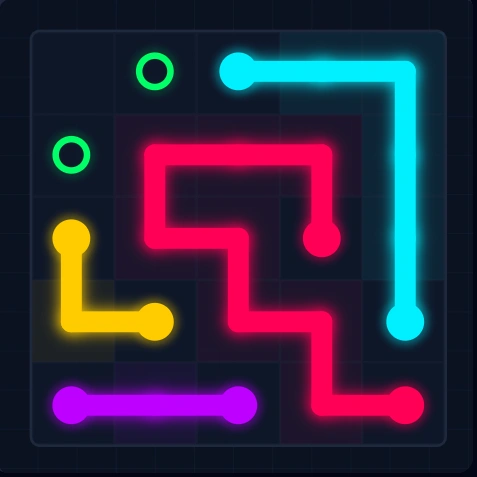
Step 4: Purple takes the bottom row.
Step 5: Green Completes the Puzzle
🎯 Try This Yourself First
Only green remains. Endpoints: (2,1) at the top and (1,2) on the left edge. There's only one way to connect them while filling the remaining cells!
This is where the "fill every cell" rule becomes your guide. With four colors placed, green must fill all remaining space.
Green's path: (1,2) → (1,1) → (2,1). Three cells in the top-left corner.
Every remaining cell filled. Puzzle complete.
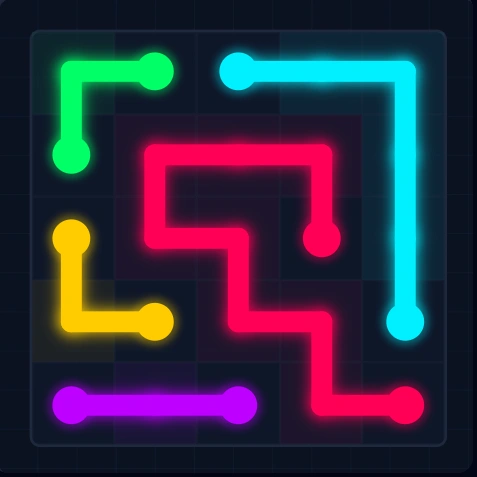
The completed puzzle - every cell filled, every pair connected, pure satisfaction.
What This Walkthrough Teaches
Take a breath—you just solved your first Connect puzzle through pure logic. No trial and error. No lucky guesses. Every single move was provable.
- Start with forced moves—edge pairs with limited options reveal themselves first
- Corner traps are real—dots near corners can only go certain directions
- Paths interact—placing one path affects all others; think about the ripple effects
- The fill constraint is powerful—every cell must be used, so paths often must take longer routes
- Backtracking is okay—if you hit an impossible situation, an earlier decision was wrong
Essential Beginner Strategies
Now that you've seen these techniques in action, let's name them. Recognizing patterns by name transforms lucky guesses into repeatable skills—the difference between "I got lucky" and "I knew that would work."
Strategy 1: The Edge Escape Rule
When a dot is on the edge of the grid, it has only three possible directions (or two if it's in a corner). This limited freedom often forces specific moves. Pattern to recognize: A dot in a corner with one direction blocked must start the other way. No other choice exists.
Strategy 2: The Parallel Pair Shortcut
When two dots of the same color are on the same row or column with no obstacles between them, the straight-line path is often (but not always) correct. Caution: The "fill every cell" rule means sometimes you need a longer path to fill space elsewhere.
Strategy 3: The Wall Hug Technique
Dots near edges often produce paths that follow the wall for a while before turning inward. Edge paths use fewer cells to cover the same distance, leaving interior space for other paths.
Strategy 4: The Bottleneck Detection
Look for narrow passages in the grid—choke points that every path has to squeeze through like Black Friday shoppers through a single door. These bottlenecks are pure gold for deduction. Use them to deduce which color must use that cell.
Strategy 5: The Parity Check
This sounds mathematical, but it's really just common sense once you see it. If a region has an odd number of empty cells with no endpoint inside, it's impossible to fill—paths entering must eventually exit, using an even number of cells. Catch the mistake now, not three moves later.
Strategy 6: The Forced Corridor
Sometimes the grid shape or existing paths create corridors where a specific color must travel. Look for "alleyways"—narrow regions between the edge and existing paths. Only one color can use that space, and its path is forced.
Strategy 7: The Last Color Standing
When you've placed all but one color, the remaining path is completely determined—it must fill all remaining space. This is like "autopilot mode" at the end of puzzles. Tip: Sometimes deliberately leaving one color for last makes the puzzle easier.
🎯 Designer's Secret
Here's something most tutorials won't tell you. Puzzle designers typically place the longest path's endpoints first, then fit shorter paths around it. This means if you see one pair that's far apart with lots of territory between them, that color probably snakes through much of the grid. Identify that "dominant" path early, and sketch its rough territory mentally before committing other paths. This single insight will help you think like the person who created the puzzle—and that's the fastest way to solve it.
Common Mistakes and How to Avoid Them
Mistake 1: Trapping Yourself in Corners
You draw a path into a corner region, only to realize there's no way out to reach the destination. Fix: Before entering any dead-end region, verify your path can exit. Trace the escape route mentally before committing.
Mistake 2: Forgetting to Fill Every Cell
All paths connect correctly, but empty cells remain. The puzzle isn't solved. Fix: Periodically scan for isolated empty regions. Paths must sometimes take inefficient-looking routes.
Mistake 3: Blocking Partner Access
You draw a path that cuts across the grid, separating a dot from its partner with no way to reconnect. Fix: Before drawing a spanning path, verify all other pairs can still reach each other.
Mistake 4: Guessing Instead of Deducing
When stuck, you pick a random direction hoping it works out. Fix: If no move feels certain, you might be missing a forced move elsewhere. Check every dot systematically. In well-designed puzzles, there's always a logical next step.
Practice Tips for Rapid Improvement
- Start Small, Then Graduate: Begin with 5x5 grids. Once comfortable, move to 6x6, 7x7, and larger.
- Look for Forcing Chains: The best solvers develop an eye for "chain reactions"—where one forced move leads to another.
- Visualize Before Drawing: Trace the path mentally before putting stylus to screen. Prevents costly restarts.
- Time Yourself (Eventually): Once mechanics feel natural, timing adds motivation. Speed comes from pattern recognition.
- Learn From Stuck Points: When stuck, examine what made the puzzle hard. Did you miss a forced move? Did an early choice box you in?
- Daily Consistency: Five minutes daily beats an hour once a week. Your brain consolidates pattern recognition between sessions.