There is a moment in every Thermometers puzzle when the grid suddenly surrenders. You fill one cell, and mercury cascades across the board---four cells here, three there, an entire thermometer empties itself. One determination, a chain of consequences. That electric chain reaction is what this guide is about.
Mercury rises from the bulb. It never skips. It never flows backward. This single rule makes Thermometers one of the most elegant logic puzzles ever designed. A row labeled "5" with a thermometer spanning all 5 cells? Filled completely. A column labeled "0"? Every thermometer segment there is empty. The beauty is in the certainty---no probability, no maybe, just pure logical consequence.
Watch the Tutorial
Prefer watching? This tutorial introduces Thermometers rules and core techniques.
Prerequisites: This guide assumes familiarity with basic Thermometers rules. New to the puzzle? Start with our Beginner's Guide to Thermometers first.
The Mercury Rule: Your Foundation
Before diving into strategies, let us cement the one principle that governs everything.
Mercury fills continuously from bulb toward tip. No gaps. No reversals.
This means:
- If any cell in a thermometer is filled, every cell from the bulb to that point is also filled
- If any cell in a thermometer is empty, every cell from that point to the tip is also empty
Think of a real thermometer on a cold morning. The mercury forms an unbroken column from the bottom. You will never see mercury floating halfway up with an air gap below it. The physics is intuitive---and that intuition is your solving superpower.
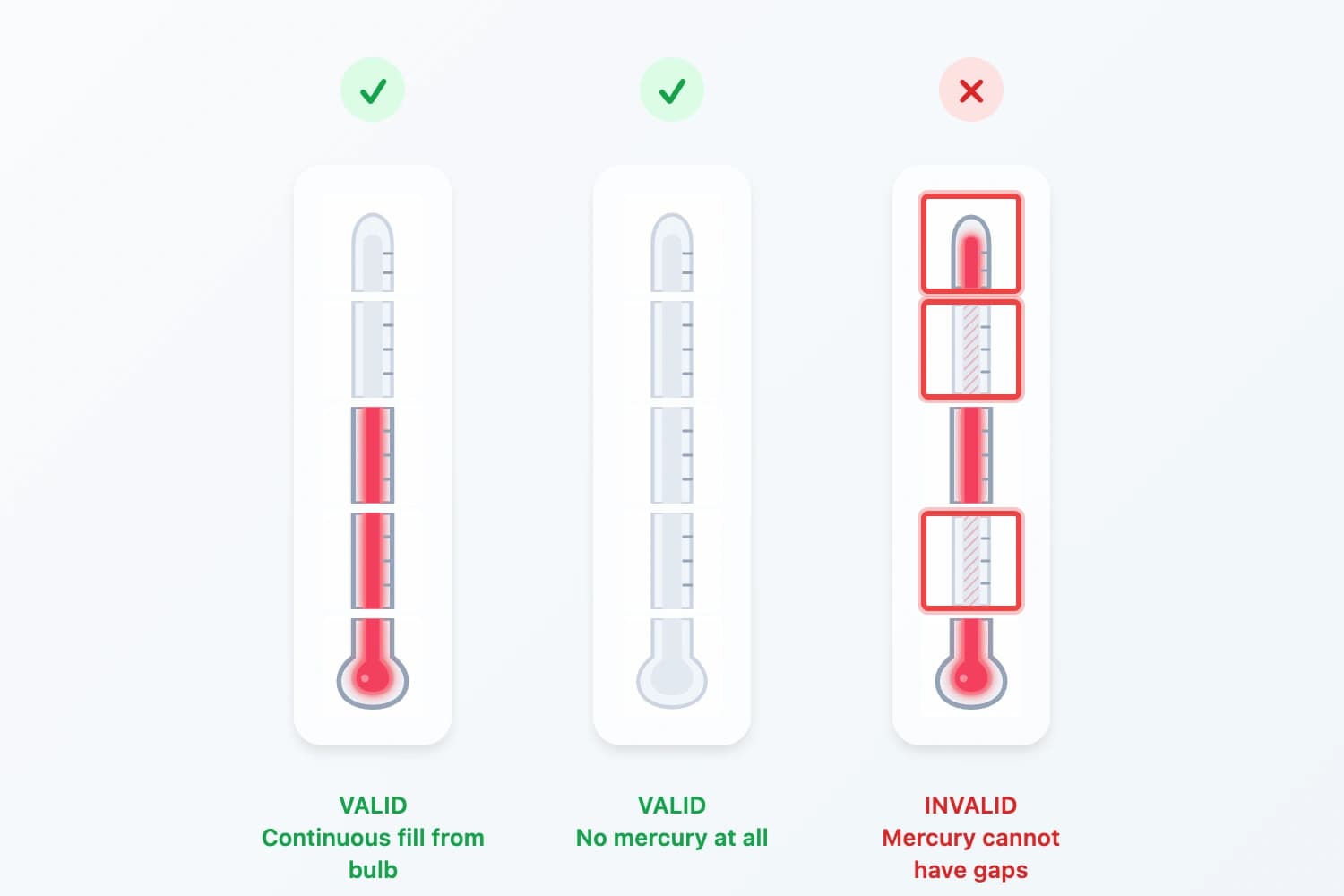
Mercury fills continuously from the bulb. Gaps are impossible.
Strategy 1: Zero Rows and Columns
The fastest wins in Thermometers come from clues of zero. When a row or column has a clue of 0, every thermometer cell in that line must be empty. No calculation required---just scan for zeros and mark every thermometer cell in that row or column with an X.
But here is the cascade that beginners miss: if a thermometer's bulb falls in a zero-clue line, the entire thermometer must be empty.
Why? Because you cannot fill any cell without first filling the bulb. If the bulb is forced empty (by the zero clue), no mercury can ever rise into that thermometer. Mark the whole thing as empty, even cells in other rows.
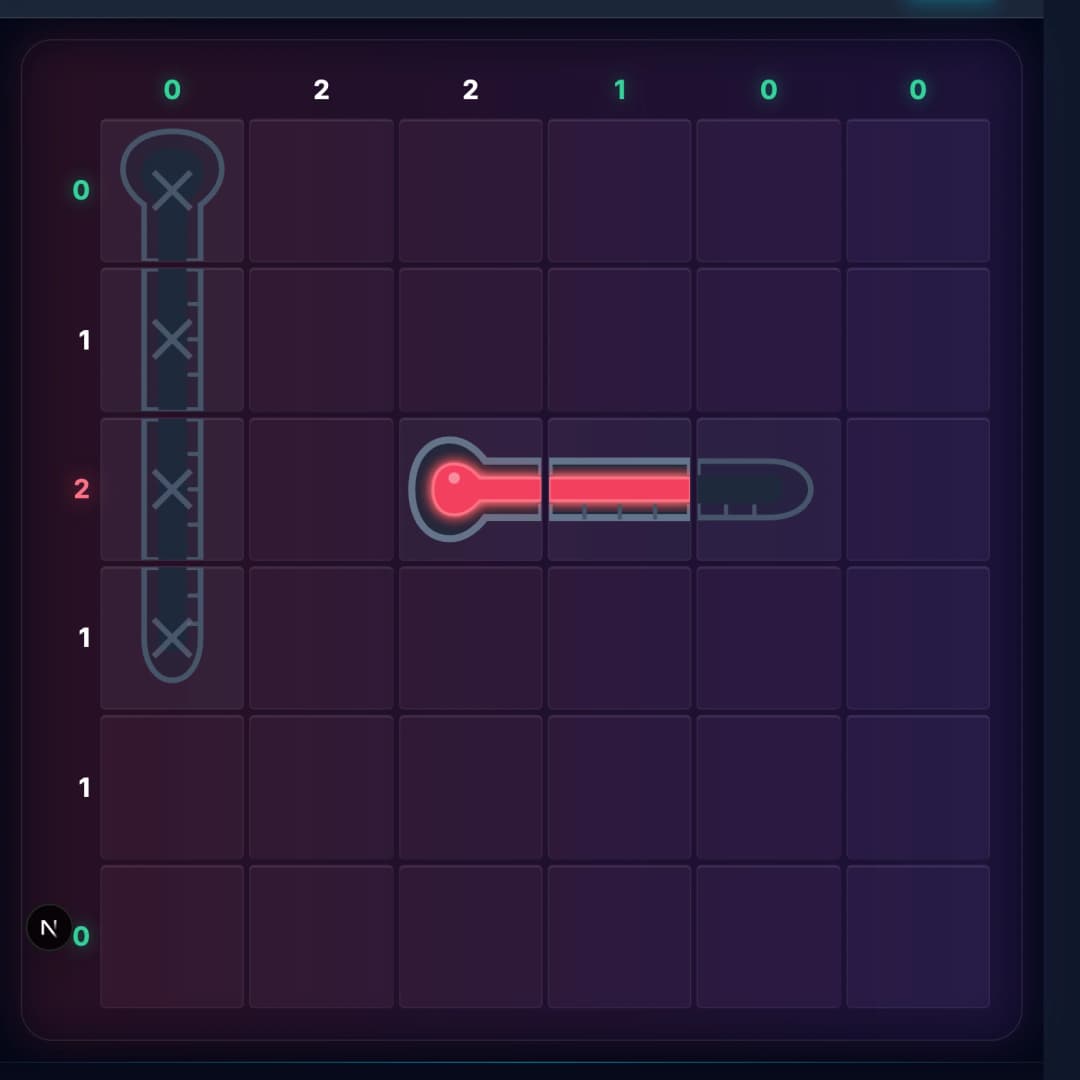
Column 0 has clue 0: the entire vertical thermometer is marked empty.
Solver's Habit: Make scanning for zeros your opening ritual. Every thermometer you eliminate simplifies everything that follows.
Strategy 2: Maximum Count Lines
This is the inverse of the zero strategy, and it is equally powerful. When a row or column clue equals the total number of thermometer cells in that line, every thermometer cell must be filled. Count the thermometer cells. Compare to the clue. If they match exactly, fill them all.
Example: Row 3 has a clue of 4. You count the thermometer cells in row 3 and find exactly 4 cells (perhaps from two different thermometers passing through). All four cells must be filled.
But wait---what about the cascade? When you fill cells in the middle of a thermometer, you must also fill every cell back to the bulb. This might push fills into other rows, which in turn affects those row counts. Suddenly, one observation triggers a cascade that solves half the puzzle.
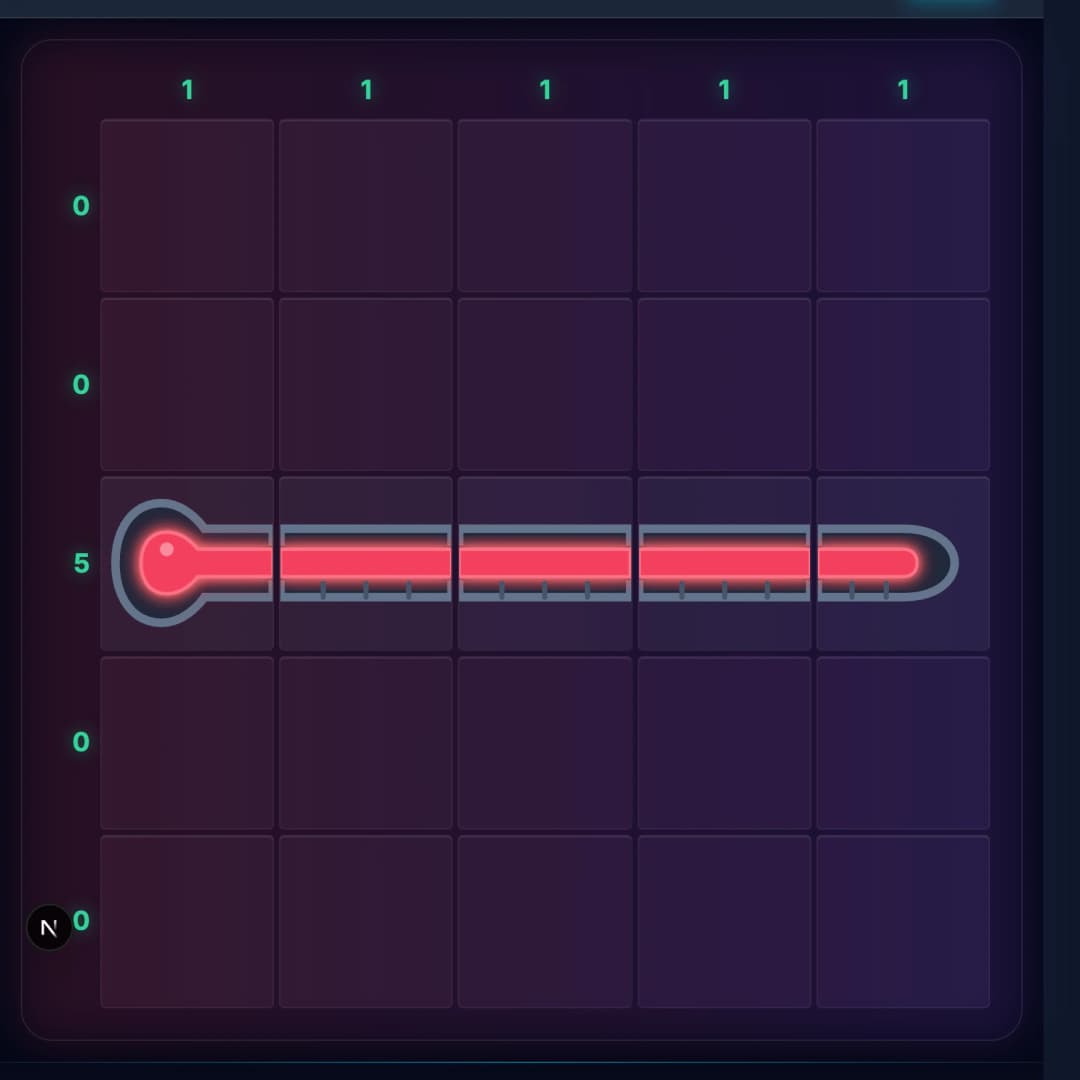
Row 2 needs 5 fills and has exactly 5 thermometer cells---fill them all.
Strategy 3: Base-First Logic
Here is where the mercury rule shows its true power.
If any cell in a thermometer is filled, every cell from the bulb to that cell must also be filled.
You do not need to know why a cell is filled to apply this. The moment you determine that cell X contains mercury---for any reason---immediately fill every cell between X and the bulb.
This sounds simple, but the implications are profound:
- Filling propagates backward. Determine that a middle cell is filled, and you have solved multiple cells at once.
- The bulb is always the easiest cell to fill. If a thermometer has any mercury at all, the bulb contains mercury.
- Partial fills are fully determined. A thermometer is either empty, or filled from bulb to some specific point. No ambiguity.
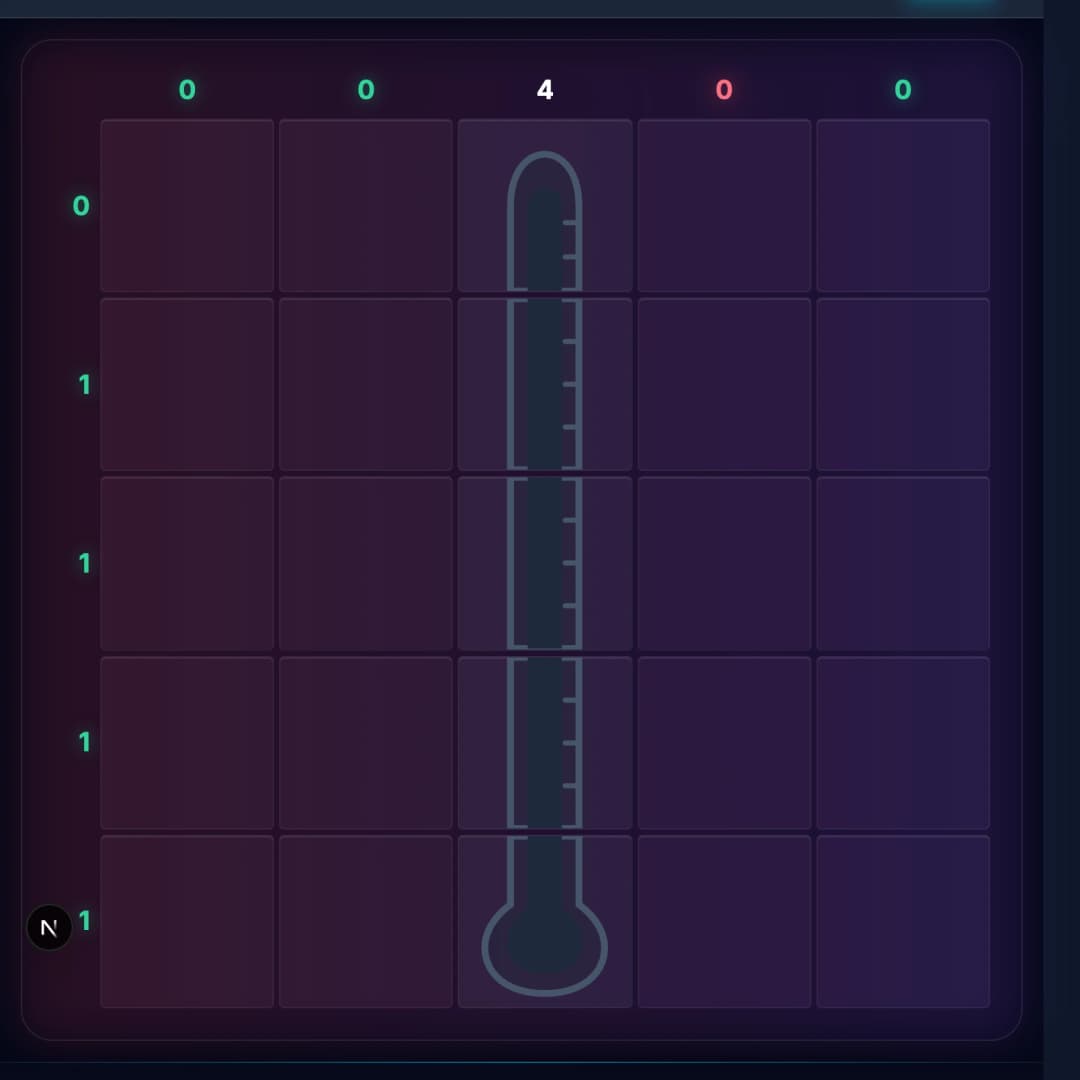
Row 1's clue forced one cell; base-first logic cascaded the fill down to the bulb.
Strategy 4: Tip-Down Logic
This is the mirror of base-first logic, and it is equally essential.
If any cell in a thermometer is empty, every cell from that point to the tip must also be empty.
Mercury cannot leap over gaps. If a cell is empty, no mercury can reach any cell beyond it. Mark them all as empty---every single one from the gap to the tip.
When Tip-Down Logic Triggers
The most common trigger is row or column satisfaction:
- A row's filled count already equals its clue
- Any remaining thermometer cells in that row must be empty
- For each newly-emptied cell, all cells toward the tip are also empty
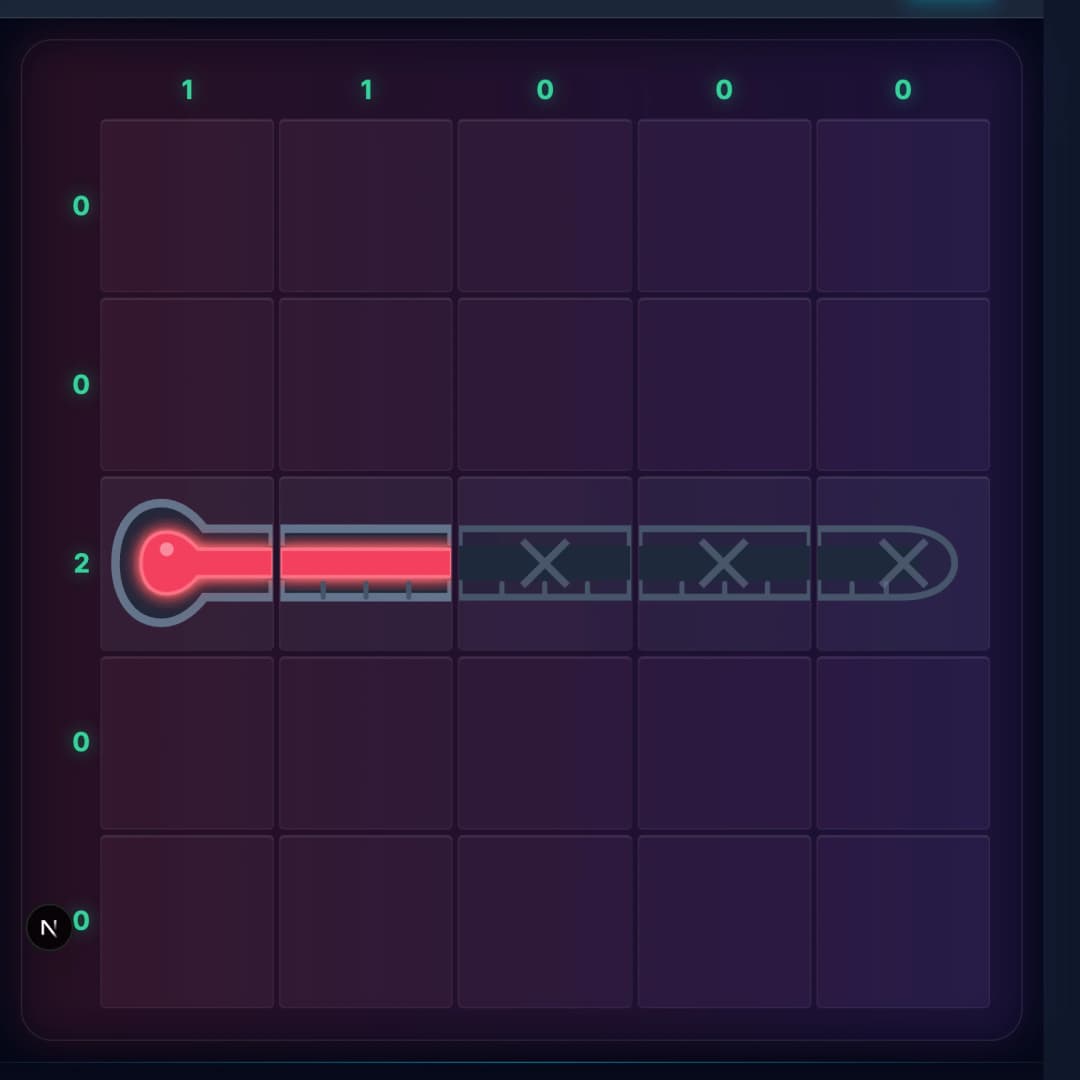
Row 2 needs only 2 fills. The remaining cells cascade empty toward the tip.
The tip-down rule often completes thermometers after base-first logic has started them. Together, they form a pincer that squeezes out the exact fill level---mercury rises from below, impossibility descends from above, and they meet at precisely the right point.
Strategy 5: Row and Column Arithmetic
This is the engine that drives most Thermometers solving. You are constantly asking: "How many more filled cells does this line need?"
The Counting Technique
For each row or column:
- Note the clue (target count)
- Count already-filled cells
- Calculate remaining needed fills
- Count available thermometer cells (not yet marked empty)
- Compare remaining fills to available cells
Three situations arise:
Remaining fills = Available cells
Fill all available cells. This is the maximum count technique applied mid-solve.
Remaining fills = 0
All available cells are empty. This is tip-down logic triggered by arithmetic.
Remaining fills < Available cells
Some cells are filled, some are empty. Not yet determined---but keep watching as other deductions reduce the available cells.
Strategy 6: Cross-Thermometer Deduction
Here is where Thermometers gets interesting. Thermometers do not exist in isolation---they share rows and columns, which means one thermometer's fill level constrains another's.
The Technique
Consider two thermometers passing through the same row:
- Thermometer A contributes 3 cells to row 5
- Thermometer B contributes 2 cells to row 5
- Row 5's clue is 4
If you determine that Thermometer A is completely filled in row 5 (all 3 cells), then Thermometer B must contribute exactly 1 cell to that row (since 3 + 1 = 4). But Thermometer B has 2 cells in the row. If only 1 can be filled, you know something about Thermometer B's fill level---and that knowledge cascades to every other row and column B passes through.
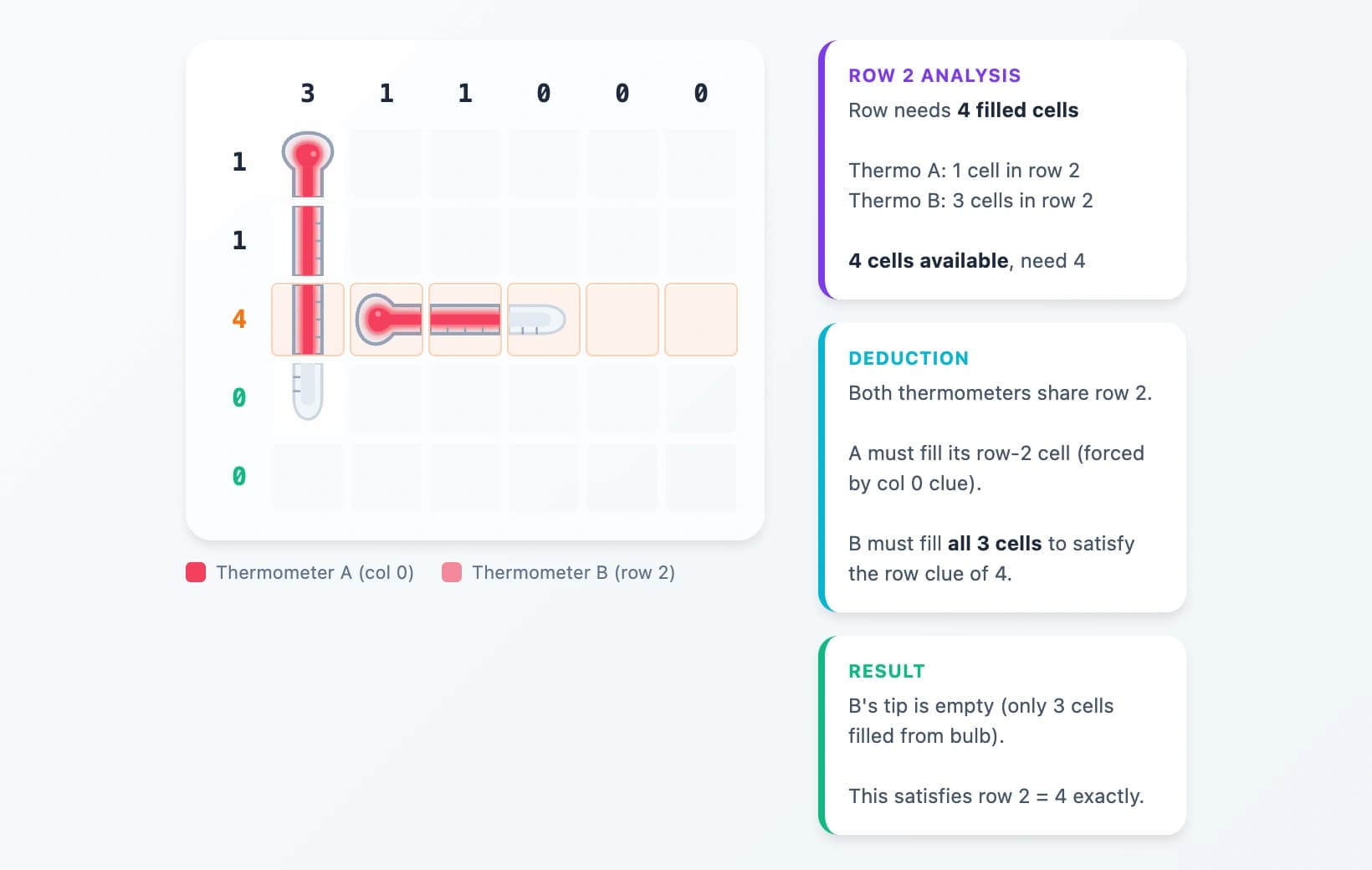
Cross-thermometer deduction: one thermometer's fill constrains another's.
Strategy 7: Multi-Thermometer Lines
Many rows and columns contain cells from multiple thermometers. Distributing the required mercury across them requires careful analysis---this is where Thermometers reveals its mathematical depth.
The Distribution Problem
Picture row 4 with a clue of 5. Three thermometers pass through:
- Thermometer A can fill at most 2 cells in this row
- Thermometer B can fill at most 2 cells in this row
- Thermometer C can fill at most 3 cells in this row
Total available: 7 cells. Needed: 5 fills. Several distributions could satisfy the row. How do you narrow this down?
The answer: use perpendicular clues to pin down individual thermometers.
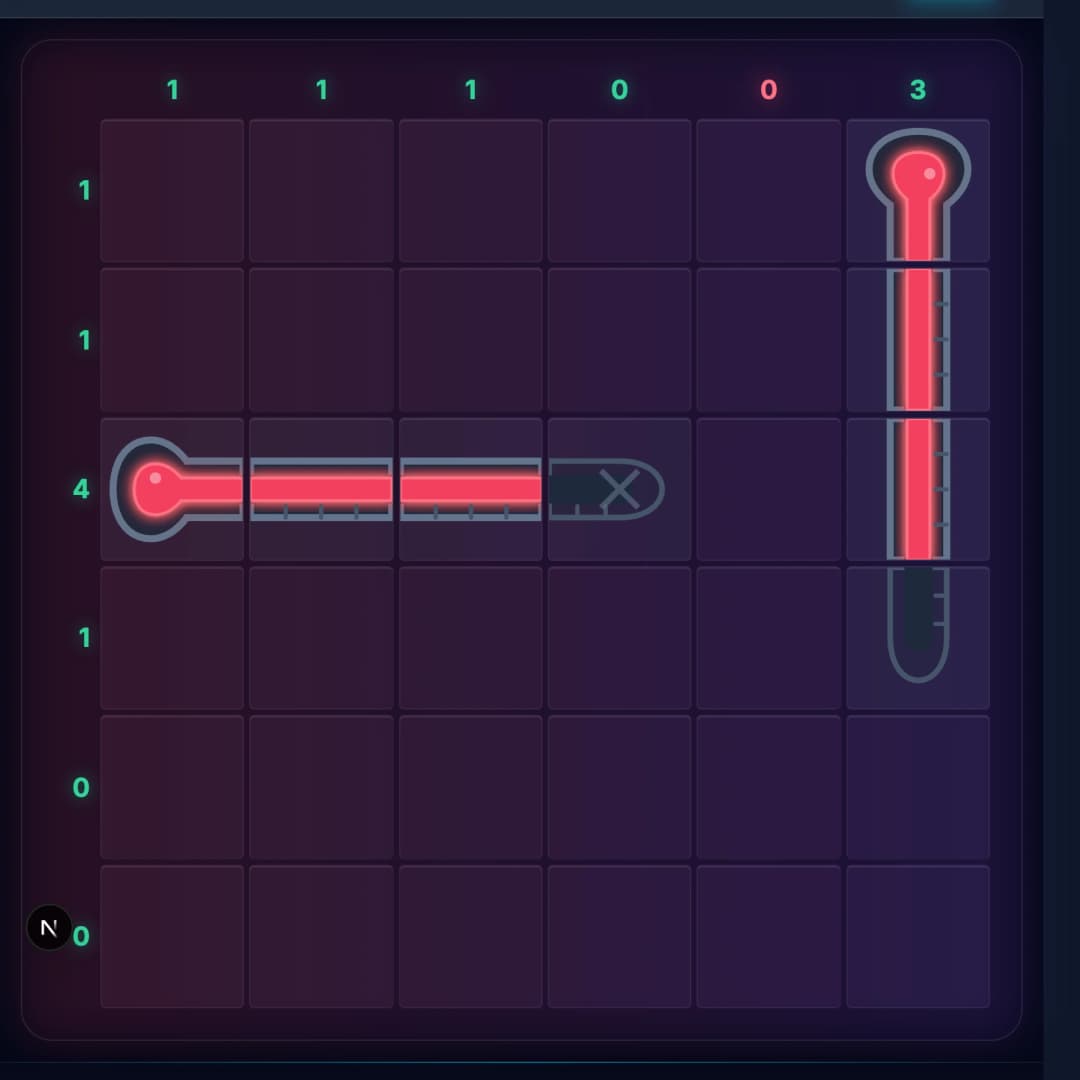
Row 2 has clue 4, shared between two thermometers. Distribution reasoning solves both.
Strategy 8: Thermometer Bounds Analysis
When stuck, analyze each unsolved thermometer to determine its minimum and maximum possible fill levels.
Calculating Bounds
For each thermometer, ask:
Maximum fill
How full could this thermometer be without violating any row or column clue? Check each row and column the thermometer passes through. The tightest constraint sets the maximum.
Minimum fill
How empty could this thermometer be without making it impossible to satisfy row or column clues? If any row or column depends on this thermometer, those cells must be filled.
Applying Bounds
When maximum equals minimum, the thermometer's fill level is completely determined. That is a beautiful moment---full certainty from constraint alone.
Even when they differ, bounds eliminate possibilities:
- If minimum fill is 3, the first 3 cells from the bulb are definitely filled
- If maximum fill is 3, cells 4 and beyond are definitely empty
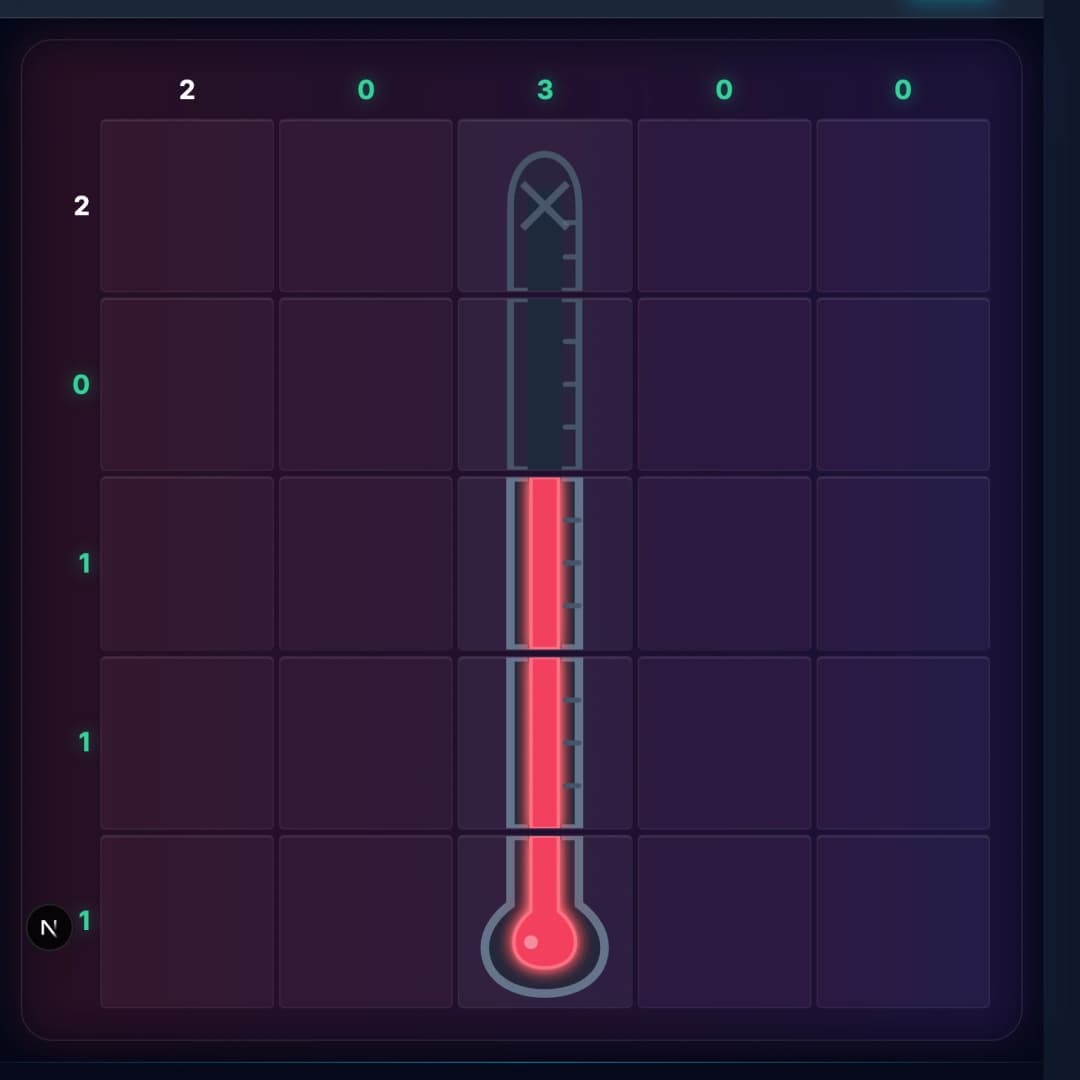
Bounds analysis: minimum fill = 3 (definitely filled), maximum fill = 4 (tip definitely empty).
Putting It All Together: A Solving Mindset
Here is the mental process that guides efficient Thermometers solving:
Phase 1: Immediate Wins
Scan for zero-clue rows and columns. Mark all thermometer cells in those lines as empty. If any bulb is emptied, mark the entire thermometer empty. Scan for maximum-count lines where clue equals cell count. Fill all thermometer cells in those lines. Apply base-first cascades for all new fills.
Phase 2: Arithmetic Analysis
For each row and column, calculate: remaining fills needed vs. remaining cells available. Where they are equal, fill or empty as appropriate. Apply base-first and tip-down cascades. Repeat until no more forced moves exist.
Phase 3: Cross-Thermometer Reasoning
Identify thermometers that share rows or columns. Use known fill levels to constrain unknown ones. Apply bounds analysis to uncertain thermometers. Look for geometry-forced fills hidden in multi-thermometer distributions.
Phase 4: Cascade and Complete
Every new determination triggers cascades. Keep cycling through the phases until the puzzle is complete. A well-designed Thermometers puzzle always has a next logical step---no guessing required.
Common Mistakes and How to Avoid Them
The Cascade Twins: Filling and Emptying Without Following Through
Every fill cascades backward to the bulb. Every empty cascades forward to the tip. Train yourself to see a single mark as a command: "Now trace the thermometer and finish what you started."
Miscounting Cells
Thermometers extend in straight lines only, but when three or four pass through the same row, it is easy to lose track. Carefully trace each thermometer through the line you are analyzing. When the count matters, count twice.
Losing Track of Bulb Direction
You fill a cell, cascade in the wrong direction, and suddenly nothing makes sense. The bulb is the rounded end---find it first, always. Mercury starts there and only there.
Solving in Isolation
Thermometers talk to each other through shared lines---but only if you are listening. After any deduction, check all affected rows and columns for new constraints. The breakthrough you need is often waiting in a thermometer you thought was already "handled."
The Temperature is Rising
You now possess a complete toolkit for Thermometers mastery. The mercury rule governs everything. Zero clues eliminate thermometers. Maximum counts fill them. Base-first and tip-down logic cascade every determination. Row and column arithmetic drive progress. Cross-thermometer reasoning handles complex interactions. Bounds analysis unsticks the stuck.
The beauty of Thermometers lies in its physical intuition. Every strategy connects back to how mercury actually behaves. When logic gets complex, return to basics: mercury rises from the bulb, fills continuously, and never skips a cell.
Here is what to look for in your next puzzle: that first zero clue or maximum count line that triggers a cascade. Follow it. Watch the mercury rise and fall across the grid. Notice how one determination forces another, then another. That chain reaction---fill begets empty begets fill---is the heartbeat of every Thermometers puzzle. Once you feel it, you will never solve the same way again.
Loved the cascade logic? Nonograms offers a similar satisfaction when fills propagate across rows and columns. Prefer the row-and-column arithmetic? Battleships brings that same counting discipline to a nautical hunt. Either way, you are ready.