Thermometers Puzzle:
A Complete Beginner's Guide to Temperature Logic
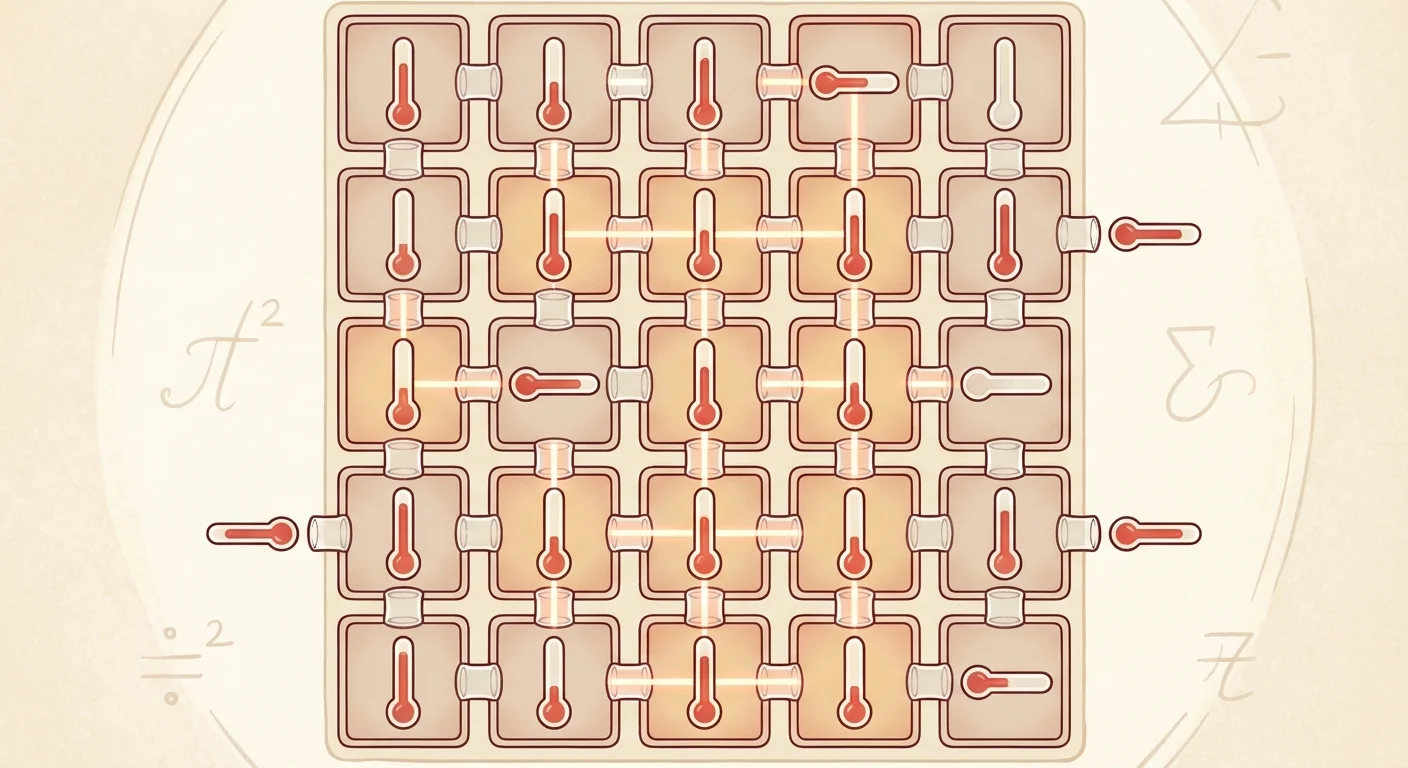
Picture a cold winter morning. You glance at the thermometer outside your window, and the red mercury has risen partway up the glass tube. It starts at the bulb, fills continuously upward, and stops at the current temperature. No gaps. No skipped sections. Just a smooth column of liquid from bottom to wherever the heat takes it.
Now imagine turning that simple physical intuition into a puzzle.
Thermometers puzzles hand you a grid filled with thermometer shapes pointing every which way, then challenge you to figure out exactly how much each one should be filled. Your only tools? Row and column clues that tell you how many cells should contain mercury, and the unbreakable rule that mercury fills continuously from bulb to tip.
The moment everything clicks--when you realize that filling one cell forces three others and suddenly an entire thermometer resolves--is the kind of "aha" that puzzle solvers chase. There is something deeply satisfying about watching the mercury levels fall into place, constrained by physics you understand instinctively.
Watch the Tutorial
Prefer watching? This short video walks you through the rules and key techniques.
What Exactly Is a Thermometers Puzzle?
A Thermometers puzzle presents you with a grid containing several thermometer shapes. Each thermometer has a rounded bulb at one end (where filling begins) and extends in a straight line toward a tip. Thermometers can point in any direction: up, down, left, or right.
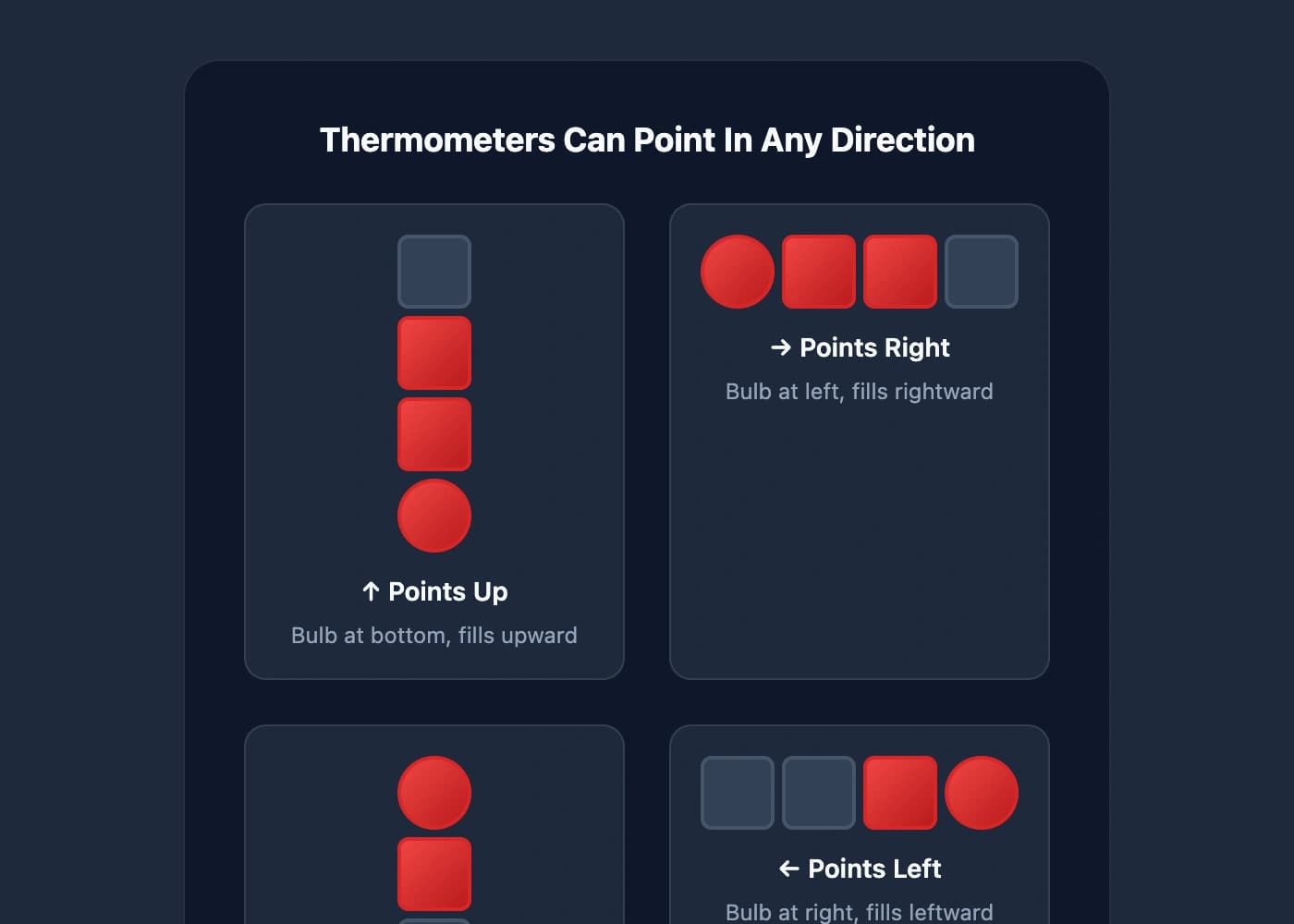
Thermometers can point in any cardinal direction. Mercury always starts at the bulb (rounded end).
Outside the grid, you will find clue numbers. Each row has a number indicating how many cells in that row should contain mercury. Each column has a number showing the same for that column.
Your mission: fill the thermometers so that every row and column clue is satisfied, and every thermometer obeys the fundamental rule of mercury--it fills continuously from bulb toward tip with no gaps allowed.
The Cold Hard Facts: Complete Rules
Two principles govern every Thermometers puzzle. Understand these, and you are ready to solve.
Rule 1: The Continuous Fill Rule
Mercury fills continuously from bulb toward tip--no gaps, no exceptions. If a cell is filled, every cell between it and the bulb must also be filled. Think of it like a real thermometer: you will never see mercury at the tip with an air gap below it.
Rule 2: The Counting Clues
The number next to each row tells you exactly how many cells in that row contain mercury. The number above each column tells you the same for that column. These clues must be satisfied precisely.
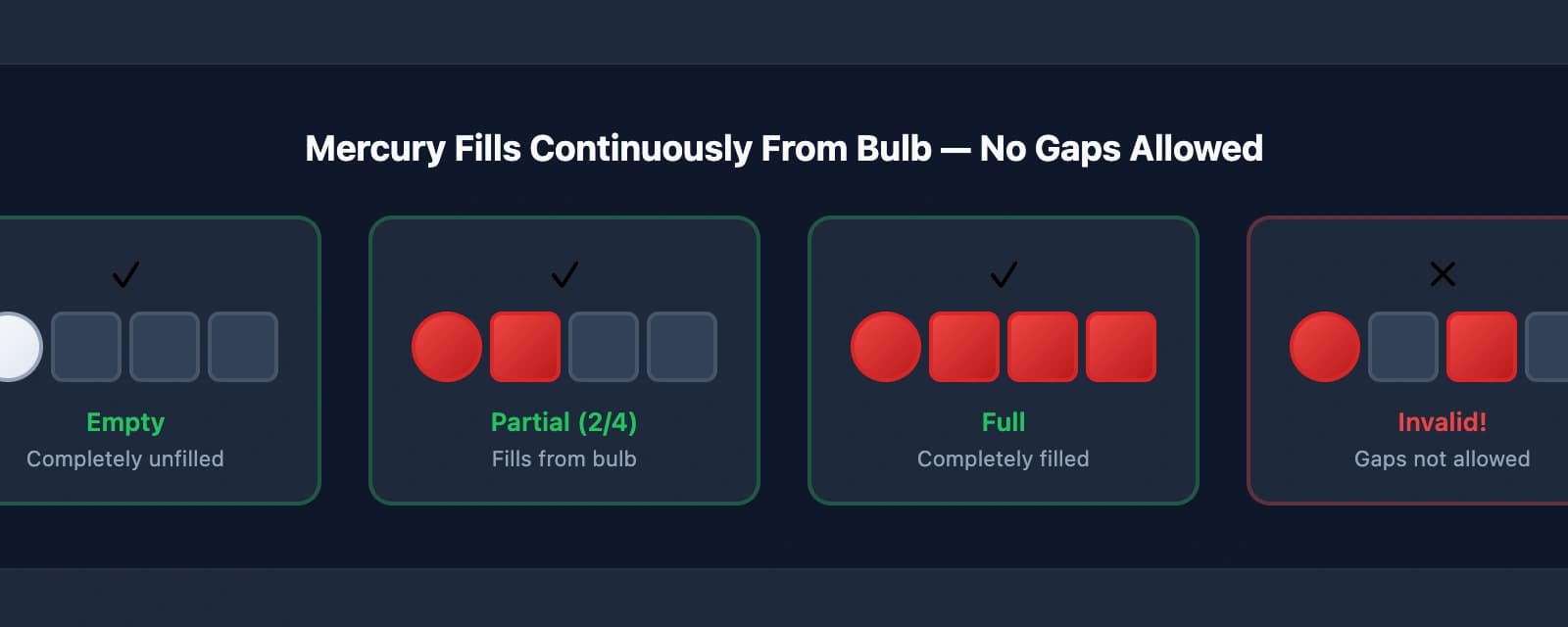
A thermometer can be empty, partially filled, or completely full--but gaps are never allowed.
Your First Solve: A Visual Walkthrough
Ready to get your hands warm? Let us solve a puzzle together. I will show you exactly what to look for and why each move is logically certain.
The Starting Grid
Here is our practice puzzle: a simple 4x4 grid with two horizontal thermometers.
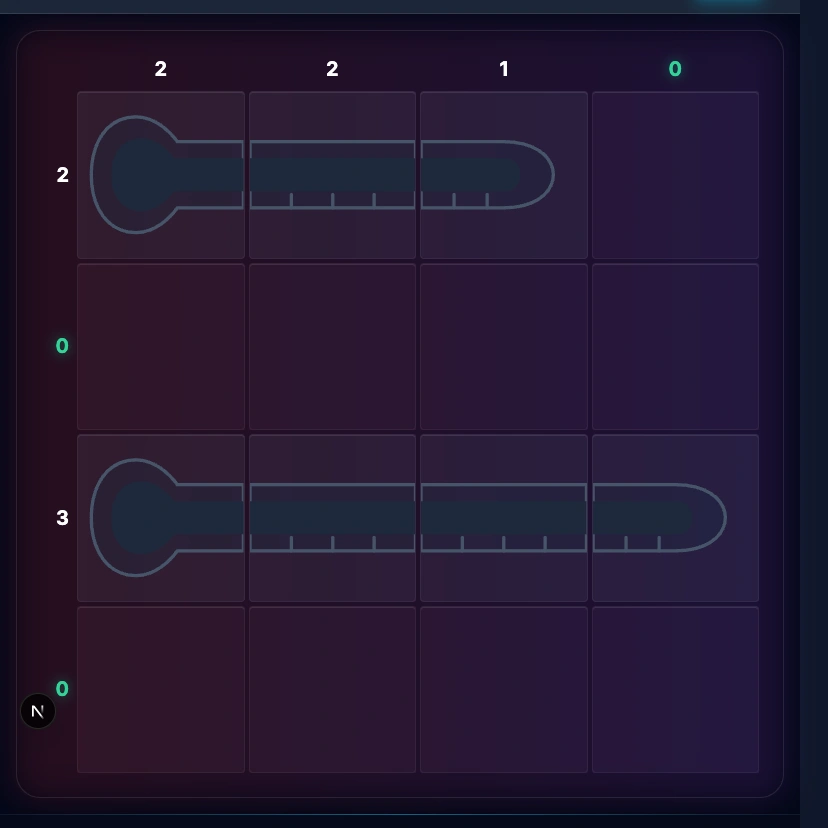
Thermometer A (row 0, 3 cells) and Thermometer B (row 2, 4 cells). Row clues: 2, 0, 3, 0. Column clues: 2, 2, 1, 0.
Thermometer A: Bulb at the top-left (row 0, column 0), extends rightward for 3 cells through columns 0, 1, and 2.
Thermometer B: Bulb at row 2, column 0, extends rightward for 4 cells through all four columns.
Step 1: Hunt the Zeros
The fastest way to make progress is to find rows or columns with a clue of 0. These are pure gold--they tell us that every thermometer cell in that line must be empty.
Column 3 needs 0 filled cells. What thermometer cells exist in column 3? Only Thermometer B's tip (its fourth and final cell). Since the clue is 0, this cell must be empty. Mark it with an X.
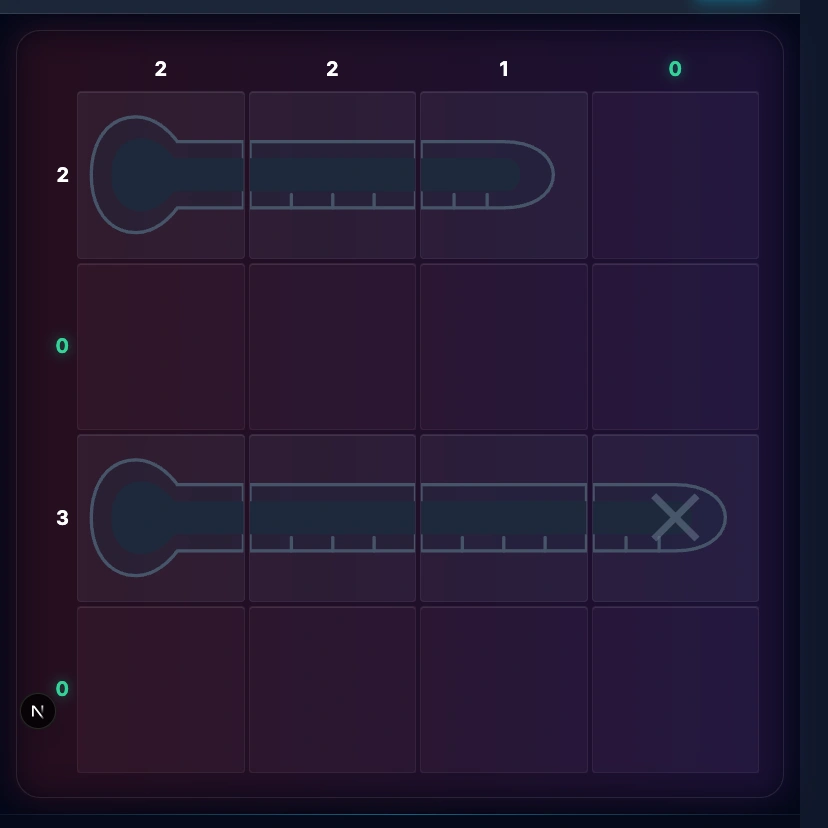
The column 3 clue of 0 forced us to mark Thermometer B's tip as empty.
Step 2: Work the Row Clues
Row 0 needs exactly 2 filled cells. Thermometer A occupies row 0 with 3 cells (columns 0, 1, 2). We need exactly 2 filled. Since mercury must fill continuously from the bulb, there is only one possibility: fill the bulb (column 0) and the next cell (column 1), leaving the tip (column 2) empty.
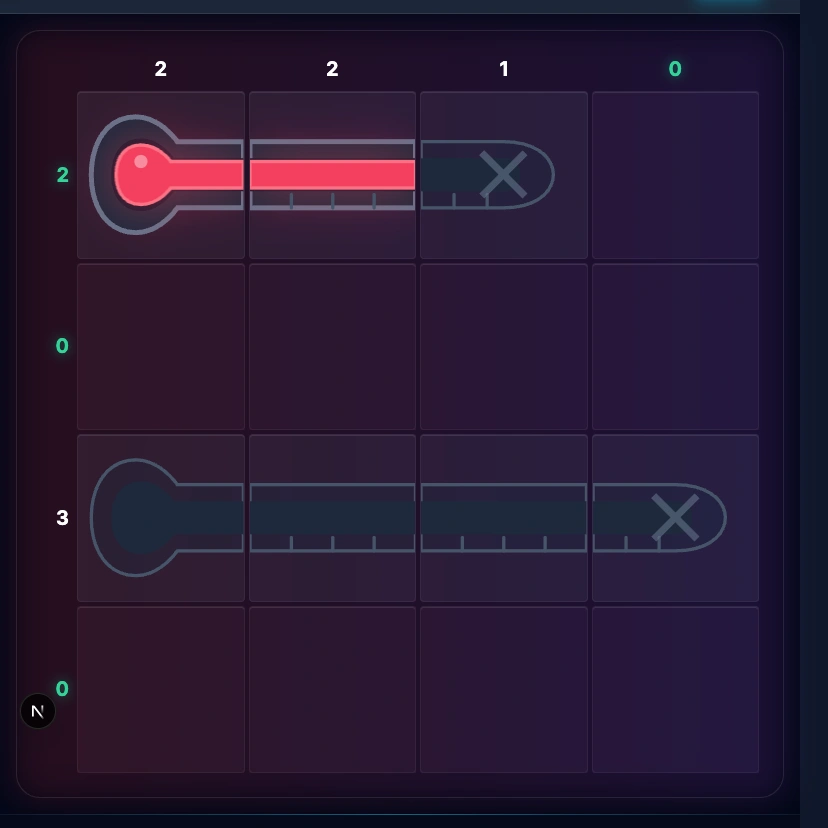
Row 0 needs 2 filled cells. With 3 thermometer cells available, we fill exactly 2 from the bulb.
Row 2 needs exactly 3 filled cells. Thermometer B occupies row 2 with 4 cells, but we already marked its tip (column 3) as empty. That leaves 3 cells available: columns 0, 1, and 2. The clue says we need exactly 3. Fill all three!
Step 3: Verify and Celebrate
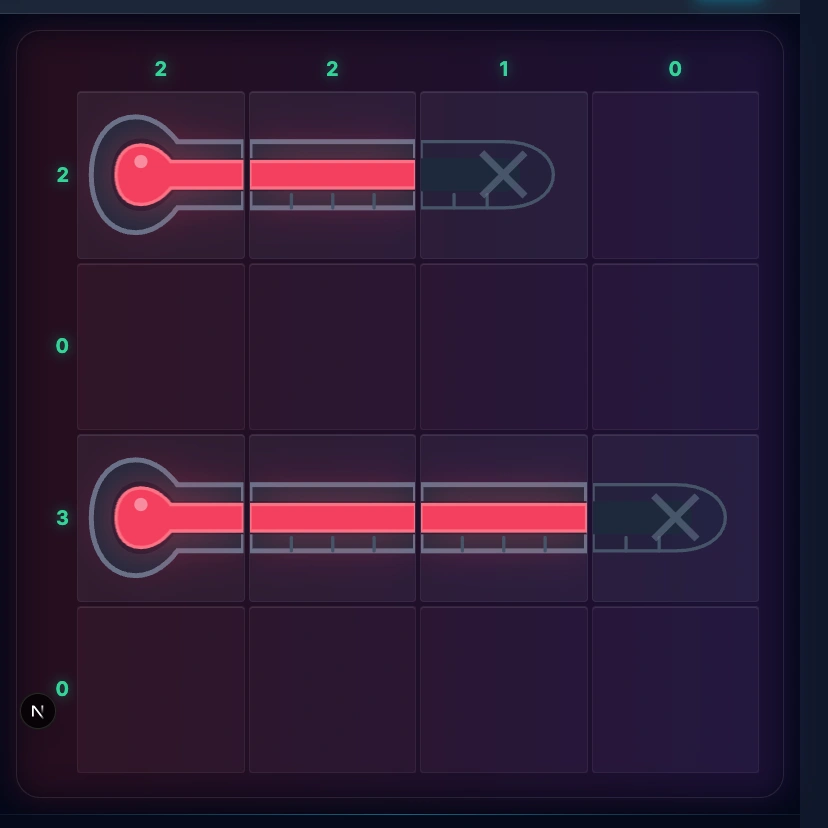
Puzzle complete! All row and column clues satisfied, all thermometers properly filled.
Let us confirm all clues are satisfied:
- Row 0: 2 filled cells. Clue says 2. ✓
- Row 1: 0 filled cells. Clue says 0. ✓
- Row 2: 3 filled cells. Clue says 3. ✓
- Row 3: 0 filled cells. Clue says 0. ✓
- Column 0: 2 filled cells. Clue says 2. ✓
- Column 1: 2 filled cells. Clue says 2. ✓
- Column 2: 1 filled cell. Clue says 1. ✓
- Column 3: 0 filled cells. Clue says 0. ✓
What This Solve Reveals
- Constraints cascade. The column 3 clue of 0 forced Thermometer B's tip to be empty, which then made the row 2 clue solvable with certainty.
- The math must balance. Row totals (2+0+3+0=5) equal column totals (2+2+1+0=5). If your totals do not match, you have made an error.
Essential Beginner Strategies
As grids grow larger and thermometers overlap in complex ways, you will need a systematic toolkit. Here are five techniques that will carry you through any beginner Thermometers puzzle.
1. Zero-Clue Elimination
When a row or column has a clue of 0, every thermometer cell in that line must be empty. If a bulb falls in a zero-clue line, the entire thermometer must be empty.
2. Full-Clue Fill
When a row or column clue equals the total number of thermometer cells in that line, fill them all. No deduction needed--just count and fill.
3. The Bulb Cascade
If you determine any cell must be filled, immediately fill every cell from the bulb up to and including that cell. The continuous-fill rule makes this automatic.
4. Tip Elimination
If a row or column already has enough filled cells, mark remaining thermometer cells as empty. When you mark a cell empty, everything from there to the tip is also empty.
5. Cross-Reference Bounds
When stuck, pick a thermometer and ask: "What is the minimum this could be filled? What is the maximum?" Calculate using both row and column clues that intersect the thermometer. Often, the bounds narrow to a single possibility.
Common Mistakes and How to Avoid Them
Mistake: Forgetting the Continuous Fill Rule
Fix: Every time you fill a cell, immediately trace back to the bulb and fill everything in between. Make this habit automatic.
Mistake: Miscounting Thermometer Cells
Fix: Remember that thermometers only extend in straight lines. For each row and column, carefully trace which cells actually occupy that line. Count twice before deducing.
Mistake: Ignoring the Direction
Fix: Always identify the bulb first. It is the rounded end. Mercury starts there, period.
Practice Tips for Rapid Improvement
- Start with small grids. Begin with 4x4 or 5x5 puzzles where you can see everything at once.
- Practice clue arithmetic. Speed comes from quickly calculating "How many more fills does this row need?"
- Visualize the mercury. Mentally picture the mercury rising from the bulb--this catches errors before they happen.
- Solve in two passes. First handle all zero clues and full clues. Then use cross-referencing to complete the puzzle.
Ready to Take the Temperature?
You now have everything needed to solve Thermometers puzzles: the continuous fill rule, zero-clue elimination, full-clue fills, the bulb cascade, and tip elimination. Start with small grids where you can see all the constraints at once, then work your way up to larger puzzles where cross-referencing between rows and columns becomes essential.
Ready to Watch the Mercury Rise?
The rules are in your head. The strategies are ready. All that's left is to fill your first thermometer and feel that satisfying click of logic falling into place.
Start Solving ThermometersPut it into practice
Ready to solve Thermometers?
Open a free puzzle and turn the ideas from this guide into your next solve.