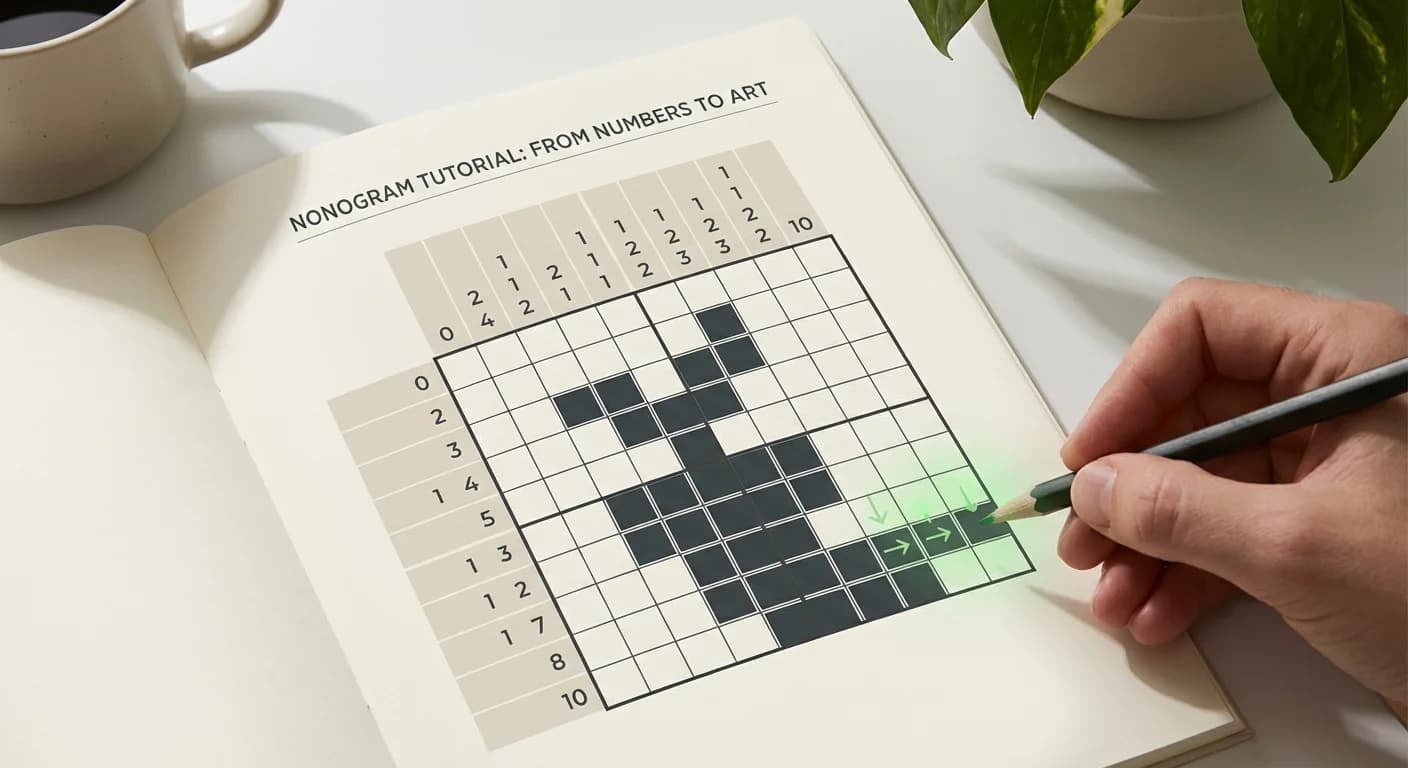
There's a moment—usually around minute three of your first Nonogram—when your brain short-circuits in the best possible way. You've been filling squares like a robot, trusting clues you barely understand. Then you lean back, squint at the grid, and wait, is that a cat?
The black squares aren't random anymore. They're whiskers. They're ears. They're looking right back at you.
That transformation—from meaningless blocks to recognizable art—hits like a magic trick performed by your own hands. You didn't draw the picture. You discovered it, hidden in the numbers all along. It's the satisfaction of solving a mystery combined with the joy of creating art, and it's why millions of people are hopelessly addicted to these deceptively simple grids.
Nonograms—also called Picross, Griddlers, Hanjie, or Paint by Numbers—originated in Japan in the late 1980s when two puzzle designers independently created similar concepts. The name "Nonogram" comes from Non Ishida, a Japanese graphics editor who won a competition with this puzzle type in 1987. Since then, these puzzles have appeared in Nintendo games, newspaper columns, and countless apps, captivating solvers who crave that perfect blend of logic and artistic revelation.
Let's paint some pixels.
Watch the Tutorial
Learn the basics of Nonograms in this short video.
What Exactly Is a Nonogram?
A Nonogram presents you with an empty grid and a set of number clues along each row and column. Your mission: figure out which cells to fill in (and which to leave empty) so that the filled cells match every clue perfectly. When you succeed, the filled squares reveal a hidden picture.
The beauty lies in the information density. Each number tells you exactly how many consecutive filled cells appear in that row or column. Multiple numbers mean multiple groups of filled cells, separated by at least one empty cell. It sounds simple because it is—but the interactions between row and column clues create surprisingly rich logical puzzles.
Think of it like Sudoku meets pixel art. Every cell you fill (or mark empty) is a logical deduction, not a guess. And at the end, you get a picture as your reward.
The Complete Rules of Nonograms
Four rules govern every Nonogram puzzle. Once these click, you'll never forget them—and you'll start seeing patterns everywhere.
- Numbers Indicate Groups of Filled Cells — Each number tells you how many consecutive filled cells appear in that row or column. A clue of "5" means five filled cells in a row, all touching.
- Multiple Numbers Mean Multiple Groups — When a row or column has multiple numbers, each represents a separate group of filled cells. The groups appear in order, left-to-right (rows) or top-to-bottom (columns).
- Groups Must Be Separated by Empty Cells — Groups are territorial—they're like rival gangs that need at least one neutral block between them at all times.
- The Clues Tell the Complete Story — Every filled cell is accounted for in the clue. If a row's clue is "4", then exactly four cells are filled—no more, no less.
That's everything. Four rules. I know—I kept waiting for the catch too, but there isn't one. Four rules, infinite puzzles.
Your First Solve: A Visual Walkthrough
Let's solve a puzzle together. I'll show you exactly what to look for and why each move is logically certain—no guessing involved.
The Starting Grid
Here's our practice puzzle: a 5x5 grid that reveals a diamond shape when solved.
Row clues (left side): 1 | 3 | 5 | 3 | 1
Column clues (top): 1 | 3 | 5 | 3 | 1
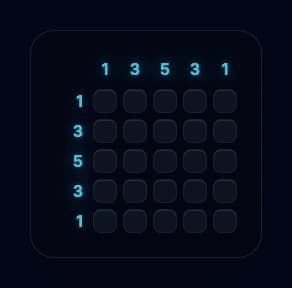
Our practice puzzle - before reading ahead, can you spot any forced moves?
Stop scrolling. Seriously—see if you can figure this out before I tell you. Look for the biggest numbers. When a clue equals the line's length, something magical happens...
Step 1: Find the Slam Dunks
The most powerful technique in Nonograms is finding cells that must be filled regardless of where the groups could shift. Some solvers call these "slam dunks"—moves so obvious you can make them instantly.
Row 3 has a clue of "5": Our grid is only 5 cells wide. A group of 5 consecutive filled cells in a 5-cell row means every single cell must be filled. There's literally nowhere else the group could go.
Column 3 has a clue of "5": Same logic! The grid is 5 cells tall, so a group of 5 means the entire column is filled.
Step 2: Watch the Cross Emerge
That feeling—watching the cross emerge from pure logic—is the first taste of what makes Nonograms addictive. Row 3 is now complete. Column 3 is also complete. But we're far from done—this information ripples outward.
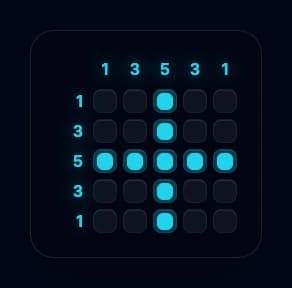
Step 2: The "5" clues give us a cross pattern with complete certainty.
Steps 3-4: The Ripple Effect
Another challenge: Before reading ahead, can you figure out why cells at positions 2 and 4 in Row 2 are guaranteed to be filled?
Row 2 has a clue of "3": Cell (3,2) is already filled from Column 3. The row needs exactly 3 consecutive filled cells. Where could this group of 3 land? Positions 1-2-3, 2-3-4, or 3-4-5—all must include position 3. The overlap of those three placements is only position 3, which we already know. But now cross-reference with the column clues: Columns 2 and 4 each have a clue of "3", meaning 3 consecutive filled cells in a 5-cell column. Apply the overlap formula (2x3 - 5 = 1): the middle cell—row 3—is guaranteed, but we need all three rows 2-3-4 filled to form the consecutive block. That forces cells (2,2) and (4,2) to be filled, and likewise (2,4) and (4,4).
Rows 2 and 4 now have exactly 3 filled cells each—matching their clues. Mark the remaining cells as empty (X). Think of X's as "no trespassing" signs—they're just as valuable as filled cells because they tell every group "not here, buddy."
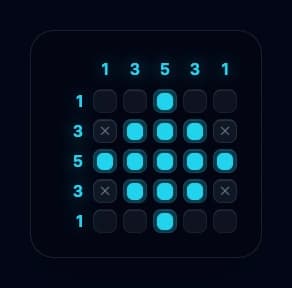
Step 4: Rows 2 and 4 complete, corners marked with X's.
Steps 5-6: Columns Fall Into Place
Columns 2 and 4 each have a clue of "3": We have filled cells at rows 2, 3, and 4. That's exactly 3 consecutive cells! Mark the remaining cells as empty.
Columns 1 and 5 each have a clue of "1": Only cell (1,3) and (5,3) are filled—exactly 1 cell each. All remaining cells must be empty.
Every clue satisfied. Every cell determined. And look at what emerged—a perfect diamond!
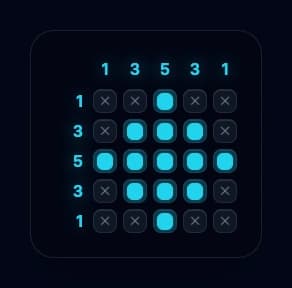
The completed puzzle reveals a perfect diamond - every cell proven through pure logic!
What This Walkthrough Teaches
- Start with the biggest clues—"5" in a 5-cell line means fill everything
- Overlap logic is your best friend—when a group must span certain cells regardless of position, fill those cells
- Track empty cells too—marking X's is just as important as filling squares
- Cross-reference constantly—row and column clues work together
- Complete rows/columns unlock others—once a line is done, its constraints help neighboring lines
Essential Beginner Strategies
Now that you've seen these techniques in action, let's formalize them so you can apply them to any puzzle.
Strategy 1: The Overlap Technique
This is your golden hammer—the one technique you'll reach for more than any other. Formula: For a group of size N in a line of length L: If N > L/2, then (2N - L) cells in the middle are guaranteed filled. It's like two friends who both want to sit on a small couch—no matter how they arrange themselves, the middle cushion is definitely getting sat on.
Strategy 2: Edge Analysis
When you know a group starts at the edge, count out its full length and fill those cells. Then mark the next cell as empty—it's the gap before the next group.
Strategy 3: Counting Minimum Space
Formula: For clues A, B, C: minimum space = A + B + C + (number of gaps). If minimum space equals line length, the entire line is determined!
Strategy 4: Cross-Reference
Every filled or empty cell affects both its row AND its column. Each cell is a double agent, reporting intelligence to both. After making progress in one line, check the perpendicular lines.
Designer's Secret
Professional Nonogram designers work backward—they start with the picture, then generate clues, then verify the puzzle is solvable through pure logic without any guessing. If you ever feel like you're guessing, you're not—you've just missed a cross-reference that makes one option impossible. The picture is already determined; you just haven't found the proof yet.
Test Yourself
- A column has a clue of "7" in a 10-cell column. How many cells are guaranteed filled? (Answer: 4. Calculation: 2x7 - 10 = 4)
- A row has clue "3 3" in an 8-cell row. What's the minimum space needed? (Answer: 7 cells. Calculation: 3 + 1 + 3 = 7)
- If minimum space equals the line length, what can you do? (Answer: Fill the entire line—groups and gaps are fully determined!)
If you got all three, you're ready for anything.
Common Mistakes and How to Avoid Them
Mistake 1: Guessing Without Proof
You're not sure where a group goes, so you pick a spot and hope it works. Fix: Never fill a cell unless you can prove it logically. If no certain moves exist, re-examine every line systematically.
Mistake 2: Forgetting to Mark Empty Cells
You mentally know a cell is empty but don't mark it, then forget later. Fix: Always mark X's immediately. This habit prevents errors and helps you spot patterns faster.
Mistake 3: Ignoring Cross-References
You make progress in rows but forget to check how it affects columns. Fix: After each deduction, check perpendicular lines. Train yourself to think in both directions simultaneously.
Practice Tips for Rapid Improvement
- Start with 5x5 Puzzles: Small grids teach the techniques without overwhelming you. Master 5x5 completely before graduating to larger sizes.
- Work Systematically: Scan all rows for easy wins, then scan all columns the same way, then return to rows affected by column progress.
- Learn to "See" Overlaps: With practice, you'll visualize overlaps instantly without calculating. Practice by mentally predicting before verifying with math.
- Celebrate the Pictures: Part of Nonograms' charm is the hidden image. After solving, step back and appreciate what you revealed!
- Try Colored Nonograms: Once black-and-white puzzles feel routine, colored variants will blow your mind. Different colors can touch, which completely changes the logic!