Battleships Puzzle:
A Complete Beginner's Guide to Fleet Finding
Forget "B7? Miss!" -- this is not your childhood guessing game.
In Battleships logic puzzles, every single ship is discoverable through pure deduction. No luck. No random shots in the dark. Just numbers, rules, and the satisfying certainty of finding hidden vessels through ironclad logic.
You stare at an empty grid. Numbers line the edges like coded messages from a naval intelligence officer. Somewhere in that sea of blank squares, an entire fleet is hiding--a battleship, cruisers, destroyers, and submarines. Then you spot your first clue. A row marked "0" must be nothing but water. A column showing "4" practically screams that ships are packed in tight.
That moment--when invisible ships materialize from numbers alone--is why Battleships puzzles (also known as Bimaru or Solitaire Battleships) have captivated logic lovers since the 1990s. This guide will take you from confused beginner to confident fleet-finder.
Watch the Tutorial
Prefer watching? This short video walks you through the rules and key strategies.
What Exactly Is a Battleships Puzzle?
A Battleships puzzle presents you with an empty grid and number clues along each row and column. Your mission: deduce where hidden ships are located by using these clues and the rules about how ships can be placed.
The beauty lies in the constraints working together. Each number tells you exactly how many ship cells occupy that line. Ships cannot touch each other--not even diagonally. And you must place every ship in the fleet exactly once.
Think of it like Sudoku meets naval warfare. Instead of filling numbers, you are revealing a hidden fleet. Every cell you mark is a logical certainty, never a guess.
The Complete Rules of Battleships
Five rules govern every Battleships puzzle. Master these, and you are ready to hunt any fleet.
Rule 1: Row and Column Numbers Tell the Truth
Each number on the edge of the grid tells you exactly how many cells in that row or column contain part of a ship. A row marked "3" has exactly three ship cells--no more, no less. The remaining cells must be water.
Rule 2: Ships Are Placed Horizontally or Vertically
Ships run in straight lines--either across (horizontal) or up-and-down (vertical). No diagonal ships. No L-shaped ships. No bent ships. Just clean horizontal or vertical lines.
Rule 3: Ships Cannot Touch Each Other
This is the crucial constraint that makes deduction possible. Ships must have water between them on all sides--including diagonals. Think of it like social distancing for naval vessels. Every ship needs a one-cell buffer zone around its entire perimeter.
Rule 4: The Fleet Is Fixed
You know exactly which ships to find. A standard 10x10 puzzle uses the classic fleet: 1 Battleship (4 cells), 2 Cruisers (3 cells each), 3 Destroyers (2 cells each), and 4 Submarines (1 cell each). You must place every ship exactly once.
Rule 5: Hints May Be Given
Many puzzles start with a few cells already revealed--a submarine here, a ship segment there, some pre-marked water. These hints give you starting points for deduction.
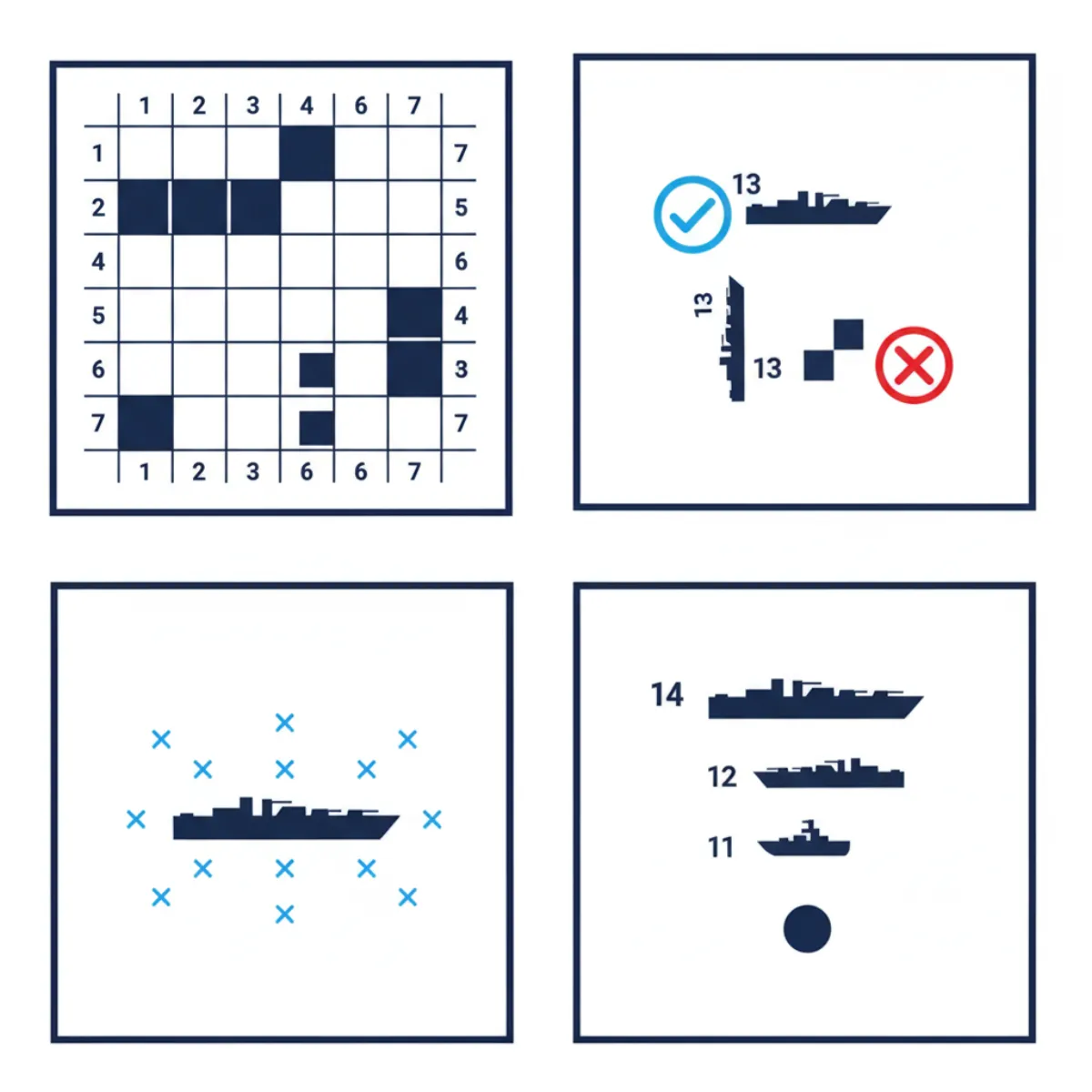
The five rules of Battleships—simple constraints that create satisfying logical puzzles.
Understanding Ship Types
Before we solve our first puzzle, you need to recognize how ships appear on the grid.
The Submarine (1 cell)
The submarine is unique--a single-cell ship shown as a circle or dot. Because it stands alone, you can immediately mark all eight surrounding cells as water once you find one. Submarines are often the easiest ships to place definitively.
Multi-Cell Ships (Destroyers, Cruisers, Battleships)
All larger ships follow the same visual system: end pieces point in the direction the ship extends, while middle pieces have flat sides showing the ship continues both ways.
- Destroyers (2 cells): Two end pieces pointing at each other
- Cruisers (3 cells): Two ends with one middle segment
- Battleships (4 cells): Two ends with two middle segments
The battleship deserves special attention. As the flagship--four cells long--finding it often unlocks significant parts of the puzzle because it occupies so much space and creates massive water zones around it.
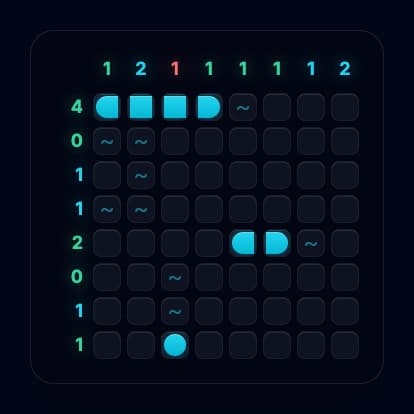
All ship types: battleship (4), cruiser (3), destroyers (2), and submarines (1).
Your First Solve: A Visual Walkthrough
Let us solve a puzzle together. I will show you exactly what to look for and why each move is logically certain--no guessing involved.
Note: We use 0-based coordinates where (0,0) is the top-left corner. Row 0 is the top row, column 0 is the leftmost column.
The Starting Puzzle
Here is a 6x6 beginner puzzle with a small fleet: 1 Cruiser (3 cells), 3 Destroyers (2 cells each), and 1 Submarine (1 cell). That is 10 ship cells total spread across 36 grid cells.
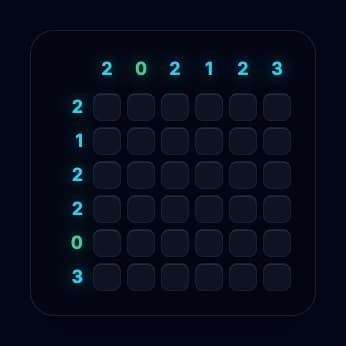
Starting puzzle. Row counts: 2,1,2,2,0,3. Column counts: 2,0,2,1,2,3.
Step 1: Mark the Zeros
The most powerful starting move in Battleships is handling the zeros. A row or column marked "0" contains no ship cells at all--the entire line is water.
Row 4 is marked "0": Every cell becomes water. Column 1 is marked "0": Every cell becomes water.
That single observation eliminated 11 cells--nearly a third of our grid! This is why zeros are gold.
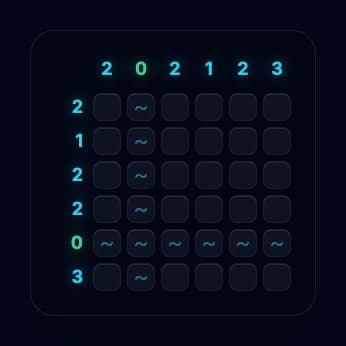
Step 1: Zeros marked--11 cells eliminated instantly!
Step 2: Place the Cruiser
Now look at row 5 (bottom row)--it needs 3 ship cells. With column 1 eliminated, the available positions are columns 0, 2, 3, 4, and 5.
Here is the key insight: A horizontal cruiser at columns 3-4-5 would satisfy all 3 of row 5's needed ships and give column 3 its required 1 ship (perfect match!).
And there it is--our first ship! The cruiser clicks into place.
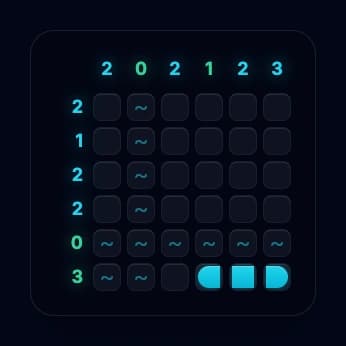
Step 2: Cruiser placed
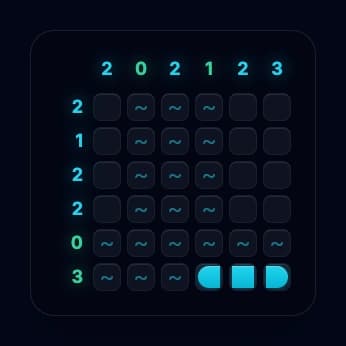
Step 2b: Water propagates
[Fleet remaining: 3 destroyers, 1 submarine]
Step 3: Find the Forced Destroyer
Column 5 still needs 2 more ships. After our water propagation, only rows 0, 2, and 3 remain available. We need 2 ship cells from only 3 available cells.
Could they be two separate submarines? No--those cells would be adjacent, so the no-touching rule forces them to be part of the SAME ship. The only way to satisfy column 5's requirement is a vertical 2-cell destroyer at rows 2-3.
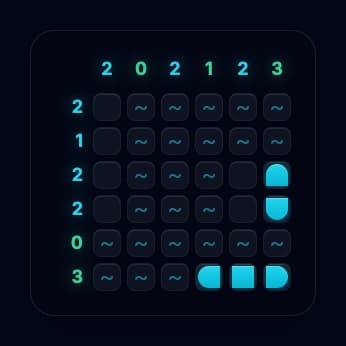
Step 3: The destroyer MUST go here--no other option fits the constraints.
[Fleet remaining: 2 destroyers, 1 submarine]
Step 4: The Submarine Reveals Itself
Column 4 needs exactly 1 ship. With diagonal cells now water from the destroyer, and cells (2,4) and (3,4) blocked by the adjacent destroyer, only ONE cell remains: (0,4).
Certain move: Cell (0,4) must be a submarine!
Notice how one placement (the destroyer) cascaded into another certainty (the submarine). This chain reaction is the heart of Battleships solving.
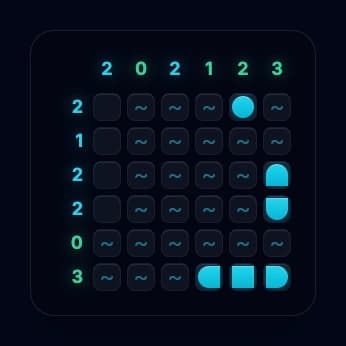
Step 4: The submarine materializes from constraints--pure logic!
[Fleet remaining: 2 destroyers]
Step 5: Place the Second Destroyer
Column 0 needs 2 ships in rows 0-3. A vertical destroyer at (0,0)-(1,0) would complete column 0's requirement and complete row 1's need for 1 ship.
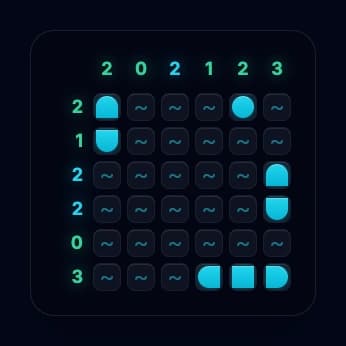
Step 5: Another destroyer found through constraint analysis.
[Fleet remaining: 1 destroyer]
Step 6: The Final Destroyer
Column 2 needs 2 ships. The only remaining cells are (2,2) and (3,2)--they are vertically adjacent. Since ships cannot touch, these two cells must be part of the SAME ship: a vertical destroyer.
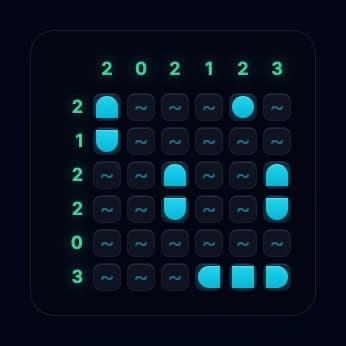
[Fleet complete!] All ships found through pure logic.
Key Principles
- Start with zeros -- they eliminate entire rows or columns instantly
- High numbers constrain placement -- rows/columns needing many ships have limited options
- Cross-reference constantly -- row and column clues work together
- The no-touching rule propagates -- each ship placement creates water zones
- Count remaining ships -- knowing the fleet helps you deduce what fits where
Essential Beginner Strategies
Strategy 1: Zero Rows and Columns First
Always start by marking zero rows and columns as water. A line marked "0" is 100% water. This eliminates large sections of the grid instantly.
Strategy 2: Look for Full Lines
A row or column where the clue equals the available cells must be entirely ships. If a 6-cell column has 2 water cells and needs 4 ships, the remaining 4 cells are all ships.
Strategy 3: Use the No-Touching Rule Aggressively
Every ship creates a buffer zone. Submarine: 8 water cells. Destroyer: 10 water cells. Cruiser: 12 water cells. Battleship: 14 water cells. Mark these immediately!
Strategy 4: Count Remaining Ships by Type
Track which ships you have placed. In the walkthrough, we tracked "[Fleet remaining: 2 destroyers]" after each placement--adopt this habit.
Strategy 5: Cross-Reference Row and Column Clues
The most powerful deductions come from combining information. Always ask: "What does this row clue tell me about this column?"
Strategy Quick Reference
- 1. Mark all zeros -- entire rows/columns become water
- 2. Check for full lines -- clue equals available space means all ships
- 3. Use no-touching zones -- each ship creates surrounding water
- 4. Track the fleet -- know which ships remain to place
- 5. Cross-reference clues -- combine row and column information
- 6. Extend from hints -- ship segments tell you about neighbors
- 7. Consider ship lengths -- match required cells to possible ships
Common Mistakes and How to Avoid Them
Mistake 1: Forgetting Diagonal No-Touch
You mark water beside ships but forget the diagonal cells. Fix: Ships cannot touch even diagonally. Mark ALL eight directions as water around each cell.
Mistake 2: Losing Track of the Fleet
You place a second battleship without realizing you already found the first one. Fix: Keep a running count. Check off each ship type as you complete it.
Mistake 3: Guessing Instead of Deducing
You get stuck and place a ship hoping it works out. Fix: Every Battleships puzzle is solvable through pure logic. If stuck, you have missed something. Re-examine each row and column.
Difficulty Progression
Your Fleet Awaits
On your first puzzle, mark all zero rows and columns as water, then look for rows or columns where the ship count equals the remaining available cells. Track your fleet checklist as you go -- knowing which ships remain tells you what can fit where. Start with a 6x6 grid and work up to 10x10 once the no-touching rule feels automatic.
Ready to Find Your First Fleet?
The strategies are in your head. The rules are crystal clear. All that's left is to mark that first water cell and watch the ships reveal themselves.
Start Solving BattleshipsPut it into practice
Ready to solve Battleships?
Open a free puzzle and turn the ideas from this guide into your next solve.