Nonograms Strategies:
Advanced Techniques for Complex Grids
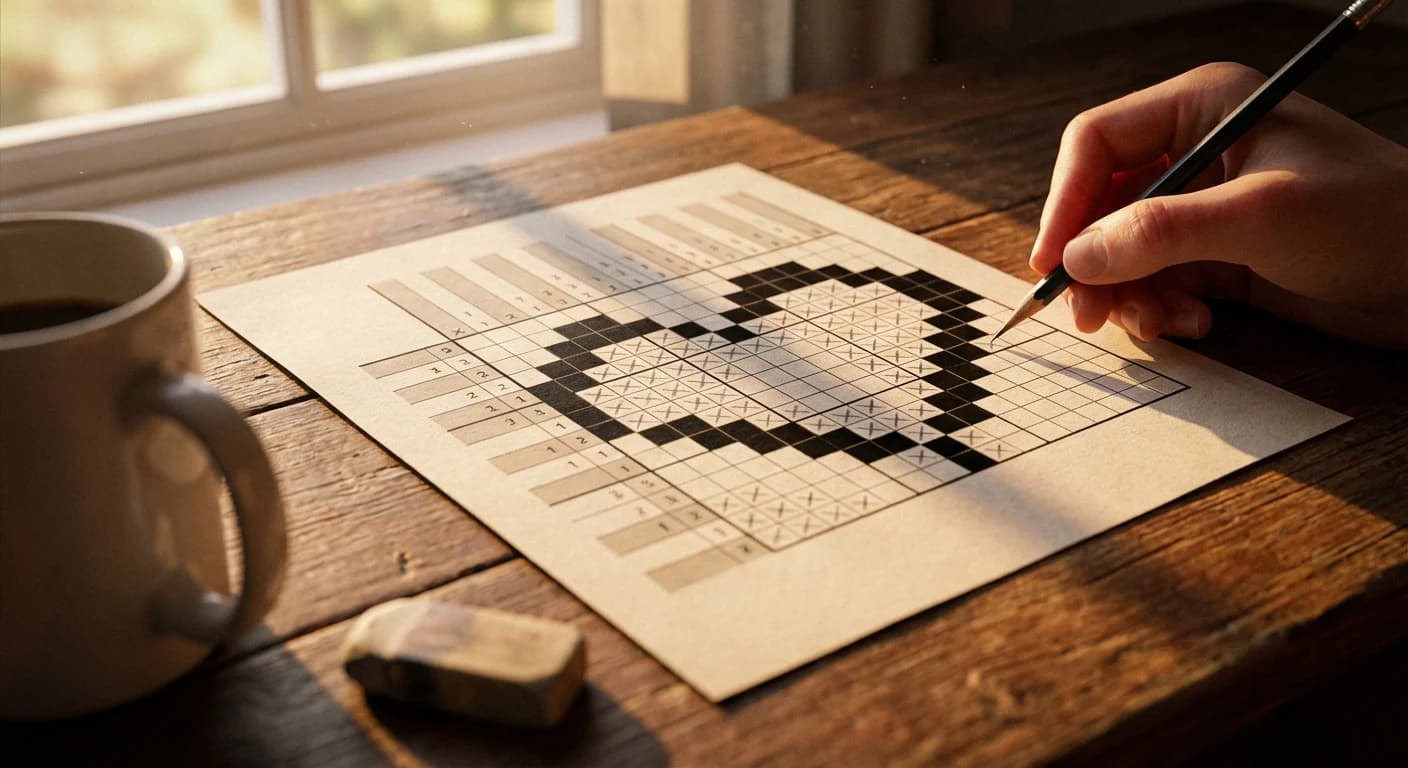
There's a moment in every Nonograms grid when chaos becomes clarity. One technique—the overlap method—is responsible for that moment more than any other. Once you see it, you'll wonder how you ever solved without it.
If you've conquered a few 5x5 and 10x10 grids, you know the basics: fill cells to match the numbers, mark X's where cells must be empty, reveal the hidden picture. But then you open a 15x15 grid, stare at clues like "3, 1, 4, 2" across fifteen cells, and suddenly everything you thought you knew feels inadequate.
Here's the truth: the leap from beginner to advanced Nonograms isn't about working harder—it's about seeing patterns you didn't know existed. Ready to tackle those intimidating 15x15 grids that seem impossible at first glance? The secret isn't patience—it's pattern recognition.
Watch the Tutorial
Learn the basics of Nonograms in this short video.
Prerequisites
This guide builds on concepts from our beginner's guide—understanding the basic rules, reading clue numbers, and marking cells. If any of these feel unfamiliar, start there first.
The Overlap Technique: Your Most Powerful Weapon
If you learn only one advanced technique from this entire post, make it this one. The overlap method is responsible for more breakthroughs than any other strategy in your solving toolkit.
Here's how it works: When a clue is large relative to the row or column length, some cells must be filled regardless of where the run starts.
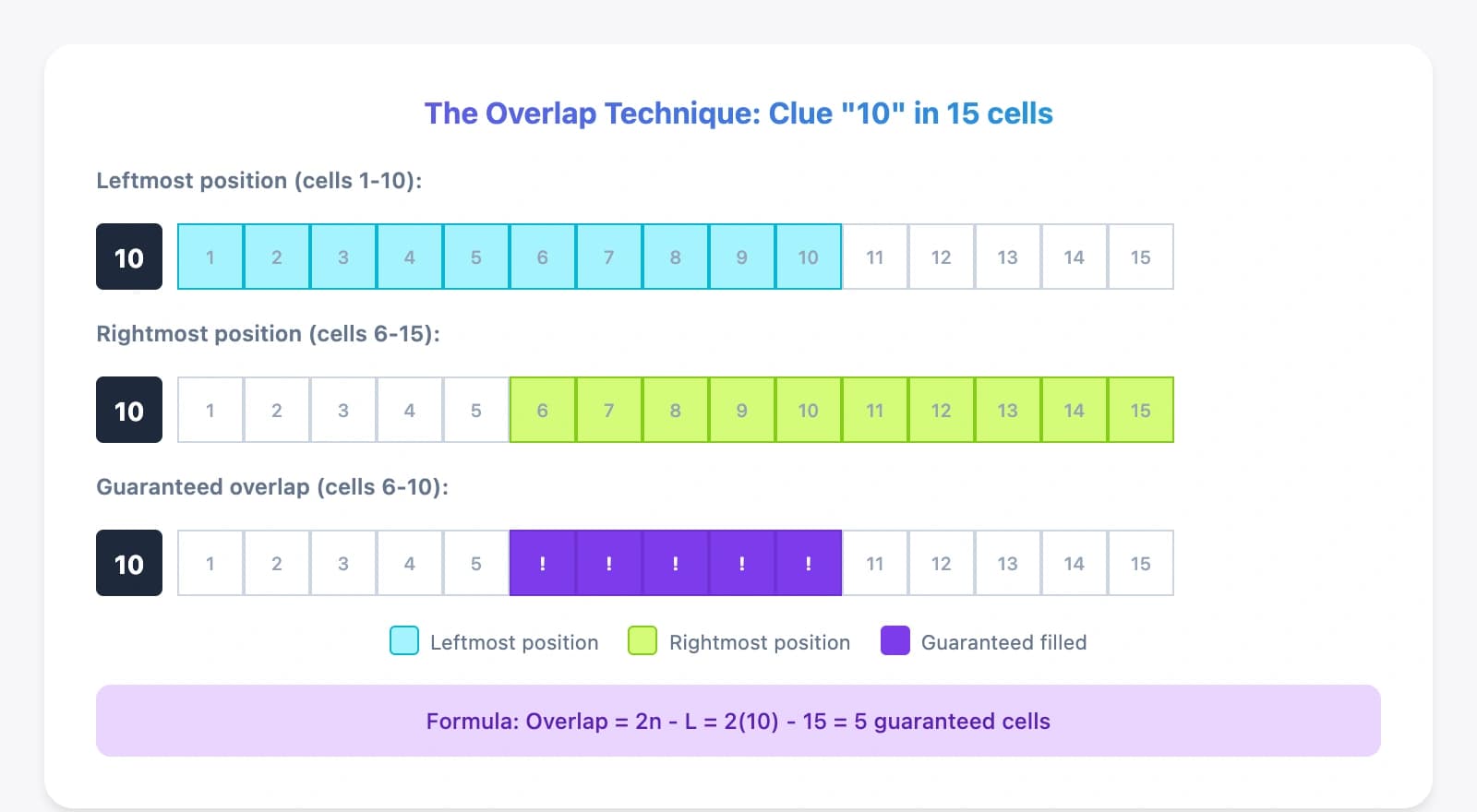
The overlap technique: cells 6-10 are guaranteed filled regardless of where the run of 10 starts.
Imagine a 15-cell row with a single clue of "10." That run of 10 filled cells could start at position 1 (filling cells 1-10) or start at position 6 (filling cells 6-15). But here's the magic: cells 6 through 10 are filled in both scenarios. They overlap. You can fill them with absolute certainty.
The Overlap Formula
For a clue "n" in a row of length "L": Overlap = 2n - L (when n > L/2)
Examples: "8" in 10 cells = 6 guaranteed cells. "12" in 15 cells = 9 guaranteed cells.
For multiple runs, apply the same logic to each segment. If you have "5, 5" in a 15-cell row, each "5" has a potential range (accounting for the minimum gap between runs), and each may have its own overlap region.
Edge Logic: Where Certainty Lives
Corners and edges are where advanced techniques really shine. Why? Because boundaries eliminate possibilities.
When a filled cell touches the edge of the grid, you instantly know where a run begins or ends. If cell 1 is filled and your first clue is "4", cells 1-4 must be filled, and cell 5 must be X.
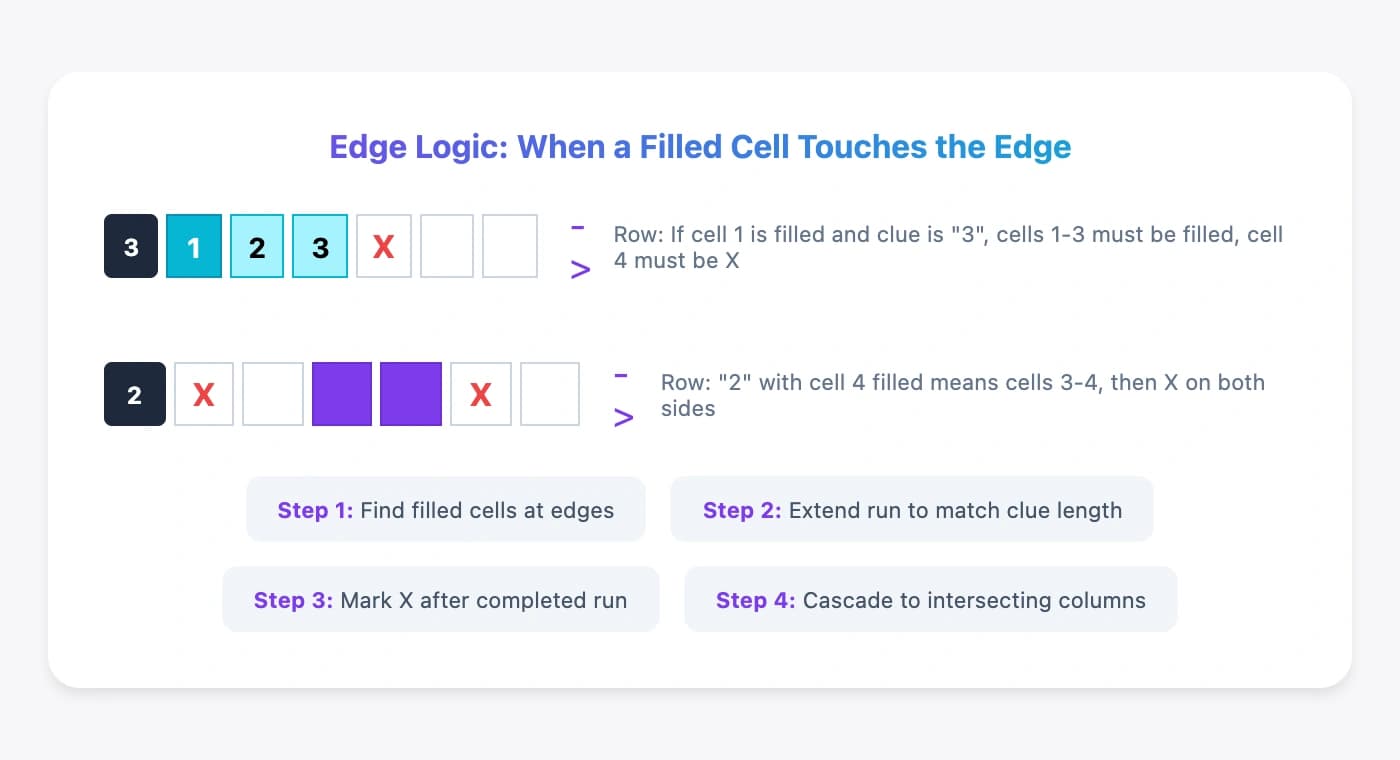
Edge logic creates cascades—one piece of information ripples outward.
The reverse is equally powerful. If your row clue starts with "3" but you discover cell 1 must be empty, you've just learned that the "3" run begins somewhere in cells 2-4. Combined with overlap logic, this often reveals additional cells immediately.
Work your edges early and often. They're the gift that keeps giving.
Gap Analysis: The Art of Strategic X Marks
Here's a question that separates casual solvers from advanced practitioners: When should you mark an X versus leaving a cell blank?
The answer involves gap analysis—understanding how empty spaces constrain possibilities. There are two distinct types of gap deductions, and mastering both will accelerate your solving significantly.
Mandatory Gaps Between Runs
The first type of gap is structural: every pair of adjacent runs must have at least one empty cell between them. This is a rule of the puzzle itself.
Elimination-Based X Marks
Beyond mandatory gaps, there's a second type of X deduction that comes from logical elimination. This happens when filling a particular cell would make it impossible to satisfy the remaining clues.
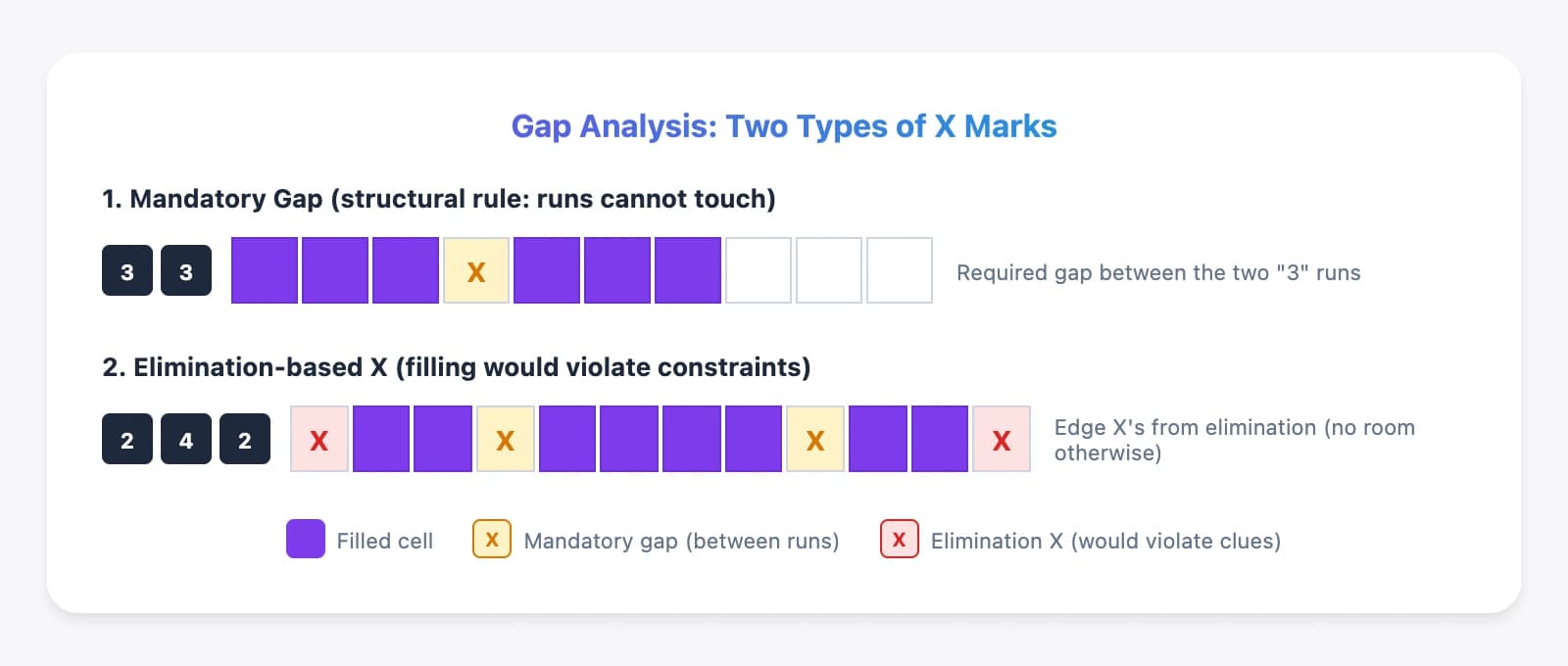
Two types of X marks: mandatory gaps (between runs) and elimination-based (would violate constraints).
1. Confirms run boundaries
Once you know where a run ends, you know where it doesn't continue.
2. Creates smaller sub-problems
X marks divide rows into segments you can analyze independently.
3. Provides column information
Every X tells the intersecting column "this cell is empty."
The Completed Run Rule: Lock It Down
Gap analysis reveals where runs must end—but in complex grids, it's easy to forget boundaries you deduced three minutes ago. The completed run rule is your memory system: immediately bracket finished runs with X marks so your past deductions stay visible.
When you know a run is complete, mark X on both sides right away. This simple habit prevents costly errors.
Quick Mental Exercise
You have clue "3, 2" and see five consecutive filled cells. What do you know immediately? Those five cells must contain both runs touching each other—which is impossible since runs need gaps between them. Something's wrong, and you need to recheck your work.
Cross-Referencing: Where Rows Meet Columns
This is where solving transforms from a linear process into a beautiful web of deductions. Every cell lives in both a row and a column. Information from one feeds the other.
When you fill a cell using row logic, immediately check what that tells you about its column. Often, a single filled cell—combined with the column's clue and existing marks—triggers a cascade of new deductions.
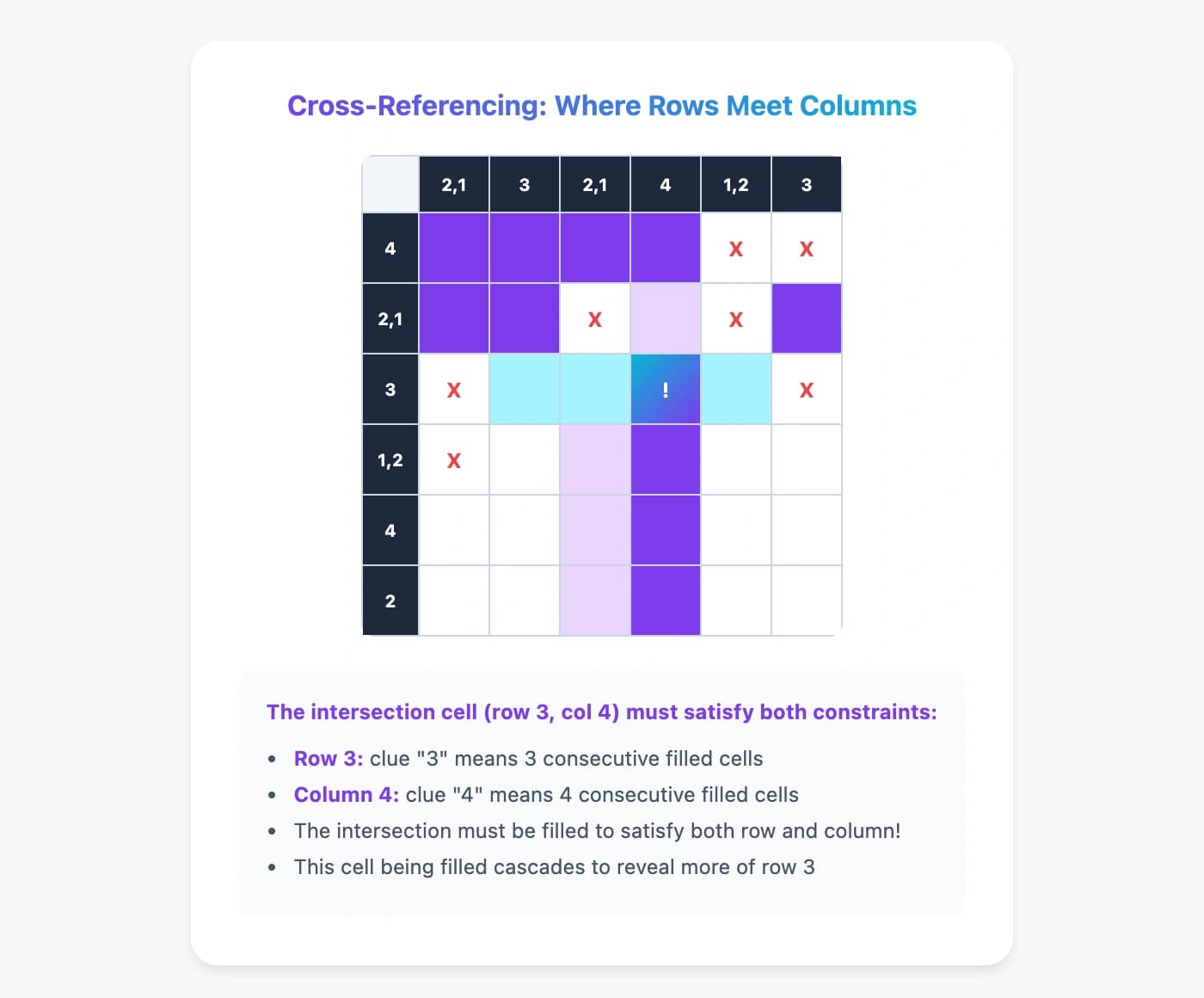
Every cell must satisfy both its row and column constraints—use this to force placements.
Pro Tip: The Stuck Strategy
The most powerful cross-referencing happens when you're stuck. Instead of staring at a difficult row, scan all the columns that intersect with your known cells. One of them will likely have new information that unlocks your stuck row.
Multi-Run Deductions: The Advanced Frontier
With clues like "2, 1, 3, 1" in a 15-cell row, you're juggling multiple constraints simultaneously. This is where advanced techniques separate the experts from everyone else.
Start by calculating the minimum space needed: 2 + 1 + 3 + 1 = 7 filled cells, plus at least 3 gaps between runs, equals 10 minimum cells. In a 15-cell row, that leaves 5 cells of "slack." Think of slack as extra breathing room.
Worked Example: "2, 1, 3, 1" in 12 cells
Minimum space: 2+1+1+1+3+1+1 = 10 cells
Slack: 12 - 10 = 2 cells
For the "3" run:
- Earliest: starts at position 6 (after 2, gap, 1, gap), fills 6-8
- Latest: ends at position 10 (leaving gap at 11, "1" at 12), fills 8-10
- Overlap: position 8 is guaranteed filled!
For the first "2" run:
- Earliest: positions 1-2
- Latest: positions 3-4 (must leave room for everything else)
- Overlap: none (slack of 2 equals the run length, so the earliest and latest positions share no cells)
Navigating Common 15x15+ Patterns
Larger grids have recurring situations that, once recognized, become autopilot territory.
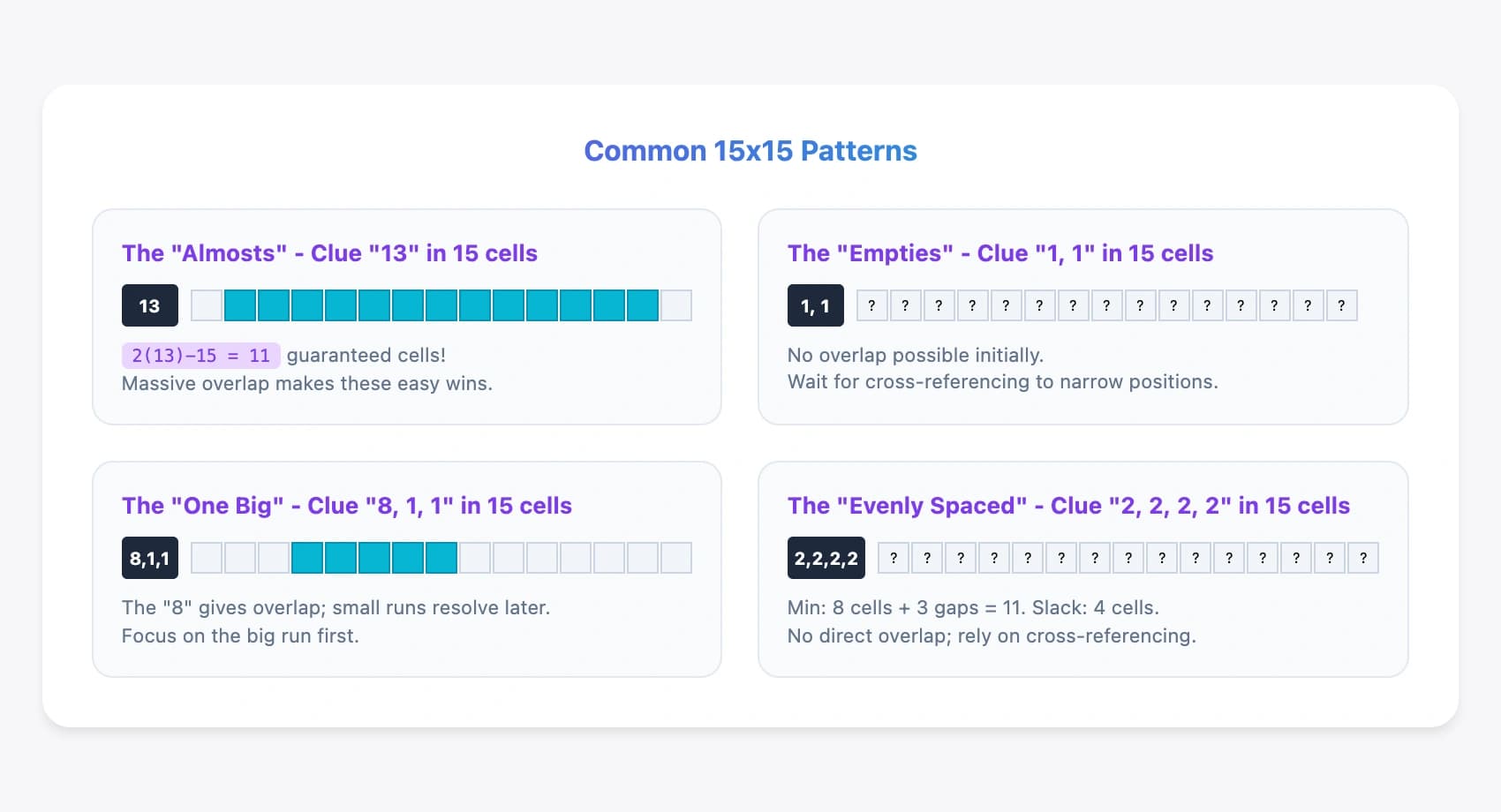
Recognize these patterns instantly and you'll know which technique to apply.
The "Almosts"
Rows with clues summing to nearly the row length (like "13" in 15 cells). Massive overlap—goldmines for quick progress.
The "Empties"
Columns with small clues (like "1, 1" in 15 cells). Nothing to deduce initially—become crucial mid-solve through cross-referencing.
The "One Big, Several Small"
Clues like "8, 1, 1" in 15 cells. Immediate overlap on the 8; small runs resolve once you know the 8's exact position.
The "Evenly Spaced"
Clues like "2, 2, 2, 2" in 15 cells. Moderate slack—cross-referencing becomes essential here.
The X Marking Decision Tree
Should this cell be X or unknown? When you're uncertain, run through this mental checklist:
Mark X when:
- The cell is adjacent to a completed run (boundary X)
- Filling it would make fitting remaining clues impossible
- All runs in that line are accounted for elsewhere
- Cross-reference logic from the intersecting line requires empty
Leave blank when:
- Multiple valid configurations exist
- You're relying on a guess rather than deduction
- The intersecting line could have this cell either way
The goal is zero guessing. Every X should be provable. Every filled cell should be certain. This discipline is what separates solvers who complete 20x20 grids from those who hit walls at 15x15.
Your Practice Progression Path
Level 1: 10x10 grids
Master overlap and edge logic. These grids should feel almost automatic before moving on.
Level 2: 12x12 to 15x15
Introduce deliberate gap analysis and the completed run rule. Start consciously cross-referencing.
Level 3: 15x15 to 20x20
Multi-run deductions become essential. Practice recognizing the common patterns. Time yourself to notice when you're stuck.
Level 4: 20x20+
Systematic scanning becomes crucial. Develop a routine: check all rows, then all columns, repeat. Trust your marks and your process.
From Chaos to Clarity
Remember that moment we mentioned at the start? The one where chaos becomes clarity?
It happens when you stop seeing a nonogram as a single overwhelming puzzle and start seeing it as hundreds of small, solvable micro-puzzles. Each row is a puzzle. Each column is a puzzle. Each decision point is its own tiny logic problem with a definite answer.
The strategies we've covered—overlap, edge logic, gap analysis, completed runs, cross-referencing, and multi-run deductions—are your toolkit for breaking impossible-looking grids into those manageable pieces.
The beautiful truth about nonograms is that the picture is already there, hidden in the mathematics of the clues. You're not creating it. You're simply uncovering what was always inevitable.
Your Next Steps
Open that 15x15 grid that's been intimidating you. Start with the longest clues. Apply overlap. Work the edges. Mark your X's with confidence. Cross-reference relentlessly.
And when the grid opens up—when cells start filling themselves in cascades of deduction—you'll know you've leveled up.
Happy solving.
Ready to Reveal the Picture?
The overlap formula is in your head. Edge logic is second nature. Time to watch those cells fill themselves in cascades of deduction.
Start Solving NonogramsPut it into practice
Ready to solve Nonograms?
Open a free puzzle and turn the ideas from this guide into your next solve.