Slitherlink Strategies:
Advanced Patterns for Faster Solving

There is a moment in advanced Slitherlink solving when the grid transforms before your eyes. What was a scattered collection of numbers becomes a living system of constraints, each cell whispering its secrets to its neighbors.
You spot two 3s sitting diagonally and your pen moves before your mind catches up—the edges between them are inevitable. You glance at a corner with a 2 and see the entire loop path through that region unfold like a movie playing in fast-forward. You catch an odd number of endpoints in a section and feel—before any calculation—that something must connect through the middle.
This is the shift from beginner to intermediate solver. The basic patterns become automatic, and your mind graduates to seeing the deeper structure: how constraints cascade through empty cells, how parity governs the loop's path, and how a single strategic placement can unlock entire regions.
Watch the Tutorial
Prefer watching? This tutorial introduces Slitherlink rules and patterns.
Prerequisites
This guide builds on concepts from our beginner's guide—the four rules, basic patterns (0 cells, corner 3s, adjacent 3s), and the dot rule. If any of these feel unfamiliar, start there first.
The Diagonal 3-3 Rule: Your Most Powerful Pattern
If there is one advanced pattern worth prioritizing, it is the diagonal 3-3 rule. It appears constantly, solves instantly, and cascades beautifully. Once this pattern becomes automatic, solving speed improves dramatically—it is that transformative.
Understanding the Pattern
When two 3s are positioned diagonally (touching at a corner but not sharing an edge), the two edges meeting at their shared corner must both be part of the loop.
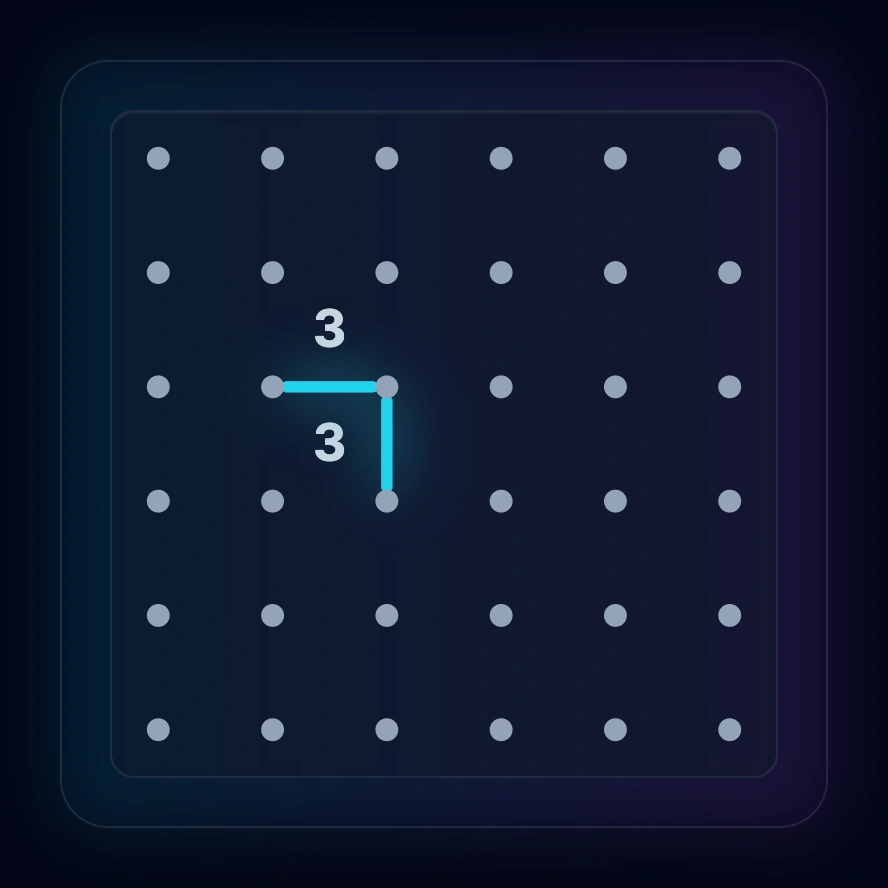
Two diagonal 3s force both edges at their shared corner—this is inevitable.
Why does this work? Consider the shared corner dot. The loop must enter and exit this dot exactly twice (the 0-or-2 rule, also called the dot rule). Each of the two diagonal 3s contributes edges to this corner. For both 3s to reach their required count of three edges, the corner must carry exactly two loop edges—one from each 3.
The mathematical inevitability is beautiful: any other configuration leaves at least one 3 unsatisfied.
Extending the Diagonal Chain
The diagonal 3-3 pattern becomes even more powerful when multiple 3s form a diagonal chain. Each adjacent pair in the chain forces its shared corner edges:
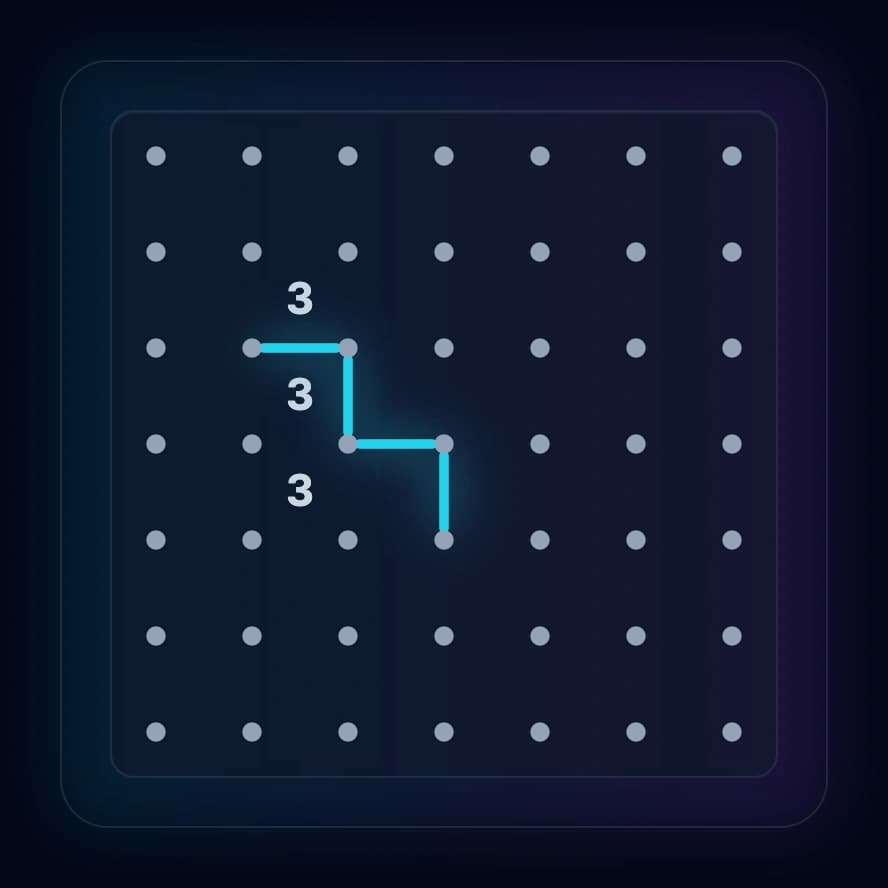
Diagonal chains create staircases of forced edges—three 3s can unlock half a region.
Three diagonal 3s create a staircase of forced edges. Four diagonal 3s create an even longer staircase. In competition puzzles, a diagonal chain of 3s often forms the backbone of the entire solution.
The Diagonal 3-3 Cascade
Here is what makes this pattern truly powerful: once you draw the corner edges, both 3s still need one more edge each. This immediately constrains their remaining options:
- Draw the two corner edges at the shared dot
- Each 3 now has two edges and needs exactly one more
- Check each 3's remaining two edges—one of them becomes determinable from dot constraints
- That determination often forces more edges in adjacent cells
- The cascade continues
In practice, spotting a diagonal 3-3 early in a puzzle typically triggers a 4-6 cell cascade. That is significant progress from recognizing a single pattern.
Advanced Corner Patterns
Corners are where constraints compress. The grid boundary eliminates possibilities, and the remaining options become highly constrained.
The Corner 2 Pattern
A 2 in the corner of the grid creates a specific forced configuration that many solvers miss. A corner cell has two boundary edges (edges along the grid's outer border) and two interior edges (edges facing inward toward other cells). For a corner 2, the key insight involves the corner dot—the outermost point of the grid where both boundary edges meet.
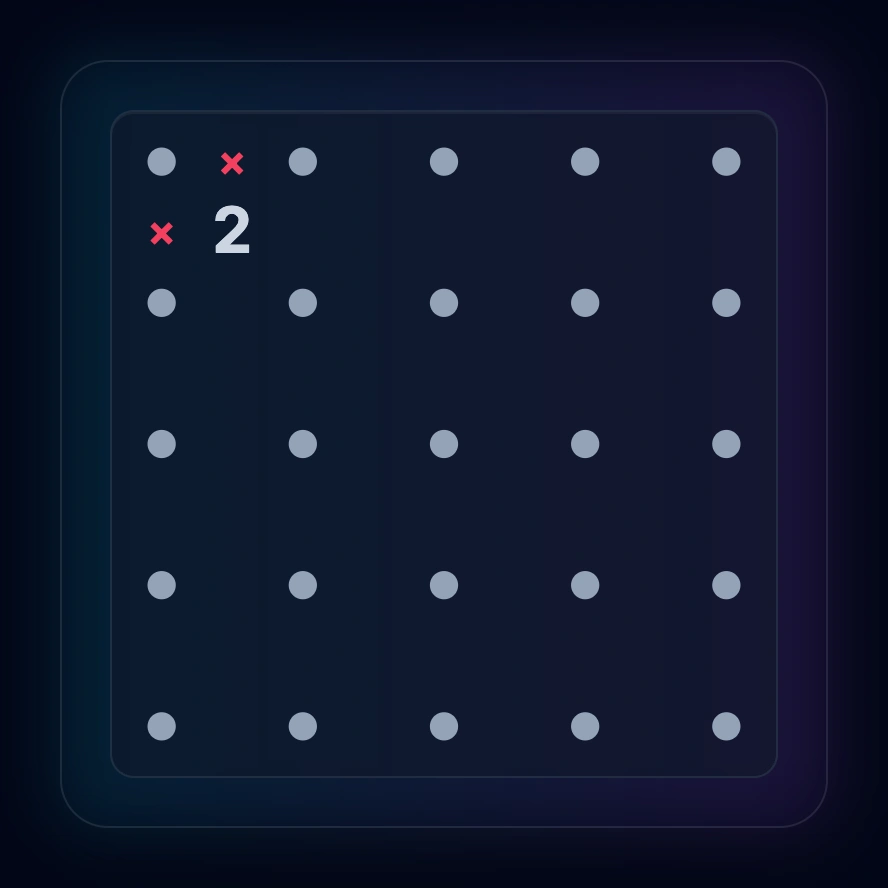
The corner dot cannot have exactly one edge—it must be zero or two.
The corner dot cannot have exactly one edge—it must have zero or two (the dot rule). For a corner 2, this creates a powerful constraint:
- Option A: Both boundary edges are part of the loop (the corner dot has 2 edges)
- Option B: Neither boundary edge is part of the loop (the corner dot has 0 edges)
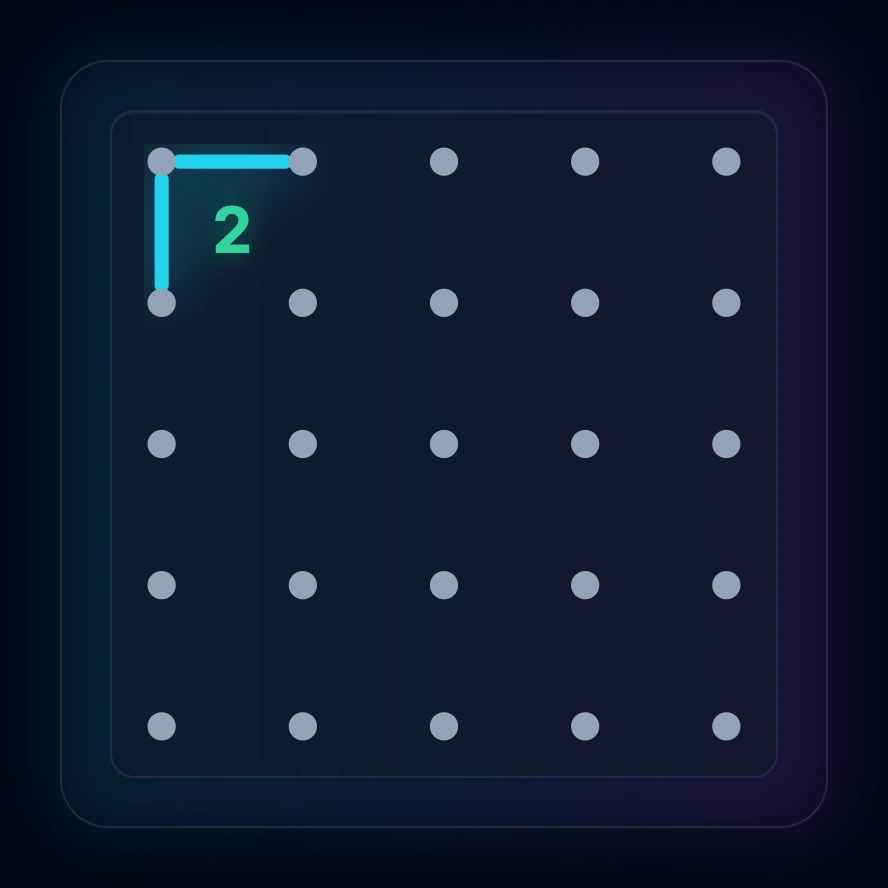
Option A: both boundary edges are part of the loop.
The corner 2 cannot have exactly one boundary edge. This "both or neither" constraint becomes powerful when combined with adjacent clues—often one option can be eliminated, forcing the other.
The Boundary 3 with Adjacent Clues
When a 3 sits along the grid boundary (not in a corner), we call it a boundary 3. Its position creates unique constraints because one of its four edges lies along the outer border.
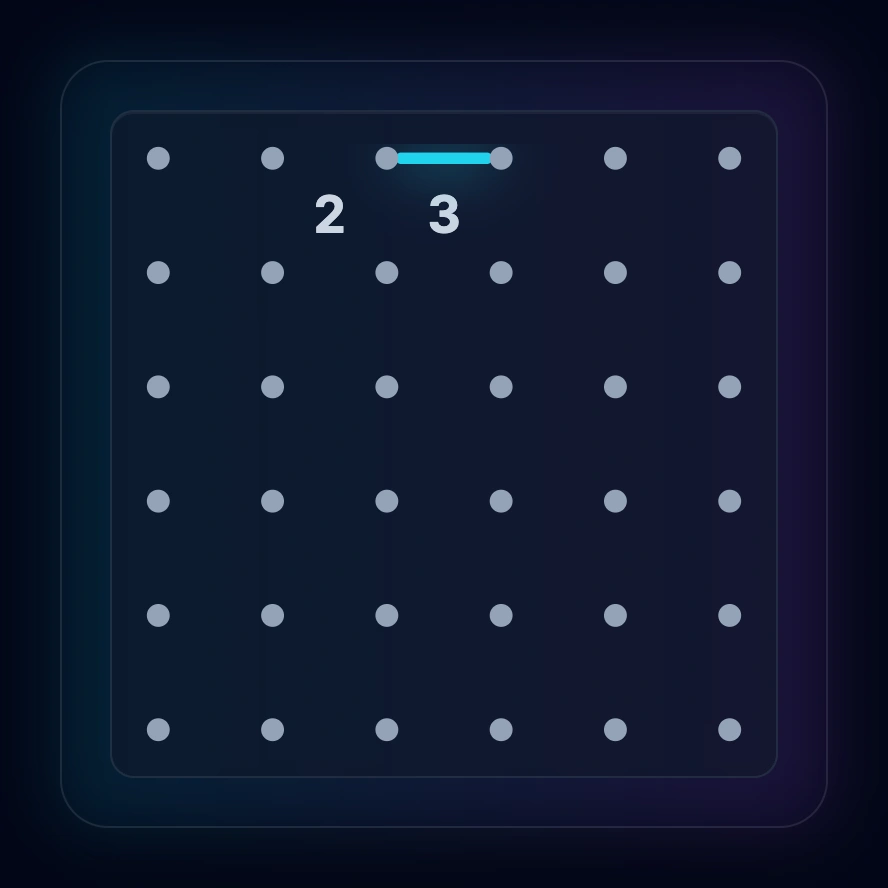
When adjacent clues constrain a boundary 3, its boundary edge often becomes forced.
Consider what happens if the boundary edge of a boundary 3 is NOT used: all three interior edges must be used to satisfy the 3. But this creates a problem—each corner dot of that cell would have only one edge from the 3, requiring matching edges from adjacent cells. When adjacent clues cannot provide those edges (like a 2 that is already constrained), the boundary edge becomes forced.
The 1-3 Corner Combination
A 1 adjacent to a corner 3 creates a beautifully constrained situation:
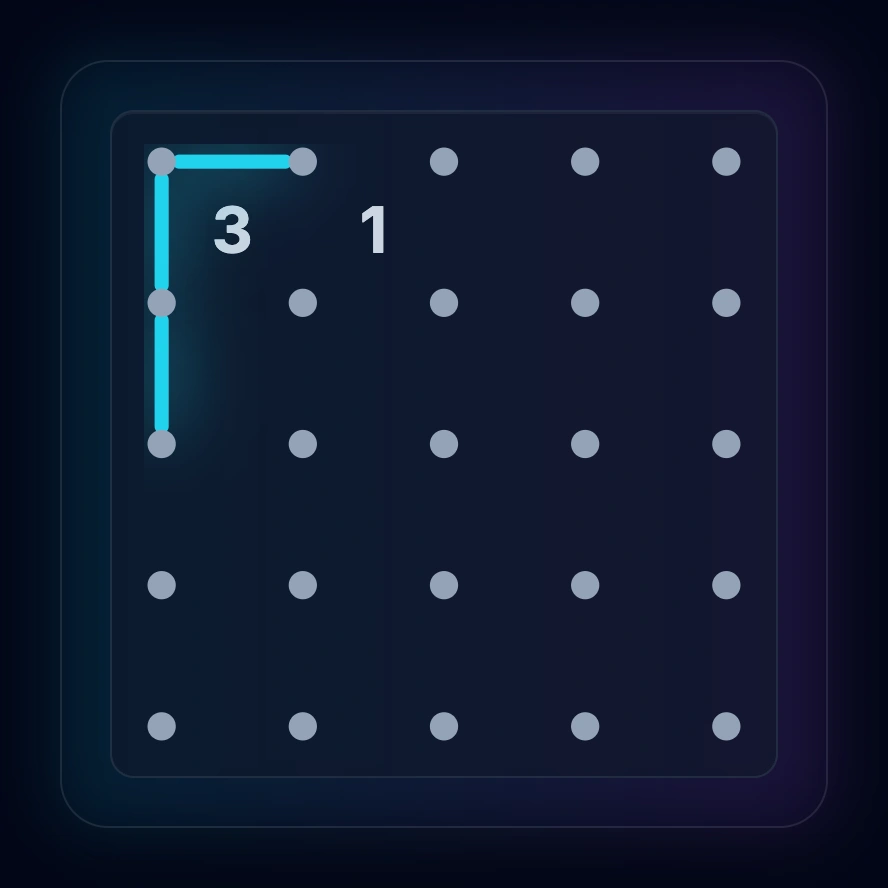
The corner 3 forces boundary edges, which constrains the adjacent 1.
The corner 3 forces both boundary edges. The dot between the 3 and 1 now has two edges meeting there (one from each boundary edge's continuation). This means the edge between the 3 and 1 cannot be used—it would give that dot three lines. With the shared edge eliminated, the 1 must get its single edge from one of its remaining sides.
Parity Analysis: The Hidden Logic
Parity analysis is the technique that elevates good solvers to great ones. It exploits a fundamental property of any closed loop: every dot on the loop has exactly two edges, and every dot off the loop has zero edges.
The Basic Parity Principle
Consider any row of dots (horizontal or vertical). Count how many loop segments cross through that row. This number must be even—because the loop enters and exits the row the same number of times.
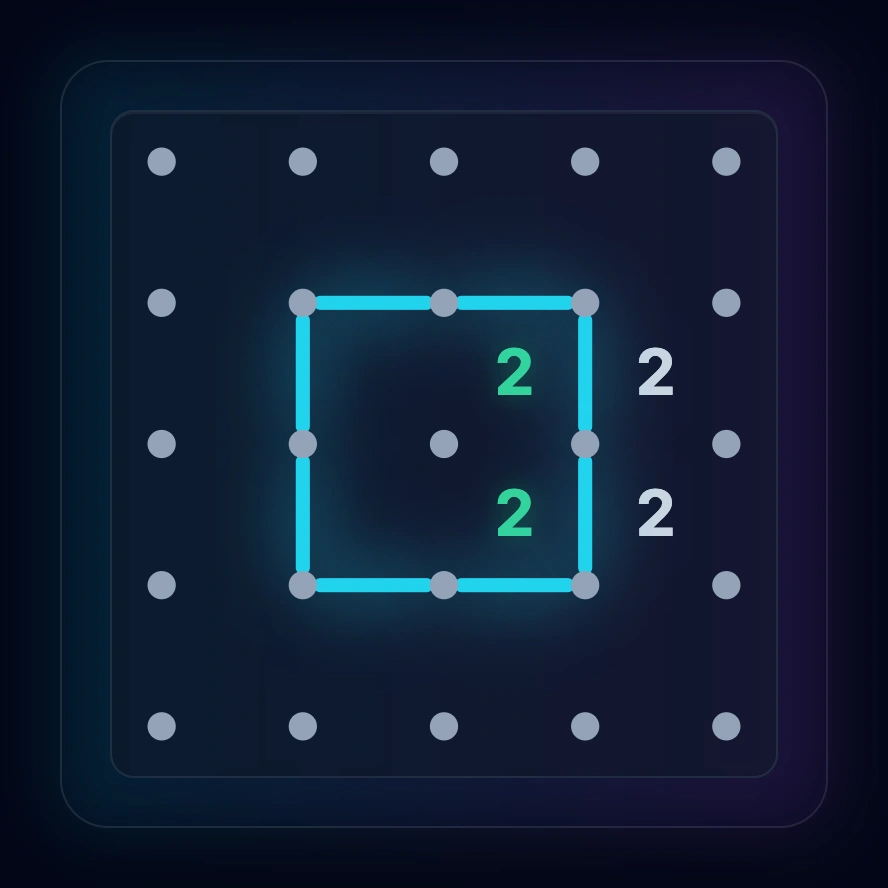
Any imaginary line through the puzzle is crossed an even number of times by the loop.
This applies to any imaginary line you draw through the puzzle. The loop must cross it an even number of times.
Applying Parity to Solve: A Worked Example
Here is how parity becomes practical. Consider a concrete example.
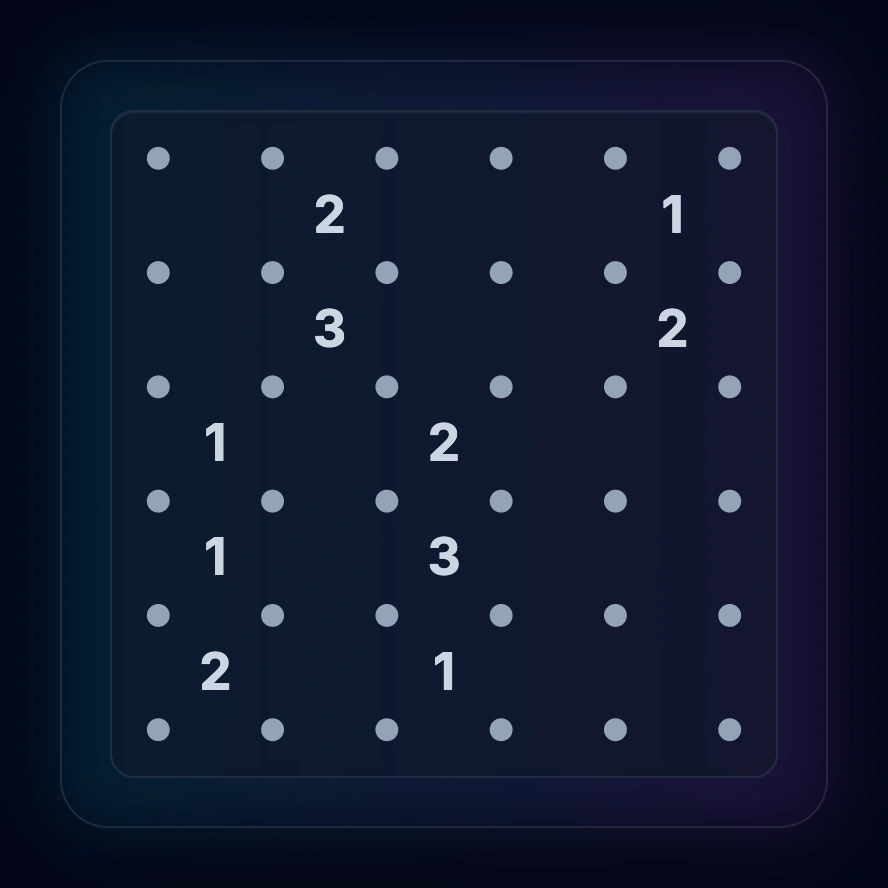
Three confirmed crossings means a fourth must exist—parity forces the remaining edge.
Step 1: Draw an imaginary vertical line
Draw an imaginary vertical line between columns 2 and 3
Step 2: Count the confirmed crossings
The loop crosses this line at Row 1, Row 2, and Row 4 (horizontal edges confirmed). That's 3 crossings.
Step 3: Apply the parity rule
Per our parity principle above, three crossings is odd—so a fourth must exist.
Step 4: Identify remaining possibilities
The only unresolved potential crossing along this line is at Row 3
Step 5: Conclusion
The horizontal edge at row 3, column 2 must be part of the loop—it is forced by parity
This single deduction, invisible to direct pattern matching, unlocks further progress.
Parity is especially valuable on larger grids. When a section seems impossible—no obvious patterns, multiple possibilities everywhere—drawing an imaginary line through the middle and counting forced crossings can reveal that one additional crossing must exist in exactly one location. That single edge can break the puzzle wide open. When direct deduction stalls, always check parity.
Parity in Enclosed Regions
Parity becomes even more powerful when you analyze enclosed regions. Any closed region bounded by puzzle edges or X-marked edges must have an even number of loop crossings on its boundary. If the loop enters the region, it must exit. If it enters twice, it must exit twice. This means:
- If you can prove the loop enters a region an odd number of times, you have found an error
- If a region has exactly one possible entry point, the loop either stays out entirely or must have a matching exit
Working from Solved Regions Outward
Strategic solving order dramatically affects speed. Experienced solvers do not simply scan left-to-right—they expand from certainty toward ambiguity.
The Expansion Principle
Once you solve a region (have determined all its edges), the cells bordering that region become easier to solve. Why? Because each bordering cell now has additional constraints from the solved region.
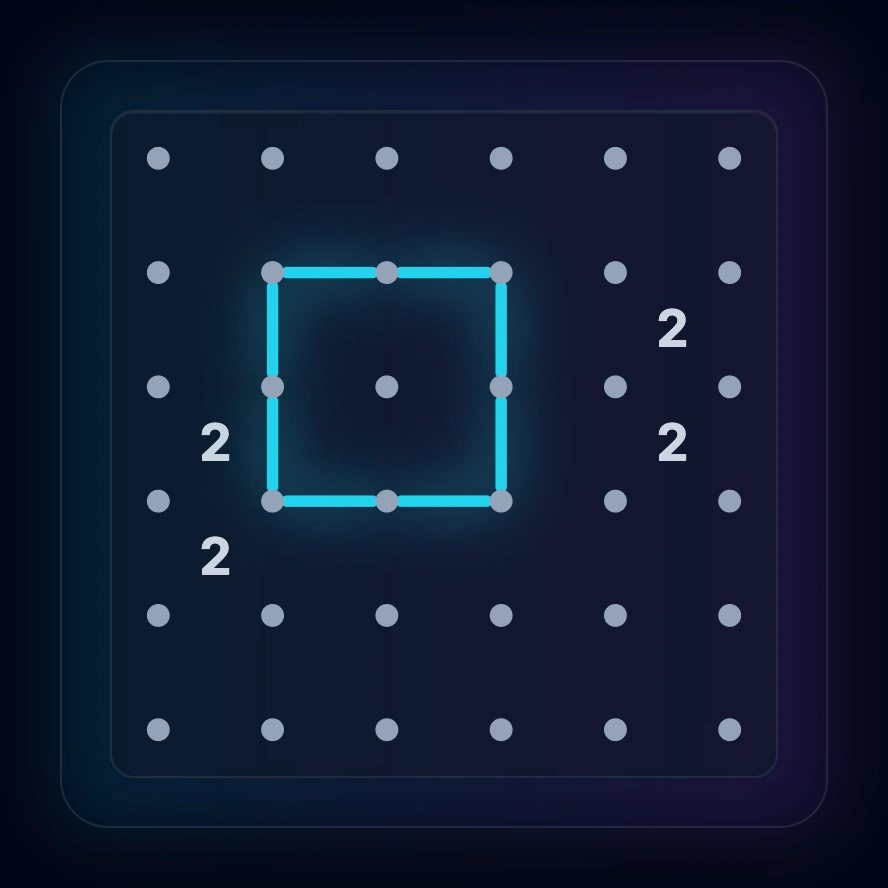
Solved regions propagate constraints outward—expand from certainty.
The Optimal Solving Order
- Find anchors first: Corner 3s, diagonal 3-3s, 0 cells—anything that solves immediately
- Cascade from anchors: Follow the dot rule and forced edges until the cascade stops
- Expand borders: Move to cells adjacent to your solved regions
- Bridge gaps: Look for how separate solved regions might connect
- Apply parity: When stuck, use parity analysis to find hidden constraints
Connecting Solved Islands
A common intermediate scenario: you have two or three solved regions (islands) that are not yet connected. The loop must eventually connect them all. Key insight: if an island has exactly two "exit points" where the loop might leave, the loop must use both exits (to maintain continuity). This often forces edges in the gap between islands.
Competition-Level Techniques
When you are ready to push further, these techniques reward the extra mental overhead with powerful deductions.
Proof by Contradiction
When direct patterns exhaust themselves, competition solvers shift into a different mindset—strategic assumption testing. Instead of looking for what must be true, you explore what happens if something were true.
- Assume edge X is a loop edge
- Apply all forced consequences (dot rule, clue satisfaction)
- If you reach a contradiction (dead end, impossible clue, broken loop), edge X must NOT be part of the loop
- Mark edge X with an X and continue
This technique is slower than pattern recognition, but when you are truly stuck, it breaks through otherwise-impossible situations.
Important
Only use proof by contradiction when you have fully exhausted direct deduction. Competition solvers use it sparingly—perhaps 2-3 times per difficult puzzle.
The Reachability Check
Before drawing an edge, ask: "If I draw this edge, can the loop still reach all parts of the grid?" Sometimes an edge seems valid locally but would isolate a section of the puzzle, making a complete loop impossible. As you gain experience, you will develop intuition for spotting these "cut points."
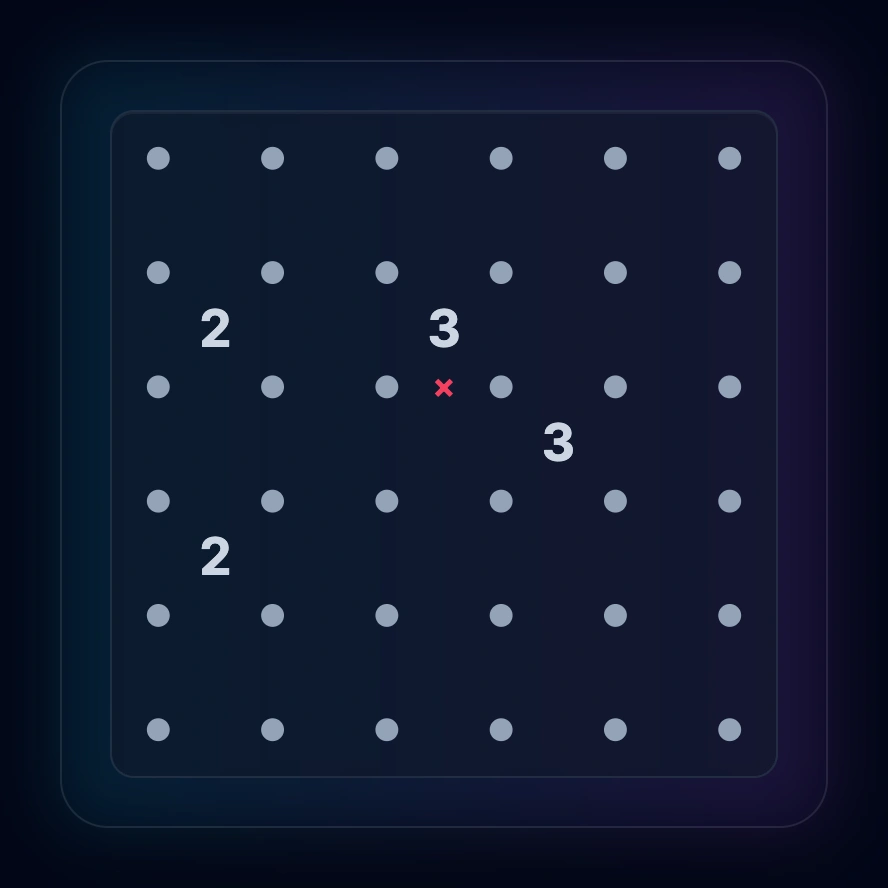
Some edges would isolate regions—learn to spot these "cut points" before drawing.
The Small Loop Check
A subtler version of reachability: ensure that the edges you are drawing cannot accidentally close a small loop that does not include the entire puzzle. Before completing any loop segment, trace back: would closing this segment create a complete loop? If yes, have you verified that all clues are satisfied? If not, the segment cannot close yet.
Global Constraint Reasoning
In competition puzzles, the total number of edges is constrained. You can sometimes calculate global properties that guide local decisions:
- Minimum edges required: Sum all clue values, then adjust for shared edges between adjacent clues
- Maximum edges possible: Count available edge positions minus those eliminated by 0s and X marks
- Forced configurations: When minimum equals maximum, every remaining edge is determined
For example, imagine a small region where three adjacent 3s share edges. The three 3s require 9 total edges, but sharing reduces this. If the region has exactly 7 available edge positions after eliminating impossibilities, you know all 7 must be used—no further deduction needed, just fill them in.
Speed-Building Exercises
Exercise 1: Diagonal 3-3 Spotting
Open a medium Slitherlink puzzle. Before making any marks, scan and identify every diagonal 3-3 pair. Circle them (mentally or physically). Only then begin solving.
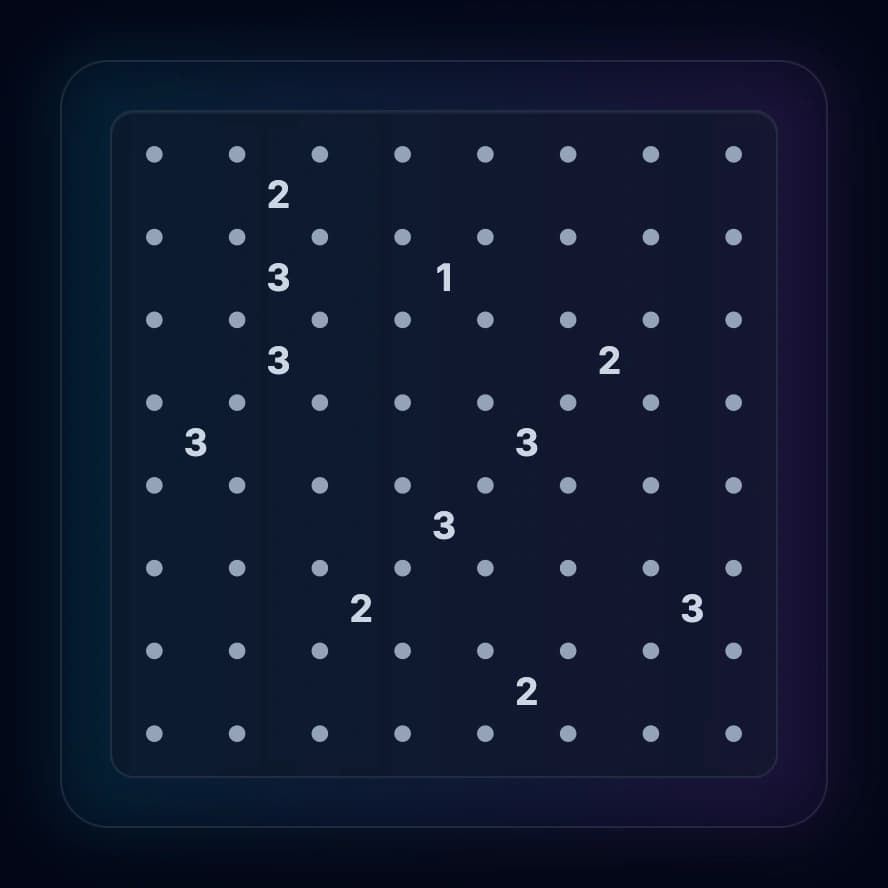
Goal: find all diagonal 3-3s within 5 seconds on a 10x10 grid.
Exercise 2: Parity Practice
Take a partially-solved puzzle. Draw horizontal and vertical lines through the middle of the grid. Count forced crossings along each line. Practice until counting becomes instant.
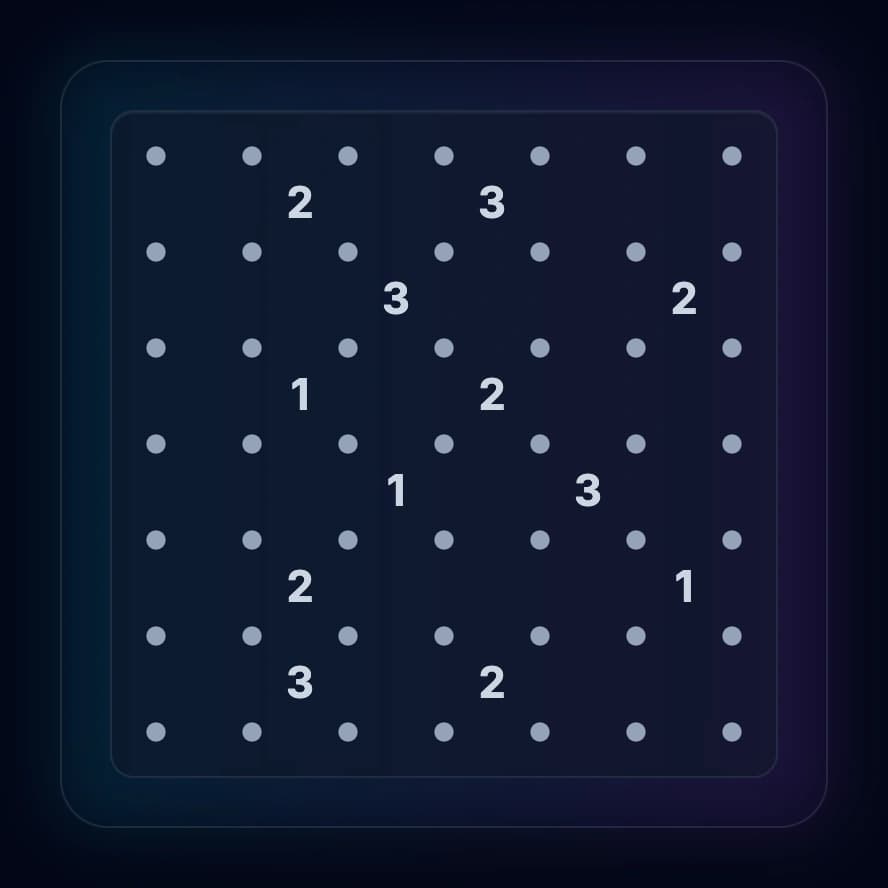
Goal: determine parity constraints within 10 seconds.
Exercise 3: Cascade Tracking
When you complete a cascade (a chain of forced edges), count how many edges you placed. Track your average cascade length over multiple puzzles. Goal: average 4+ edges per cascade on medium puzzles.
Exercise 4: Speed Solving
Time yourself on puzzles of consistent difficulty. Track improvement weekly. Do not sacrifice accuracy for speed initially—accuracy builds true speed. Goal: reduce solving time by 20% over four weeks while maintaining accuracy.
Quick-Reference Cheat Sheet
Pattern Priority Order
- 0 cells (immediate elimination)
- Corner 3s (two forced edges each)
- Diagonal 3-3 pairs (two forced edges each)
- Adjacent 3s (two forced edges)
- Boundary 3s with constraints
- Corner 2s and 1s (mark "both or neither")
- Parity analysis (when stuck)
Parity Rule
Any closed loop crosses any line an even number of times.
Solving Order
Anchor → Cascade → Expand → Bridge → Parity
Speed Tips
- Scan for patterns before marking
- Expand from solved regions
- Trust cascades; verify at the end
- Use proof by contradiction sparingly
Common Intermediate Mistakes
Mistake 1: Ignoring Empty Cells in Cascades
You follow the dot rule along numbered cells but forget that empty cells have dots too. Every dot in the grid—whether adjacent to clues or not—must have 0 or 2 edges. Fix: When cascading, trace your endpoint to every adjacent dot, not just those near numbered cells.
Mistake 2: Creating Premature Closed Loops
In your enthusiasm to draw edges, you accidentally close a small loop that does not encompass the entire puzzle. Fix: Before drawing an edge that would close a loop segment, verify: "Are all clues inside this potential closure already satisfied? If I close here, can I still satisfy clues outside?"
Mistake 3: Forgetting Diagonal 3-3 Extensions
You spot a diagonal 3-3 and draw its corner edges, but then move on without checking for a third diagonal 3. Diagonal chains extend the pattern. Fix: Whenever you find a diagonal 3-3, immediately scan for additional 3s along the same diagonal.
Mistake 4: Overusing Proof by Contradiction
You fall into the habit of assuming and checking instead of looking for direct deductions. This dramatically slows solving. Fix: Only use contradiction after 30+ seconds of direct analysis fails. Train yourself to see more patterns directly.
Mistake 5: Solving Linearly Instead of Strategically
You work through the puzzle left-to-right, top-to-bottom, instead of expanding from certainty. Fix: Consciously practice the anchor-cascade-expand-bridge pattern. It feels unnatural at first but becomes faster with practice.
The Journey to Mastery
You now have the techniques that separate intermediate solvers from beginners: the diagonal 3-3 rule, advanced corner patterns, parity analysis, strategic solving order, and competition-level reasoning.
But here is the truth about Slitherlink mastery: knowing the techniques is not enough. You must internalize them until they become automatic. The diagonal 3-3 should trigger before conscious thought. Parity concerns should arise naturally when you are stuck. Cascade expansion should feel like the only logical approach.
This internalization takes time and deliberate practice. Every puzzle you solve with these techniques in mind strengthens the neural pathways. After a few hundred puzzles, what once required conscious effort becomes instinct.
The reward is worth it. Advanced Slitherlink solving has a flow state unlike any other puzzle. You see the loop forming before your pen moves. Constraints cascade through the grid like dominoes falling. The final edge closes the loop with a satisfying inevitability—every segment proven, every doubt resolved.
That experience is waiting for you—one pattern at a time.
Now go draw some loops.
Your Practice Roadmap
Start with Medium puzzles to practice the diagonal 3-3 rule and cascade expansion. Focus on spotting patterns before making any marks. Speed is not the goal yet—building pattern recognition is.
Move to Hard puzzles once diagonal 3-3s and corner patterns feel automatic. Hard puzzles require parity analysis and occasionally proof by contradiction. You will know you are ready when Medium puzzles feel almost too straightforward.
Graduate to Expert puzzles when your Hard puzzle cascades regularly chain 5+ edges and parity checks happen without conscious effort. Expert puzzles demand all techniques working in concert.
Ready to Draw Some Loops?
The diagonal 3-3 rule is in your head. Parity analysis is waiting to be deployed. All that's left is to feel the cascade flow through an entire grid.
Start Solving SlitherlinkPut it into practice
Ready to solve Slitherlink?
Open a free puzzle and turn the ideas from this guide into your next solve.