Kakuro Strategies:
Essential Combinations Every Solver Must Know
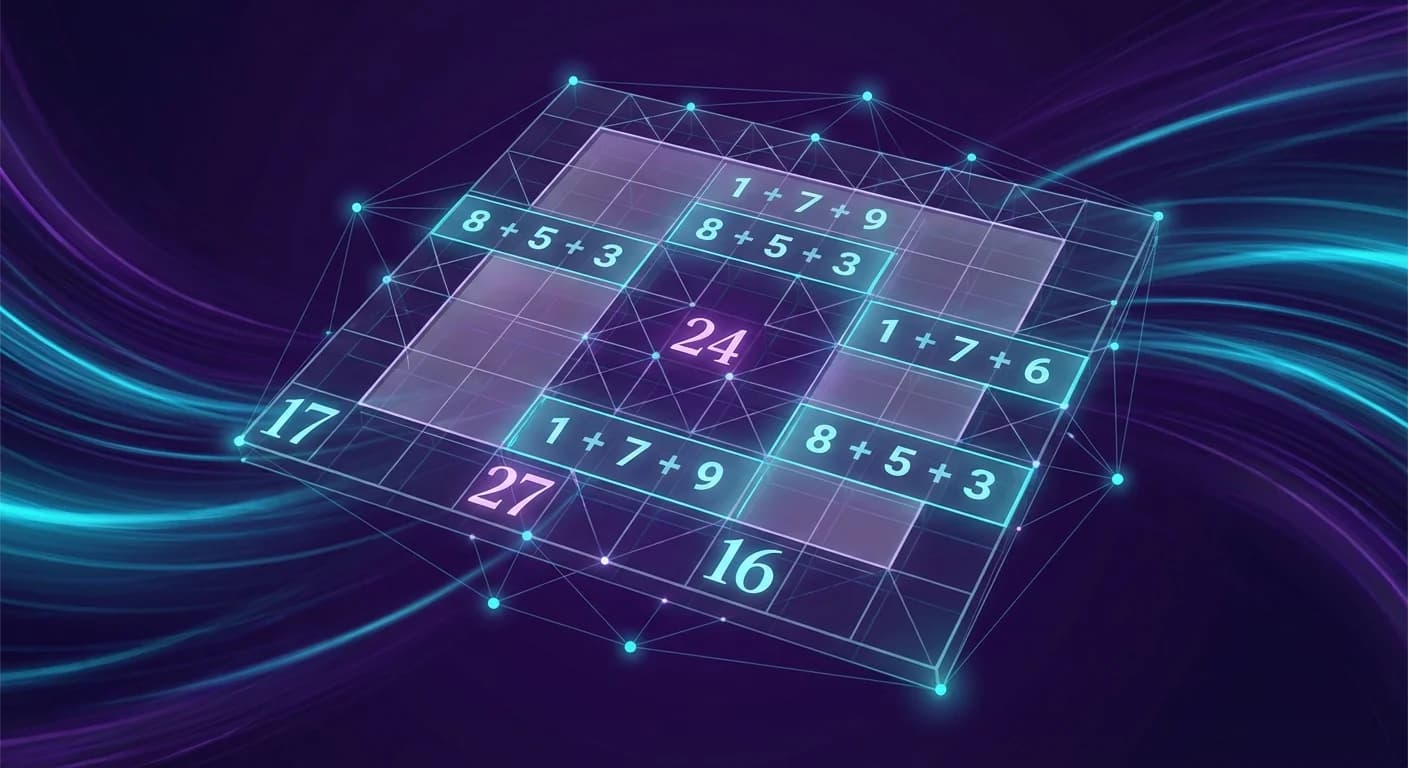
There is a moment in every Kakuro solver's journey when the puzzle stops being about arithmetic and starts being about recognition.
You see "17 in two cells" and your hand reaches for 8 and 9 before your conscious mind finishes reading the clue. You spot "24 in three cells" and immediately know it must be 7, 8, and 9. The numbers are not calculated—they are recalled, like the face of an old friend.
This is the difference between solving Kakuro and mastering it. The calculations that once took precious seconds now happen instantaneously. The logic that required careful thought now flows automatically. What remains is pure pattern recognition, cross-referencing, and the satisfying cascade of deductions that turns a grid of empty cells into a completed puzzle.
Watch the Tutorial
Prefer watching? This quick tutorial covers the fundamentals of Kakuro solving.
Prerequisites
This guide builds on concepts from our beginner's guide—understanding Kakuro rules, reading clue cells, and basic intersection logic. If any of these feel unfamiliar, start there first.
The Foundation: Understanding Unique Combinations
Before we dive into advanced strategies, we need to establish why certain number combinations are more valuable than others.
In Kakuro, a clue tells you two things: the target sum and the number of cells. Some clue-length combinations can only be achieved one way. Others have multiple possibilities. The combinations with only one solution are pure gold—they give you certain knowledge before placing a single digit.
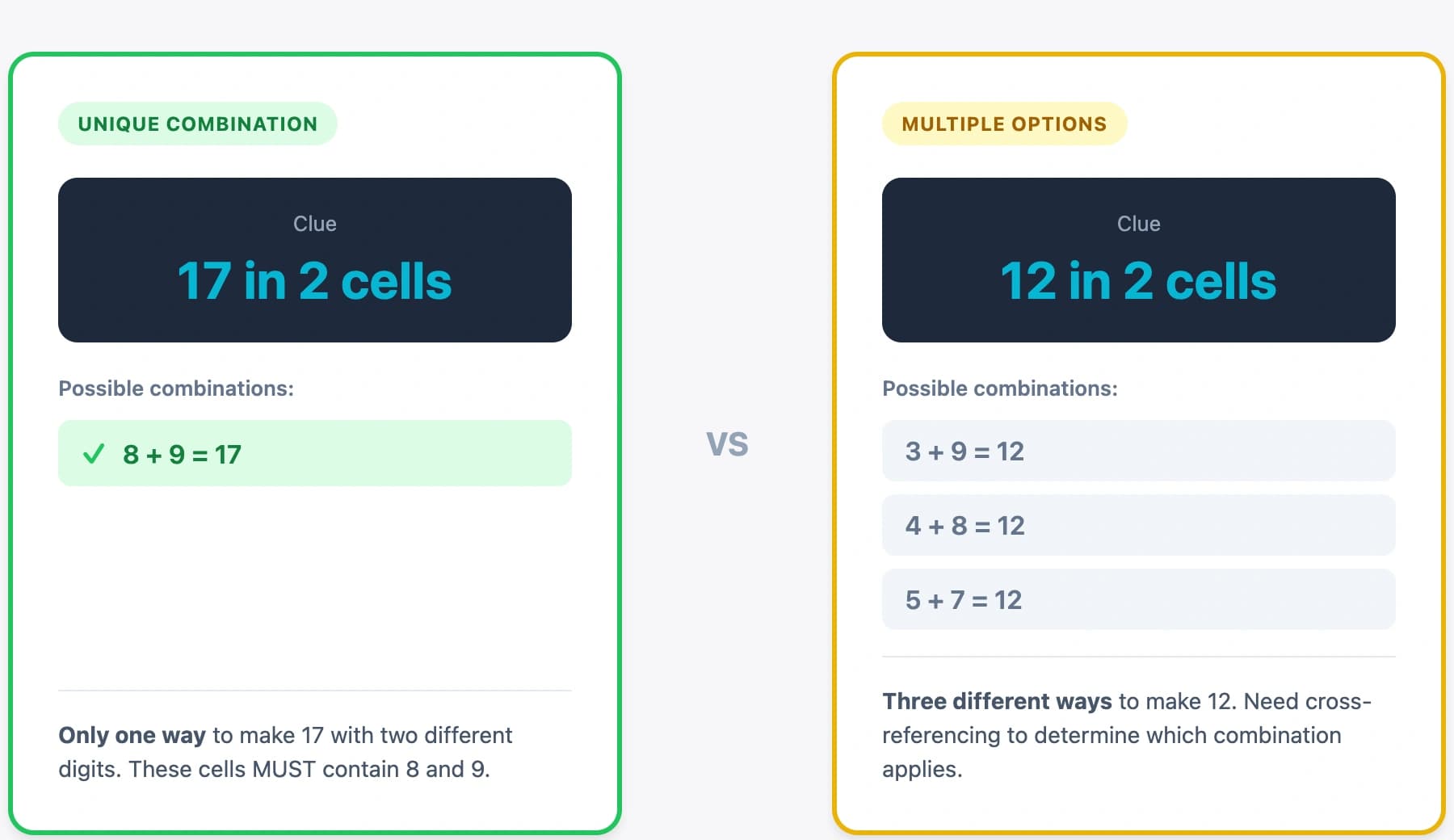
Unique combinations give you certain knowledge—multiple options require cross-referencing.
The master solver scans for unique combinations first, uses them to establish footholds, and then leverages intersecting clues to resolve the ambiguous runs.
The Complete Magic Numbers Reference
These are the combinations you should know by heart. They represent every sum-and-length pairing that has only one possible set of digits.
Two-Cell Magic Numbers
The extremes of the two-cell range are your most powerful allies:
| Sum | Combination | Memory Aid |
|---|---|---|
| 3 | 1 + 2 | The minimum |
| 4 | 1 + 3 | Just above minimum |
| 16 | 7 + 9 | Just below maximum |
| 17 | 8 + 9 | The maximum |
Three-Cell Magic Numbers
| Sum | Combination | Memory Aid |
|---|---|---|
| 6 | 1 + 2 + 3 | The minimum (1+2+3=6) |
| 7 | 1 + 2 + 4 | One above minimum |
| 23 | 6 + 8 + 9 | One below maximum |
| 24 | 7 + 8 + 9 | The maximum (7+8+9=24) |
Four-Cell Magic Numbers
| Sum | Combination | Memory Aid |
|---|---|---|
| 10 | 1 + 2 + 3 + 4 | The minimum |
| 11 | 1 + 2 + 3 + 5 | One above minimum |
| 29 | 5 + 7 + 8 + 9 | One below maximum |
| 30 | 6 + 7 + 8 + 9 | The maximum |
View 5, 6, and 7-cell magic numbers
Five-Cell Magic Numbers
Six-Cell Magic Numbers
Seven-Cell Magic Numbers
The Pattern Behind the Magic
Notice the pattern: magic numbers cluster at the minimum and maximum possible sums for each length. This makes intuitive sense—when you are forced to use the smallest or largest possible digits, there is less room for variation.
The minimum sum for N cells is: 1 + 2 + 3 + ... + N = N(N+1)/2
The maximum sum for N cells is: (10-N) + (11-N) + ... + 9 = the N largest digits
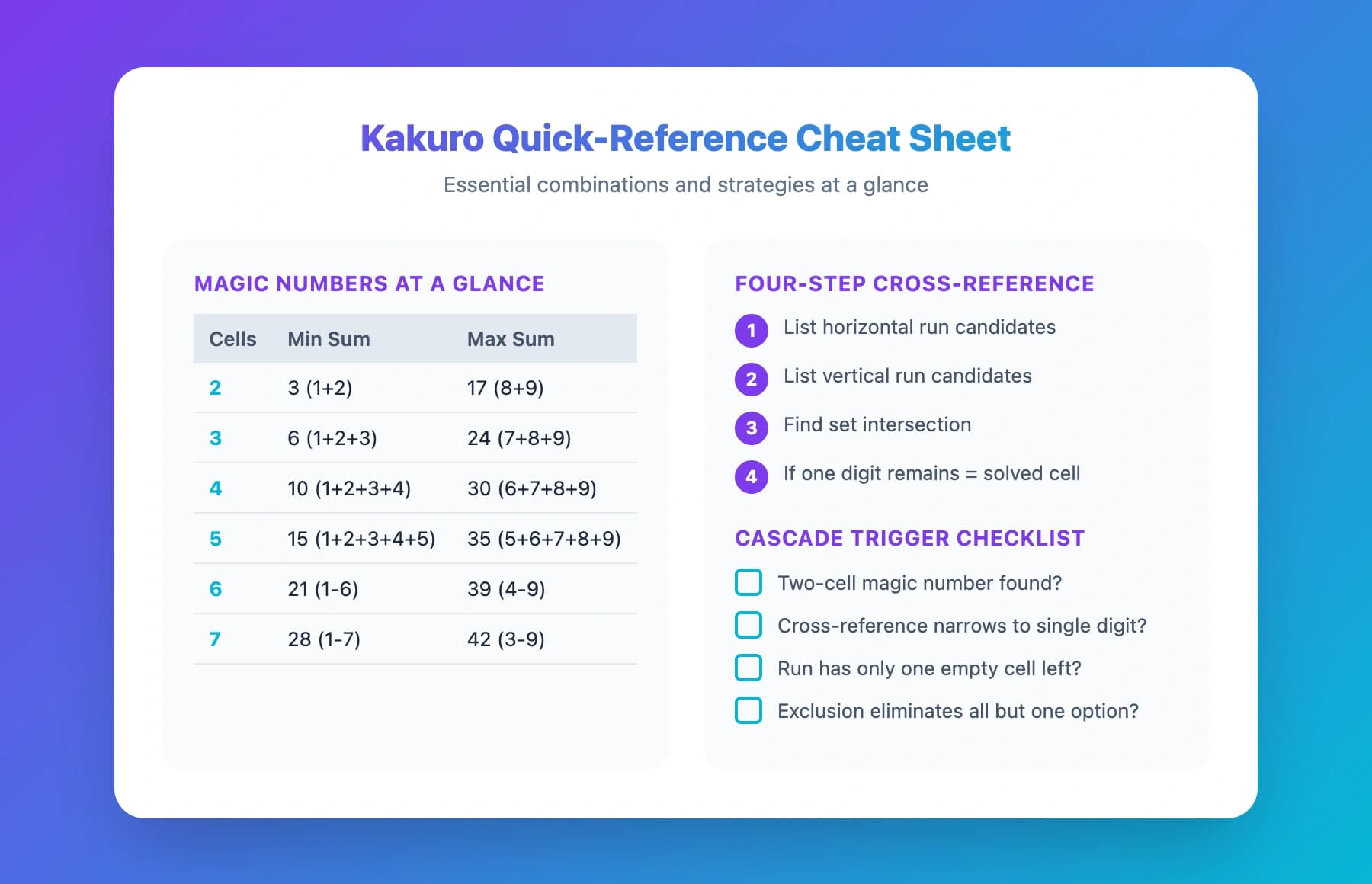
Save this cheat sheet—reference it while you build automatic recall.
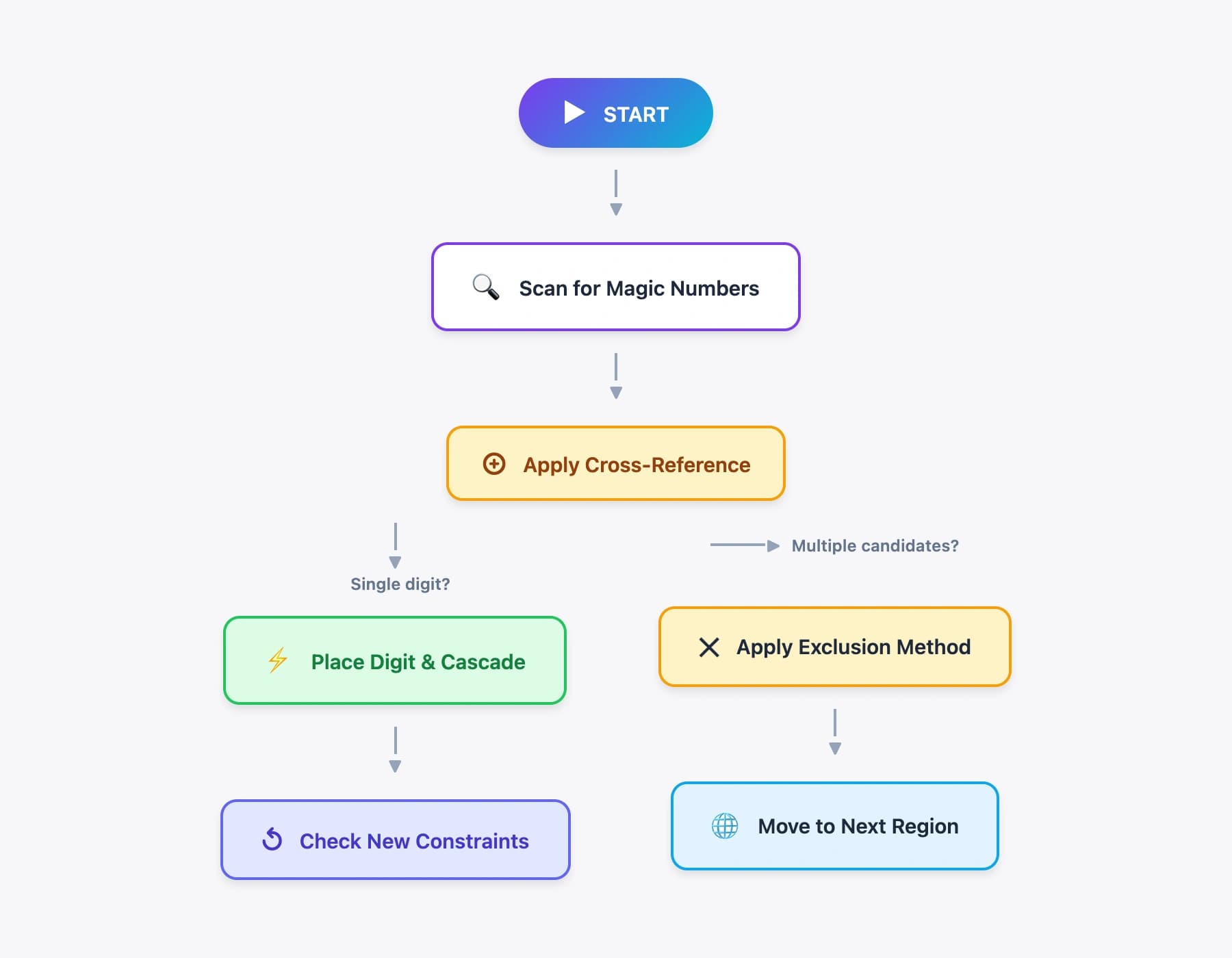
The solving flow: scan → cross-reference → cascade → exclusion → next region.
Cross-Reference Technique: Finding Forced Cells
Knowing the magic numbers is just the beginning. The real power comes from cross-referencing—using the intersection of horizontal and vertical constraints to force specific digits into specific cells.
The Basic Cross-Reference
Every white cell in Kakuro belongs to exactly two runs: one horizontal, one vertical. When you know the possible digits for each run, the cell can only contain digits that appear in both sets.
The intersection of {8,9} and {7,9} yields only 9—this cell is solved.
Consider this example: the horizontal clue "17 in 2 cells" means this run must contain {8, 9}—the only way to make 17 with two different digits. The vertical clue "16 in 2 cells" means this run must contain {7, 9}—the only way to make 16 with two different digits.
The intersection cell must satisfy both constraints. Which digit appears in both {8, 9} and {7, 9}? Only 9.
This cell must be 9. No other digit satisfies both clues. From this single deduction, the entire region unlocks: the horizontal run's other cell must be 8 (since 17 - 9 = 8), and the vertical run's other cell must be 7 (since 16 - 9 = 7).
The Cross-Reference Algorithm
- Identify the possible digits for the horizontal run
- Identify the possible digits for the vertical run
- Find the intersection of these two sets
- If one digit remains, that cell is solved
- If multiple digits remain, note them as candidates for later
Common Question: What if two magic numbers share a cell but have no common digits?
Answer: You have found an error—recheck your constraints. Cross-referencing also serves as a powerful error-detection tool.
The Cascade Method: Unlocking Chain Reactions
The cascade method is where Kakuro transcends arithmetic and becomes pure logical flow. One solved cell triggers another, which triggers another, creating a chain reaction that can fill an entire region.
Anatomy of a Cascade
Here is what a typical cascade looks like in practice. A grid full of empty cells, nothing obvious. Then a "17 in 2" intersecting with a "16 in 2" reveals itself. Cross-reference: the shared cell must be 9. Place it. Suddenly the 8 falls into place. Then the 7. Then a cell in the adjacent run becomes forced. Within ninety seconds, an entire corner of the puzzle fills from that single 9. That is the cascade in action.
Step 1: Find your entry point
Scan for magic numbers that intersect. "17 in 2 cells" = {8, 9}, "16 in 2 cells" = {7, 9}. The intersection must be 9—the only digit in both sets.
Step 2: Place and propagate
With 9 placed in the intersection: the "17 in 2" run now has one cell remaining = 17 - 9 = 8. The "16 in 2" run's remaining cell = 16 - 9 = 7. Three cells solved from one cross-reference.
Step 3: Follow the chain
Now check what the 8 and 7 force in their perpendicular runs. Each placement creates new constraints. Follow every thread until the cascade naturally stops.
Triggering the Cascade
The best cascade triggers are:
- 1.Unique two-cell combinations (3, 4, 16, 17 in two cells) — these give you exactly two known digits, and cross-referencing often forces one specific placement.
- 2.Nearly-solved runs — a run with only one empty cell remaining. The missing digit is simply: target sum minus placed digits.
- 3.Constrained intersections — a cell where horizontal and vertical constraints narrow to 1-2 options. Placing this cell often completes one or both runs.
Advanced Technique: The Exclusion Method
Sometimes direct cross-referencing does not immediately solve a cell, but it gives you powerful information for elimination within a run.
Consider a three-cell run summing to 15. The possible combinations are: {1,5,9}, {1,6,8}, {2,4,9}, {2,5,8}, {2,6,7}, {3,4,8}, {3,5,7}, {4,5,6}. That is eight different combinations—not very helpful on its own.
But what if cross-referencing tells you that one cell must be 8 or 9? Now you can exclude any combination that does not include 8 or 9. Still multiple options, but we have cut the possibilities nearly in half.
Exclusion shines when direct cross-referencing stalls. For example, a stubborn "15 in 3" run may seem intractable until exclusion reveals that every valid combination forces a 3 into the corner cell. That single insight can open up an entire region. Exclusion finds what direct cross-referencing misses.
The Regional Analysis Approach
For larger puzzles, thinking cell-by-cell becomes overwhelming. Regional analysis lets you solve in chunks.
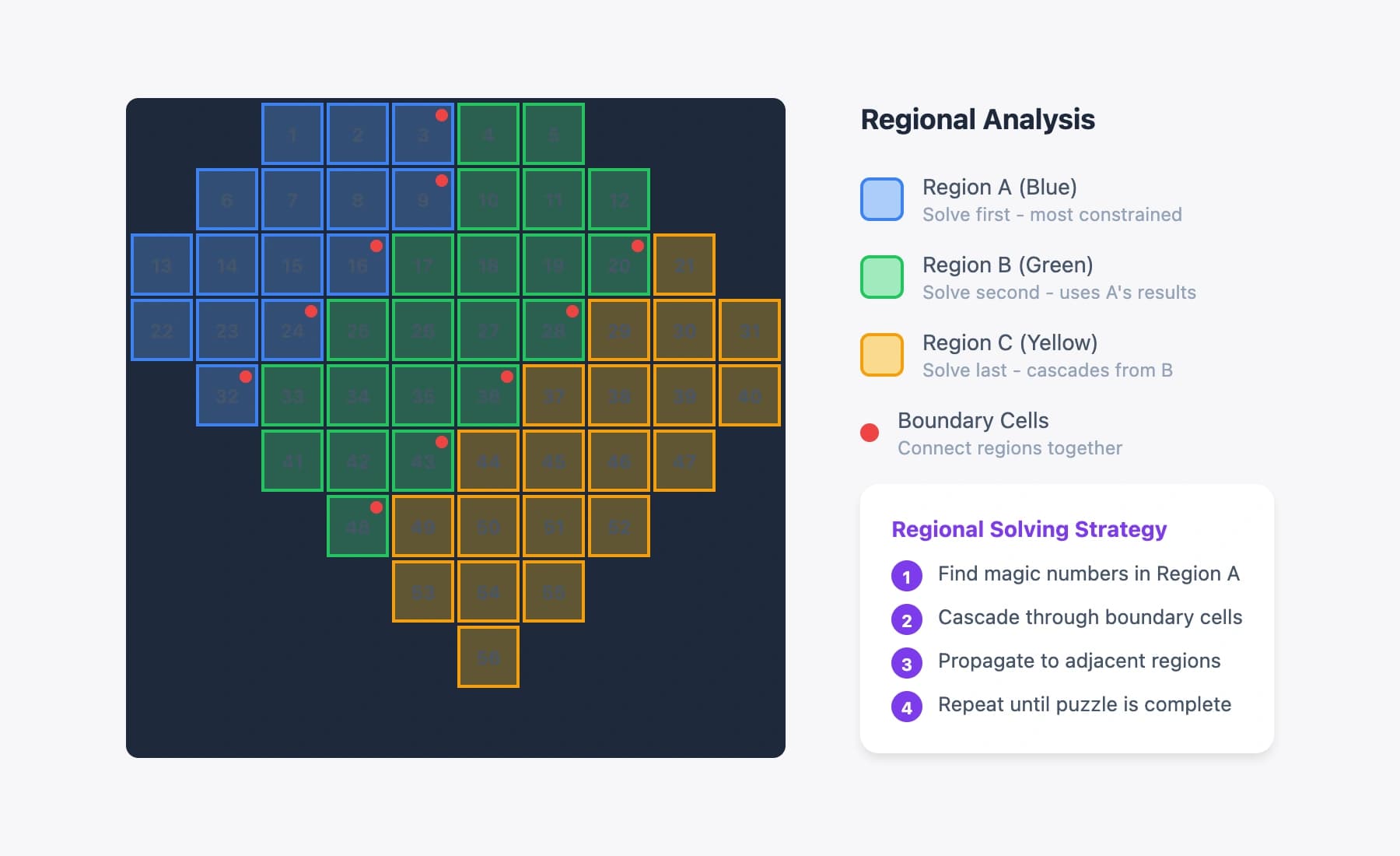
Regional analysis: solve one region at a time, using boundary cells as bridges.
Within each region: (1) Find all magic numbers touching the region, (2) Cross-reference every intersection, (3) Cascade from any forced cells, (4) Apply exclusion to narrow remaining ambiguities, (5) Move to adjacent region using boundary cells as bridges.
This is how expert solvers approach large Kakuro grids—not as 100+ individual cells, but as 8-10 interconnected regions with logical bridges between them.
Common Intermediate Mistakes
Mistake 1: Forgetting the No-Repeat Rule Mid-Cascade
You are cascading beautifully, placing digits rapidly, and you accidentally put a 7 in a run that already has a 7. Fix: When cascading, briefly check: "Is this digit already in this run?"
Mistake 2: Incomplete Cross-Referencing
You cross-reference using one constraint but forget the cell has another constraint from a perpendicular run. Fix: Always identify both constraints before declaring a cell's candidates.
Mistake 3: Abandoning Cascades Too Early
The cascade seems to stop, so you look for a new entry point. But there was one more forced cell you missed. Fix: Before abandoning a cascade, systematically check every cell you just placed for additional implications.
Building Mastery: A Practice Progression
Week 1: Magic Number Recognition
Solve puzzles focusing exclusively on magic numbers. Circle every unique combination clue before solving. Note how they cascade into non-unique runs.
Week 2: Cross-Reference Fluency
For every intersection cell, explicitly list horizontal candidates, vertical candidates, and the intersection. Do this even when the answer seems obvious.
Week 3: Cascade Chains
Time how long your cascades last. A good intermediate solver should average 3-4 cells per cascade. Work toward 5-6.
Week 4: Regional Thinking
Practice dividing puzzles into regions before solving. Identify your planned solving order. Then execute and see if your regional analysis was correct.
Week 5: Speed Integration
Put it all together. Time yourself. Track improvement. Aim for smooth, confident solving where each technique flows into the next.
The Journey Continues
You now have the tools that separate casual solvers from serious enthusiasts. The magic numbers will become second nature. Cross-referencing will happen automatically. Cascades will flow through entire regions.
But here is the beautiful truth about Kakuro: there is always more to learn. Larger grids introduce complex regional interactions. Competition-level puzzles require techniques we have not even touched—bifurcation analysis, proof by contradiction, global constraint reasoning.
What you have learned here is the foundation. It is more than enough to solve any standard Kakuro puzzle with confidence. And it is the launching pad for everything that comes next.
The next time you see "17 in two cells," your hand will reach for the 8 and 9 before your conscious mind finishes reading. That is mastery beginning to form.
Now go build it.
Your Practice Roadmap
Start with Easy puzzles to build magic number recognition. Focus on spotting the 3s, 4s, 16s, and 17s instantly. Prioritize accuracy over speed.
Move to Medium puzzles once you can identify all magic numbers within 10 seconds of seeing the grid. This is where cross-referencing becomes essential.
Graduate to Hard puzzles when your cascades regularly chain 4-5 cells. Hard puzzles require the exclusion method and regional thinking.
Ready to Master Your Cascades?
The magic numbers are in your head. The cross-reference algorithm is second nature. All that's left is to feel the cascade flow through an entire region.
Start Solving KakuroPut it into practice
Ready to solve Kakuro?
Open a free puzzle and turn the ideas from this guide into your next solve.