Sudoku Puzzle:
A Complete Beginner's Guide to Number Placement
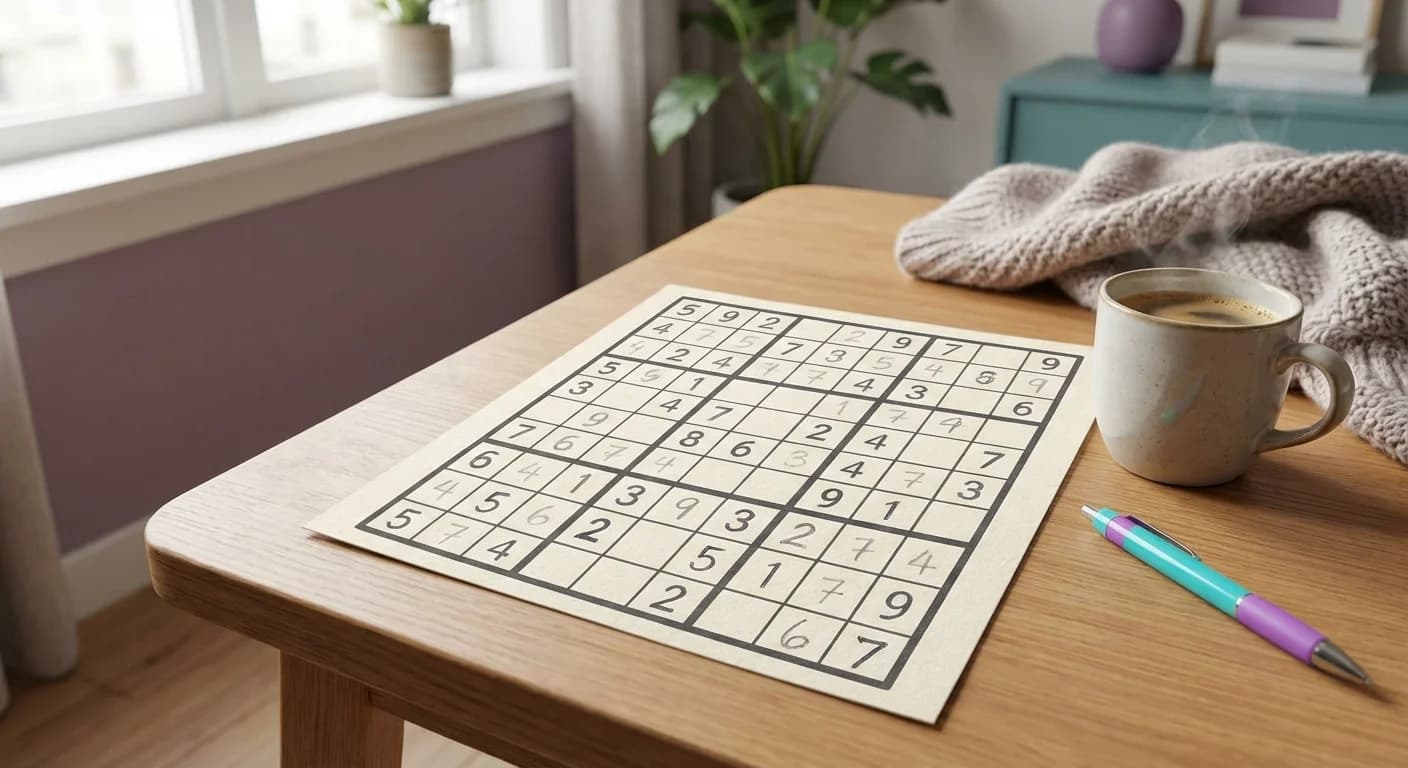
You are sitting in a coffee shop. The person at the next table pulls out a newspaper, flips to the puzzle page, and starts filling in a grid of numbers. Within minutes, they are completely absorbed—occasionally pausing, nodding to themselves, then writing with renewed confidence.
That focused contentment? It is the Sudoku experience. And it is far more accessible than most people think. Sudoku has become the world's most popular logic puzzle for a reason: the rules take sixty seconds to learn, the satisfaction is immediate, and the depth keeps you coming back for years.
No math required—despite all those numbers staring back at you. Just pure logical deduction. This guide will take you from "I have no idea where to start" to confidently solving your first puzzle.
Watch the Tutorial
Prefer watching? This short video walks you through the rules and key strategies.
A Reliable First-Solve Loop
Beginners often scan the whole grid without a plan and repeatedly inspect the same cells. Use this short loop instead. It gives every pass a purpose and tells you what to try next when the obvious placements run out.
- 01
Finish nearly complete units
Check rows, columns, and boxes with only one or two empty cells. Their missing digits are the fastest deductions.
- 02
Sweep one digit at a time
Choose a digit and scan all nine boxes. Existing copies often leave that digit only one legal position in a box.
- 03
Add candidates only when needed
When direct scanning stops, note the legal digits in unresolved cells instead of trying to hold every option in memory.
- 04
Rescan after every placement
A new digit changes its row, column, and box. Check those three units immediately before searching elsewhere.
If the loop produces nothing, verify your previous placements before escalating to harder techniques. A valid beginner puzzle should not require a guess.
What Is Sudoku?
Sudoku is a number-placement puzzle played on a 9×9 grid. Your goal: fill every cell with a digit from 1 to 9, following three simple rules. The puzzle provides some starting numbers (called "givens"), and you deduce the rest through logic.
The name comes from the Japanese phrase "Suuji wa dokushin ni kagiru," which means "the digits must remain single"—a perfect description of the puzzle's core constraint. Though the name is Japanese, the modern puzzle was actually invented in 1979 by American architect Howard Garns, who called it "Number Place." It was later popularized in Japan in the 1980s before sweeping across the globe in 2004.
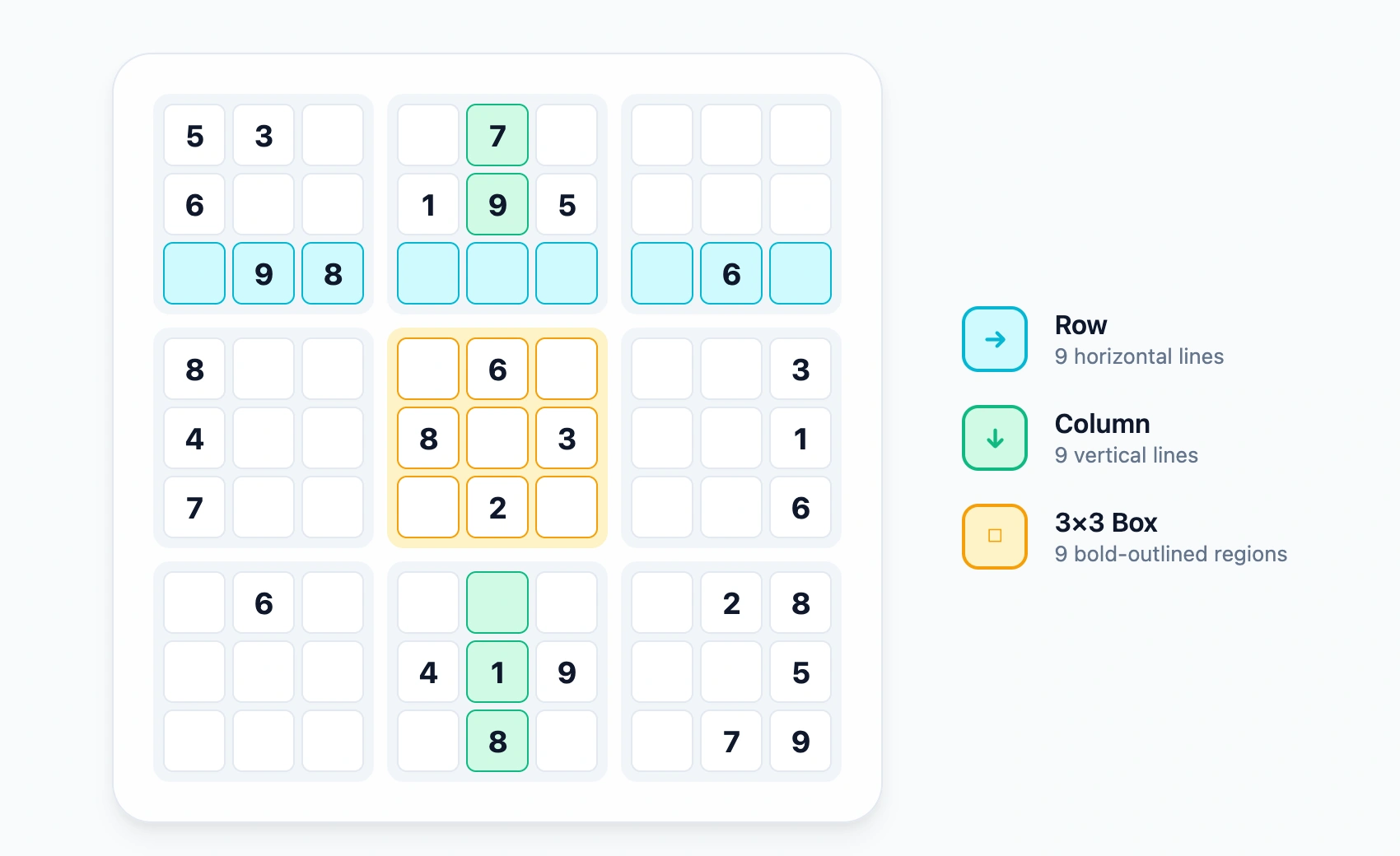
A Sudoku grid showing rows (blue), columns (green), and 3×3 boxes (yellow)—each must contain 1-9 exactly once.
The Three Golden Rules
Every Sudoku puzzle follows exactly three rules. Master these, and you understand the entire game.
Rule 1: Each Row Contains 1-9 (No Repeats)
Look at any horizontal row across the grid. It must contain each digit from 1 to 9 exactly once. If you see a 7 in a row, no other cell in that row can be 7. Think of it like a dinner party with nine seats—each guest (digit) gets exactly one chair.
Rule 2: Each Column Contains 1-9 (No Repeats)
The same logic applies vertically. Every column must have each digit from 1 to 9 exactly once. If a column already has a 3, you cannot place another 3 anywhere in that column.
Rule 3: Each 3×3 Box Contains 1-9 (No Repeats)
The grid is divided into nine 3×3 boxes (outlined with thicker borders). Each box must also contain the digits 1 through 9 exactly once. This is where Sudoku gets interesting—cells must satisfy their row AND column AND box simultaneously.
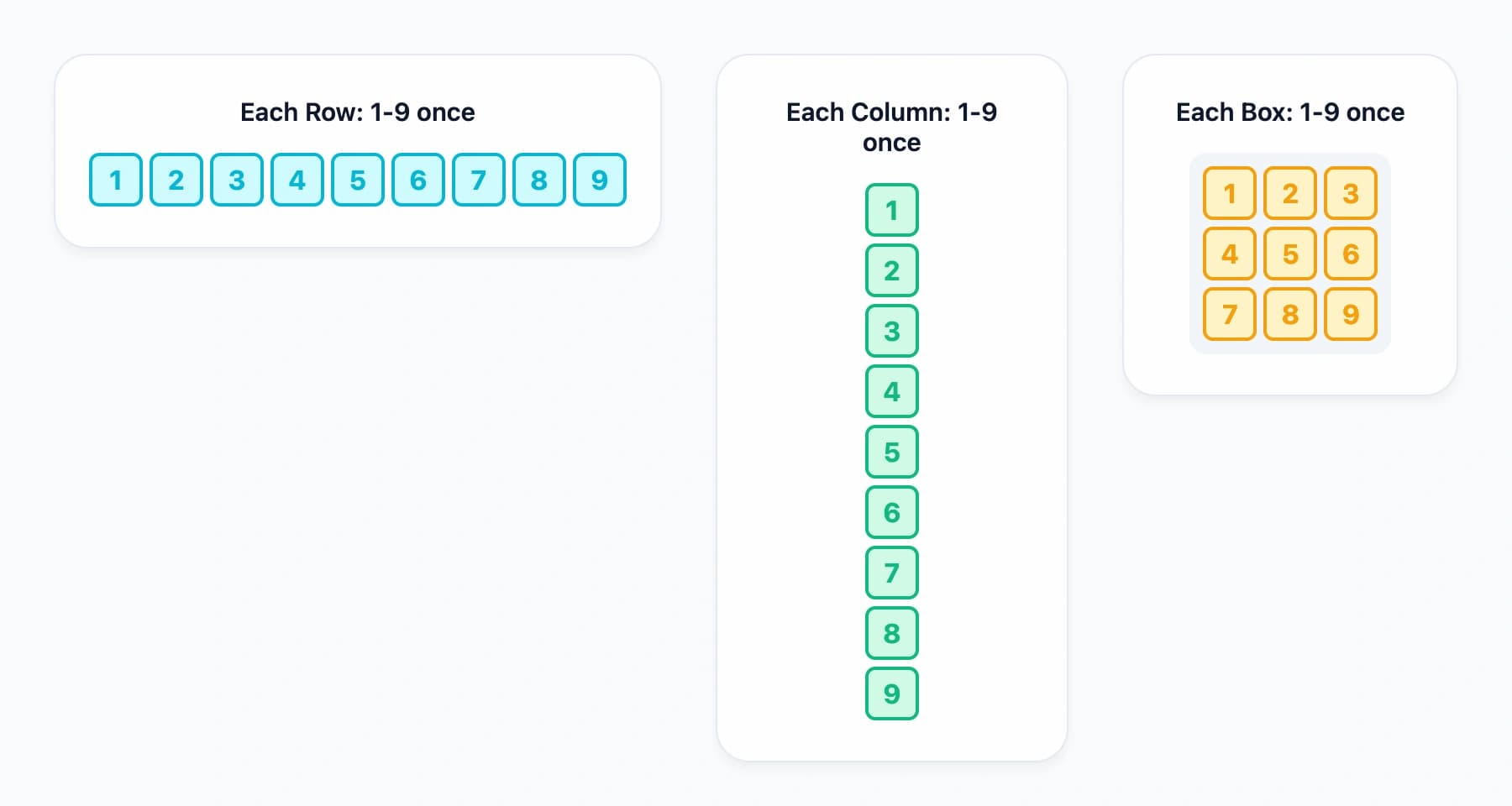
Three rules, infinite puzzles. Every cell must satisfy all three constraints simultaneously.
The magic happens at the intersections. Every cell belongs to exactly one row, one column, and one box. To place a number, it must be valid in all three groups. This triple constraint is why Sudoku puzzles have unique solutions and why the deduction feels so satisfying.
Understanding the Grid
Before we solve, let us make sure you can read the puzzle correctly.
The Structure
- • 81 cells arranged in a 9×9 square
- • 9 rows (horizontal lines)
- • 9 columns (vertical lines)
- • 9 boxes (the 3×3 sections with thick borders)
Given Numbers vs. Empty Cells
When you start a puzzle, some cells already contain numbers—these are the "givens" or "clues." They are fixed and cannot be changed. Your job is to fill the empty cells while respecting all three rules.
Difficulty Levels
The number of givens determines difficulty. Easy puzzles might have 35-40 givens. Medium puzzles have 30-35. Hard puzzles can have as few as 20-25. The placement of givens matters as much as the quantity.
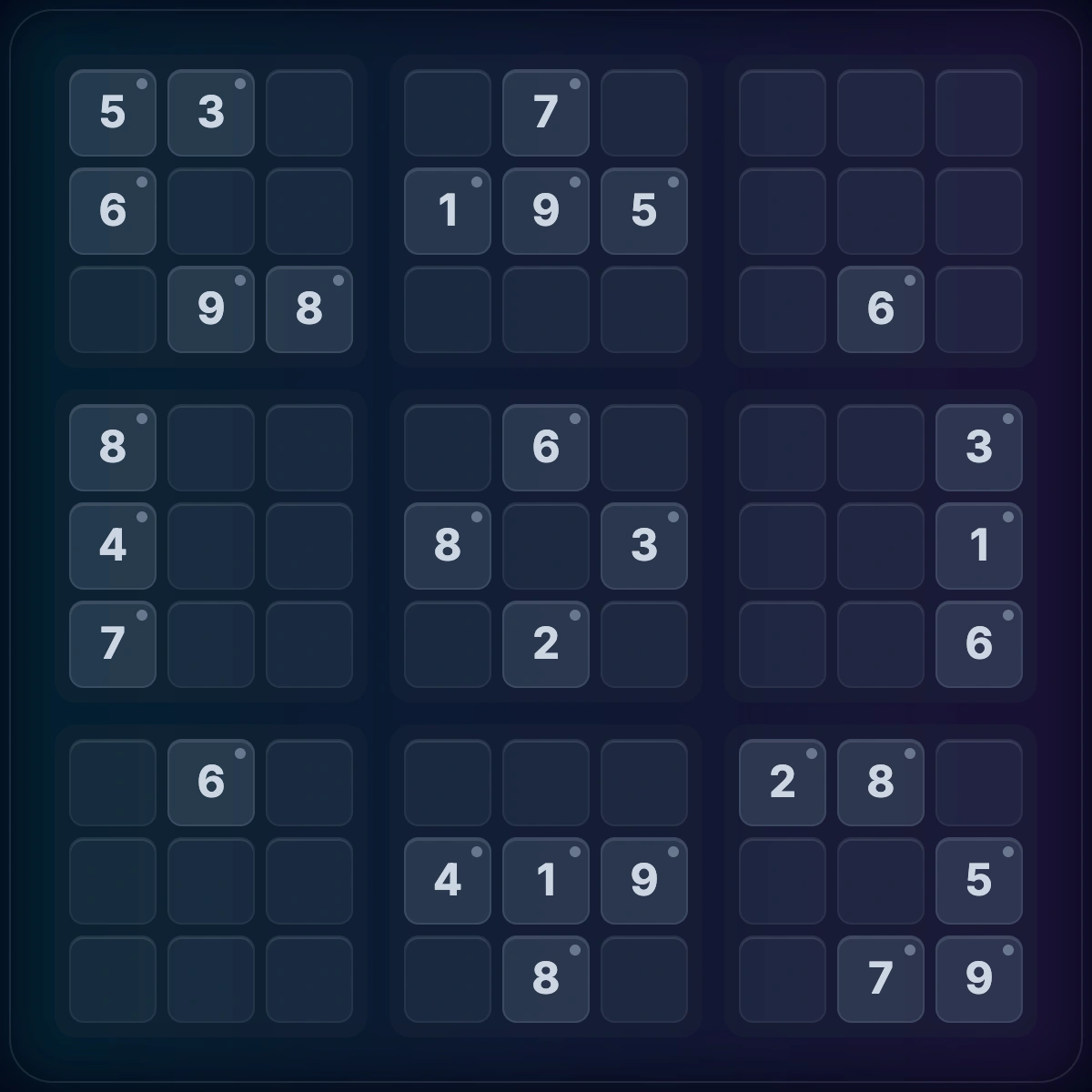
A typical beginner puzzle with approximately 35 givens to get you started.
Your First Solve: A Complete Walkthrough
Theory is helpful. Practice is essential. Let us solve a beginner-friendly 4×4 Sudoku together, step by step. A 4×4 Sudoku follows identical rules to the 9×9 version, just smaller: each row, column, and 2×2 box must contain the digits 1 through 4 exactly once.
The Starting Puzzle
Here is our starting grid. We have 6 given numbers and 10 empty cells to fill.
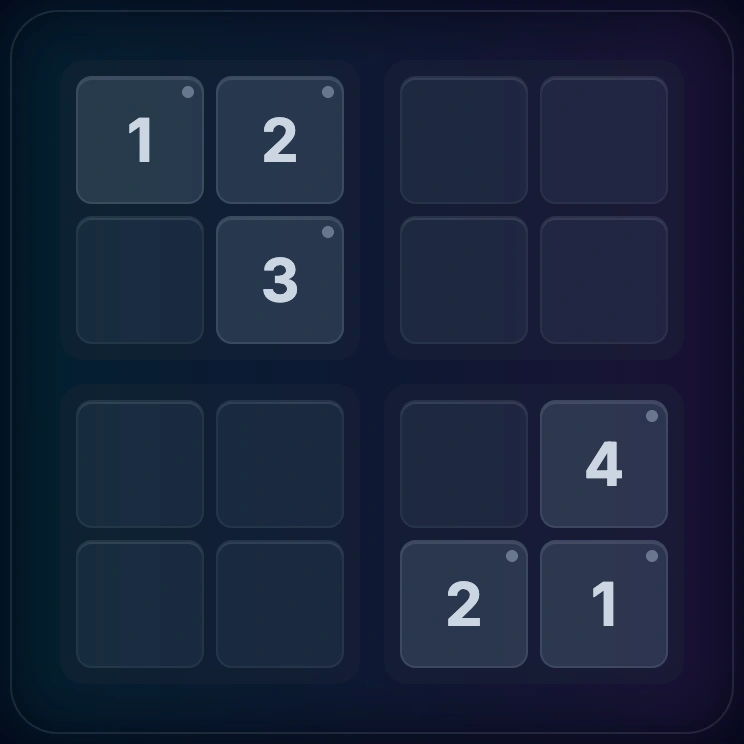
Row 1: 1, 2, _, _ | Row 2: _, 3, _, _ | Row 3: _, _, 4, _ | Row 4: _, _, 2, 1
Step 1: Analyzing Row 1
Row 1 has the digits 1 and 2 already placed. It needs 3 and 4 in its two empty cells. Row 1, Column 3: Row needs 3 or 4. Column 3 contains 4 and 2, so it needs 1 and 3. The intersection of "3 or 4" and "1 or 3" gives us exactly one digit: 3.
Row 1, Column 4: With 3 now placed, this cell needs 4 (the only remaining digit for Row 1).
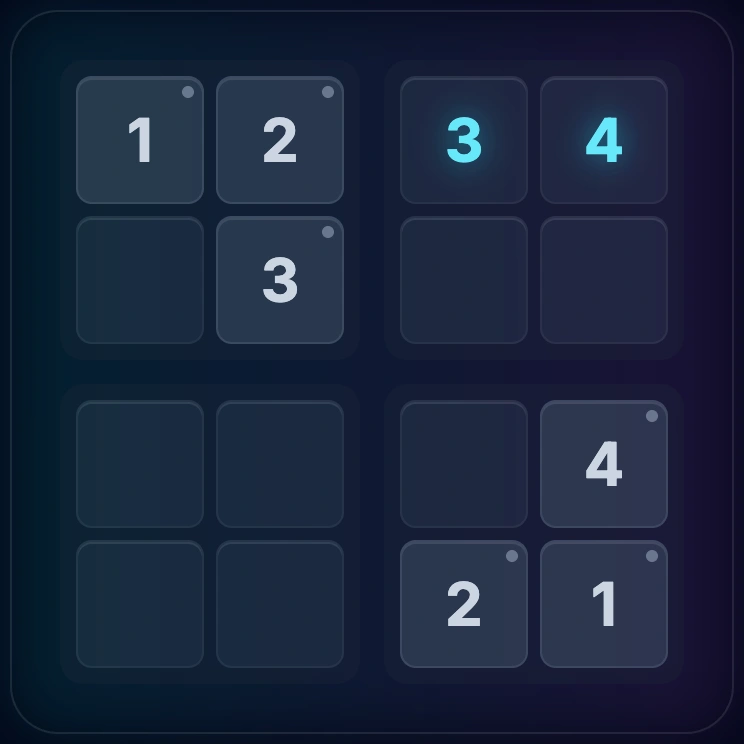
Row 1 complete: 1, 2, 3, 4. This technique—finding a cell where constraints leave only one option—is called a "naked single."
Step 2: Completing Column 4
Column 4 now contains 4 and 1. It needs 2 and 3. Row 2, Column 4: Row 2 has only a 3, so it needs 1, 2, and 4. Column 4 needs 2 or 3. The intersection is 2. Row 3, Column 4: Column 4 now needs only 3.
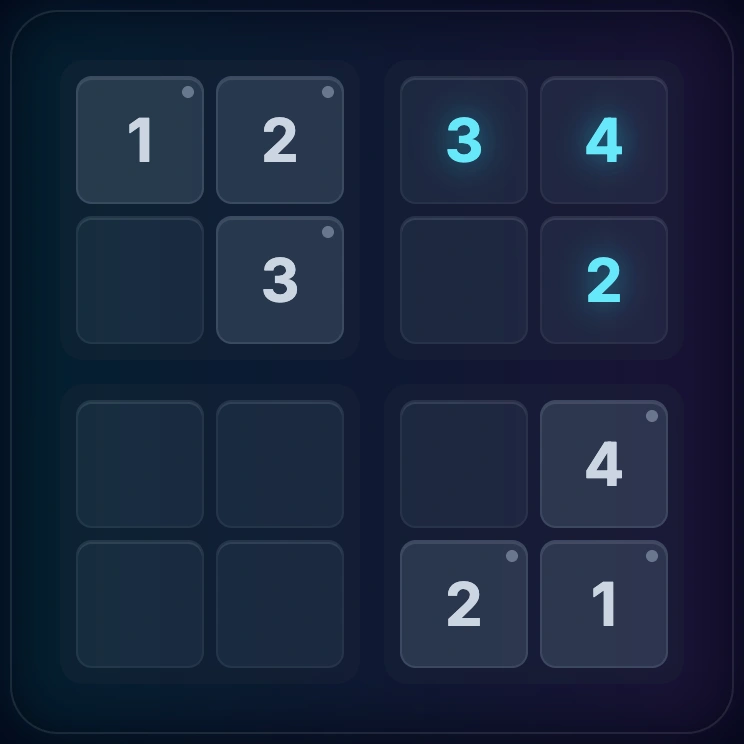
Column 4 complete: 4, 2, 3, 1. Each placement opens new opportunities.
Step 3: Using Box Constraints
Let us examine the top-left box (rows 1-2, columns 1-2). This box contains: 1, 2, 3. It needs only 4 in the remaining cell at Row 2, Column 1.
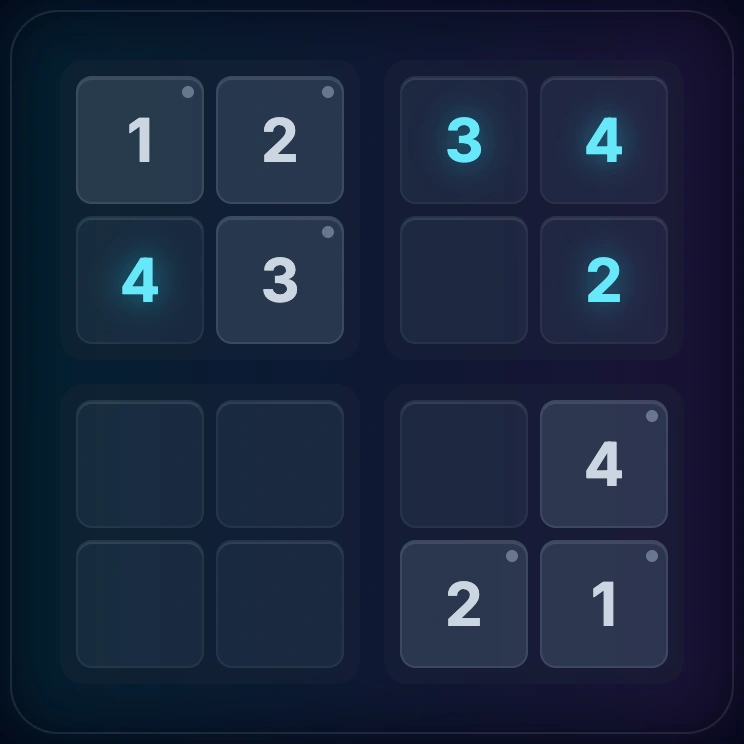
Box constraints narrow possibilities—the top-left box needs only one more digit.
Step 4: Completing Row 2
Row 2 now reads: 4, 3, _, 2. It has 4, 3, and 2. The missing digit is 1.
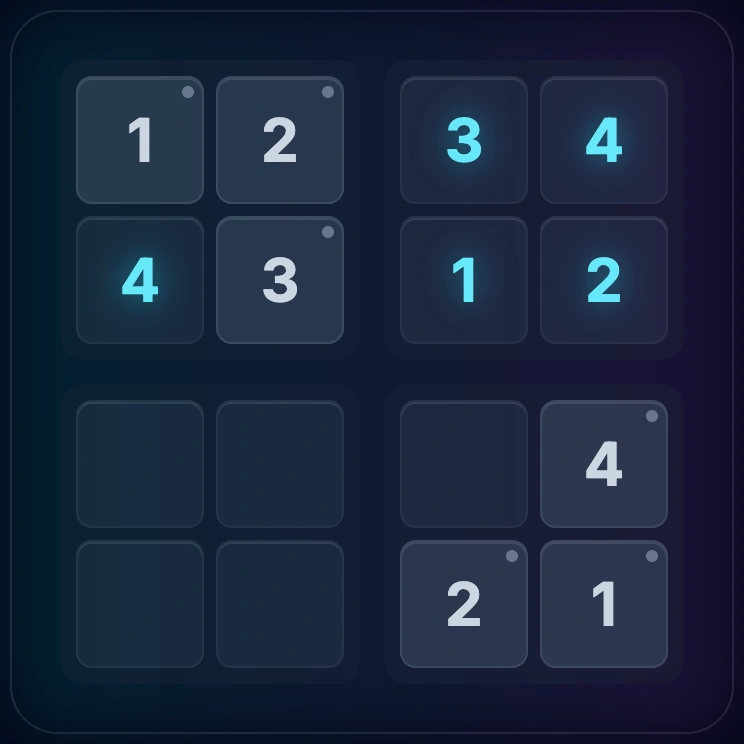
Row 2 complete: 4, 3, 1, 2. The cascade continues.
Step 5: The Cascade Continues
Column 1 has: 1, 4. It needs 2 and 3. Row 3, Column 1: Row 3 has 4 and 3, needs 1 and 2. Column 1 needs 2 or 3. Intersection: 2. Row 4, Column 1: Column 1 now needs only 3.
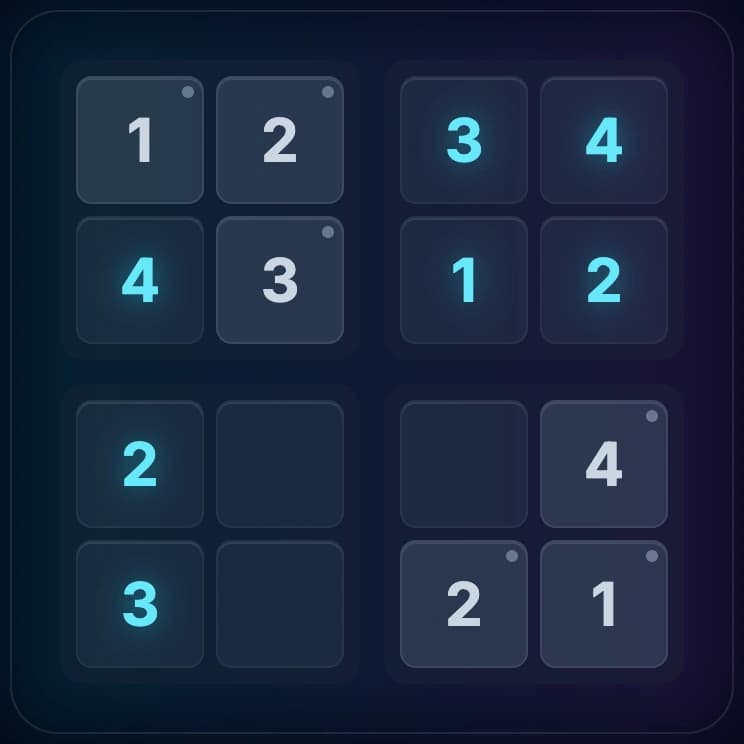
Column 1 complete: 1, 4, 2, 3. Almost there!
Step 6: Solved!
Row 3 reads: 2, _, 4, 3. Missing digit: 1 in Column 2. Row 4 reads: 3, _, 2, 1. Missing digit: 4 in Column 2.
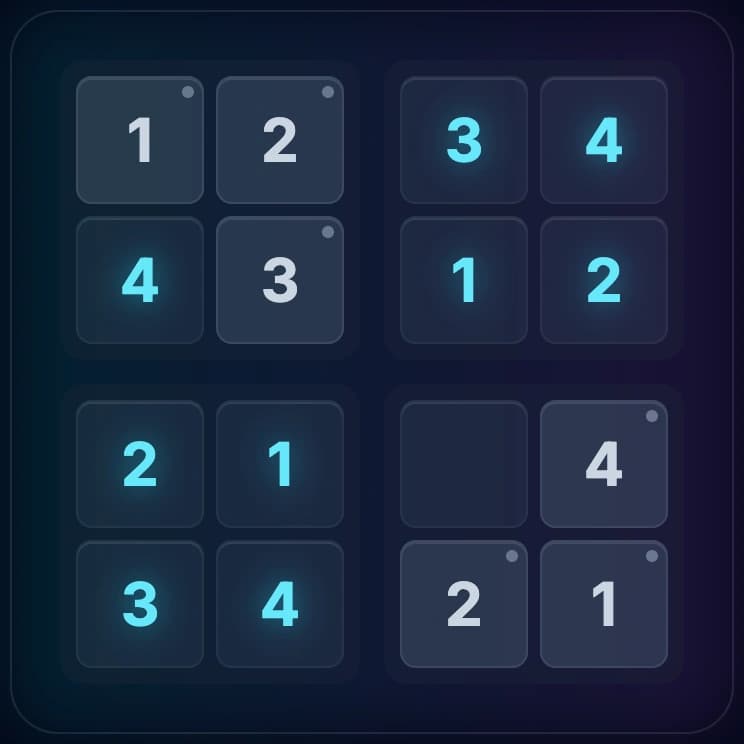
Every row, column, and box contains 1, 2, 3, 4 exactly once. Solved!
The Solving Process
- Examine constraints (row, column, box)
- Find cells with only one option
- Place the digit and repeat
- Each placement narrows possibilities elsewhere
Using Pencil Marks
For harder puzzles, you will encounter cells where multiple digits seem possible. Experienced solvers handle this by writing small "pencil marks" (also called candidates) to track possibilities.
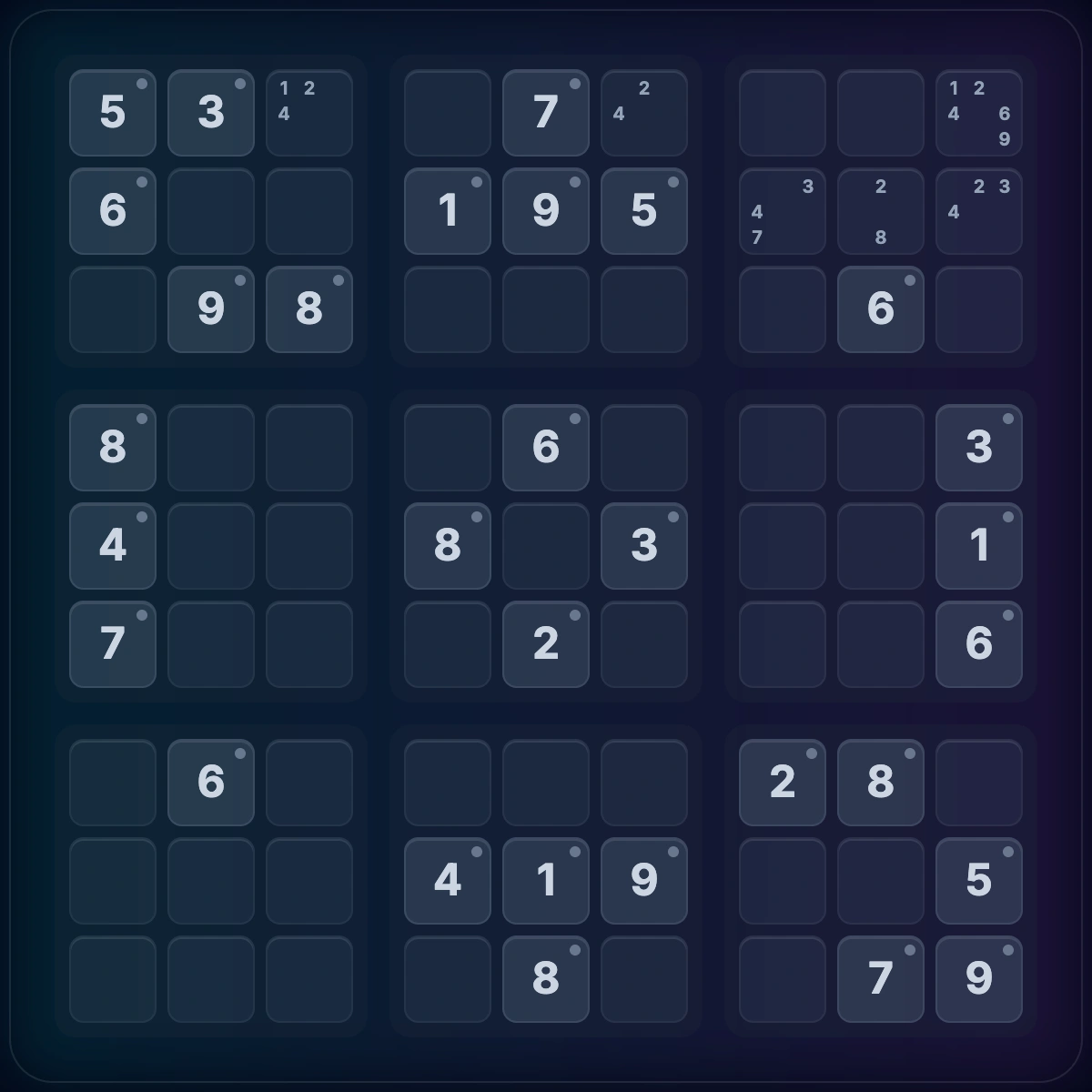
Pencil marks show all candidates for each cell. When a cell has one candidate left, you have found your answer.
How to Use Pencil Marks
- 1. For each empty cell, check the row, column, and box
- 2. Write small digits for every number NOT already present
- 3. After each placement, remove that digit from affected cells
- 4. When a cell has one candidate left, place it
Essential Solving Techniques
Technique 1: Scanning (Cross-Hatching)
Pick a number (say, 7) and scan the grid to find where it can and cannot go. Where a 7 already exists, that entire row, column, and box cannot have another 7. Often, you will find a unit where 7 can only go in one cell.
Technique 2: Naked Single
When a cell has only one possible digit after considering all constraints, you have found a "naked single." This is what we found repeatedly in the walkthrough—a cell where row, column, and box constraints leave exactly one option.
Technique 3: Hidden Single
Sometimes a digit can only go in one cell within a row, column, or box—even though that cell might theoretically accept other digits. The digit is "hidden" among other possibilities but is the only home for that number in that unit.
Technique 4: Box-Line Reduction
When a digit in a box can only appear in one row (or column), you can eliminate that digit from the rest of that row (or column) outside the box. Use when basic techniques stall.
Common Beginner Mistakes (And How to Avoid Them)
Mistake 1: Forgetting One Constraint
You find a cell where "row says 5" and "column says 5" and excitedly place a 5—but forgot to check the box, which already has a 5. Fix: Always verify all three constraints. Make it a ritual: row, column, box. Every time.
Mistake 2: Guessing Instead of Deducing
You feel stuck and place a digit hoping it works. If it does not, you face a cascade of errors. Fix: Every Sudoku published in reputable sources is solvable through pure logic. If stuck, scan the entire grid again—you have missed something.
Mistake 3: Not Following the Cascade
You place a digit and immediately search elsewhere, missing that your placement just forced answers in three other cells. Fix: After every placement, check the affected row, column, and box. New singles often appear immediately.
Pro Tips for Faster Solving
Start With the Most Constrained Areas
Rows, columns, or boxes with the most givens have the fewest possibilities. They often yield quick placements.
Hunt for the Same Digit Across the Grid
Instead of solving cell by cell, pick one digit and find everywhere it must go. This "digit hunting" often reveals patterns invisible when working cell by cell.
Look for Pairs and Triples
When two cells in a unit can only contain the same two digits (like 4 and 7), those digits are "locked" to those cells. You can eliminate 4 and 7 from other cells in that unit.
Your Turn: Practice Puzzle
The 9×9 grid follows identical logic to the 4×4 we solved together—just with three times as many cells and larger 3×3 boxes. If you understood the walkthrough above, you have all the tools you need.
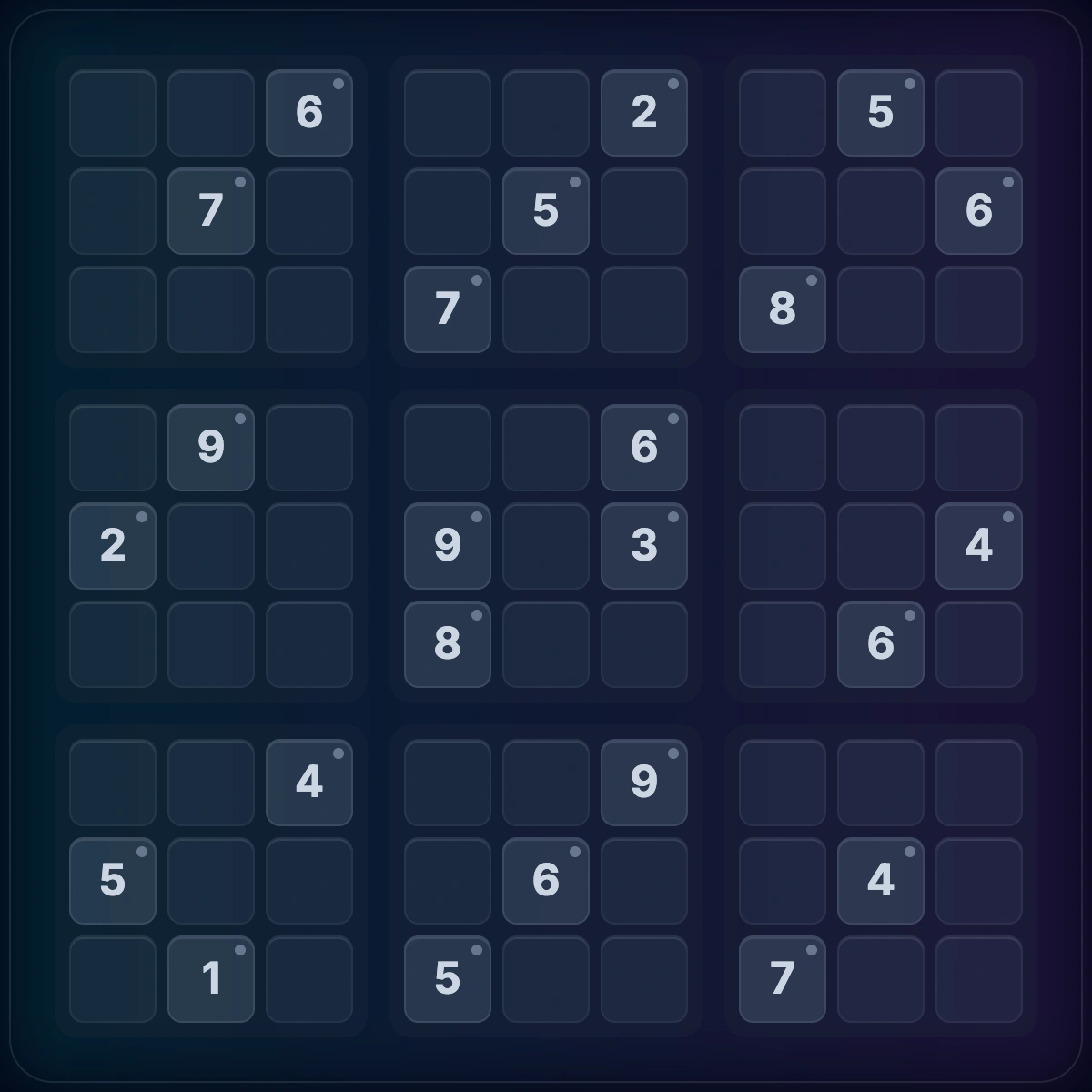
A beginner-friendly 9×9 puzzle. Scan for immediate naked singles first!
Suggested Approach
- 1. Scan for any immediate naked singles
- 2. Pick a digit (start with 1) and scan where it must go in each box
- 3. Repeat for digits 2 through 9
- 4. Use pencil marks for cells with only 2-3 candidates
- 5. Look for hidden singles in nearly-complete units
- 6. Follow every cascade—one placement often triggers more
Your Grid Awaits
Start with an Easy puzzle and scan for naked singles -- cells where row, column, and box constraints leave only one digit. Once that feels comfortable, try digit hunting: pick a number and find every box where it must go. Graduate to Medium when you can solve Easy puzzles without pencil marks.
Quick Reference Checklist
- Check all three constraints for every placement—row, column, box
- Scan systematically—pick a digit and hunt for where it must go
- Follow the cascade after every placement
- When stuck, move to a different area of the grid
- Trust the logic—every puzzle is solvable through deduction
Ready to Fill Your First Grid?
The three rules are in your head. The techniques are at your fingertips. All that's left is to experience the satisfaction of watching a grid come together, one logical deduction at a time.
Start Solving SudokuPut it into practice
Ready to solve Sudoku?
Open a free puzzle and turn the ideas from this guide into your next solve.