Futoshiki Puzzle:
A Complete Beginner's Guide to Inequality Logic
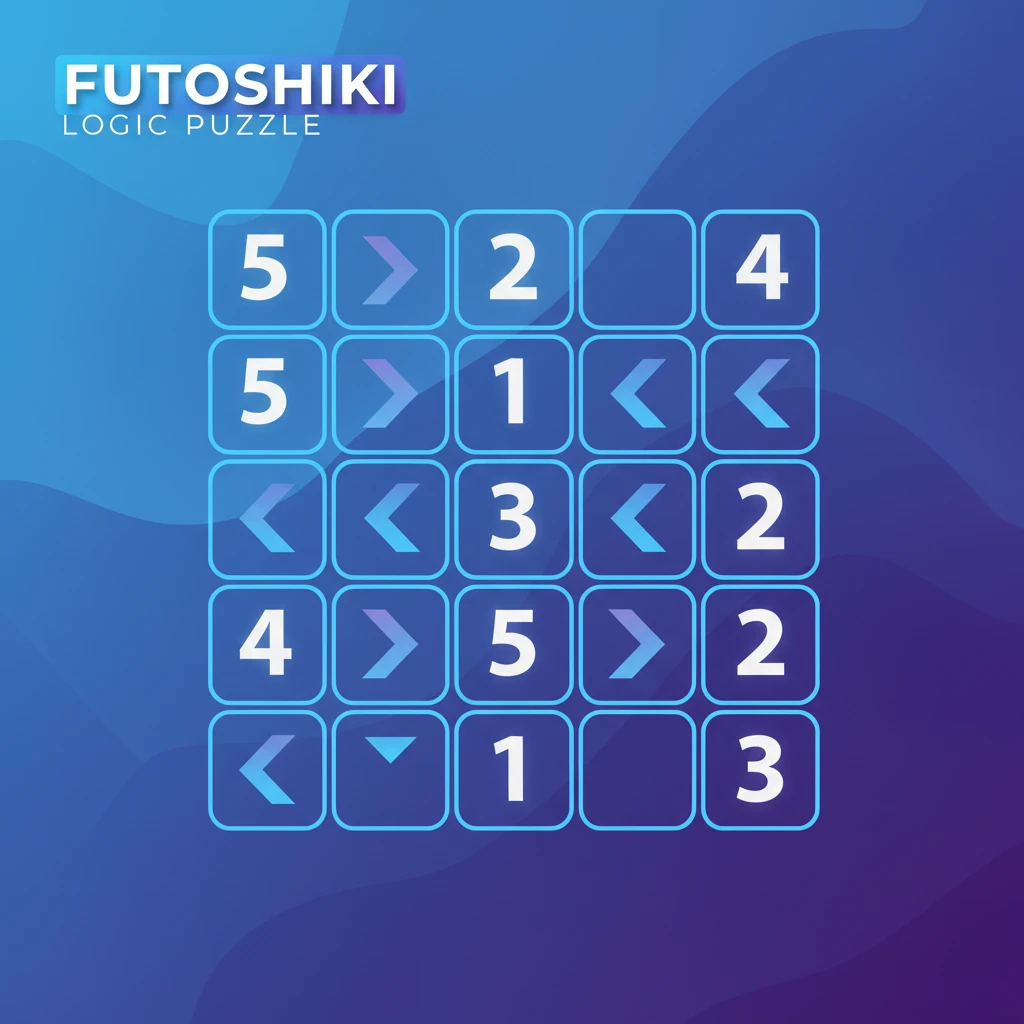
You know that feeling when someone tells you to fill a grid with numbers, and you think you have seen this before? Futoshiki looks like Sudoku at first glance. A grid. Numbers. Logic required.
Then you notice the little arrows.
Greater than. Less than. Those symbols from math class that most of us forgot the moment the exam ended. In Futoshiki, they become your best friends--whispering secrets about which numbers can go where, eliminating possibilities with surgical precision.
The name itself is a clue. Futoshiki is Japanese for "not equal"--a perfect description of a puzzle built entirely on relationships between neighbors. This cell must be greater than that one. That cell must be smaller than this one. Chain enough of these constraints together, and suddenly you know exactly which number belongs where.
Watch the Tutorial
Prefer watching? This short video walks you through the rules and key strategies.
What Exactly Is a Futoshiki Puzzle?
A Futoshiki puzzle presents you with a square grid, typically 4x4, 5x5, or larger. Your mission: fill each cell with a digit so that every row and column contains each number exactly once, while also obeying all the inequality symbols between adjacent cells.
If you have heard the term "Latin square," that is exactly what we are building--a grid where each row and column contains every digit once. (Think of it as Sudoku without the 3x3 boxes.) The inequalities are what make Futoshiki unique.
Futoshiki vs Sudoku: A Quick Comparison
| Aspect | Sudoku | Futoshiki |
|---|---|---|
| Grid structure | Rows, columns, AND 3x3 boxes | Rows and columns only |
| Main constraint | No repeats in row/column/box | No repeats + inequalities |
| Starting clues | Given numbers scattered in grid | Inequality symbols (numbers optional) |
| Empty puzzle possible? | Never | Often--inequalities provide all info |
The key mindset shift: In Sudoku, you hunt for where a number CAN go. In Futoshiki, you hunt for where a number MUST go based on its relationships to neighbors.
The Complete Rules of Futoshiki
Four rules govern every Futoshiki puzzle. Master these, and you are ready to tackle any grid.
Rule 1: Fill 1 to N
For an NxN grid, use digits 1 through N. A 4x4 grid uses 1, 2, 3, 4. Every cell must contain exactly one digit.
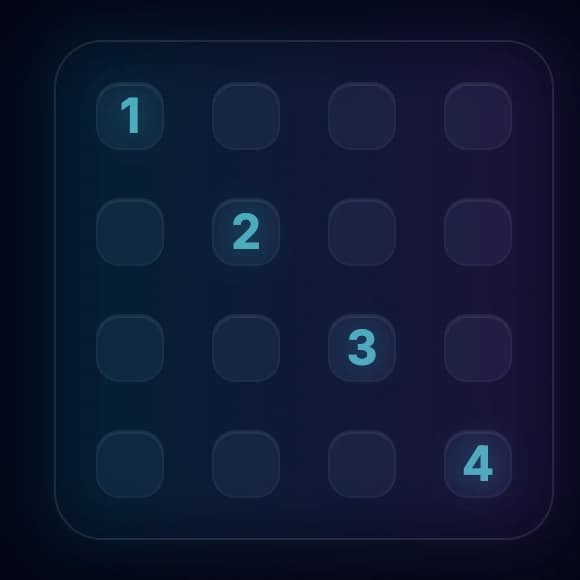
Rule 2: No Row Repeats
Each row must contain every digit exactly once. If you place a 3 somewhere in a row, no other cell in that row can be 3.
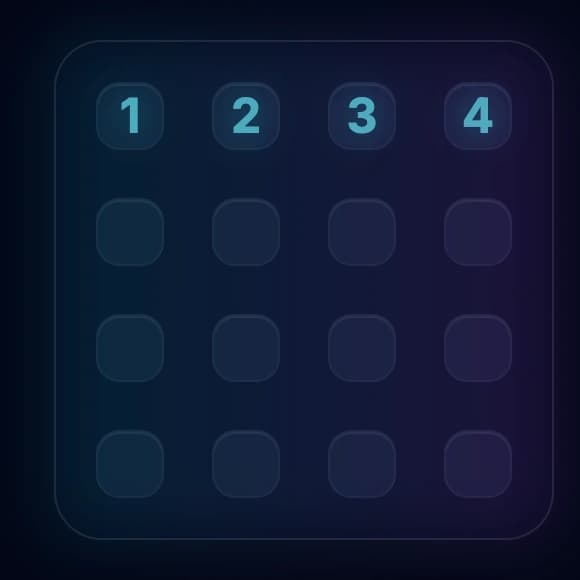
Rule 3: No Column Repeats
Each column must also contain every digit exactly once. Unlike Sudoku, there are no box regions--just rows and columns.
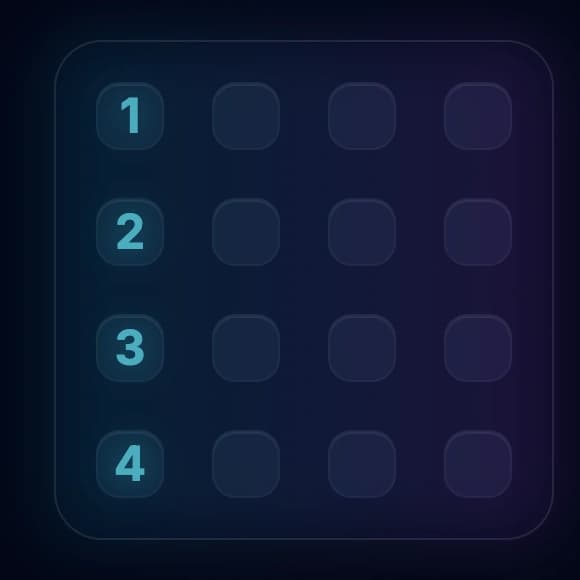
Rule 4: Obey Inequalities
The symbol's "mouth" faces the smaller number. < means left is smaller; > means left is larger.
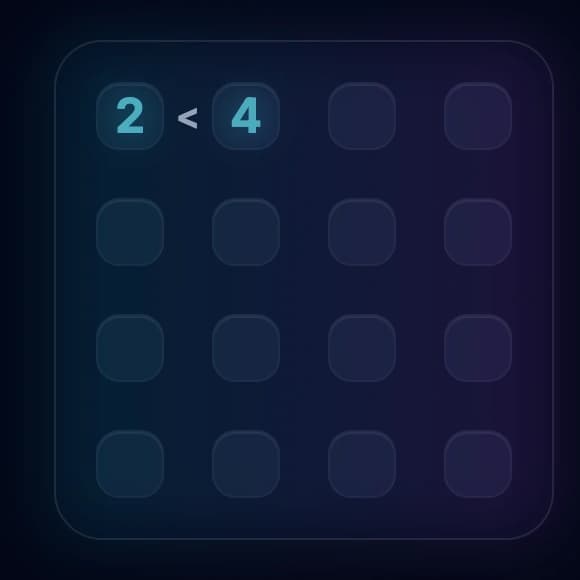
Four rules, infinite puzzles. The inequalities are not obstacles--they are your primary source of information.
Inequality Signs Explained
If the < and > symbols feel rusty from math class, here is the quick refresher. Think of the symbol as a mouth that always opens toward the bigger number--it wants to "eat" the larger value.
Horizontal Signs
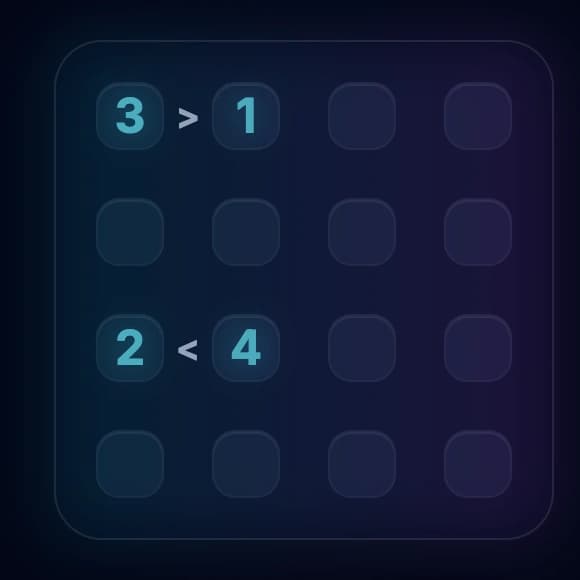
Between cells in the same row. 3 > 1 means the left cell is larger. 2 < 4 means the left cell is smaller.
Vertical Signs
Between cells in the same column. An arrow pointing down means the top cell is larger. An arrow pointing up means the bottom cell is larger.
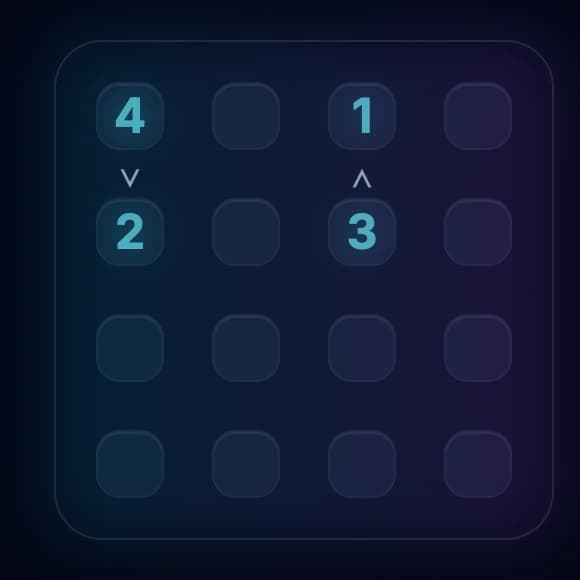
The golden rule: The symbol's open end (the wide side) always faces the bigger number. This works identically whether the sign sits horizontally between columns or vertically between rows. Once this clicks, you will read inequality signs as effortlessly as reading text.
Inequality Chains: Your Most Powerful Tool
When inequalities connect in a sequence, their constraints multiply. Consider a chain: [Cell A] < [Cell B] < [Cell C] in a 4x4 puzzle.
The chain rule: In a chain of K cells (all connected by inequalities pointing the same direction), the cell at the "small" end can only hold digits 1 through (N - K + 1), and the cell at the "large" end can only hold digits from K to N.
For the ultimate case: a 4-cell chain in a 4x4 grid (A < B < C < D) completely determines every cell: A=1, B=2, C=3, D=4.
This is the core mechanism of Futoshiki--once you internalize it, half the puzzle often solves itself.
Your First Solve: A Complete Walkthrough
Time to put theory into practice. Here is my promise: every single move will be logically certain. No guessing. Just pure deduction.
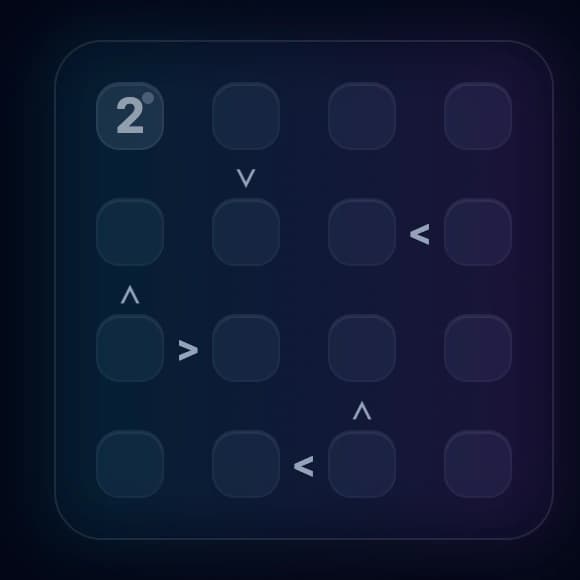
Our starting puzzle. Given: Cell (0,0) = 2. Several inequality constraints to guide us.
Phase 1: The Detective Work
Grab a coffee. We are about to make this puzzle confess everything.
Before placing a single digit, smart solvers do reconnaissance. Mapping constraints first reveals hidden restrictions:
| Cell | Can Be | Why |
|---|---|---|
| (0,0) | 2 | Given |
| (0,1) | 3, 4 | Row needs 1,3,4 but must be > cell below |
| (1,0) | 1, 3 | Column needs 1,3,4 but must be < cell below |
| (3,2) | 3, 4 | Must be > TWO other cells |
We have not placed anything yet, and we have already slashed possibilities everywhere. That is the power of constraint analysis -- mapping what each cell can be before committing to any placement.
Phase 2: The Breakthroughs
Breakthrough 1: Cell (0,1) can be 3 or 4. Tracing the constraints, if Cell (0,1) = 3, the column constraints create an impossible situation. Therefore, Cell (0,1) must be 4. Not a guess. A certainty.
This is the moment. Our first definite placement, forced by pure logic.
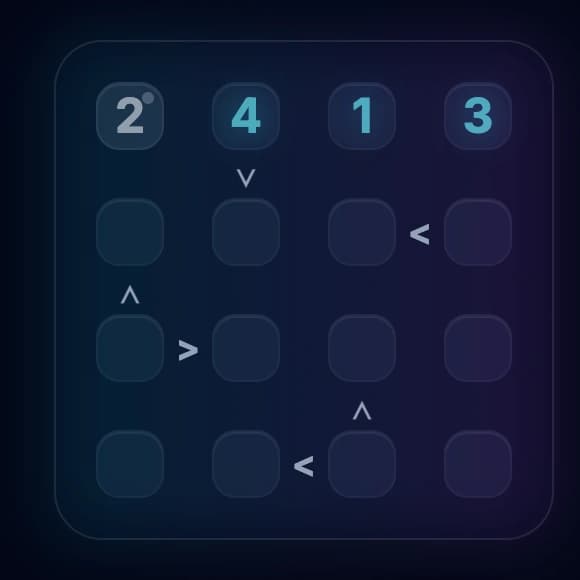
Row 0 now reads [2, 4, ?, ?] and needs 1 and 3. The cascade begins.
The Cascade: Row 0 needs 1 and 3. Column analysis pins them down: Cell (0,2) = 1, Cell (0,3) = 3. Row 0 complete: [2, 4, 1, 3]
One breakthrough led to three placements. This is Futoshiki's rhythm--solve one cell, and others fall like dominoes. That satisfying click you feel? That is logic doing its thing.
Contradiction Trap: Row 1 needs 1, 2, and 4. What if Cell (1,3) = 2? Then Cell (1,2) must be 1--but Column 2 already has a 1!
Contradiction. That path is impossible. The puzzle just eliminated itself. Therefore Cell (1,3) = 4, Cell (1,2) = 2, Cell (1,1) = 1.
Contradictions in Futoshiki are like your opponent accidentally revealing their hand.
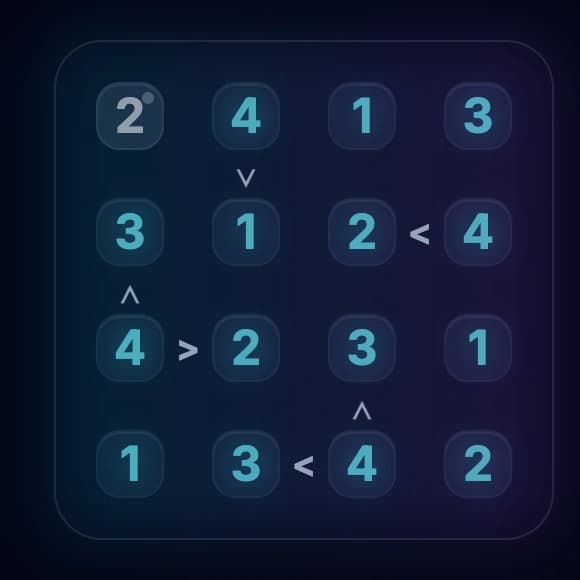
Solution: Row 0: [2,4,1,3] | Row 1: [3,1,2,4] | Row 2: [4,2,3,1] | Row 3: [1,3,4,2]
And just like that, it is over. Sixteen cells. Six inequalities. Zero guesses.
Essential Strategy Summary
- 1. Hunt the chains first -- Inequality chains dramatically limit possibilities
- 2. Extreme value elimination -- Greater side cannot be 1; smaller side cannot be N
- 3. Cross-reference everything -- Row needs + column needs + inequality = certainty
- 4. Contradictions are gifts -- When one path fails, the other is forced
- 5. Ride the cascade -- One placement triggers others; follow the dominoes
Speed Solving Tip
The "Boundary Scan": Before anything else, quickly scan the grid edges. Corner cells have the fewest neighbors, which means inequalities pointing into corners are highly constrained. A corner cell that must be "greater than" its only neighbor immediately tells you that corner holds a high value. Chain this insight across multiple edges and you often solve 3-4 cells in the first 30 seconds.
Try it on your next puzzle: edges first, interior second.
Practice Puzzle
Ready to apply what you have learned? Here is a 4x4 Futoshiki designed for beginners.
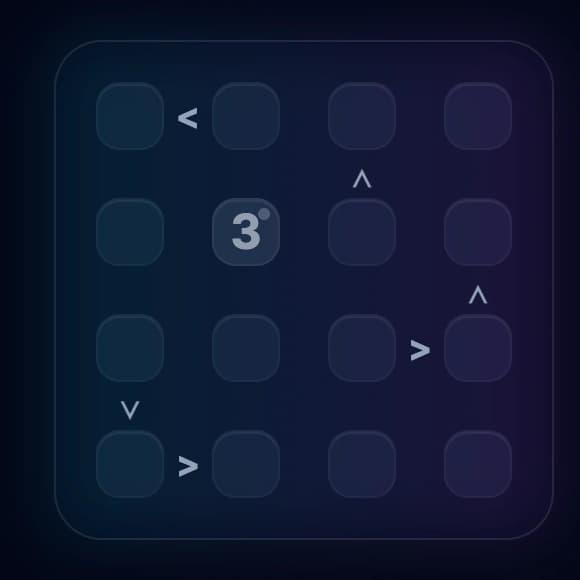
Start with the given 3 in Cell (1,1). Look for inequality chains and use contradiction testing.
Difficulty Progression
Your Inequalities Await
Start with a 4x4 puzzle and look for inequality chains first -- they eliminate the most possibilities in one step. When you get comfortable, move to 5x5 where chains are longer and cross-referencing rows with columns becomes essential.
Ready to Follow Your First Chain?
The techniques are in your head. The inequality arrows are your guide. All that's left is to place that first certain digit.
Start Solving FutoshikiPut it into practice
Ready to solve Futoshiki?
Open a free puzzle and turn the ideas from this guide into your next solve.