Suguru Puzzle:
A Complete Beginner's Guide to Number Blocks
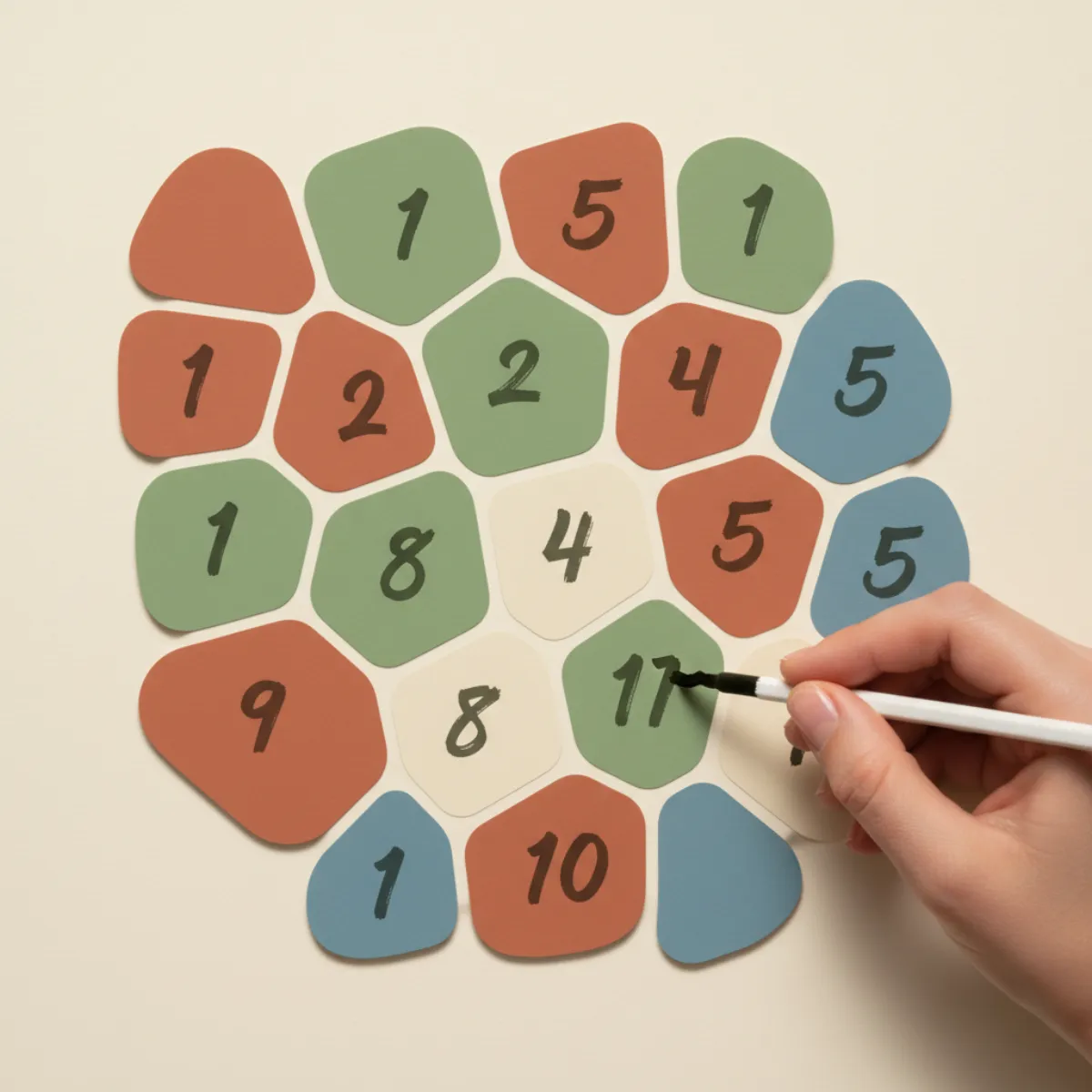
Sudoku taught you that numbers cannot repeat in rows and columns. Suguru throws that rulebook into a blender--then adds a rule that changes everything.
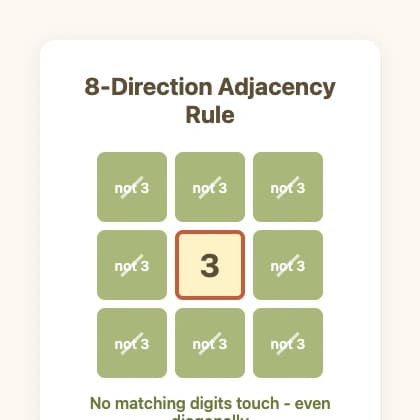
Place a 3 in a cell. In Sudoku, that 3 blocks the same number from appearing in its row, column, and box. In Suguru, your 3 creates a force field around itself--eight cells in every direction where no other 3 can exist. Not just horizontally and vertically. Diagonally too.
There are no rows in Suguru. No columns. No neat 3x3 boxes. Instead, you face a grid carved into irregular regions that snake and twist like puzzle pieces scattered on a table. Each region demands specific digits based on its size. And every number you place ripples across the grid, eliminating possibilities in neighboring regions you had not even considered yet.
This is why Suguru (also known as Tectonics or Number Blocks) has quietly become one of the most popular logic puzzles among Sudoku veterans craving something fresh. Japanese puzzle designer Naoki Inaba created it in 2001, and solvers have been hooked ever since.
Watch the Tutorial
Prefer watching? This short video walks you through the rules and key techniques.
What Exactly Is a Suguru Puzzle?
A Suguru puzzle presents you with a grid divided into irregular regions called "cages" or "blocks." Your mission: fill each cell with a digit so that every region of size N contains the numbers 1 through N, and no identical numbers touch each other--not even diagonally.
Think of it like Sudoku's adventurous cousin. Instead of rigid rows and columns, you have organic, flowing regions. Instead of worrying about nine cells in a line, you focus on the eight cells surrounding every number you place.
The Complete Rules of Suguru
Four rules govern every Suguru puzzle. Master these, and you are ready to tackle any grid.
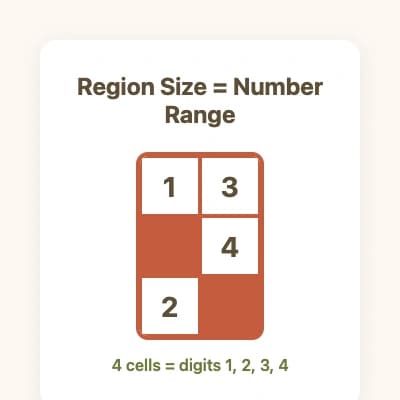
Rule 1: Region Size = Number Range
Count the cells in a region--that determines which digits belong. A 4-cell region gets 1, 2, 3, 4.
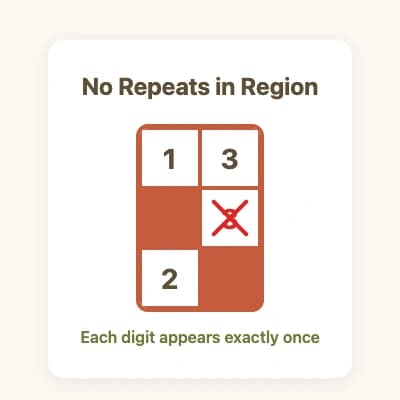
Rule 2: No Repeats in Region
Each digit appears exactly once. No doubling up. Think of it like assigning seats--everyone gets one chair.
Rule 3: 8-Direction Adjacency
Each digit blocks eight neighbors--orthogonal AND diagonal. This is the game-changer.
Rule 4: Starting Clues
Pre-filled cells give you anchor points. More clues = easier puzzle. Expert puzzles have very few.
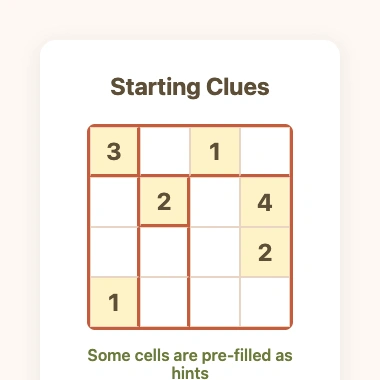
Four rules, infinite puzzles. The diagonal constraint is your superpower.
Understanding Regions (Polyominoes)
Each region in Suguru is a "polyomino"--fancy math-speak for those shapes you know from Tetris, minus the panic of them falling. Suguru uses polyominoes of various sizes, typically ranging from 1 to 5 cells.
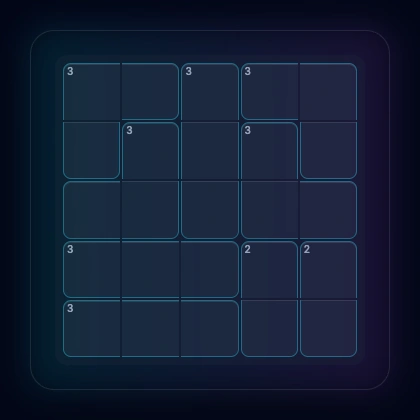
Regions of the same size can have completely different shapes. Each creates unique constraint patterns.
Your First Solve: Core Techniques
Master these five techniques and you will see solving opportunities everywhere.
Technique 1: The Single-Cell Freebie
Whenever you spot a 1-cell region, place a 1 immediately. No other option exists. After placing that 1, scan its eight neighbors--every single one is now blocked from containing 1.
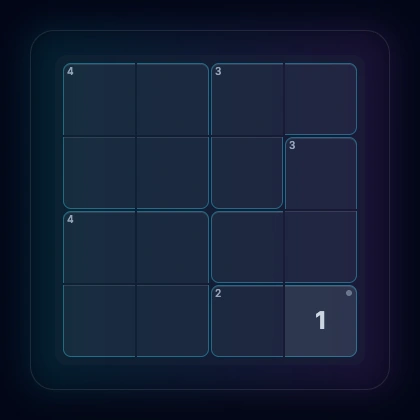
That tiny 1-cell region just rippled constraints across multiple neighbors.
Technique 2: The Last Digit Standing
When a region has N cells and N-1 of them are filled, the last cell is forced. A 3-cell region with 1 and 2 already placed? The empty cell must be 3. Simple math, powerful results.
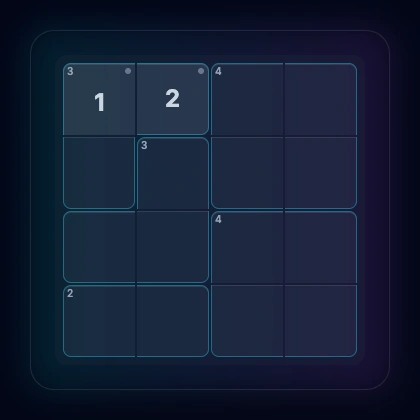
Golden rule: After every move, check if any region now has only one empty cell.
Technique 3: The Elimination Cascade
This is Suguru's signature move. You place a digit, it blocks that digit from eight neighbors, and suddenly a cell in a neighboring region has only one option left. One placement triggers another. This chain reaction can ripple across the entire grid.
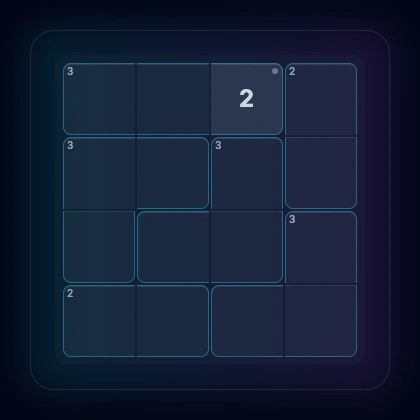
The cascade is pure Suguru joy--one move leads to another leads to another.
Technique 4: The Internal Squeeze
Cells within the same region can be adjacent to each other--and adjacent cells cannot match. In an L-shaped region, the corner cell is adjacent to both tips. If that corner contains 1, neither tip can be 1.
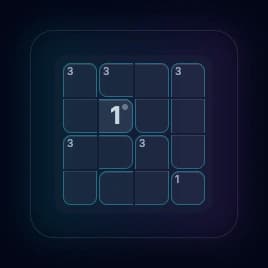
Look for cells adjacent to both others in the same region--that is your constraint hub.
Technique 5: The Neighbor Audit
When stuck, pick a troublesome cell and list every digit in all eight adjacent cells. Whatever is not blocked is your candidate list--often surprisingly short. This transforms "I have no idea" into "I have two options" in seconds.
Essential Strategy Summary
- 1. Hunt the freebies first -- Single-cell regions always contain 1
- 2. Small regions, big payoff -- 2-cell regions have only two possibilities
- 3. Treat diagonals as equals -- Every digit blocks eight neighbors, not four
- 4. Chain your deductions -- One forced placement often creates another
- 5. When stuck, audit neighbors -- List every adjacent digit to find remaining options
Practice Your First Puzzle
Here is a simple 4x4 Suguru to try. The puzzle solves cleanly using only the techniques covered above. Beginners typically complete it in 5-10 minutes.
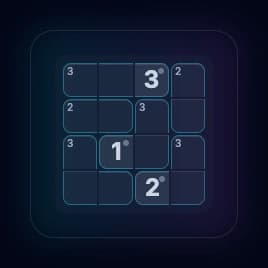
Try this approach: Start with 2-cell regions, use given clues to eliminate candidates, look for forced cells.
Difficulty Progression
Your Number Blocks Await
You now have the five core techniques--single-cell freebies, last digit standing, elimination cascades, the internal squeeze, and the neighbor audit. Combined with the diagonal adjacency rule, these will carry you through any beginner Suguru puzzle and well into intermediate territory. Start small, chain your deductions, and let the grid solve itself.
Ready to Fill Your First Blocks?
The techniques are in your head. The diagonal rule is your superpower. All that's left is to place that first certain digit.
Start Solving SuguruPut it into practice
Ready to solve Suguru?
Open a free puzzle and turn the ideas from this guide into your next solve.