Murderer Sudoku Strategies: From Clues to a Closed Case
Solve harder Murderer puzzles with candidate tracking, row and column elimination, room capacity, and precise directional deductions.
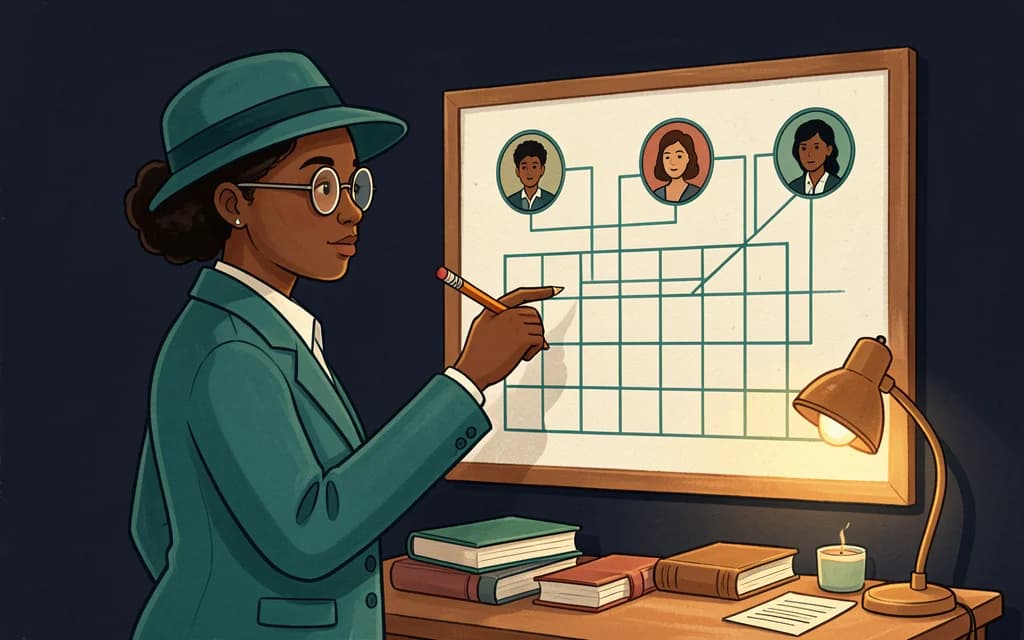
Track possibilities for people, not just squares
Harder Murderer Sudoku cases ask you to combine several weak clues into one strong deduction. Rather than asking which portrait looks right in a square, ask which squares remain possible for each suspect after every rule and clue is applied.
A useful solving loop is: constrain a suspect, remove impossible rows and columns, check the rooms, then revisit the relational clues. Repeat after every confirmed placement. The information that unlocks a clue may come from a different part of the board.
1. Apply the strongest anchors first
An “at the object” clue fixes an exact square. A room clue restricts a suspect to that room’s cells. An empty-room clue eliminates the entire room for every suspect. Apply these before broad statements such as being somewhere west of another person.
For example, suppose the nurse must be in a room containing B2, C2 and C3. If another suspect is already in column B, remove B2. If row 3 is already occupied, remove C3. C2 is now forced, even though the original room clue did not identify a specific square.
2. Use row and column reservations
A suspect does not always need a confirmed square to constrain everyone else. If all of one suspect’s candidates are in row 3, that suspect reserves row 3. No other suspect can use it, even if their exact column is still uncertain. The same reasoning works for columns.
You can extend this to pairs. If two suspects can only occupy rows 2 and 4, those two rows are reserved for that pair. Every other suspect must be elsewhere. This does not tell you which of the two belongs in row 2, so keep both possibilities until another clue resolves them.
3. Measure a room’s actual capacity
Room area is not the same as room capacity. A three-cell room lying entirely in one row can hold at most one suspect. A room touching only two rows can hold at most two, and occupied columns or blocked cells may reduce that further.
If a clue puts two suspects in the same room, that room needs two legal squares in different rows and different columns. Reject rooms where every available pair would collide. You may be able to identify their room before finding either person’s exact position.
4. Treat the victim’s room as an exact-one clue
The victim’s room needs exactly one suspect, not at least one. Once a confirmed placement occupies that room, eliminate its remaining cells from every other suspect’s candidates. If only one suspect can still enter it, that person must be there, although their exact square may remain undecided.
Do not make the reverse mistake and treat every room as an exact-one region. Other rooms can be empty or shared. The special restriction belongs to the victim’s room, together with any explicit clues about the other rooms.
5. Turn directions into ordered ranges
Suppose the porter is west of the lecturer, and the lecturer is west of the curator. Their columns must occur in that order. On a four-column board, the porter cannot be in C or D: there would not be two columns to the right. The curator cannot be in A or B, and the lecturer cannot occupy either outer column.
Now add a clue placing the lecturer in column C. The curator must be in D, while the porter remains in A or B. A separate row or room constraint can resolve that final choice. This is a chain of deductions, not a reason to put all three people in one row.
Object directions have a different meaning. “Directly north of the lamp” requires the lamp’s column and an earlier row. “Beside the lamp” requires an edge-adjacent square. Diagonal proximity satisfies neither clue.
6. Check why a candidate is impossible
When progress stalls, choose a suspect with few remaining candidates and examine each against the full clue set. Would a placement leave another suspect with no legal square? Would it force two people into the victim’s room? Would it leave a row impossible to fill? A demonstrated contradiction eliminates that candidate.
Keep tentative moves separate from confirmed ones, using Notes and undo when necessary. A clue turning green only means your present arrangement satisfies that clue. It does not certify your other deductions or establish that a trial placement belongs to the unique solution.
A reliable final check
- Every suspect appears once, and every row and column contains exactly one suspect.
- No suspect occupies the victim’s blocked square.
- Exactly one suspect shares the victim’s room.
- All room, object and relative-position statements match the finished board.
The casebook’s puzzles are checked for a unique solution. That is a property of the complete puzzle, not a promise that every intermediate move is obvious. Work through a smaller case to practise these techniques, then take the same reasoning into the larger floor plans or today’s shared mystery.