Every arrow points somewhere. Your job is to follow the right ones.
But here is what separates guessers from solvers: some arrows have no choice. An arrow pointing at the exit with no other path? It is on your route. An arrow pointing into a corner with no escape? It is a trap—skip it.
Arrow Maze looks like a maze, but it solves like a logic puzzle. Forget wandering. Start thinking in constraints. The exit can only be reached by certain arrows. Those arrows can only be reached by certain others. Trace backward, cell by cell, and the path does not emerge—it is revealed, like it was always there, hidden in the arrows, waiting for you to read them in reverse.
Prerequisites: This guide builds on concepts from our beginner's guide—following arrows, basic path tracing, and understanding how arrows constrain movement. If you are new to Arrow Maze, start there first.
The Core Insight: Read the Grid Backward
Forward thinking feels natural. You start at the beginning, follow arrows, hope for the best. Sometimes you reach the goal. More often, you wander into dead ends, backtrack, try again, wander into different dead ends.
Here is the uncomfortable truth: forward exploration is inefficient. The start cell's arrow offers multiple distance choices, each leading to a different cell with its own branching options. Most paths lead nowhere.
But the goal cell? Only a handful of cells can reach it in one move. Maybe two. Maybe three. Often just one.
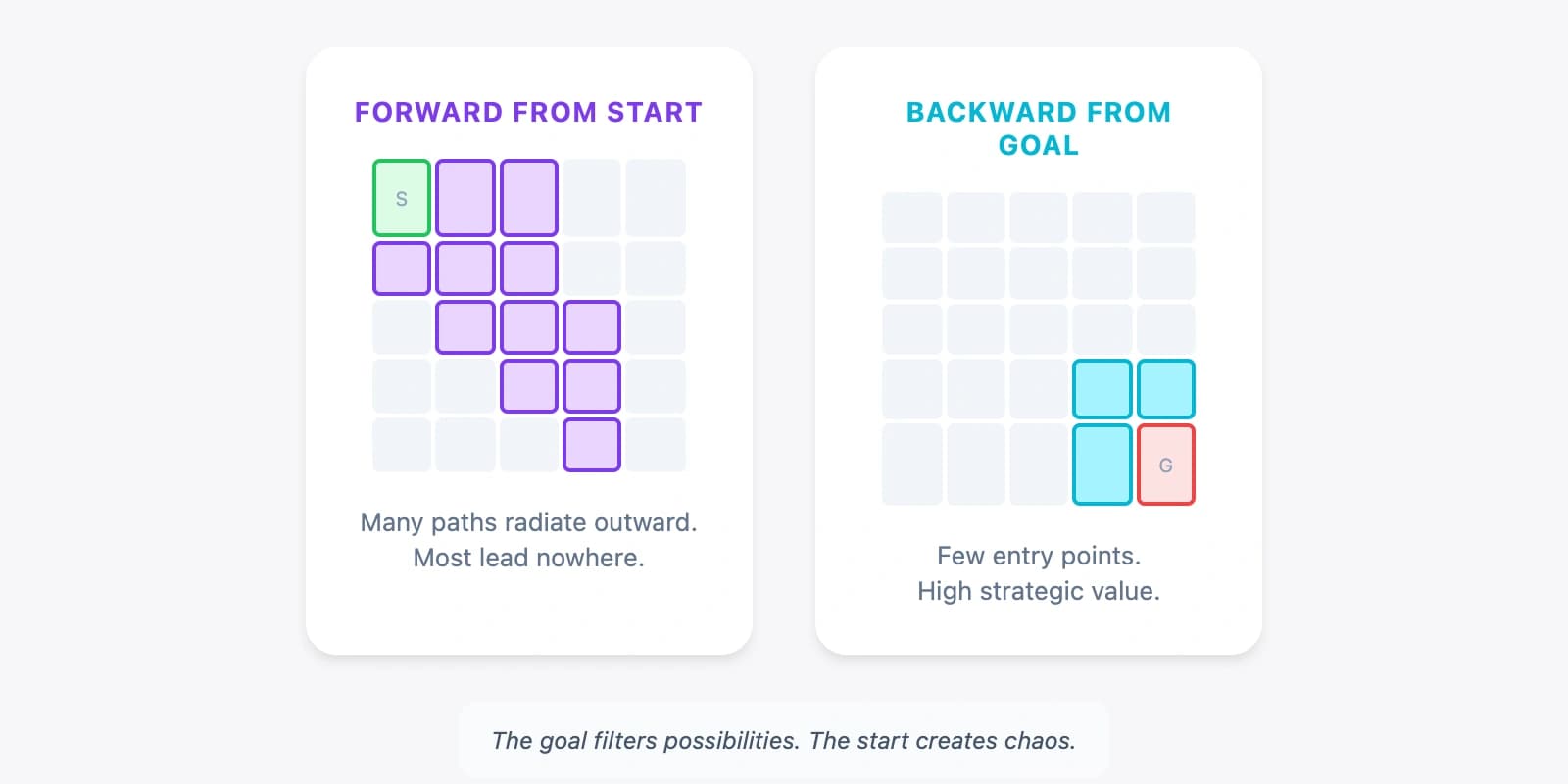
This asymmetry is your leverage. The goal acts as a filter. The start creates options; the goal eliminates them.
Key Principle: Work backward from the goal to narrow possibilities, then forward from the start to confirm the path.
Strategy 1: Work Backward from the Exit
The exit has limited entry points. Find them first.
Step 1: Identify Goal-Adjacent Cells
Look at every cell that can reach the goal in one move--any cell whose arrow points toward the goal and shares the same row or column. These are your "one step away" candidates. In most puzzles, you will find between one and four such cells.
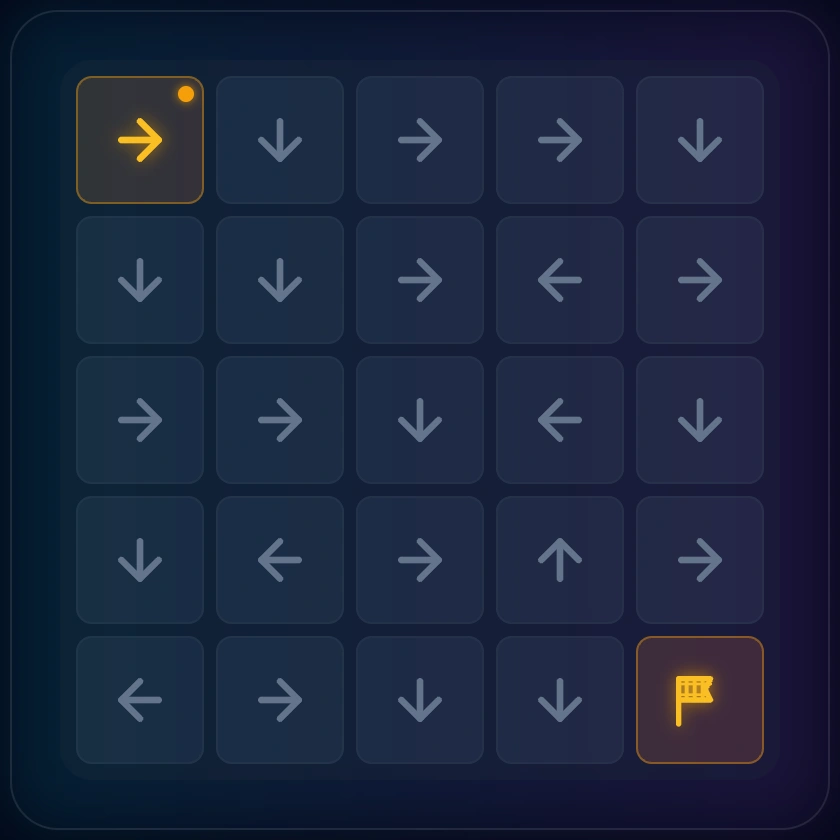
Identify cells whose arrows point to the goal
Step 2: Trace Backward from Each Candidate
For each goal-adjacent cell, ask: "Which cells can reach here at some distance?" Those become your "two steps away" cells. Continue this process, building a tree of cells that can potentially reach the goal.
This backward trace reveals your reachability map—the territory of cells that can possibly connect to the goal.
Step 3: Prune the Map
As you trace backward, you will often find that some branches terminate quickly. A cell that can reach the goal might only be reachable from a single other cell. That single cell becomes a mandatory waypoint—the path must pass through it.
Practical Example
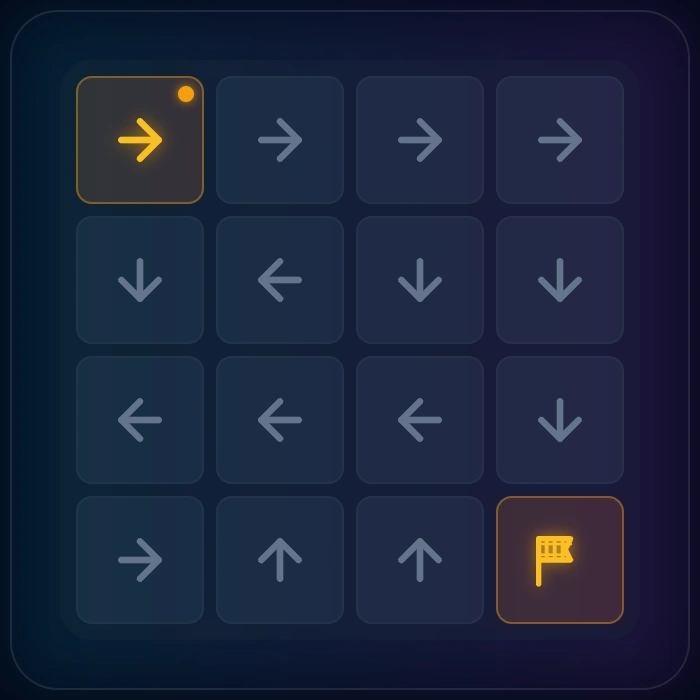
Consider a 4x4 puzzle where the goal sits at (3,3).
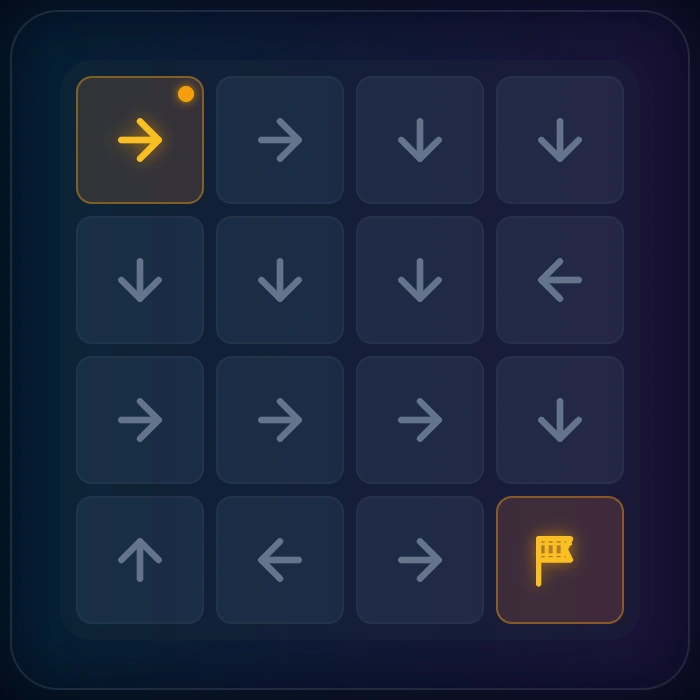
Trace backward from the goal
Starting from the goal:
- Which cells can reach (3,3) in one move? Any cell in row 3 with a right-pointing arrow (at any distance), or any cell in column 3 with a down-pointing arrow (at any distance).
- For each cell that can reach the goal, repeat: which cells can reach those cells?
- Continue until you reach the start or determine that the start cannot connect
This backward analysis often solves 30-50% of the puzzle before you trace a single step forward.
Key Takeaway: The goal has fewer entry points than the start has exit points. Exploit this asymmetry by working backward.
Strategy 2: Dead-End Detection
Arrows pointing into walls or inescapable corners are never on the path. Mark them as impossible and eliminate them from consideration.
The Obvious Dead Ends
Some dead ends announce themselves:
Edge escapes: Any arrow pointing off the grid is immediately invalid. A right-pointing arrow on the rightmost column leads nowhere.
Arrows pointing off-grid are immediate dead ends
Corner traps: Corner cells have only two possible valid directions (the two directions that lead inward). If a corner arrow points toward either edge, it leads off-grid and is a dead end.
The Propagating Dead Ends
Dead ends spread backward through the grid like a contagion.
If cell A's arrow points in a direction where every reachable cell (at every distance) is a dead end, then cell A is also a dead end. It does not matter that you can choose distance--if every landing spot is dead, the cell is dead.
This propagation continues upstream. If cell C's arrow leads only to dead cells at every distance? Cell C is now dead too. But note: a single live cell among the reachable options keeps a cell alive.
The Propagation Algorithm
- Initial scan: Mark all cells whose arrows point off the grid (no reachable cells in that direction)
- First propagation: Mark cells where every reachable landing spot (at any distance) is already marked dead
- Repeat until no new cells are marked
- Result: Everything marked is a dead zone; everything unmarked might be viable
On a typical 6x6 grid, this process often eliminates 8-15 cells before you trace a single path. That is 20-40% of the grid removed through pure logic.
Dead Zone Clusters
Dead ends rarely appear in isolation. They cluster—and once they start clustering, they spread like wildfire.
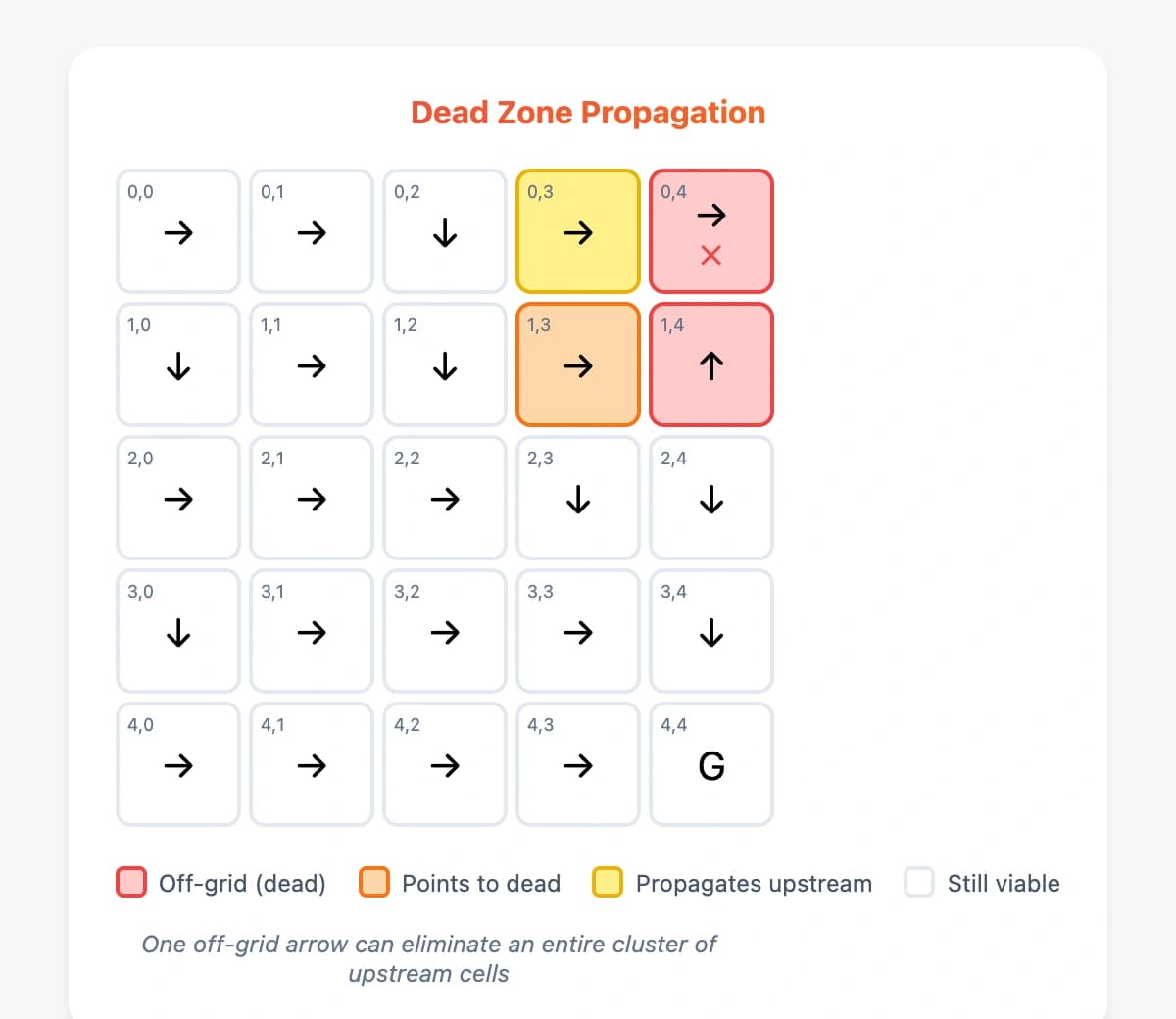
Key Takeaway: Dead ends spread backward. One arrow pointing off-grid can poison upstream cells--but only when all their distance options also lead to dead zones.
Strategy 3: Forced Path Recognition
Some arrows have no choice but to be on the path. Learn to spot them instantly.
Here is the beautiful secret of Arrow Maze: every puzzle has exactly one solution, which means every move along that solution is forced by the puzzle's design. Your job is not to find a path—it is to recognize which arrows must be used.
Why Every Move Is Forced
Think about it. If any cell on the solution path had two valid distance choices that both led to the goal, the puzzle would have multiple solutions. It does not. Therefore, at every step, something in the grid's structure eliminates all distance options but one. The arrows are not suggesting a path—they are demanding one.
This realization changes everything. You are not exploring. You are uncovering.
Forced Entry Points
Suppose your backward analysis reveals that cell X must be on the solution path (perhaps it is the only cell that can reach the goal at any distance). Now ask: how many cells can reach X?
If only one cell can reach X (considering all arrows and distance options), that cell is also forced onto the path. The chain continues: how many cells can reach that cell?
The Start Cell: Your First Forced Arrow
The start cell's arrow is always on the path—you must follow it, no questions asked. Whatever direction the start points, that is your first move.
Combine this with backward analysis: the start's arrow is forced, and certain arrows near the goal are forced. Often, the "middle" of the puzzle contains the only apparent ambiguity—and even that ambiguity dissolves under closer inspection.
Recognizing Forced Chains
Forced cells chain together beautifully. When you find one forced cell, immediately check what can reach it. If only one cell can (at any distance), you have extended your forced chain. Continue until you either:
- Reach the start (puzzle solved!)
- Find a cell where multiple arrows from different cells converge
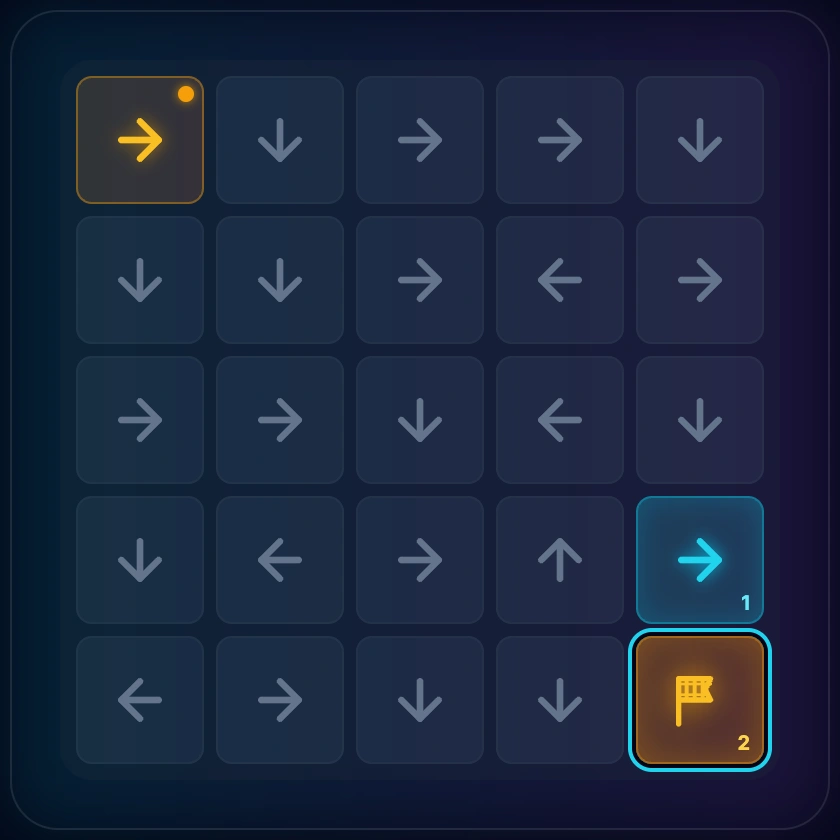
A forced chain: only one path leads to the goal
Key Takeaway: Every arrow on the solution path is there because it has to be. Forced arrows chain together, often solving large portions of the puzzle automatically.
Strategy 4: Elimination Sweeps
Mark impossible arrows as "not on path" to clarify your options.
The Mental Marking System
As you analyze the grid, develop a system for tracking eliminated cells:
- Dead cells: Arrows that lead off-grid or into dead zones
- Forced cells: Arrows that must be on the path
- Uncertain cells: Everything else
The goal is to shrink the "uncertain" category until only the solution remains. Think of it like clearing fog from a battlefield map—each sweep reveals more terrain, and eventually the path emerges from the mist.
The Systematic Sweep
Periodically sweep the entire grid:
- Check every edge cell for off-grid arrows
- Check every cell adjacent to dead cells for forced death
- Check every cell pointing to the goal for forced life
- Propagate both dead and forced status as far as possible
After each sweep, your mental model clarifies. Uncertain cells become certain in one direction or the other.
When to Sweep
Perform a full sweep:
- At the start, before tracing any path
- After discovering any new forced arrow
- After marking any new dead zone
- Whenever you feel stuck
Key Takeaway: Systematic elimination sweeps convert uncertain cells to certain ones. Sweep early, sweep often.
Strategy 5: Choke Point Analysis
Cells that every valid path must pass through become solving anchors.
What Makes a Choke Point
A choke point is a cell where all viable paths converge. No matter which route you take from start to goal, you must pass through this cell. Picture a narrow mountain pass between two valleys—armies can approach from either side, but everyone must squeeze through that single gap.
Choke points often appear:
- Where dead zones create "walls" blocking certain regions
- At narrow passages between grid sections
- Where multiple backward-traced paths converge
Finding Choke Points
After performing backward analysis from the goal and dead zone elimination, look for cells that appear on every viable route:
- Trace all possible backward paths from the goal
- Note which cells appear on all paths
- These common cells are your choke points
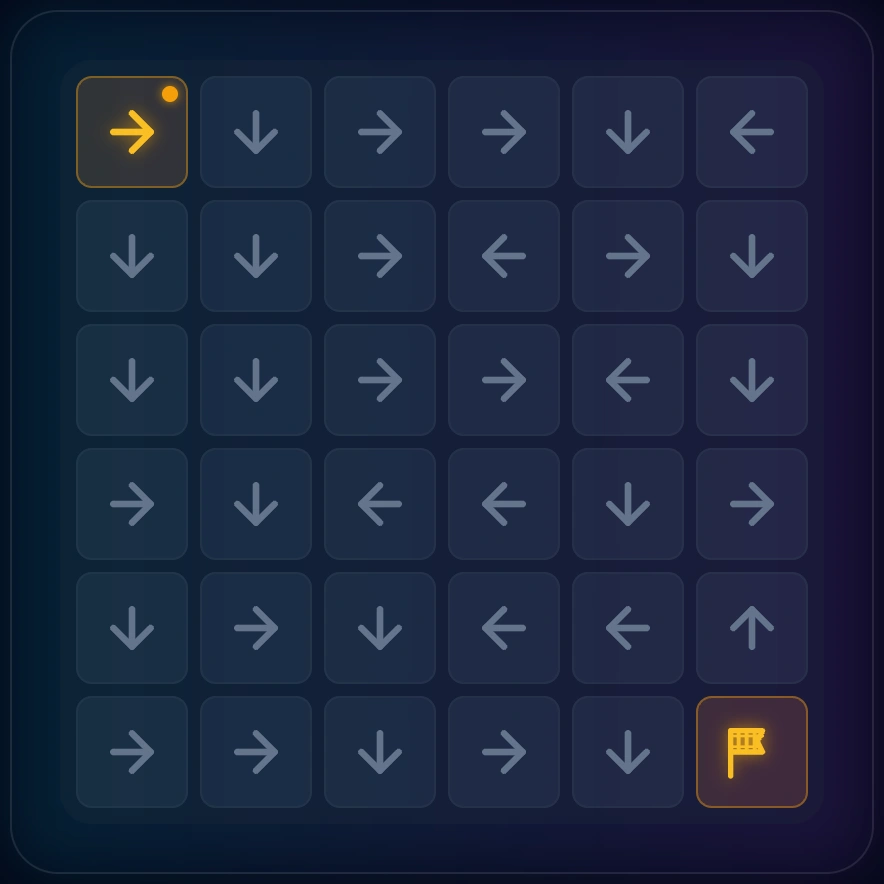
Identifying choke points where paths converge
Using Choke Points Strategically
Once you identify a choke point:
- Divide and conquer: The puzzle splits into two sub-puzzles
- From start to choke point
- From choke point to goal
- Solve each segment independently: The smaller problems are easier
- Verify connection: Ensure your segments join cleanly at the choke point
Multiple choke points let you slice the puzzle into even smaller pieces. A 6x6 puzzle with two choke points becomes three manageable sub-puzzles.
Key Takeaway: Choke points are mandatory waypoints. Find them to divide the puzzle into smaller, solvable segments.
Strategy 6: Forward-Backward Convergence
Working from start AND end simultaneously is faster than either direction alone.
The Convergence Method
- Backward phase: Starting from the goal, identify cells that can reach it
- Forward phase: Starting from the start, identify cells you can reach
- Find the intersection: Cells in both sets form your "solution corridor"
The solution path exists entirely within this intersection. Everything else is noise.
Why Convergence Works
Forward analysis alone explores too many paths. Backward analysis alone might miss how to connect to the start. Together, they create a pincer movement that squeezes out impossible cells.
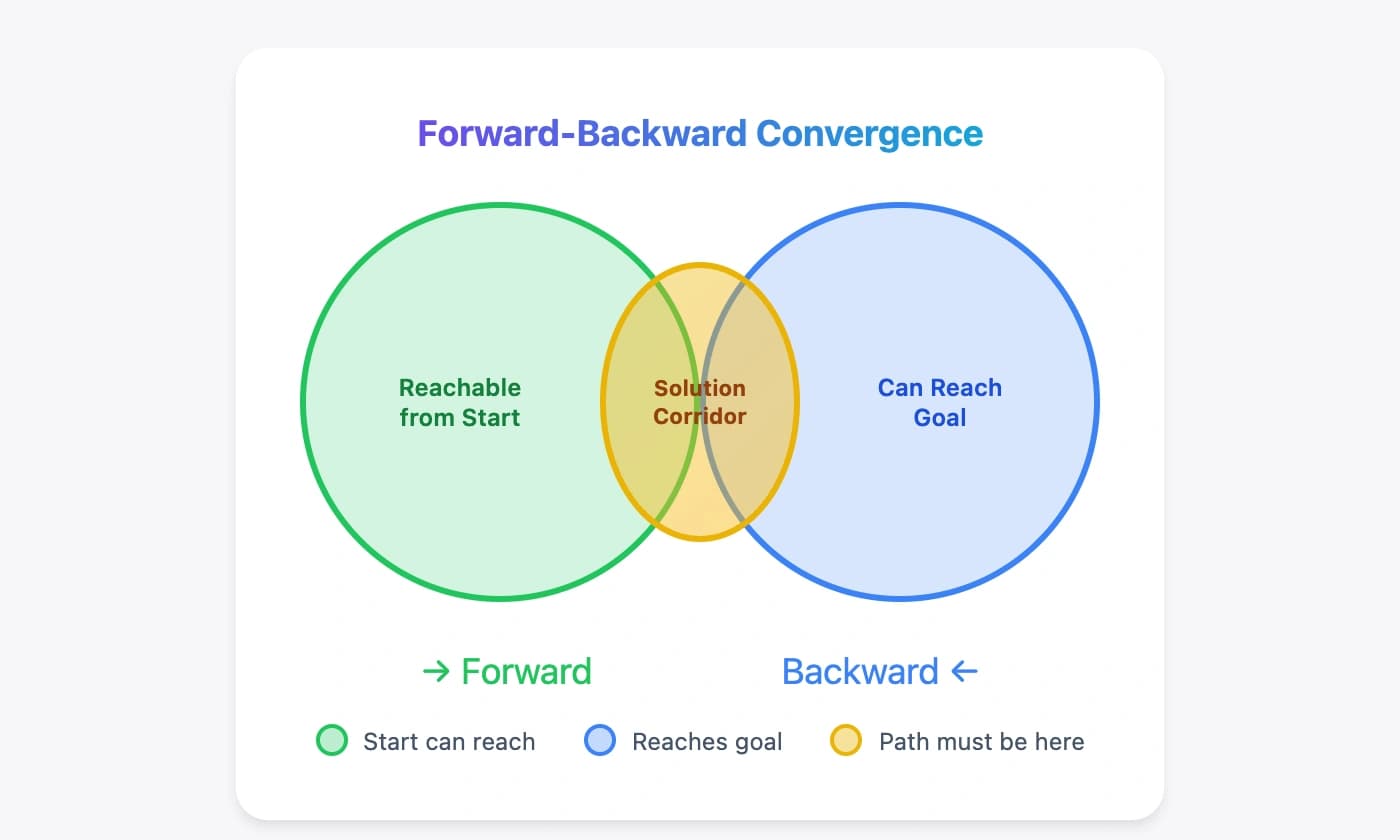
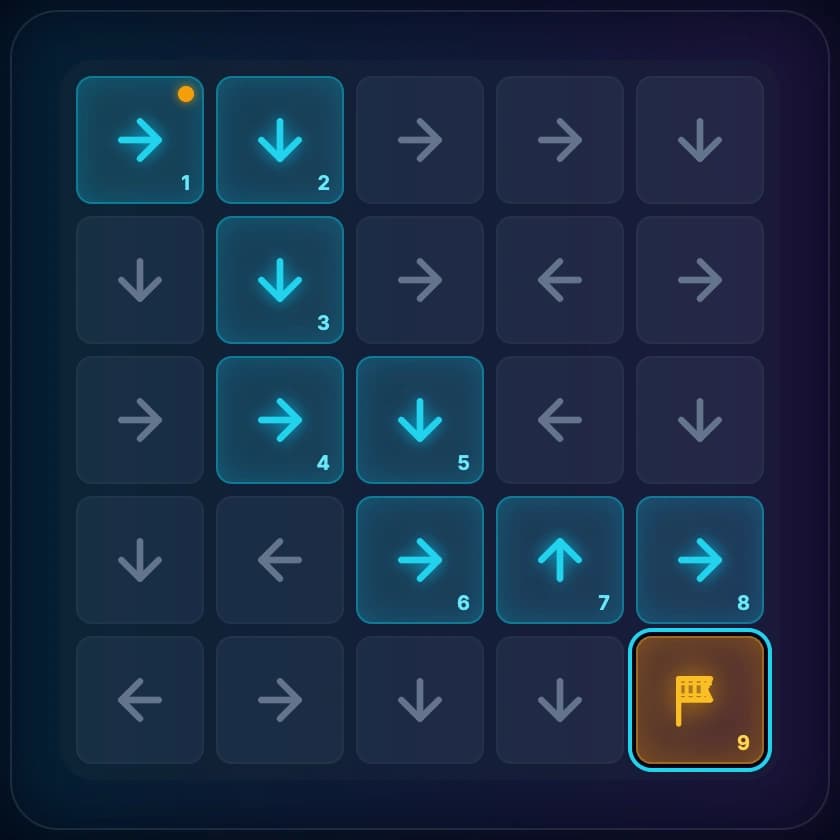
The solution corridor: where forward and backward analysis meet
Practical Convergence
You do not need to complete both analyses before they become useful. Even partial convergence helps:
- If forward analysis reveals you can only reach the left half of the grid, ignore the right half entirely
- If backward analysis reveals only two cells can reach the goal, focus on reaching either one
Incomplete convergence still narrows your search dramatically.
The Meeting Point
When forward and backward traces meet, you have found your path. The meeting point is where your "cells reachable from start" overlaps with your "cells that reach goal."
If there is exactly one meeting point, the puzzle is solved. If there are multiple, you need additional analysis to choose between them.
Key Takeaway: Combine forward and backward analysis. The intersection of what you can reach and what can reach the goal contains your answer.
Strategy 7: Direction Clustering
Recognizing when multiple arrows create a forced corridor accelerates solving.
What Is a Direction Cluster
A direction cluster is a group of adjacent arrows all pointing the same way. Three right-pointing arrows in a row. Four down-pointing arrows in a column. These clusters act as highways—no matter which distance you choose, you land on another cell pointing the same direction, keeping you moving along the highway until you reach its end.
Strategic Implications
Highway commitment: Once you enter a cluster, every distance choice keeps you in the same direction. Check where the cluster exits before entering. Nothing worse than landing on a highway only to realize it dumps you straight into a dead zone.
Cluster chaining: The exit cell of one cluster might be the entry cell of another. Mapping these chains reveals the grid's coarse structure—like seeing the interstate system before worrying about local roads.
Dead cluster detection: If the cell at the end of a cluster exits into a dead zone, the entire cluster is dead--since every cell in the cluster points the same way and ultimately exits at the same point.
Mapping the Highway System
Before detailed analysis, scan for all clusters of 3+ arrows:
- Note each cluster's start, direction, and end
- Check where each cluster's exit arrow points
- Identify which clusters connect to each other
- Mark any clusters leading to dead zones
This highway map often reveals the solution's skeleton—"enter cluster A, exit to cluster B, arrive near goal"—before you trace individual cells.
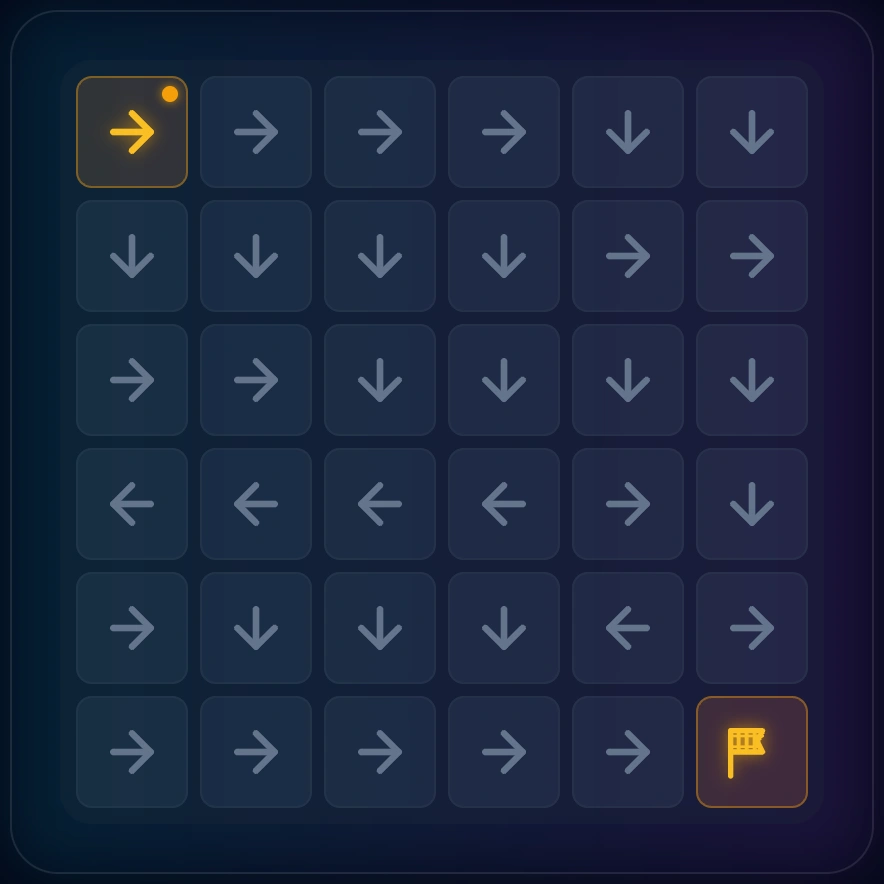
Direction clusters form highways through the grid
Key Takeaway: Direction clusters are highways--every distance choice keeps you moving the same way. Map them to understand the grid's coarse structure before tracing paths.
Strategy 8: The Complete Path Test
Verify your solution is continuous with no branches.
The Verification Checklist
Before declaring victory, confirm:
- Starts correctly: The path begins at the start cell
- Ends correctly: The path terminates at the goal cell
- Each step follows arrows: Every move matches the cell's arrow direction
- Valid distances: Each step moves one or more cells in the arrow's direction
- No branches: The path is a single continuous line
- Stays in bounds: No step leaves the grid
Common Verification Failures
The invisible branch: You traced two possible paths but forgot to choose between them. Go back and determine which one is actually valid.
The false arrival: You reached the goal cell, but the path leading there was not actually continuous. Re-trace step by step.
The direction error: In haste, you moved in a direction that does not match the cell's arrow, or you landed on a cell that is not aligned with the arrow's direction. Check each step individually.
Key Takeaway: Always verify your solution step by step. A path that looks correct might have hidden errors.
Common Mistakes and Fixes
Before we walk through a complete example, let us address the mistakes that trip up most solvers.
Mistake 1: Forward-Only Thinking
You trace from the start, hit dead ends, backtrack, trace again. This works on 4x4 grids but fails on larger puzzles.
Fix: Always start with backward analysis from the goal. The goal has fewer entry points, making backward analysis more efficient.
Mistake 2: Incomplete Dead Zone Propagation
You mark the obvious dead ends but stop too early. Upstream cells that should be dead remain unmarked.
Fix: After each propagation pass, ask: "Are there any new cells pointing only to dead zones?" Keep asking until the answer is no.
Mistake 3: Missing Forced Chains
You identify one forced arrow but fail to follow its chain. The forced arrow points to a cell that only has one arrow pointing to it, which points to another such cell...
Fix: Every time you identify a forced arrow, immediately check what points to its cell. Follow the chain until it branches or reaches the start.
Mistake 4: Ignoring Direction Clusters
You analyze cells individually instead of recognizing clusters. A highway of four right-pointing arrows could be analyzed as one unit, but you trace it cell by cell.
Fix: Scan for clusters before detailed analysis. Map the highway system to understand coarse structure.
Mistake 5: Skipping Verification
You find what looks like a solution and move on. But the path has an error—a step that does not actually follow its cell's arrow.
Fix: Always verify step by step. Trace your final path from start to goal, confirming each arrow direction matches your claimed move.
Putting It All Together: A Worked Example
Let's work through these strategies on a 5x5 puzzle. Watch for the mistakes we just discussed—can you spot where a less careful solver might go wrong?
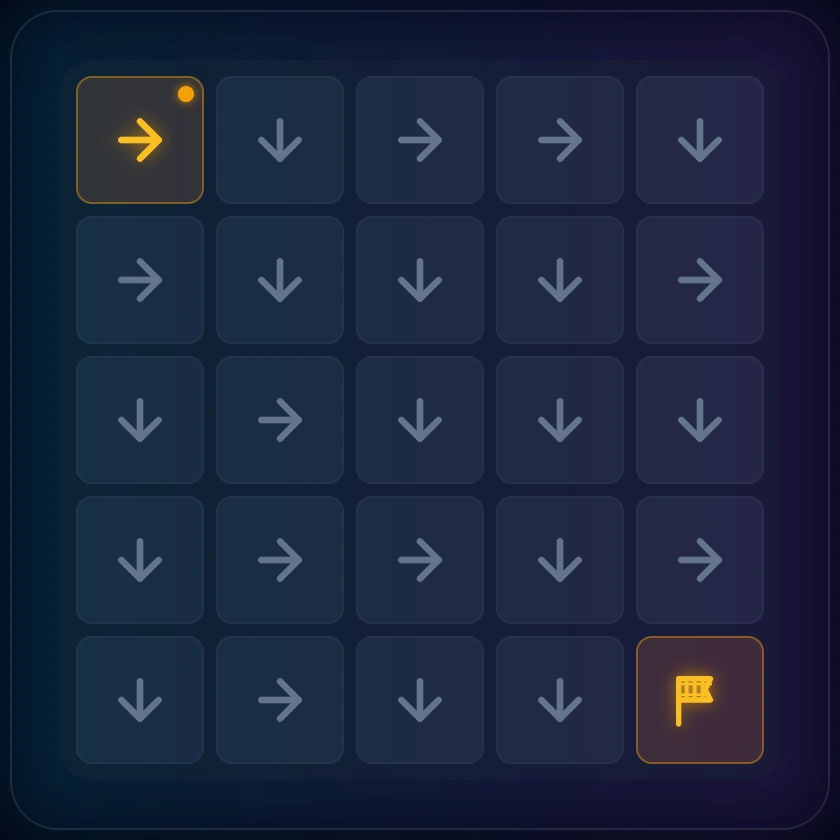
Initial puzzle state: find the path from start to goal
Phase 1: Initial Scan
Dead zone check: Scanning the edges... check for off-grid arrows. Mark any obvious dead zones.
Goal neighborhood: What points to (4,4)? Identify cells one step from victory.
Start direction: The start at (0,0) points right. This is our first forced move.
Phase 2: Backward Analysis
Starting from the goal at (4,4), trace backward. Which cells point to (4,4)? For each one-step cell, identify what points to it. Build the backward reachability tree.
Phase 3: Forward Analysis
From the start at (0,0), follow the forced path. Start points right to (0,1). What does (0,1) point? Continue until you reach a cell that could come from multiple sources.
Phase 4: Convergence
Find where forward-reachable and backward-reachable cells overlap. The solution must exist within this intersection—the solution corridor.
Phase 5: Solution
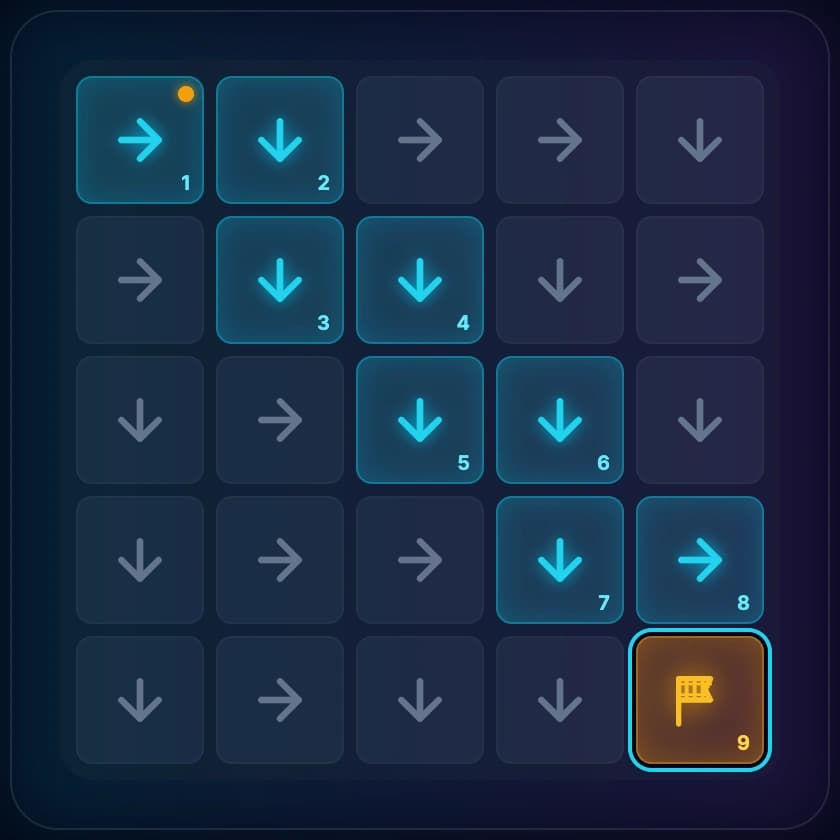
The solution path revealed
The path: (0,0) → (0,1) → (1,1) → (1,2) → (2,2) → (2,3) → (3,3) → (3,4) → (4,4).
Verification: Each step follows the cell's arrow. The path is continuous from start to goal.
Quick Reference: The Strategy Hierarchy
Use these strategies in order of efficiency:
| Phase | Strategies |
|---|---|
| 1. Elimination | Dead-end detection, dead zone propagation, elimination sweeps |
| 2. Constraint | Backward analysis, forced path recognition, choke point analysis |
| 3. Synthesis | Forward-backward convergence, direction clustering, path verification |
When Stuck
If analysis stalls:
- Perform a complete elimination sweep
- Look for direction clusters you missed
- Check for choke points creating natural divisions
- Try partial forward tracing to reveal new constraints
Building Your Arrow Maze Intuition
The strategies in this guide will solve any Arrow Maze you encounter. But mastery comes from pattern recognition—seeing the path emerge without conscious calculation.
Practice Progression
Start with 5x5 puzzles and focus on one strategy per session. Solve ten puzzles using only backward analysis. Then ten more focusing on dead zone propagation. Then ten emphasizing cluster recognition. By isolating each technique, you build muscle memory that later combines automatically.
Once individual strategies feel natural, tackle 6x6 and 8x8 grids using the full toolkit. Which strategy gave you the most "aha" moments this week? That is the one to practice more.
The Pattern Recognition Shift
At first, you will apply these strategies deliberately—consciously checking for dead ends, consciously tracing backward, consciously identifying clusters.
With practice, the analysis becomes automatic. You will see the goal and instantly know which cells can reach it. You will see an edge and instantly mark dead zones. You will see a cluster and instantly know whether it connects to the goal.
This shift—from conscious application to unconscious recognition—is where speed comes from. The fastest solvers are not calculating faster. They are recognizing patterns they have seen hundreds of times before.
Every Arrow Maze has exactly one path hiding in plain sight. The arrows have always been telling you where to go—they just needed someone patient enough to ask the goal where it came from. Now you speak that language.
Do you start with dead zone propagation, or dive straight into backward analysis? We would love to hear which strategy clicks best for you.