
You have solved your first dozen Arrow Maze puzzles. You can trace paths forward and backward, and you have developed an intuition for spotting dead ends before they trap you. And yet—the 6x6 grids are starting to feel overwhelming.
What worked beautifully on a 4x4 grid—simple forward tracing, basic backward analysis—begins to crumble under the weight of larger puzzles where each arrow offers more distance choices. Here is the uncomfortable truth: beginner strategies are necessary but not sufficient for intermediate challenges. The grid has grown, and so has the number of decisions per step. Let us fix that.
Watch the Tutorial
Prefer watching? This tutorial covers Arrow Maze rules and basic solving techniques.
Prerequisites: This guide builds on concepts from our beginner's guide—following arrows, working backward from the goal, identifying dead zones, and recognizing simple arrow chains. If any of these feel unfamiliar, start there first.
The Fundamental Shift: From Tracing to Territory
On small grids, you can trace every possible path in your head. This approach does not scale. A 4x4 grid has 16 cells; an 8x8 has 64. Complexity grows rapidly because at each cell you choose how far to travel in the arrow's direction--and on a larger grid, each arrow offers more distance options.
The intermediate solver's secret: stop thinking about individual paths and start thinking about territory.
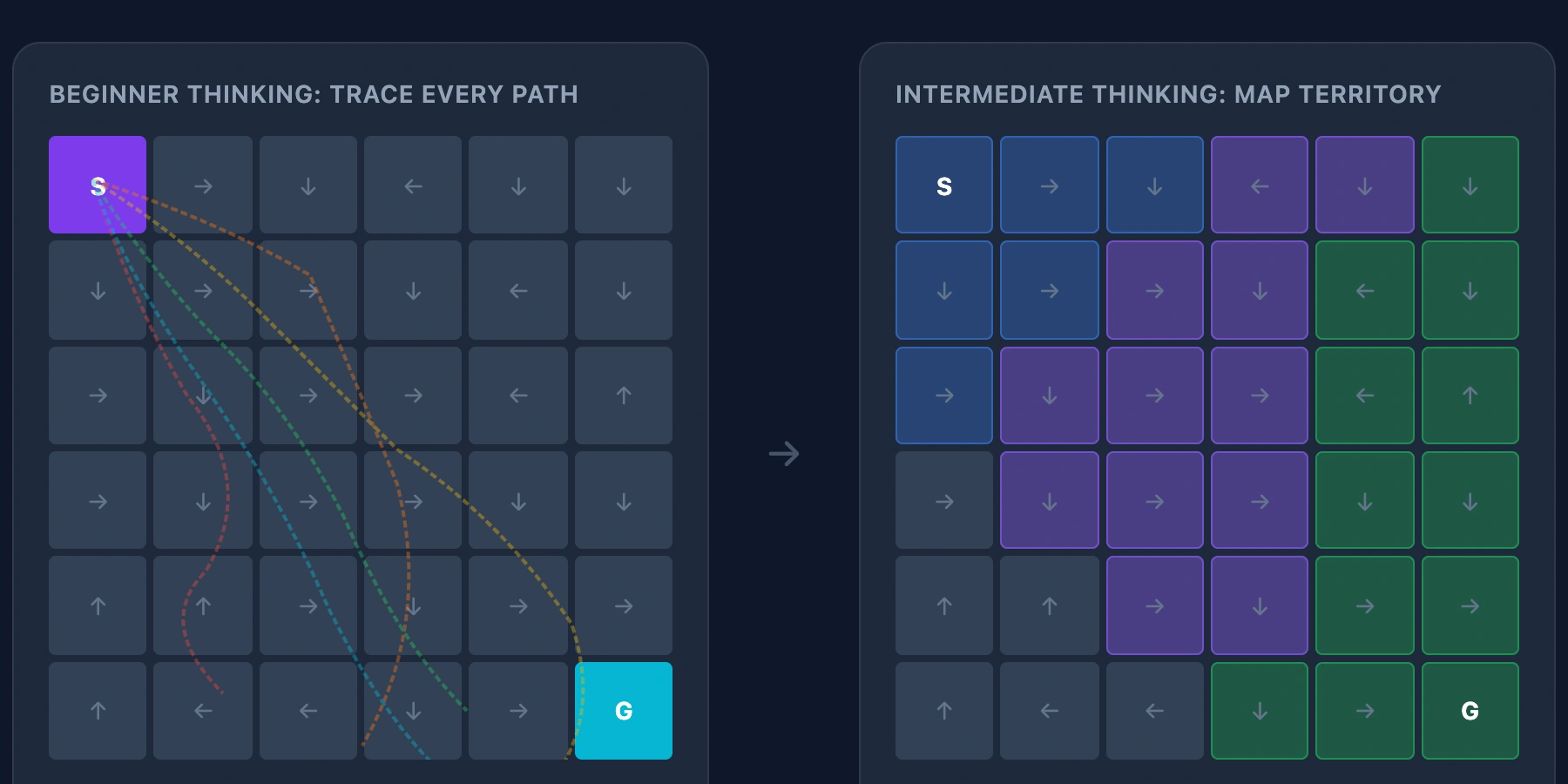
Instead of asking "Which specific sequence of arrows connects start to goal?", ask:
- Which cells can the start reach, even indirectly?
- Which cells can reach the goal, even indirectly?
- Where do these two territories overlap?
The solution path must exist entirely within that overlap. Everything else is noise you can ignore. You are no longer hunting for a needle in a haystack; you are systematically shrinking the haystack until the needle becomes obvious.
Key Takeaway: Think in territories, not individual paths—the solution exists only where start-reachable and goal-reaching regions overlap.
Strategy 1: The Bidirectional Sweep
You have already learned to work backward from the goal. Now it is time to formalize this into a systematic technique.
Phase 1: Forward Reachability
Starting from the start cell, mark every cell you can potentially reach by following arrows. Do not trace complete paths—just flood outward, marking cells as "reachable from start."
Phase 2: Backward Reachability
Starting from the goal cell, identify every cell that can reach the goal. A cell can reach the goal if its arrow points toward either the goal itself or another cell already marked as "can reach goal."
Phase 3: The Intersection
The solution path can only pass through cells that appear in both sets—cells that are reachable from the start AND can reach the goal.
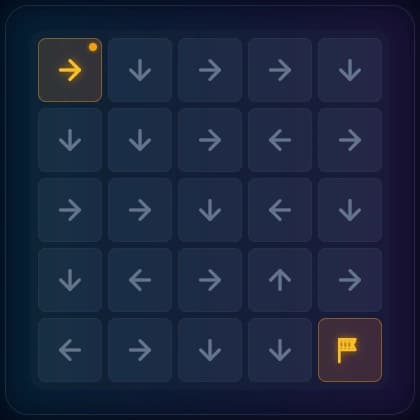
Initial puzzle state
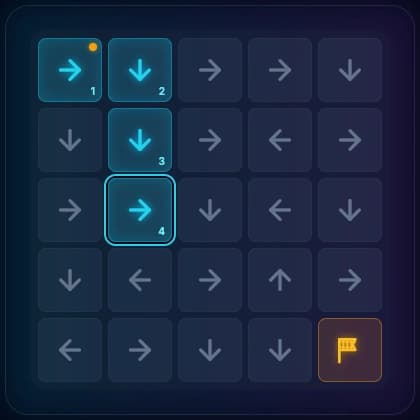
Path emerging from the solution corridor
The Sweep in Practice
You do not need to complete both sweeps before they become useful. Even a partial sweep narrows your search. If the forward sweep reveals that the start can only reach cells in the left half of the grid, you know immediately that any cell in the right half is irrelevant.
Key Takeaway: Perform forward and backward sweeps to identify the solution corridor—cells that are both reachable from start and able to reach the goal.
Strategy 2: Convergence Point Analysis
As you perform the bidirectional sweep, watch for convergence points—cells where multiple incoming paths funnel into a single outgoing direction. Think of it like an airport hub: dozens of flights arrive from every direction, but everyone passes through the same terminal before departing to their final destination.
Why do convergence points matter? If a convergence point is on your solution corridor, your path MUST pass through it. This transforms your search from "find any path" to "find the path through this specific checkpoint."
The Funnel Pattern
Multiple arrows from different directions all point toward the same cell. If that cell is on your solution corridor, it becomes a mandatory waypoint.
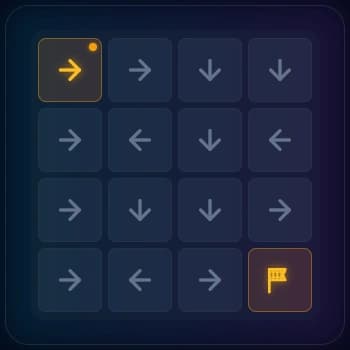
Funnel pattern: multiple arrows point to one cell
The Bottleneck Pattern
A narrow passage where the only way to cross from one region to another is through a specific cell. Bottlenecks often appear when dead zones create "walls" that block certain regions.
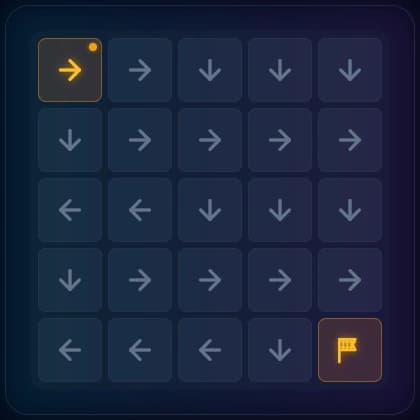
Bottleneck: the only crossing point between regions
Using Convergence Points Strategically
Once you identify a convergence point on your solution corridor:
- Mark it as a mandatory waypoint
- Solve the puzzle in segments: start-to-waypoint, then waypoint-to-goal
- If you find multiple convergence points, chain them together
This segmented approach makes large grids manageable. An 8x8 puzzle with two convergence points becomes three smaller sub-puzzles.
Key Takeaway: Convergence points are mandatory waypoints—find them, then solve the puzzle in smaller segments between checkpoints.
Strategy 3: Dead Zone Propagation
In the basics guide, you learned to identify dead zones—cells that lead off the grid or into inescapable loops. Now let us weaponize that knowledge with systematic dead zone propagation.
Dead zones spread through the grid like a contagion. If cell A's arrow direction leads only to dead zones at every possible distance, then cell A is also a dead zone. Even one viable landing spot keeps a cell alive--but once all options die, the infection spreads upstream.
The Propagation Algorithm
- Initial pass: Mark all cells whose arrows point off the grid as dead zones
- Propagation pass: Mark any cell where every reachable landing spot (at any distance) is already a dead zone
- Repeat until no new cells are marked
- Result: Everything marked is a dead zone; everything unmarked is potentially on your solution corridor
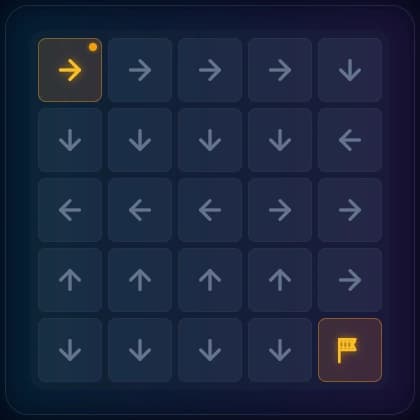
Dead zones propagate upstream through the grid
Why This Matters for Larger Grids
On a 4x4 grid, you might identify 2-3 dead zones. On an 8x8, you might find 15-20 cells that can never be part of any solution—nearly a third of the grid eliminated before you trace a single path.
Key Takeaway: Dead zones propagate upstream—systematically mark infected cells to eliminate large portions of the grid before tracing paths.
Strategy 4: Arrow Chain Highways
Think of a long arrow chain--several adjacent cells all pointing the same direction--as a highway through the grid. If you land anywhere on the chain, every distance choice keeps you moving in the same direction, landing on another cell in the chain or exiting at the end.
This has profound implications:
- If the highway leads to a dead zone, every cell on the highway is also dead
- If the highway passes through your solution corridor, you must travel its entire length
- The highway's entry and exit points become the key decision points
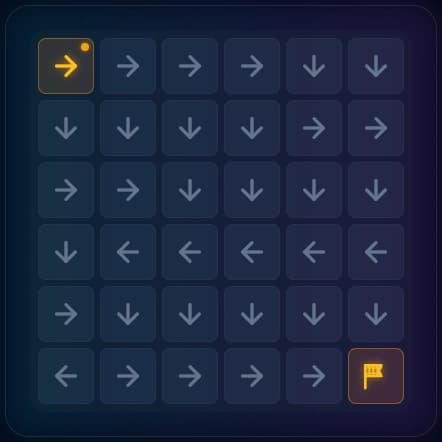
Highway: a chain of arrows with no exits
Mapping the Highway System
Before solving, scan the grid for all chains of 3+ consecutive arrows. Map where each highway starts (entry point), ends (where the chain terminates or changes direction), and leads (what the exit cell points toward). This highway map reveals the grid's coarse structure.
Key Takeaway: Arrow chains are highways with no exits—map their entry and exit points to understand the grid's coarse structure.
Strategy 5: Grid Decomposition for 6x6 and Larger
Now we bring everything together into a systematic approach for larger grids.
The Quadrant Method
For 6x6 and larger grids, mentally divide the puzzle into quadrants: Upper-left (UL), Upper-right (UR), Lower-left (LL), and Lower-right (LR).
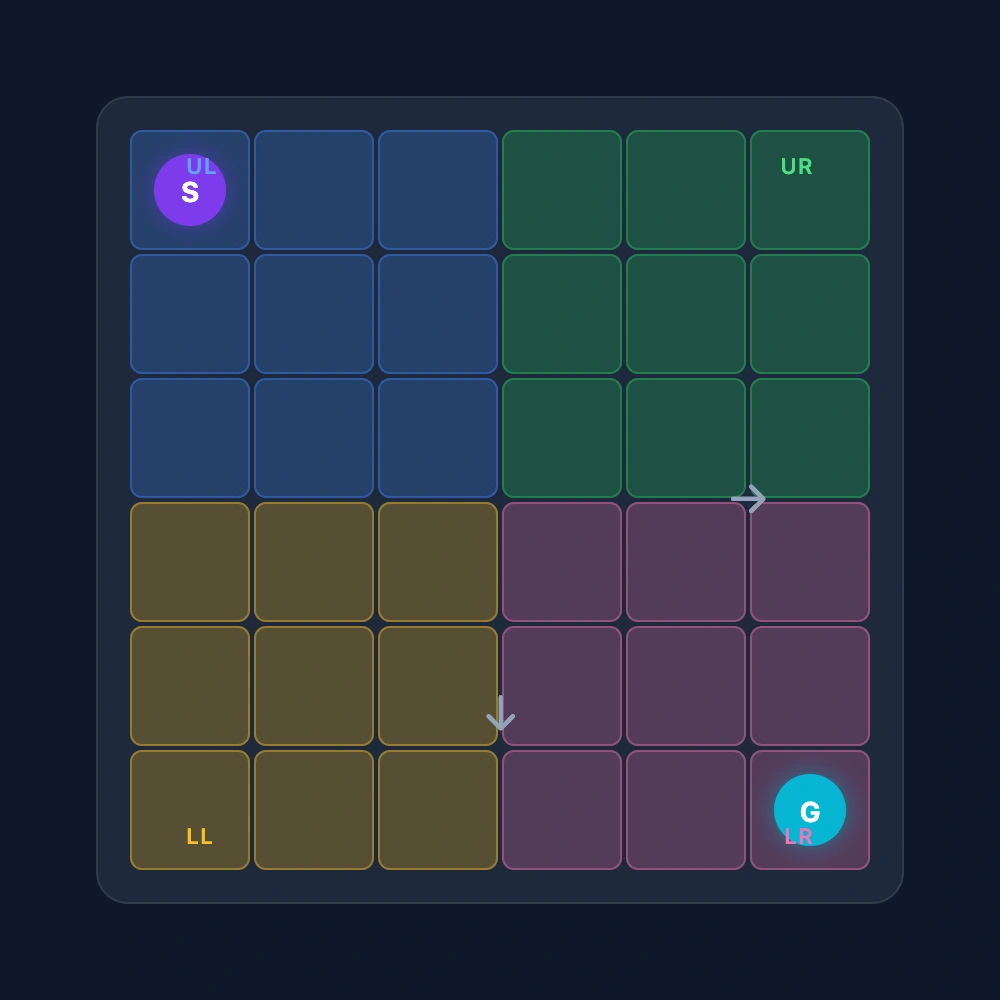
Quadrant division: UL, UR, LL, LR
For each quadrant, answer these questions:
- Can the start reach this quadrant?
- Can this quadrant reach the goal?
- Are there internal dead zones?
- Are there highways passing through?
- What are the entry/exit points to adjacent quadrants?
Quadrant-Level Flow Analysis
Rather than tracing individual cells, first determine the quadrant-level flow: Does the solution go UL → UR → LR? Or UL → LL → LR? Or something more complex like UL → UR → LL → LR?
Most 6x6 puzzles have only 2-3 viable quadrant-level paths. Once you identify the correct quadrant sequence, you have reduced a 36-cell problem to three 9-cell problems.
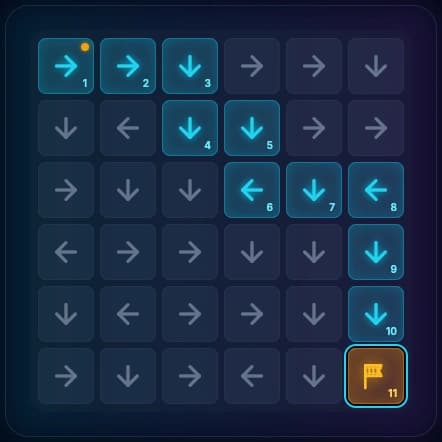
Solution path flowing through quadrants
Key Takeaway: Divide large grids into quadrants, determine the quadrant-level flow first, then solve each segment individually.
Strategy 6: Pattern Recognition Library
As you solve more puzzles, you will notice recurring arrow patterns. Building a mental library accelerates your solving dramatically.
The Spiral Approach
When arrows near the goal form a spiral pattern—circling inward toward the target—the solution often requires approaching from a specific direction. Identify the "entry point" to the spiral; there is usually only one cell from which you can successfully navigate inward to the goal.
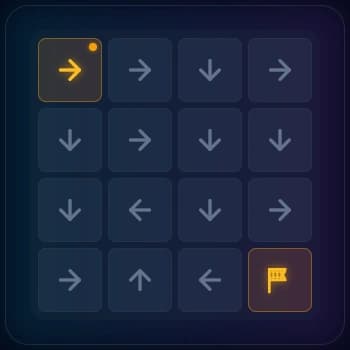
Spiral pattern near the goal
The Diagonal Descent
When arrows create a staircase pattern—alternating between horizontal and vertical movement—you have a Diagonal Descent. These patterns are usually reliable paths because each step brings you closer to the goal quadrant.
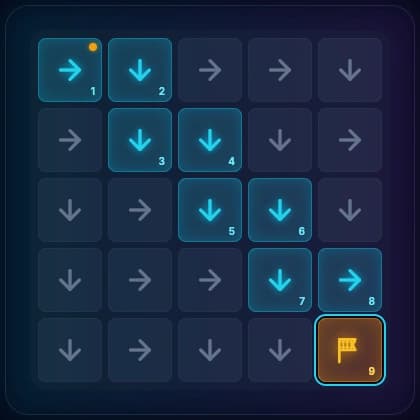
Diagonal descent: reliable staircase path
The False Direct
One of the trickiest patterns is the False Direct—arrows that seem to point straight toward the goal but actually lead to dead zones just before reaching it. A classic example: the cell adjacent to the goal has an arrow pointing AWAY from the goal, but earlier cells seem to lead directly there. The cure: always verify the last few steps backward from the goal before committing to an approach.
Key Takeaway: Build a mental library of patterns—Spiral Approach, Diagonal Descent, and False Direct—to recognize solutions instantly.
Strategy 7: Speed-Solving Techniques
Once you have internalized the strategic approaches, you can optimize for speed.
Technique 1: Visual Scanning Before Tracing
Before touching the puzzle, spend 5-10 seconds visually scanning for obvious dead zones (arrows pointing off edges), long highways (3+ arrow chains), and the goal's immediate neighborhood. This initial scan often reveals the solution's skeleton without tracing a single path.
Technique 2: Anchor Points First
Identify 2-3 "anchor points"—cells that are almost certainly on the solution path: the start and goal (obviously), any convergence points on the solution corridor, and the entry/exit points of major highways. Solve the connections between anchor points rather than tracing from scratch.
Technique 3: Parallel Processing
When an arrow offers multiple distance choices--say, landing 1, 2, or 3 cells away--do not fully trace one option before checking the others. Try landing at the nearest cell and trace 3-4 steps, then try a farther landing and trace 3-4 steps. One will usually hit a dead zone or loop; abandon it and continue with the surviving option.

Key Takeaway: Speed comes from pattern recognition, not faster tracing—scan first, identify anchor points, and test multiple distance choices in parallel.
Advanced Exercise: Putting It All Together
Let us work through a challenging 6x6 puzzle using all our intermediate strategies.
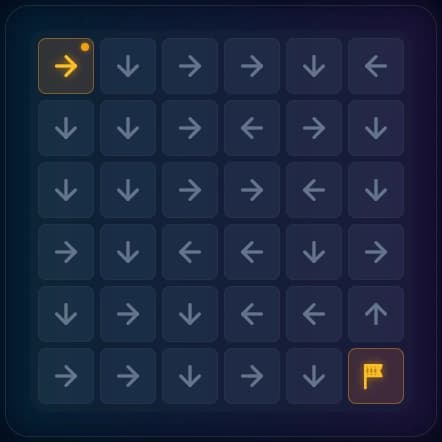
Advanced exercise: 6x6 puzzle
Solving Steps
- Initial Scan (5 seconds): Scan edges for dead zones, look for obvious highways, check goal neighborhood
- Dead Zone Propagation: Mark cells pointing off-grid, propagate the infection, note surviving territory
- Bidirectional Sweep: Forward: what can start reach? Backward: what can reach goal? Find the intersection
- Identify Convergence Points: Look for funnels and bottlenecks, mark mandatory waypoints
- Quadrant Analysis: Which quadrants are viable? What is the quadrant-level path?
- Solve Segment by Segment: Start to first convergence point, between convergence points, final convergence point to goal
Try solving this puzzle yourself using these steps before looking at the solution below.
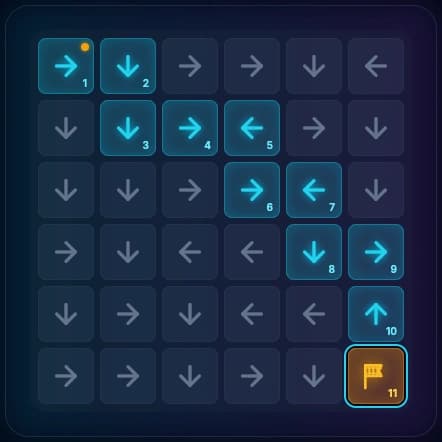
Solution: path flows through upper quadrants
The quadrant analysis reveals the path must flow UL → UR → LR, as the LL quadrant contains several dead zones that block direct access.
Common Intermediate Mistakes
Even with these strategies, certain mistakes trip up intermediate solvers.
Mistake 1: Incomplete Dead Zone Propagation
You mark the obvious dead zones but stop propagating too early. That cell three steps upstream? It is dead too, but you missed it and wasted time exploring.
Fix: Be systematic. After each propagation pass, ask: "Are there any cells that now only point to dead zones?" Keep asking until the answer is no.
Mistake 2: Ignoring the Goal Neighborhood
You get so focused on forward exploration from the start that you forget to analyze what can actually reach the goal. Then you discover, ten moves later, that nothing you traced connects to the goal.
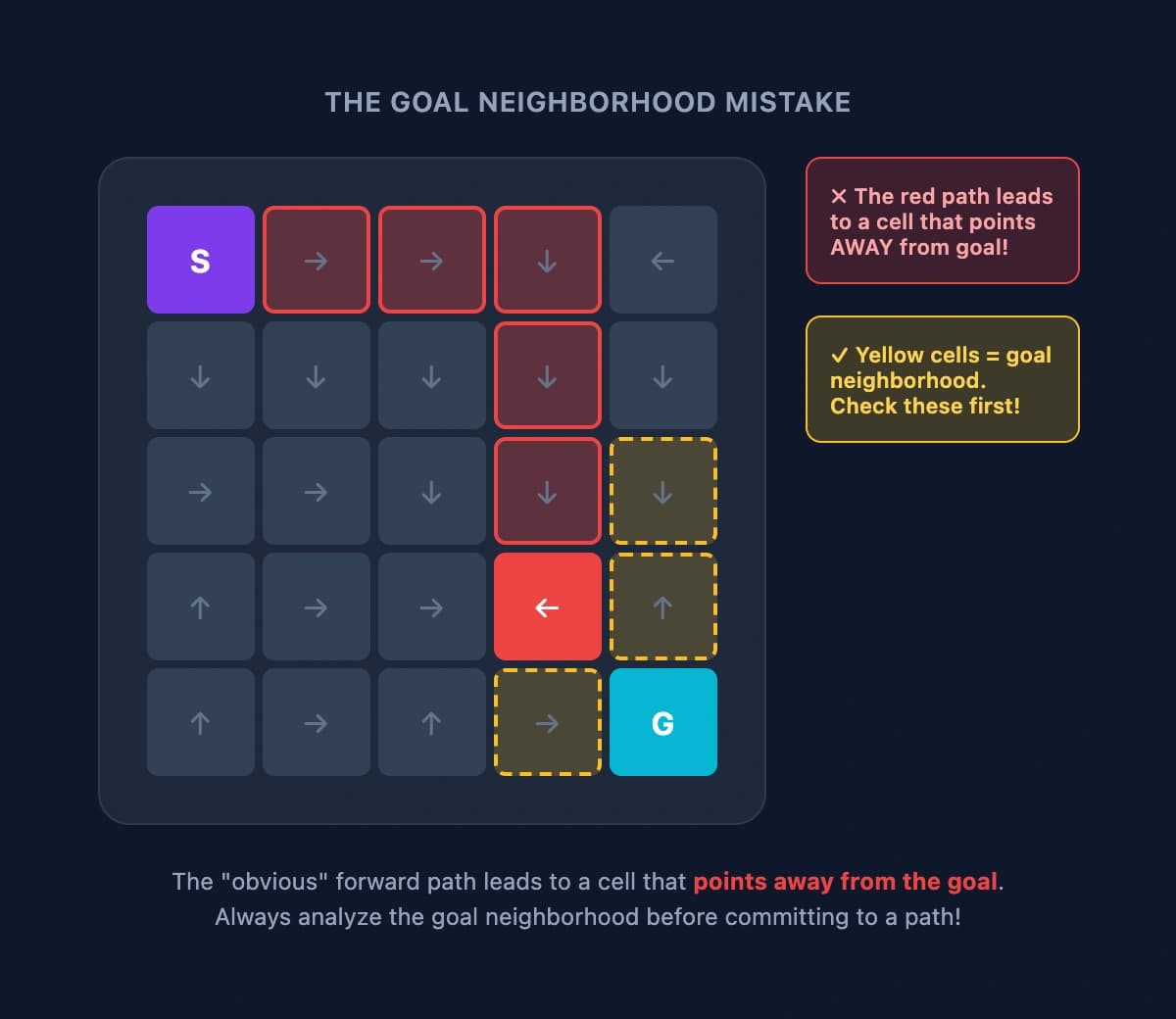
Fix: Always start with backward analysis of the goal's immediate neighborhood. Know which cells are "one step from victory" before you trace anything forward.
Mistake 3: Abandoning Partial Progress
You trace forward, hit what seems like a dead end, and restart from scratch. But that dead end might just mean you chose the wrong distance at a previous step--a different landing spot could work.
Fix: Keep track of where you had multiple distance options. When you hit a dead end, backtrack to the most recent step with untried distances, not all the way to the start. Your partial progress toward that step is still valid.
Building Your Intermediate Skills
The strategies in this guide take practice to internalize. Focus on one technique at a time: solve a batch of 5x5 puzzles using only dead zone propagation, then a batch using only bidirectional sweeps, then a batch looking specifically for convergence points. Once each technique feels natural on its own, tackle 6x6 and 8x8 grids using whatever combination the puzzle calls for.
From Intermediate to Advanced
The strategies in this guide will carry you through most Arrow Maze puzzles you encounter. But there is always another level. Advanced solvers develop intuitions that are hard to articulate—a sense for how arrows "want" to flow, an instant recognition of viable and non-viable regions, an almost unconscious elimination of dead zones.
These intuitions come from one source: volume. Solve hundreds of puzzles, and your brain starts doing the analysis automatically.
But here is the good news: with the intermediate strategies you have now learned, that journey becomes faster and more enjoyable. You are no longer stabbing in the dark. You have a framework, a vocabulary, a set of tools that make each puzzle an engaging logic exercise rather than a frustrating guessing game.
Now you see grids differently. Where you once saw chaos, you now see territory—regions of possibility and regions of impossibility, solution corridors waiting to be discovered. The arrows await. Go follow them—strategically.