Star Battle Strategies:
Techniques Every Solver Should Know
You place a star in the only cell that works. The adjacency rule eliminates its eight neighbors. A region collapses to one option. A column resolves. A row follows. And suddenly, like a constellation emerging from a dark sky, the entire grid clicks into place.
That cascade is what makes Star Battle one of the most elegant logic puzzles ever designed. No arithmetic. No word knowledge. Just spatial reasoning and the relentless power of elimination.
But between "I understand the rules" and "I can solve Expert grids" lies a gap -- not of talent, but of technique. This guide bridges it. We will work through every major solving technique, from fundamental adjacency elimination to advanced region interaction chains.
Watch the Tutorial
Prefer watching? This short video walks you through the rules and solving techniques.
Prerequisites
This guide assumes you know the basic rules of Star Battle. If regions, the star-per-unit constraint, or the no-touch rule feel unfamiliar, start with our beginner's guide first.
A Quick Rules Refresher
Star Battle -- which you may know as Starstruck on Netflix -- comes in several grid sizes, each divided into N colored regions:
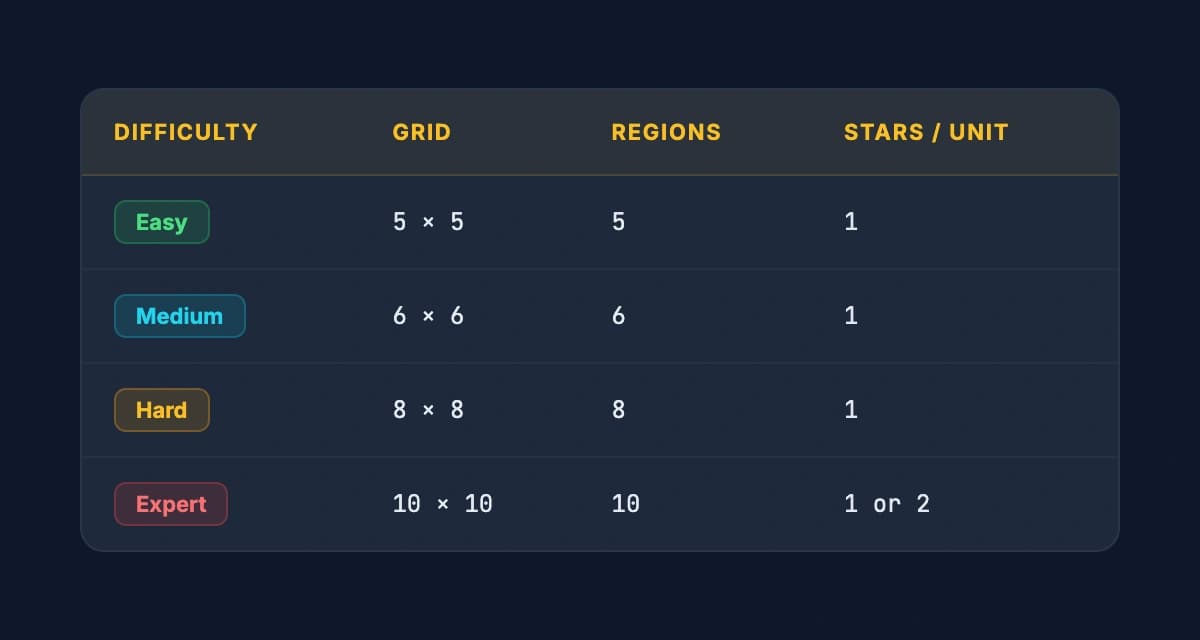
Place exactly one star (or two, in 2-star variants) in every row, every column, and every region. Stars cannot touch each other in any direction -- horizontally, vertically, or diagonally. Each star eliminates all eight surrounding cells.
A Note on 2-Star Puzzles
These techniques apply to both variants. That said, 2-star puzzles require genuinely different reasoning -- you must consider which pairs of cells can coexist, and overlap analysis becomes multi-layered. Master these techniques on 1-star grids first.
Technique 1: Elimination by Adjacency
This is where every Star Battle solution begins. When you place a star, you can immediately mark all eight surrounding cells with an X -- they cannot contain a star. On a 5x5 grid, a single star in the center cell eliminates eight cells. That is nearly a third of the grid, gone in one move.
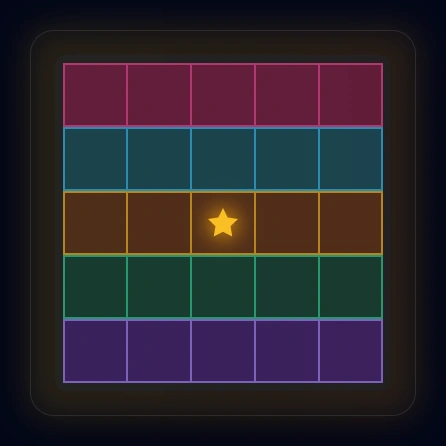
A single star at the center of a 5x5 grid. Its exclusion zone eliminates all 8 surrounding cells.
But adjacency elimination also works backward. If placing a star in a particular cell would make it impossible for an adjacent row, column, or region to get its required star, then that cell cannot hold a star. Think of each star as claiming a 3x3 block of influence, not just one cell.
Practice this: Every time you place a star, immediately trace the adjacency consequences. Make it mechanical. Star goes down, eight X marks go down. This chain reaction is where Star Battle's elegance lives.
Technique 2: Region Analysis
If adjacency elimination is the engine, region analysis is the steering wheel. Count the available cells in each region. If a region has been reduced to exactly one cell that could hold a star, that cell is forced. Place the star, apply adjacency elimination, and watch the cascade begin.
Small Regions Are Your Best Friends
Start every puzzle by scanning for the smallest regions. A three-cell region has at most three options for its star. After adjacency eliminations from other progress, that number drops fast.
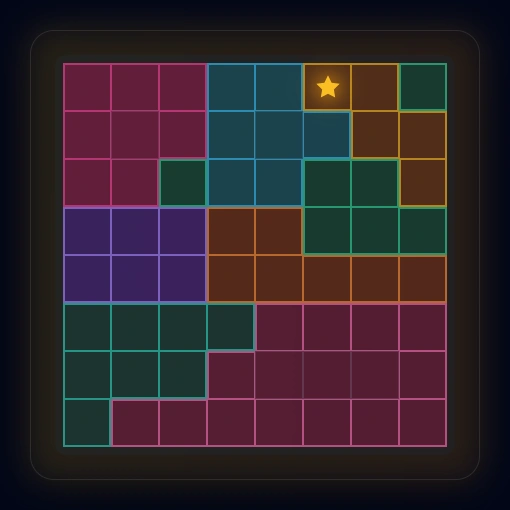
An 8x8 grid where a placed star constrains a nearby small region, forcing its star into the only remaining valid cell.
Bottleneck Regions
Some regions have a special property: all their cells fall within a single row or column. These are bottleneck regions, and they are solving gold. A region whose three cells all sit in row 4 means row 4's star must be one of those cells. Any other region with cells in row 4 can safely eliminate those cells -- the row is spoken for.
The Cell-Counting Habit
Make it routine: after every wave of eliminations, scan each region and note how many viable cells remain. When a region drops to one viable cell, you have a forced placement. When it drops to zero, you have made an error -- time to backtrack.
Technique 3: Row/Column Counting
Nothing is forced. The smallest region still has three viable cells. You feel stuck. Here is what to do: stop looking at regions and start counting rows.
Rows and columns also need exactly one star, and they provide an independent axis of deduction that cross-references beautifully with region analysis. After a round of eliminations, examine each row. If only one viable cell remains, that cell must hold a star.
Cross-Referencing Rows and Regions
The real power emerges when you combine row counting with region analysis. If a row has only two viable cells and both are in the same region, that region's star must be in that row -- eliminate all of the region's cells in other rows. The reverse also works: if a region's star must be in a specific row, no other region can use that row.
Key insight: Cross-reference constantly -- it is the heartbeat of intermediate solving.
Technique 4: Overlap Analysis
Try a quick challenge: Region C has only two viable cells left, at (row 2, col 1) and (row 2, col 4). Region D has a viable cell at (row 2, col 5). Can Region D use that cell?
No. Both of Region C's options are in row 2, so C's star must be somewhere in row 2. Since row 2 can only hold one star, it is spoken for. Region D's cell in row 2 is eliminated.
This is overlap analysis: when every possible position for a region falls within a single row, that region claims that row. No other region can place a star there. The same logic applies to columns.
Why this matters: Overlap analysis extracts information from uncertainty. You do not know which cell holds the star, but you know the row -- and that constrains everything else. This is the technique that separates beginners from intermediate solvers.
Technique 5: The Exclusion Principle
The core idea here is pairing: two units that share the same two options must claim both, locking everyone else out. (Sudoku solvers will recognize this as "naked pairs" -- same logic, different puzzle.)
The Setup
Picture two regions claiming two rows:
- Region E's viable cells are only in rows 1 and 4
- Region F's viable cells are only in rows 1 and 4
Between them, Region E and Region F will consume the stars for rows 1 and 4. One takes row 1, the other takes row 4. You do not know which is which -- but you know that no other region can place a star in row 1 or row 4.
Applying the Deduction
Any other region with viable cells in row 1 or row 4 can have those cells eliminated. The exclusion principle generalizes beyond pairs -- three regions in three rows, four in four -- but pairs are by far the most common application in 1-star Star Battle.
Technique 6: Working from Constraints
The order in which you attack a puzzle matters enormously. Random scanning wastes time and misses cascades. Strategic ordering multiplies your efficiency.
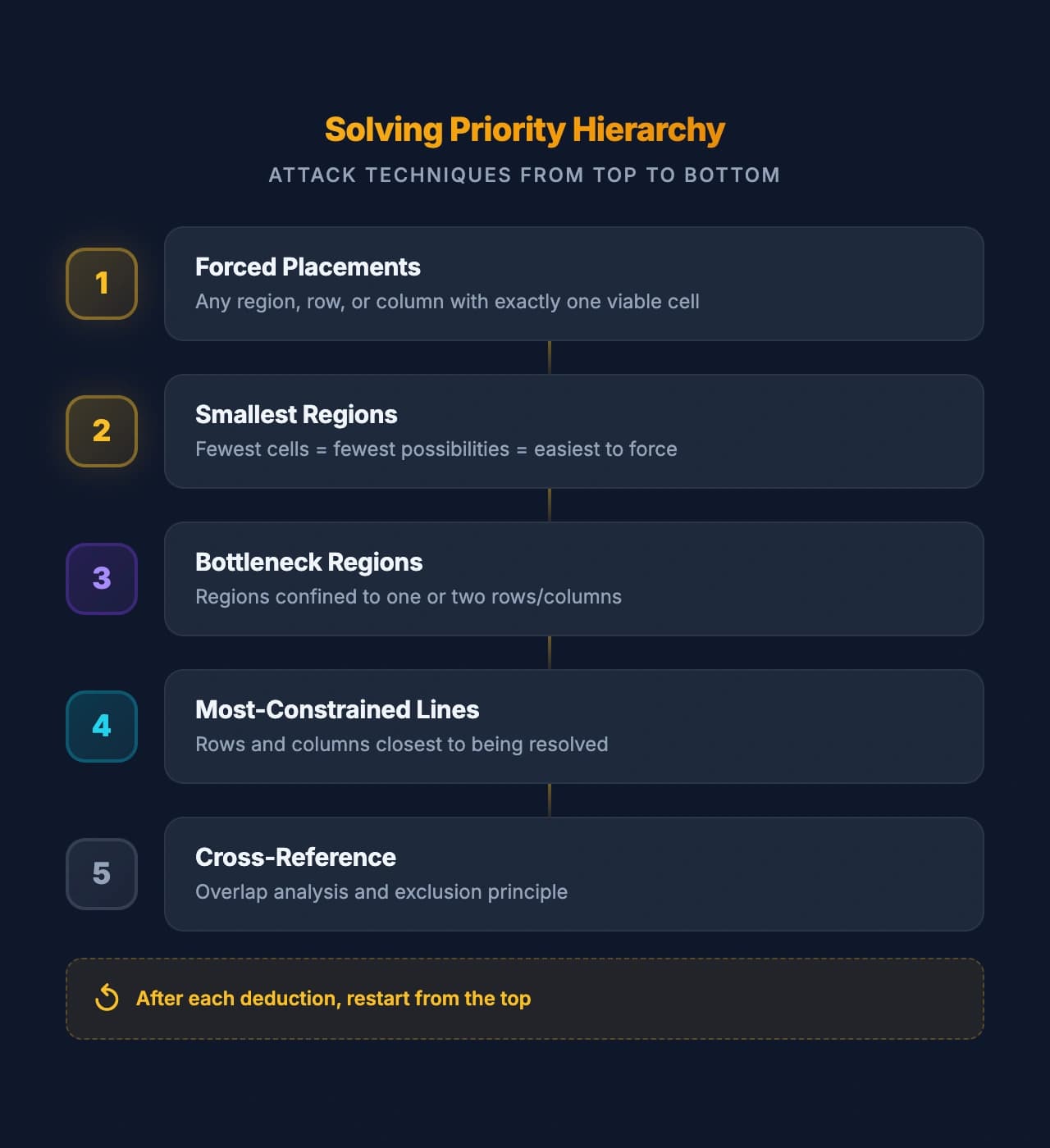
Every certain placement creates ripples. Those ripples create new certainties. The strongest solvers ride the cascade -- place a star, trace every elimination, check every affected region, row, and column, and only stop when the cascade dies down.
The Mistake to Avoid
Do not jump around the grid randomly. Work outward from your last placement, following the chain of consequences until it runs dry.
Technique 7: Region Interaction Chains
This is the technique that unlocks Expert-level grids. It combines overlap analysis and the exclusion principle into multi-step deduction chains that propagate constraints across the entire board.
How Chains Form
- Region A's star must be in column 3 (overlap analysis)
- Region B cannot use column 3, forcing it into column 7
- Region B in column 7 eliminates a cell in Region C
- Region C's surviving cells all fall in row 6, claiming it
- Region D is forced out of row 6, into row 2 -- position resolved
Each link is a simple deduction. But the chain propagates a constraint across the entire grid.
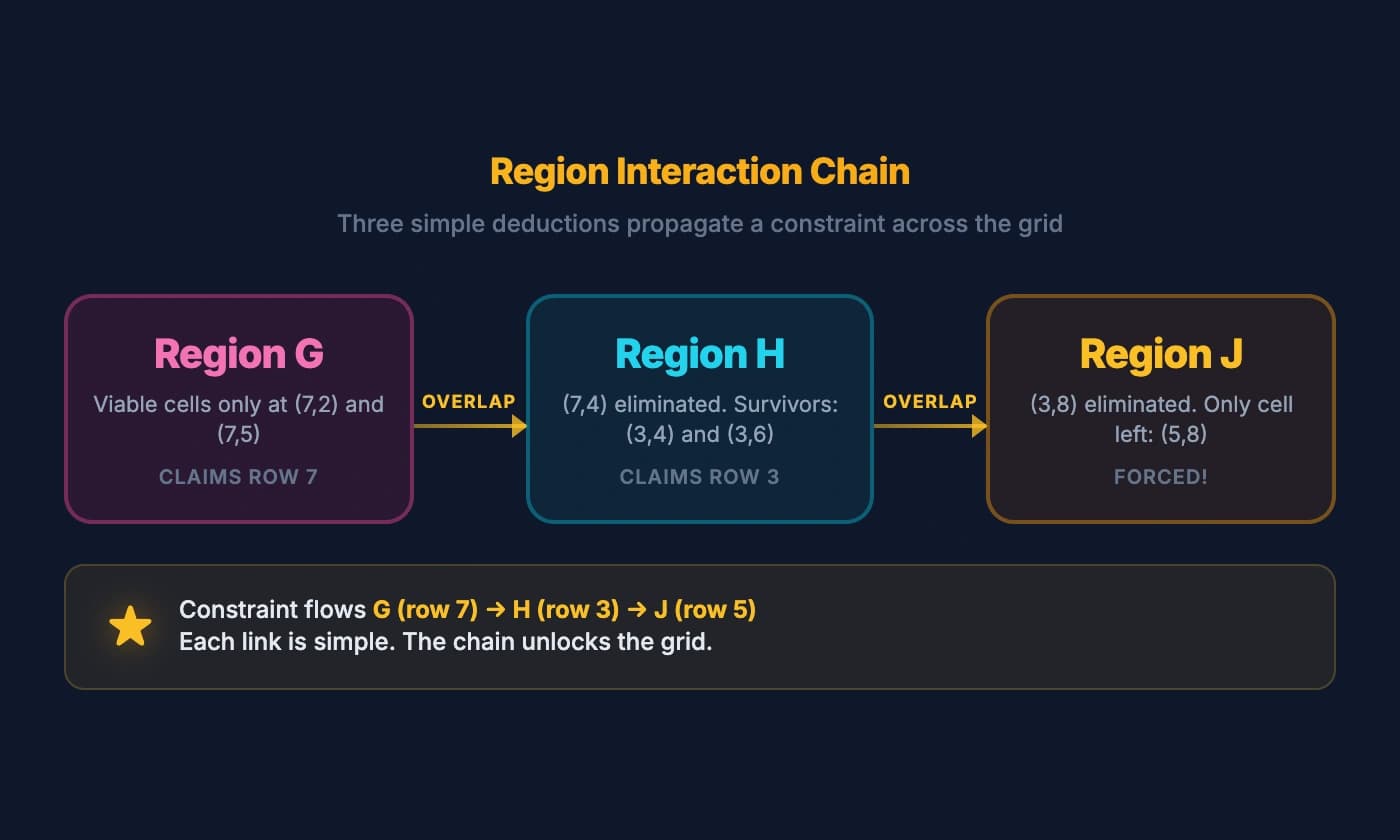
Start by practicing two-link chains. Once two-link chains become automatic, longer chains emerge naturally. Experienced solvers describe this as "feeling" the constraints flow through the grid -- pattern recognition built from hundreds of puzzles.
Common Mistakes (and How to Fix Them)
Forgetting Diagonal Adjacency
Two stars that are not in the same row, column, or region can still be diagonally adjacent. After every placement, trace the full 3x3 exclusion zone -- all eight cells, including diagonals.
Ignoring Eliminated Cells When Counting
You scan a region and count five viable cells, but two were eliminated moves ago. Mark every elimination as you make it. What is obvious now becomes invisible later.
Solving Regions in Isolation
Every region shares rows and columns with every other region. After making progress in any region, immediately check the rows and columns that progress affected.
Guessing Instead of Deducing
Before guessing, systematically check: Have you applied overlap analysis to every region? Have you looked for exclusion principle pairs? Ninety percent of "stuck" positions have a deduction hiding in overlap analysis.
Two stars placed diagonally adjacent -- the most common beginner error. Each star's 3x3 exclusion zone overlaps at the diagonal.
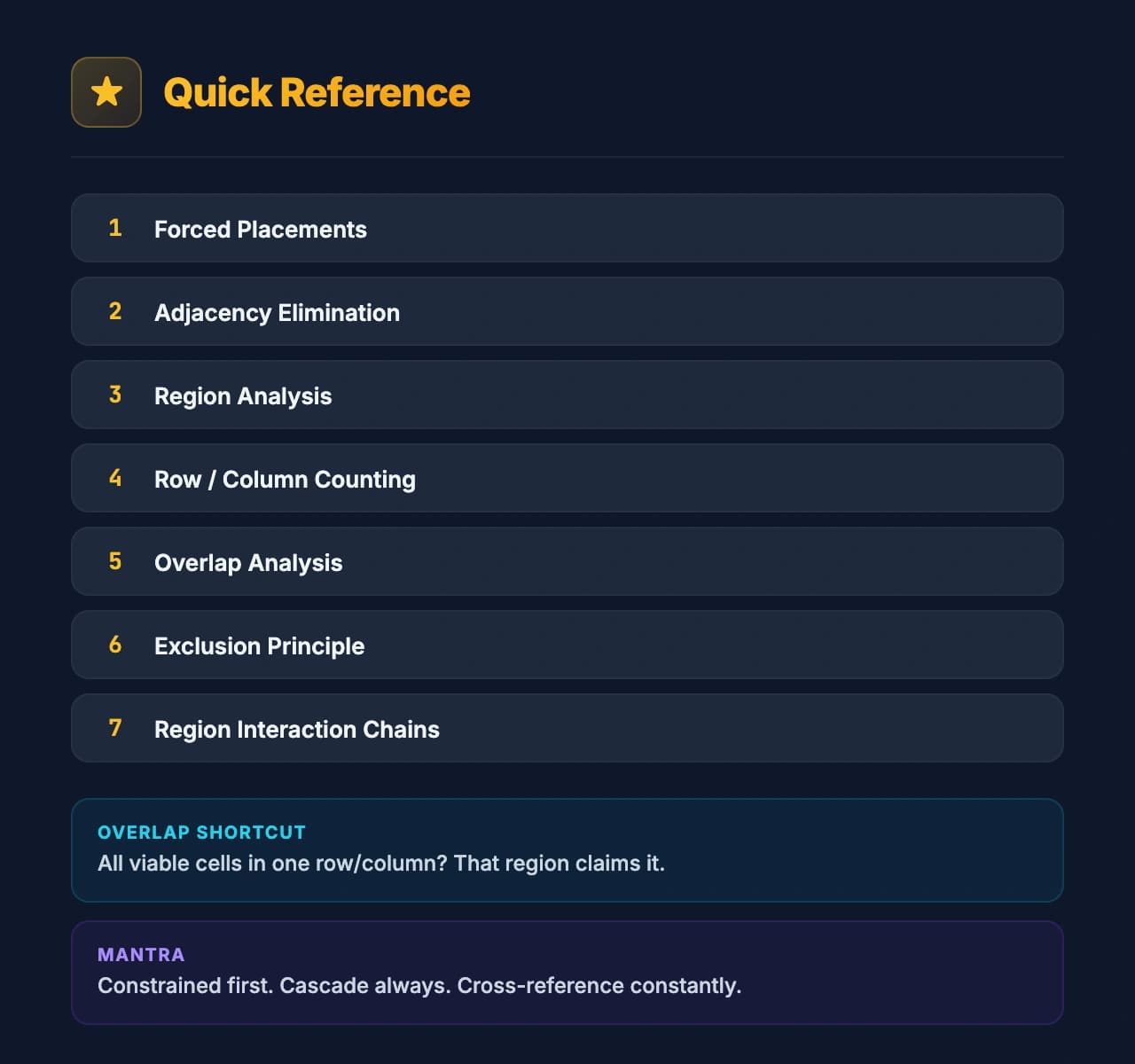
Putting It All Together: A Solving Walkthrough
Let me walk you through a concrete 6x6, 1-star grid. Every deduction is definite, every coordinate is specific, and every star placement is logically forced.
The Grid
Our puzzle has six regions labeled A through F. Region A is a large 7-cell inverted-T shape through the top-center. Region B is a tiny 3-cell L-shape in the top-left. Region C runs down the right side. Region D is a small 3-cell L-shape in the bottom-left. Region E fills the center-left. Region F runs down the center-right.
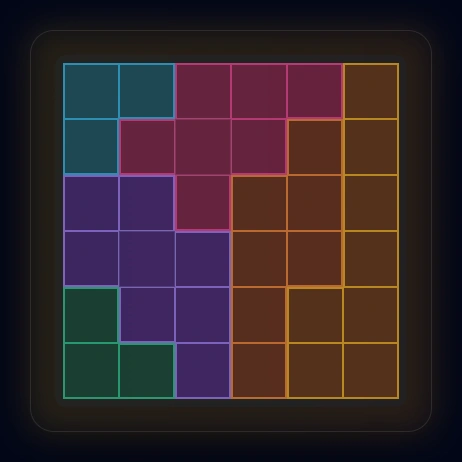
Our 6x6 walkthrough puzzle with regions A-F. Two tiny 3-cell regions (B and D) are the key.
Steps 1-3: The Exclusion Principle Locks Columns 1-2
Two regions stand out: Region B (3 cells, all in columns 1-2) and Region D (3 cells, all in columns 1-2). Both are confined entirely to columns 1 and 2.
By the exclusion principle: B and D will consume both columns between them. No other region can place a star in column 1 or column 2. This eliminates cells from Regions A and E in one stroke -- Region E drops from 8 viable cells to just 3.
Step 4: Overlap Analysis Locks Column 3 to Region E
Region E's three surviving cells are all in column 3. By overlap analysis, E claims column 3. This eliminates Region A's column-3 cells. Region A drops to 3 viable cells: all in columns 4-5.
Step 5: Exclusion Locks Columns 4-5
Region A's surviving cells are all in columns 4-5. Region F's cells are also entirely in columns 4-5. Same pattern as B and D: two regions claim both columns. Region C's surviving cells collapse to column 6 only.
Step 6: All Columns Assigned
Without placing a single star, we have assigned every column:
That is the power of overlap analysis and the exclusion principle: they extract maximum information from the grid's structure before you commit to specific cells.
Steps 7-8: Testing Scenarios
Region B and A both have cells in rows 1-2. Testing Scenario X (B takes row 1, A takes row 2 at (2,4)): every path leads to a diagonal adjacency contradiction. Scenario X is impossible.
In Scenario Y, B takes row 2 and A takes row 1. B's star goes to (2,1) -- the only Region B cell in row 2. This fixes B in column 1, which means D goes to (6,2).
Step 9: The Cascade Begins
Adjacency from D at (6,2) eliminates two of Region E's three surviving cells. E is forced to (4,3) -- the only cell remaining.
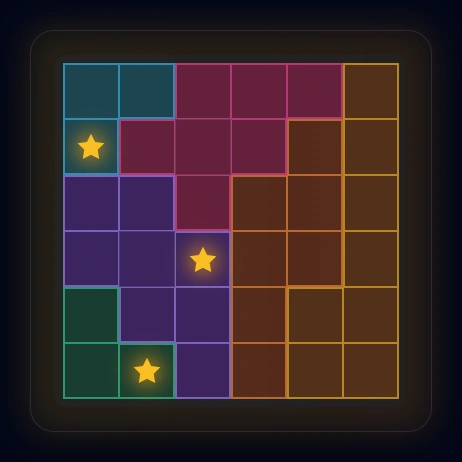
Three stars placed: B, D, and E. The cascade from D's adjacency forced E into its only remaining cell.
Step 10: A and F Resolve
If A takes column 5 at (1,5), then F must take column 4 -- but F's only column-4 cell is in row 6, already taken by D. Contradiction. A's star must be at (1,4).
With A in column 4, F must take column 5. F's column-5 cell at (2,5) is in row 2 (taken by B), so F is forced to (3,5).
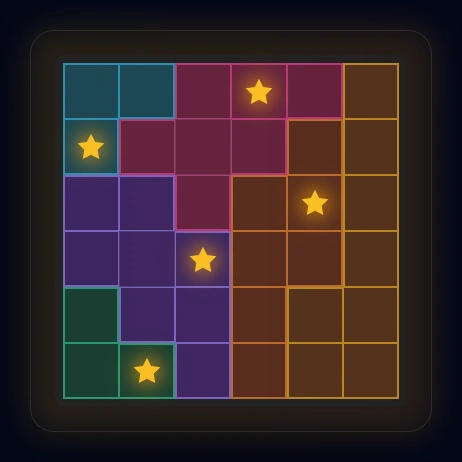
Five stars placed. Only row 5 and column 6 remain open. Region C's final cell is obvious.
Step 11: The Final Star
The only open row is row 5. Column 6 belongs to Region C. C's column-6 cell in row 5 is (5,6). C's star goes to (5,6). All adjacency checks clear.
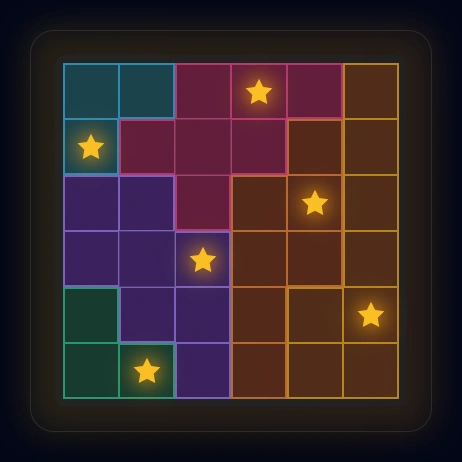
All six stars placed. Notice how solving flowed from abstract to concrete -- all six columns were assigned before placing a single star.
The Puzzle Always Has Enough Information
The puzzle strips away everything except spatial reasoning. No numbers to calculate. No words to know. Just colored regions, empty cells, and the elegant constraint that stars cannot touch.
The grid always has enough information. The strategies above are how you read it. Now go place some stars. The first one is the hardest. After that, the constellation builds itself.
Your Practice Roadmap
Easy (5x5)
Build the adjacency elimination habit. Techniques 1-3 are sufficient. Focus on mechanical consistency.
Medium (6x6)
Move here once adjacency and region counting feel automatic. You will need overlap analysis (Technique 4).
Hard (8x8)
Graduate here when overlap analysis becomes second nature. These grids demand the exclusion principle and strategic solving order.
Expert (10x10)
Tackle these once you spot exclusion pairs without searching. Region interaction chains (Technique 7) are deeply satisfying.
Our Star Battle puzzle collection offers grids at every level, from gentle 5x5 warm-ups to demanding 10x10 challenges. Pick your starting point, apply what you have learned, and watch the stars fall into place.
Ready to Test Your Strategies?
The techniques are in your toolkit. Overlap analysis is your secret weapon. All that's left is to ride that first cascade.
Start Solving Star BattlePut it into practice
Ready to solve Star Battle?
Open a free puzzle and turn the ideas from this guide into your next solve.