Suguru Strategies:
Mastering Irregular Region Logic
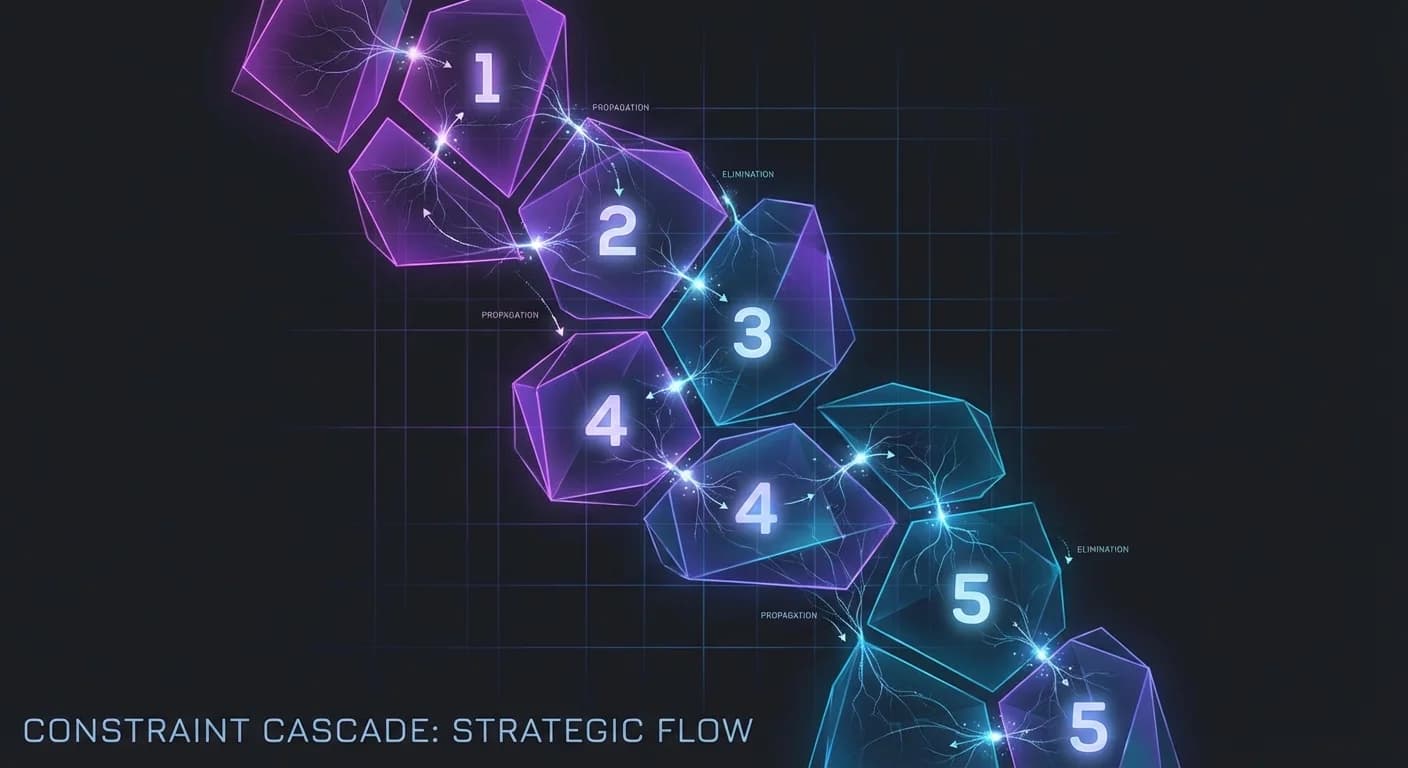
In Sudoku, a number affects its row, column, and box. In Suguru, a number affects every single neighbor—including diagonals. That is up to 8 cells eliminated with one placement.
The best Suguru solvers do not just place numbers; they detonate controlled explosions of eliminations across the grid. One placement. Eight cells affected. Three more placements forced. That is the Suguru cascade.
This guide will teach you to think like an advanced Suguru solver. We will move beyond basic elimination into territory that separates struggling beginners from confident masters: strategic region analysis, the power of boundary cells, cascade recognition, and techniques that turn a grid of possibilities into a grid of certainties.
Watch the Tutorial
Prefer watching? This quick tutorial covers the fundamentals of Suguru solving.
Prerequisites
This guide builds on concepts from our beginner's guide—understanding Suguru rules, region constraints, and basic elimination. If any of these feel unfamiliar, start there first.
The Neighbor Scan: Counting Your Impact
Before placing any digit, ask yourself: "How many cells will this placement affect?"
In Suguru, every cell has up to 8 neighbors—four orthogonal (up, down, left, right) and four diagonal. When you place a number, that number is immediately eliminated from every neighboring cell, regardless of which region those neighbors belong to.
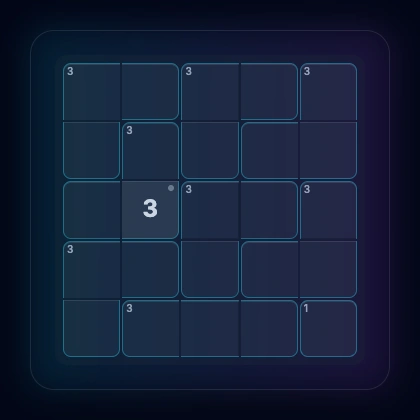
Every cell has up to 8 neighbors. One placement eliminates that digit from all of them.
This is the foundation of strategic Suguru solving. When you have multiple valid placements, choose the one that eliminates the most possibilities from neighboring cells. The solver who maximizes elimination impact solves faster.
Note: Throughout this guide, we reference cells by their row-column position. Cell 23 means row 2, column 3, counting from 0. So cell 00 is the top-left corner, and cell 01 is one step to the right.
The High-Impact Placement
Consider two cells where you could place a 3. One cell sits in a corner of the grid, touching only 3 neighbors. The other sits in the interior, surrounded by 8 neighbors across 4 different regions.
Which placement is more powerful? The interior cell. Placing a 3 there eliminates 3 as a possibility from 8 cells across potentially 4 regions. That single placement might force a cascade of additional placements as those regions lose options.
Strategic principle: When you have a choice of where to place a digit, prefer cells with more neighbors. The elimination ripples further.
The Pre-Placement Audit
Before committing to a placement, perform a quick neighbor audit:
- Count the neighbors (typically 3-8 depending on position)
- Note which regions those neighbors belong to
- Ask: "Will eliminating this digit from those cells force any placements?"
If the answer to question 3 is yes, you have found a high-value move. Make it and follow the cascade.
Region Size Analysis: Why 5-Cell Regions Are Harder
Not all regions are created equal. A 2-cell region contains only 1 and 2—just two possibilities per cell. A 5-cell region contains 1 through 5—five possibilities per cell. This difference fundamentally changes solving strategy.
The Constraint Density Principle
Smaller regions have higher constraint density. Here is why:
2-cell region: Each cell has 2 possible values. Place one digit, and the other cell is immediately solved. The region provides strong internal constraints.
5-cell region: Each cell has 5 possible values. Place one digit, and the remaining 4 cells still have 4 possibilities each. The region provides weaker internal constraints.
This means smaller regions resolve faster and more completely. Large regions often require external pressure—eliminations from neighboring regions—to narrow down their cells.
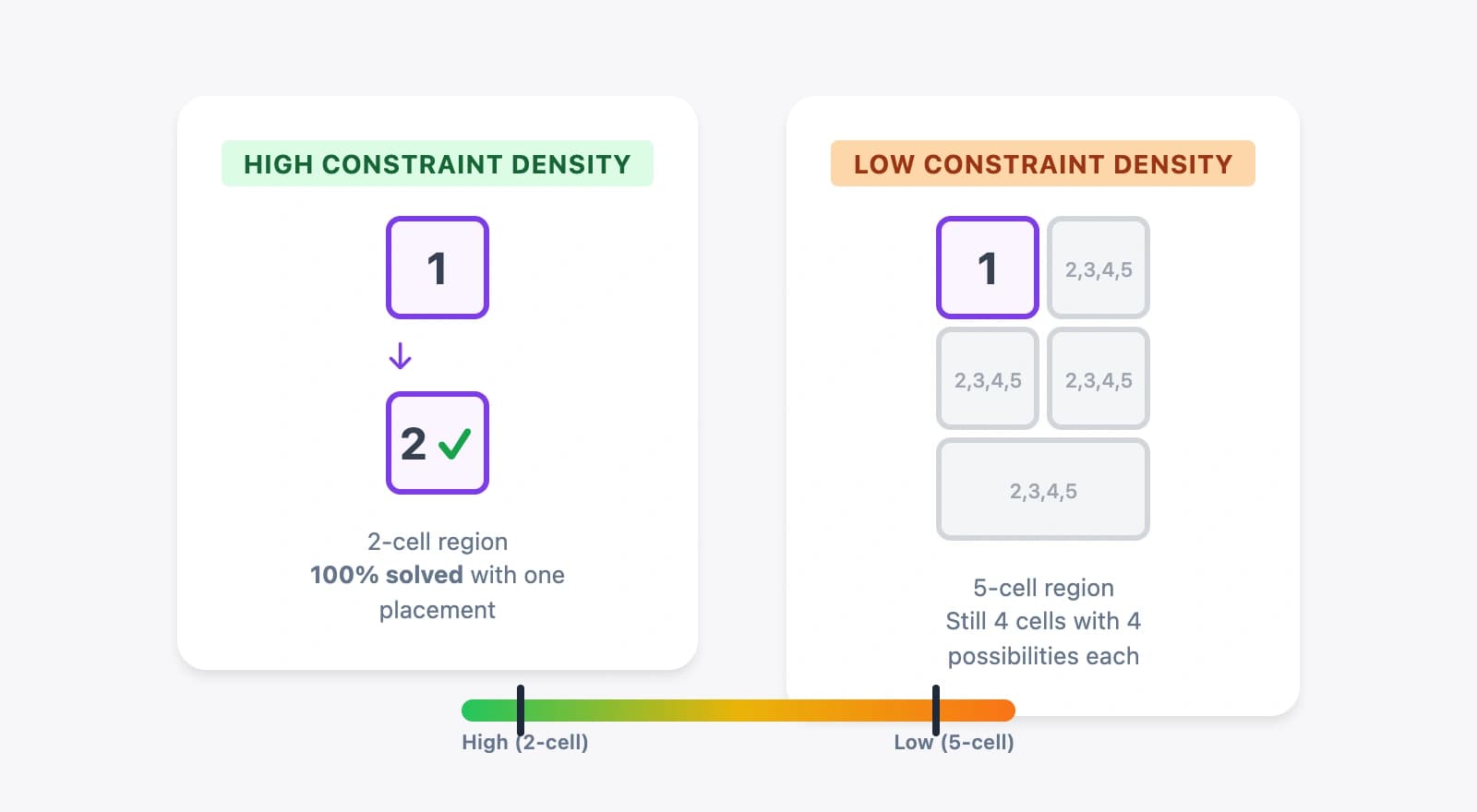
Smaller regions have higher constraint density—one placement solves more of the region.
Strategic Implication: Small Regions First
When scanning a puzzle for your next move, prioritize smaller regions:
The small-region-first approach is noticeably more efficient. The early eliminations from small regions cascade into the larger regions, doing much of the work for you.
The Forced Single Rule: When Only One Cell Fits
This technique is the backbone of intermediate Suguru solving. Within any region, each required digit must appear exactly once. If eliminations leave only one cell where a specific digit can go, that digit is forced into that cell.
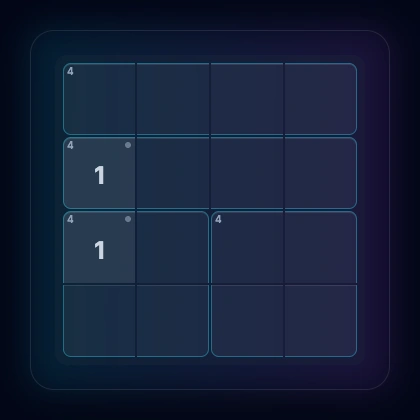
When three cells in a region are blocked from holding 1, the fourth cell must be 1.
The Systematic Region Sweep
When stuck, perform a systematic sweep of each region:
- Pick an unsolved region
- List the digits it still needs
- For each needed digit, count how many cells in the region can hold it
- If any digit has only one valid cell, place it
- Repeat for all regions
This methodical approach catches forced singles that casual scanning misses. For most intermediate puzzles, forced singles account for a large portion of placements.
Diagonal Awareness: The Often-Forgotten Constraint
Many solvers master orthogonal constraints quickly but underutilize diagonal constraints. This is a mistake. Diagonal neighbors are just as blocked as orthogonal neighbors—the rule makes no distinction.
The Eight-Direction Mindset
Train yourself to see all 8 directions simultaneously. When you place a digit, mentally flash the 8-cell neighborhood around it. Every single one of those cells—up, down, left, right, and all four diagonals—just lost that digit as a possibility.
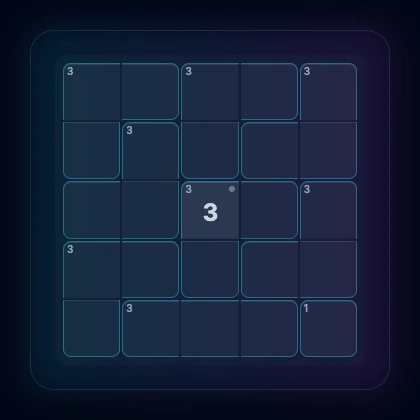
The placed 3 eliminates that digit from all 8 surrounding cells, including diagonals.
The Corner Touch Technique
When two regions share only a corner (diagonal touch, no edge touch), they can still block each other's digits. This is easy to overlook because the regions are not "really" adjacent in the traditional sense.
If Region A's corner cell contains a 3, and Region B's adjacent corner cell (diagonal neighbor) needs to place a 3, that placement cannot happen in that corner cell. The diagonal constraint blocks it.
Boundary Cell Power: Multi-Region Chain Reactions
Boundary cells—cells that touch multiple regions—are the most strategically valuable cells on the grid. A single placement in a boundary cell sends eliminations into 2, 3, or even 4 different regions simultaneously.
Identifying High-Power Boundaries
Not all boundary cells are equal. The most powerful boundary cells are:
- Multi-region intersections: Cells touching 3+ different regions
- Small-region boundaries: Boundary cells adjacent to 2-cell regions
- Interior boundaries: Boundaries between regions in the grid's center (more total neighbors)
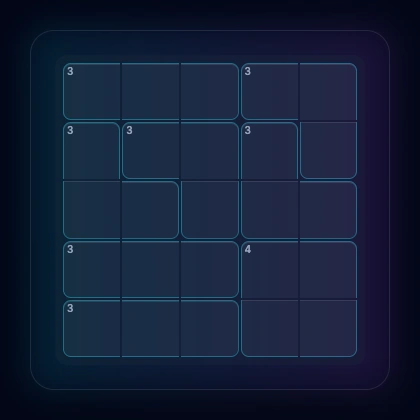
Boundary cells at region intersections are your highest-value targets.
When stuck: Find the cell touching the most different regions. List the digits eliminated by each region. The remaining candidates are usually few.
Small Region First: The 2-Cell Advantage
Two-cell regions are your best friends. They contain only {1, 2}, and once you know where one digit goes, the other follows immediately. Solving 2-cell regions early provides maximum cascade potential.
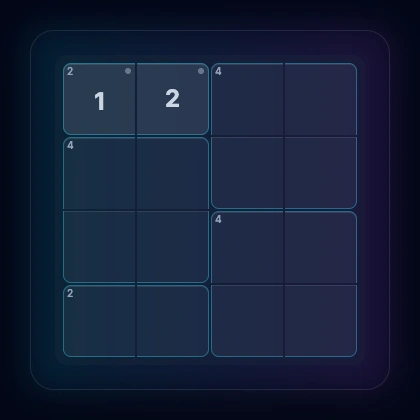
A solved 2-cell region eliminates both 1 and 2 from neighboring cells.
The 2-Cell Adjacent Pair Pattern
When two 2-cell regions are adjacent (sharing a boundary), they create a beautiful constraint:
- Region A contains {1, 2}
- Region B contains {1, 2}
- The cells at their boundary cannot both be 1 or both be 2 (neighbor constraint)
This forces a pattern: if the boundary cell of Region A is 1, the boundary cell of Region B must be 2 (and vice versa). If either region has any external constraint that forces one digit's position, both regions solve completely.
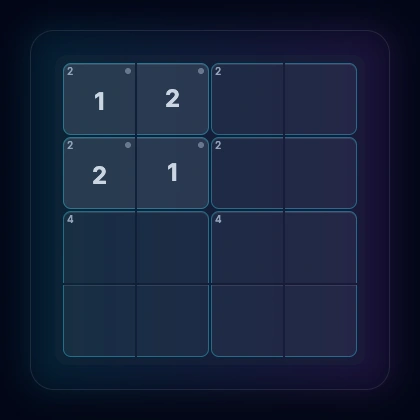
Adjacent 2-cell regions force alternating patterns at their boundary.
Cascade Recognition: Spotting Multi-Cell Sequences
The cascade is Suguru's signature satisfaction. One placement forces another, forces another, forces three more. Recognizing cascade potential before you commit to a placement is a master-level skill.
What Makes a Good Cascade Trigger?
A placement is a strong cascade trigger when:
- It sits in a boundary cell (affects multiple regions)
- It eliminates a digit that is already scarce in neighboring regions
- It completes or nearly completes a small region
- Multiple neighbors have only 2-3 candidates remaining
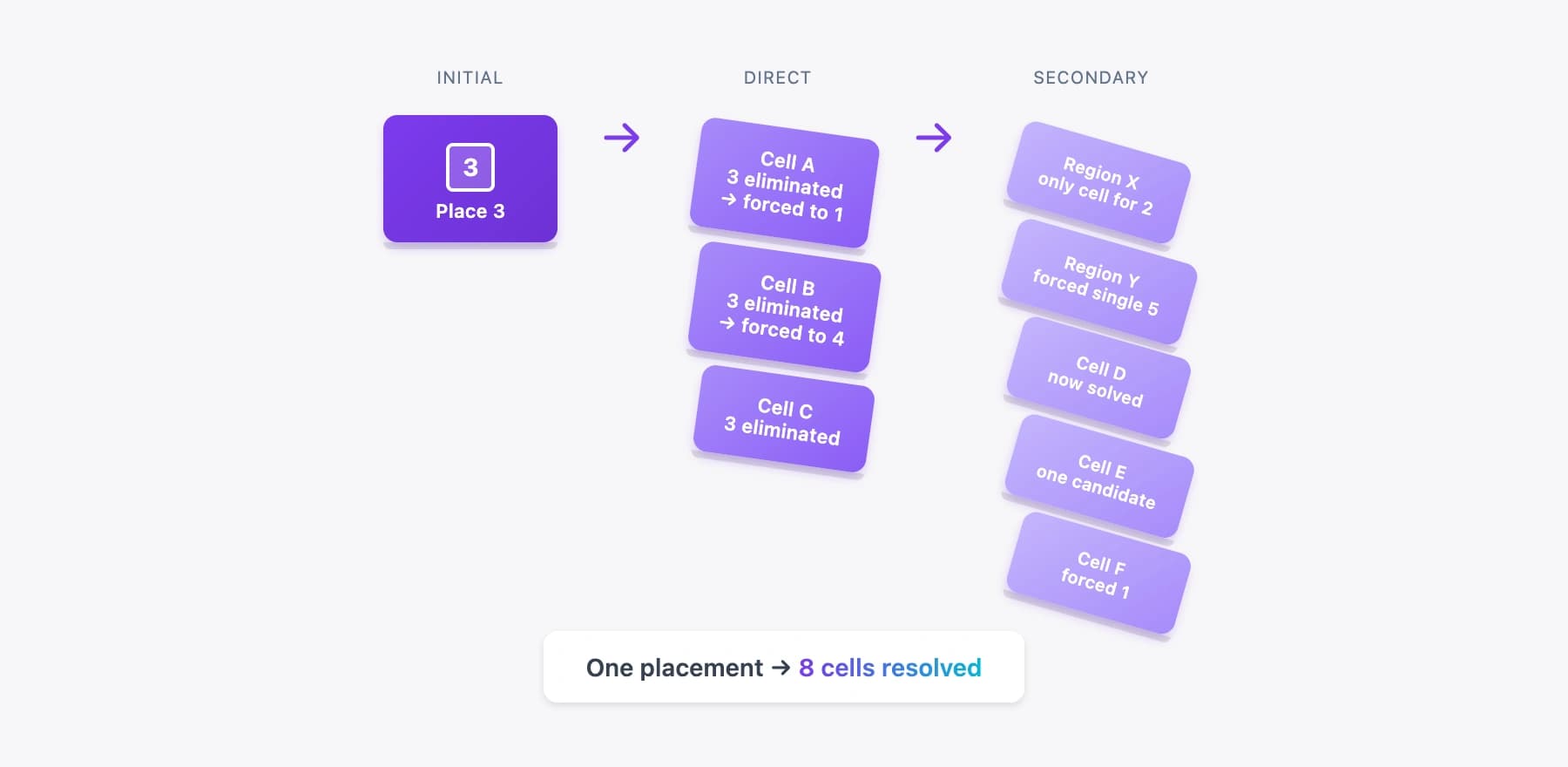
One strategic placement can cascade into solving 8+ cells through chain reactions.
The Three-Deep Look
Master solvers look three placements ahead:
- "If I place this 4 here..."
- "...that forces the neighbor to be 2..."
- "...which forces that region's only remaining cell to be 1..."
- "...which creates a forced single in the adjacent region."
You do not need to calculate every possibility. Just identify one promising chain of three forced moves. If it exists, make the initial placement.
Advanced Pattern: The L-Shape Elimination
L-shaped regions (three cells in an L configuration) have a special property worth memorizing.
In an L-shaped region, the corner cell is diagonally adjacent to both tip cells, but the tip cells are not adjacent to each other. This means: if the corner contains digit X, neither tip can contain X. Within a 3-cell L-region needing {1, 2, 3}, the corner digit determines the tips.
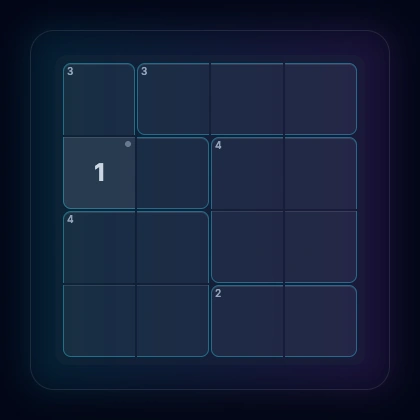
In L-shaped regions, the corner digit eliminates that value from both tips diagonally.
When you encounter an L-shaped region: identify the corner cell, note which digits the corner can hold (after external eliminations), and those same digits are eliminated from both tips. L-shapes frequently solve in a cascade: solve the corner, and both tips are forced or nearly forced.
Putting It Together: A Worked Example
Here is a walkthrough of solving a section of a 5x5 puzzle using all the techniques covered above.
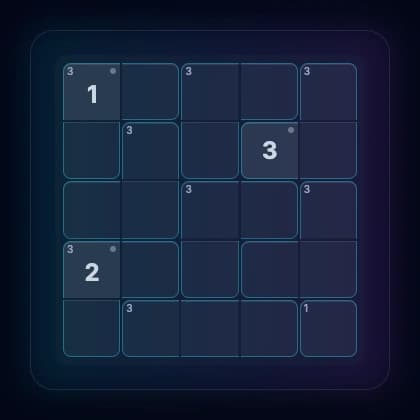
A 5x5 puzzle with strategic opportunities for cascade solving.
Phase 1: Analyze Small Regions First
The top-left region (cells 00, 01, 10) has a 1 already placed. It needs {1, 2, 3} and has 1, so it still needs 2 and 3 in the remaining two cells.
Phase 2: Apply Neighbor Elimination
Cell 01 is adjacent to cell 02, which contains 3. So cell 01 cannot be 3. Cell 01 must be 2. That forces cell 10 to be 3.
Phase 3: Cascade the Results
Placing 2 in cell 01 eliminates 2 from neighboring cells. Placing 3 in cell 10 eliminates 3 from its neighbors. Cell 11's region needs {1, 2, 3}. Cell 11 just lost 2 and 3. Cell 11 must be 1.
Phase 4: Continue the Cascade
From one observation (cell 01 cannot be 3), we solved: Cell 01 = 2, Cell 10 = 3, Cell 11 = 1, Cell 20 = 2, Cell 21 = 3. Five cells from one deduction.
Common Intermediate Mistakes
Forgetting Diagonal Constraints
You place a digit and check orthogonal neighbors, but miss that a diagonal neighbor was blocked. Fix: After every placement, mentally trace all 8 directions.
Ignoring Small Regions
You see a promising chain in a large region and dive in, missing easy wins in small regions. Fix: Always scan 2-cell and 3-cell regions first.
Not Following Cascades
You place a digit and immediately look elsewhere, missing the cascade it triggered. Fix: After every placement, fully trace its elimination cascade before moving on.
Guessing When Stuck
You reach a point with no obvious moves and guess rather than systematically checking. Fix: Do a complete forced-single sweep of every region first.
Quick-Reference Strategy Summary
Priority Order
- Single-cell regions (always = 1)
- Two-cell regions (always = {1, 2})
- Forced singles in any region
- Boundary cells with multiple region pressure
- L-shaped region corners
- Surrounded cells with heavy elimination
The Elimination Mindset
Do not ask: "What can this cell be?"
Ask: "What can this cell NOT be?"
When Stuck
- Sweep all regions for forced singles
- Check surrounded cells
- Trace any recent placements for missed cascades
- Look for diagonal-only eliminations
The Journey to Mastery
You now have the techniques that separate confident solvers from frustrated beginners: region size analysis, forced singles, diagonal awareness, boundary cell strategy, cascade recognition, and the elimination mindset.
But knowing the techniques is not enough. You must internalize them until they become automatic. The neighbor scan should happen before conscious thought. Cascade potential should register instantly. Small-region priority should feel like the only natural approach.
The reward is worth it. With practice, the neighbor scan, cascade tracing, and forced-single sweeps become second nature. The final digit drops into place with satisfying inevitability—every cell proven, every doubt resolved.
Your Practice Roadmap
Start with Easy 5x5 puzzles to build small-region recognition and cascade awareness. Focus on solving 2-cell and 3-cell regions first.
Move to Medium 6x6 puzzles once cascade tracing feels natural. Medium puzzles require boundary cell analysis and the forced-single sweep.
Graduate to Hard 8x8 puzzles when your cascades regularly chain 5+ cells. Hard puzzles demand all techniques working in concert.
Ready to Master the Cascade?
The elimination mindset is in your toolkit. Cascade recognition is ready. Open a puzzle, find a small region, and start the chain reaction.
Start Solving SuguruPut it into practice
Ready to solve Suguru?
Open a free puzzle and turn the ideas from this guide into your next solve.