Futoshiki Strategies:
Mastering Inequality Chains

Most Futoshiki solvers treat each inequality as a single constraint. Masters see them as connected systems—chains that ripple across the entire grid.
One arrow doesn't just say "this is smaller than that." It says "every cell before me in this chain is bounded, and every cell after me is bounded too." Read the chains, and the puzzle reads itself.
A chain of three inequalities pointing the same direction? The first cell is limited to 1-3, the last to 3-5. Stack that with Latin square rules and suddenly "impossible" becomes "obvious." If you've been handling each arrow in isolation, you're working harder than you need to. Today, we're unlocking the full power of inequality chain analysis.
Watch the Tutorial
New to Futoshiki? This tutorial covers the fundamentals.
Prerequisites
This guide builds on concepts from our beginner's guide—understanding Futoshiki rules, Latin square constraints, and basic inequality logic. If any of these feel unfamiliar, start there first.
Understanding Inequality Chains
Unlike Sudoku, where constraints come from regions, Futoshiki adds directed relationships between adjacent cells. The grid follows Latin square rules (each row and column contains each digit exactly once), but the inequality symbols create additional constraints. That little arrow pointing from A to B doesn't just tell you A is less than B. It creates a mathematical boundary that limits both cells.
Here's the insight that changes everything: when inequalities connect in sequence, their constraints multiply.
The K-Cell Chain Rule
Consider a chain of K cells connected by inequalities all pointing the same direction:
A < B < C < D (a 4-cell chain)
In a 5x5 grid where values range from 1 to 5, this chain creates powerful limits:
- Cell A (first in chain): maximum value = 5 - 4 + 1 = 2
- Cell D (last in chain): minimum value = 4
The formula is elegant: in a chain of K cells within an N-sized grid, the first cell can be at most N - K + 1, and the last cell must be at least K.
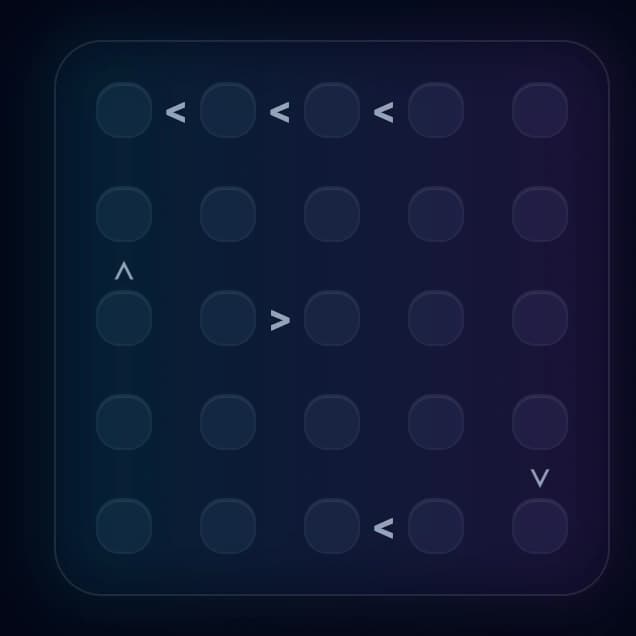
A 4-cell chain in a 5x5 puzzle constrains endpoints before placing a single digit.
This single rule eliminates possibilities before you've placed a single digit. A chain of 4 in a 5x5 puzzle? The endpoints are practically solved already.
Why Chains Matter More Than Individual Arrows
A single inequality "A < B" in a 5x5 grid eliminates one candidate from each cell (A can't be 5, B can't be 1). That's useful but limited.
A chain of 3 inequalities eliminates three candidates from the first cell and three from the last. The power grows with chain length. Master solvers scan for long chains first because they offer the biggest payoff.
Core Techniques for Chain Mastery
1. Boundary Elimination
This technique extends chain logic to non-endpoint cells. The key insight: eliminating values from one side of an inequality can eliminate even more values from the other side.
Consider A < B in a 5x5 grid. Initially, A can be 1-4 and B can be 2-5. Now suppose you determine (through Latin square logic) that B cannot be 2. What happens to A?
Since A must be strictly less than B, and B's minimum possible value is now 3, A's maximum possible value becomes 2. You've eliminated 3 and 4 from A's candidates, leaving only {1, 2}.
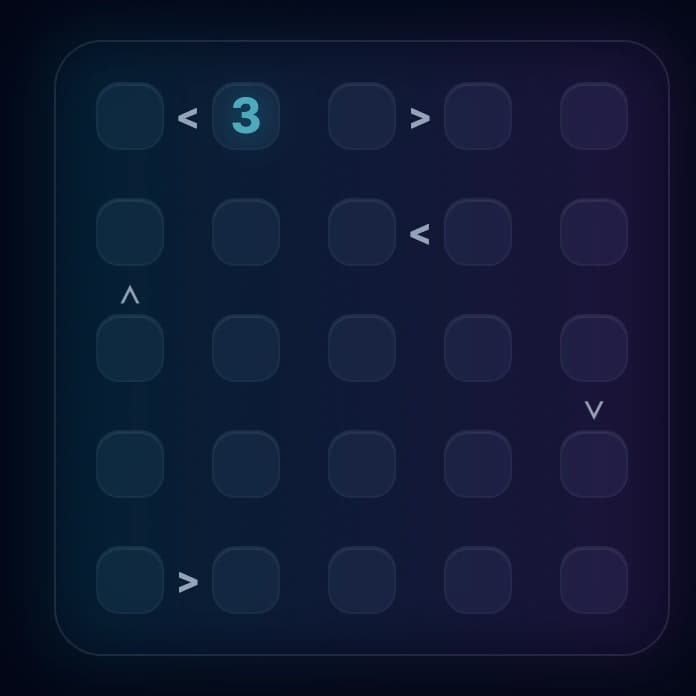
The rule: If B's minimum is M, then A's maximum is M - 1.
This cascades beautifully through chains. Eliminate low values from one cell, and watch the maximum drop for every cell earlier in the chain.
2. The "Squeeze" Technique
Some cells are caught in the middle—constrained by inequalities on both sides. These "squeezed" cells often resolve quickly.
Consider: A < X < B
If this appears in a 5x5 puzzle, X must be greater than A (so X can't be the minimum) and X must be less than B (so X can't be the maximum). X is squeezed toward middle values.
The squeeze gets tighter when you know more about A and B. If A = 2 and B = 4, then X can only be 3. Instant solve.
3. Cascade Deductions
Here's where Futoshiki gets exciting. One placement can force a chain reaction through connected inequalities.
Say you place a 4 in cell A, where A < B in a 5x5 grid. B must now be 5. That's forced.
But what if B is also part of another inequality? B < C perhaps? Now C must be... wait. C must be greater than 5? Impossible!
This contradiction tells you something valuable: your original placement of 4 in A was wrong, or some earlier assumption failed. Cascade logic helps you test placements mentally before committing.
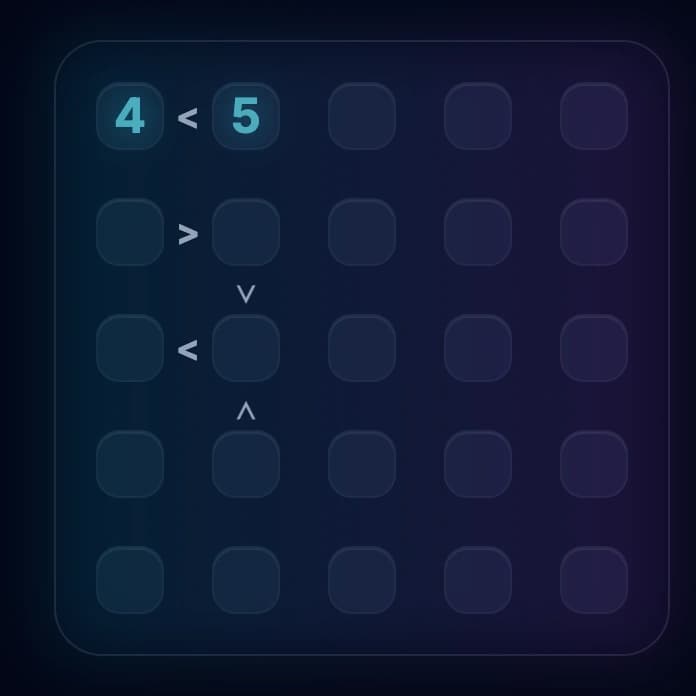
Place one digit, watch three others fall into place as the inequalities force each value.
4. Latin Square Integration
Never forget: Futoshiki is built on Latin square rules. Each row and column must contain each digit exactly once. The arrows add constraints, but the foundation remains.
Smart solvers constantly cross-reference:
- "This cell must be less than 3 due to the chain, AND the row already has 1... so this cell is 2"
- "The column needs a 4, and only one cell in the column can be 4 after applying inequality constraints"
The magic happens at the intersection of these rule systems. Neither Latin square logic nor inequality logic alone might solve a cell. Together, they leave only one possibility.
5. Edge Cell Advantages
Edge cells have fewer neighbors, which means fewer potential inequality constraints. But when they do have inequalities, those constraints pack more punch because there's nowhere for the pressure to dissipate.
A corner cell with two inequalities pointing outward? In a 5x5 grid, that cell is almost certainly 4 or 5. Both arrows saying "I'm greater than my neighbor" means this cell sits high in the value range.
Start your solving by scanning edges for chains. They frequently offer the cleanest entry points into a puzzle.
Quick check: In your current puzzle, which cells are squeezed between multiple inequalities? These are often your fastest solves.
Advanced Patterns and Techniques
6. When You're Stuck: The Elimination Sweep
When progress stalls, try a systematic elimination sweep. Go through each unsolved cell and ask:
- What does the chain analysis say about this cell's bounds?
- What Latin square constraints apply?
- What values remain after combining both?
Write down the candidates for each cell. Often, this process reveals a cell you missed—one that looked complex but actually has few candidates once you tally all constraints.
7. Multi-Chain Intersections
The most powerful deductions occur where chains cross. A cell that sits at the intersection of horizontal and vertical inequality chains receives constraints from both directions.
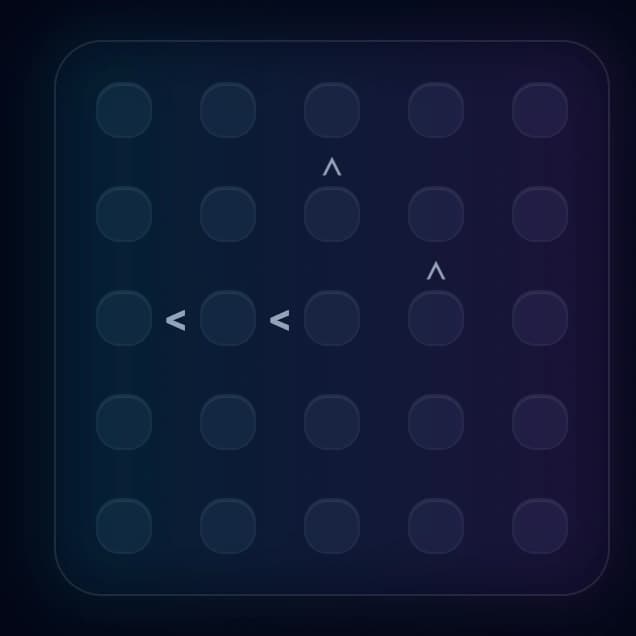
Intersection cells receive double restrictions from both chain directions.
Consider a cell that is third in a horizontal chain of 4 (pointing right) and second in a vertical chain of 3 (pointing down). The horizontal chain says: "I can't be too small or too big." The vertical chain says: "I must be at least 2."
Cross-reference these constraints with row and column eliminations, and intersection cells frequently solve with pure logic—no trial and error needed.
8. Common 5x5 and 6x6 Patterns
Experienced solvers recognize certain setups instantly. Here are patterns worth memorizing:
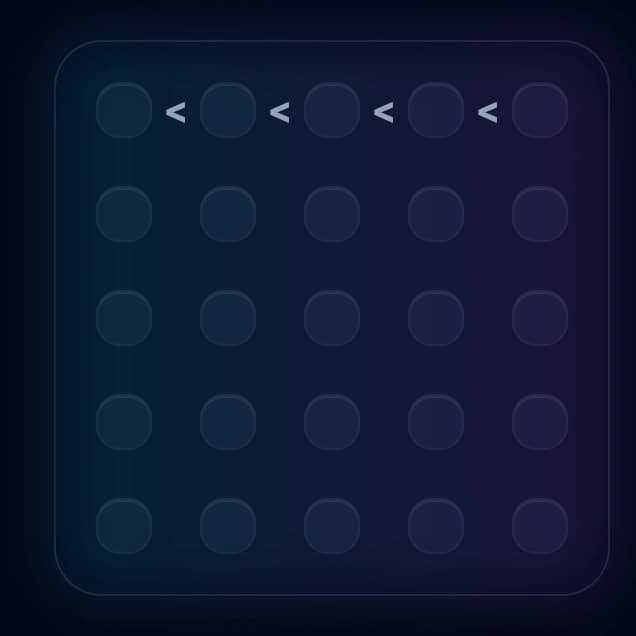
The Full Chain (5 cells in 5x5)
A < B < C < D < E means A = 1, E = 5, and the others are forced: B = 2, C = 3, D = 4. Entire row solved!
The Convergence (Peak)
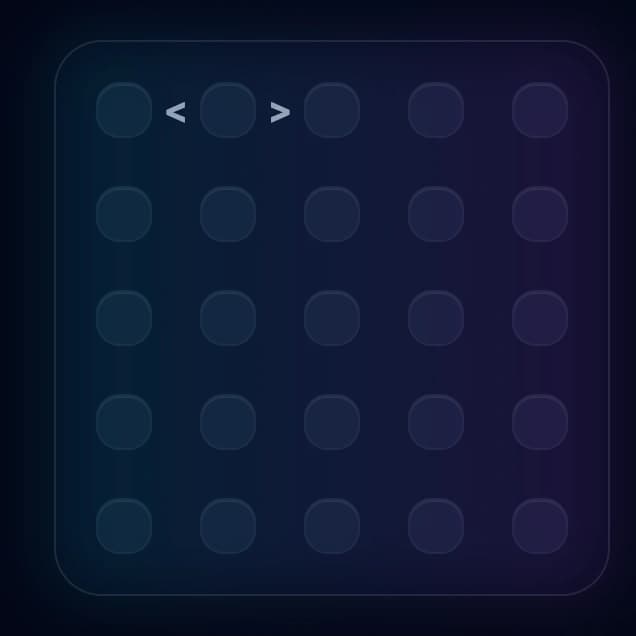
A < B > C — The middle cell B must be larger than both neighbors. In a 5x5, B is likely 4 or 5.
The Divergence (Valley)
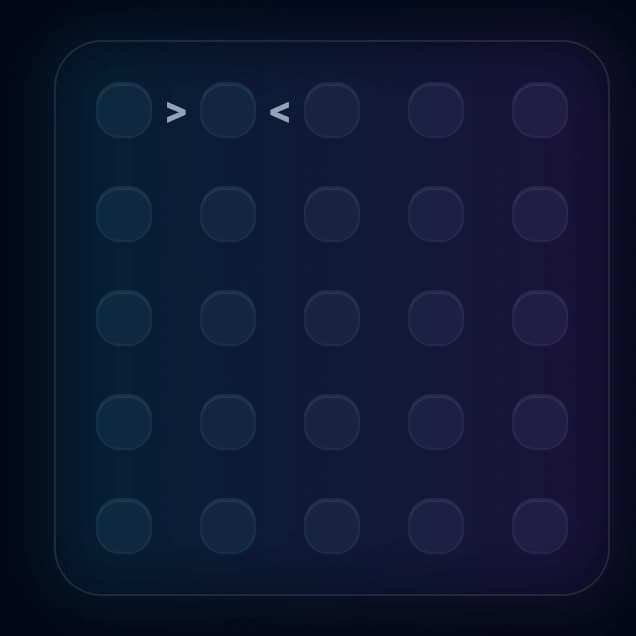
A > B < C — Here, B must be smaller than both neighbors. B is probably 1 or 2. This cell often resolves first.
The Corner Lock
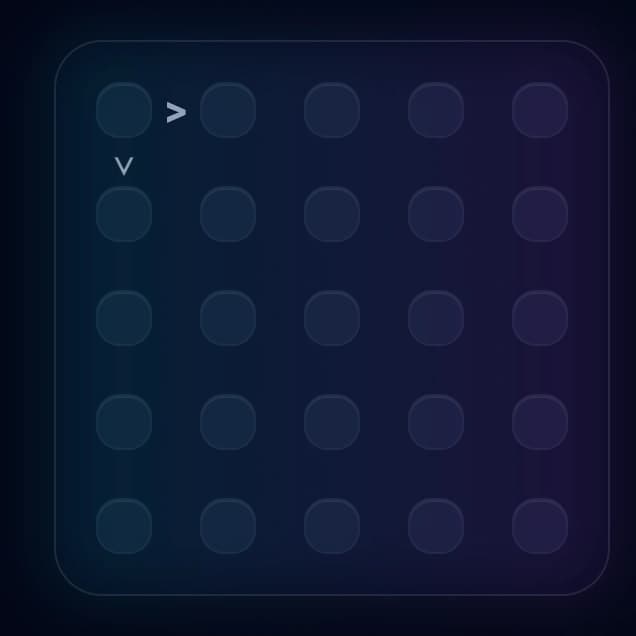
A corner cell with both adjacent edges having outward-pointing inequalities is forced high. Inward? Forced low.
9. Reading the Puzzle's Story
Here's what separates good solvers from great ones: the ability to read the puzzle holistically.
Don't just see individual arrows. See the flow. Which direction do most arrows point? Where do they converge? Where do chains terminate?
A puzzle heavy with rightward arrows in one area is pushing high values toward that direction. A vertical chain pointing downward is pushing high values to the bottom of that column.
Read the puzzle's "geography" and the correct placements become intuitive. You stop calculating and start seeing.
Putting It All Together
Let's walk through a solving mindset for a challenging Futoshiki:
- Scan for long chains. Find any sequence of 3+ inequalities. Apply the K-cell rule immediately to restrict endpoints.
- Check edges and corners. Look for cells with multiple inequality constraints. These often have limited candidates.
- Apply Latin square basics. Any obvious singles? Any rows or columns where a digit can only go one place?
- Find chain intersections. Where do horizontal and vertical constraints meet? These cells receive double restrictions.
- Use boundary elimination. As you place digits, immediately update adjacent cells through inequalities.
- Watch for cascades. After each placement, follow the inequality chains. Does this force the next cell?
- When stuck, sweep. List all candidates for unsolved cells. Look for hidden singles or cells you overlooked.
Let's Apply These Techniques: A Worked Example
Theory is helpful, but let's see these techniques in action on an actual puzzle.
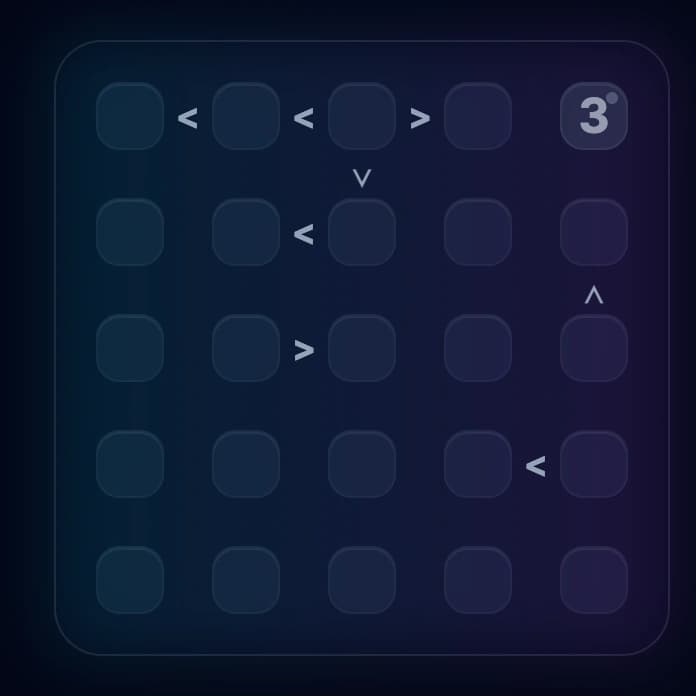
Starting position with chain R1C1 < R1C2 < R1C3 > R1C4 and given digit R1C5 = 3.
Move 1: K-Cell Chain Rule on Row 1
Look at row 1: R1C1 < R1C2 < R1C3. That's a 3-cell chain. R1C1's max = 5 - 3 + 1 = 3. R1C3's min = 3.
Move 2: Boundary Elimination Cascade
R1C3 > R1C4, so R1C3 must be at least 2. Combined with chain: R1C3 is at least 3. Row 1 has 3 at R1C5, so R1C3 cannot be 3. Therefore R1C3 is {4, 5}.
Move 3: Latin Square Forces R1C3
R1C1 is {1, 2}, R1C2 is {1, 2, 3}. For the row to work with R1C4 < R1C3 and both from {4, 5}: R1C4 = 4 and R1C3 = 5.
Move 4: Cascade Completes Row 1
With R1C3 = 5 placed, cascade backward. R1C1 < R1C2, both from {1, 2} since the row needs 1 and 2. So R1C1 = 1 and R1C2 = 2. Row 1 complete: [1, 2, 5, 4, 3]
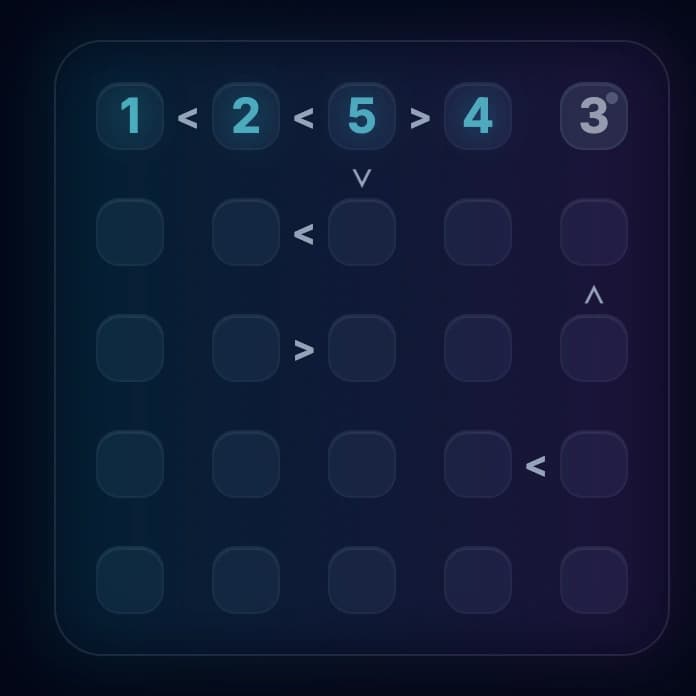
Row 1 solved: [1, 2, 5, 4, 3] — chain analysis + Latin square logic
The Flow State
There's a moment in Futoshiki solving when everything clicks. The chains aren't separate constraints anymore—they're an interconnected system, and you can see how each placement affects the whole grid.
That's when Futoshiki stops being a puzzle you solve and becomes a puzzle you experience. The arrows guide you, the boundaries narrow, and the solution emerges not through grinding effort but through understanding.
Practice these techniques until chain analysis becomes second nature. Start with the long chains, respect the boundaries, watch for cascades, and always—always—integrate your inequality logic with Latin square rules.
The arrows are speaking. Learn to listen, and every Futoshiki puzzle will tell you its solution.
Your Challenge
Open a 5x5 Futoshiki puzzle and, before making any marks, find the longest inequality chain. Calculate the endpoint bounds using the K-cell rule (first cell's max is N - K + 1, last cell's min is K).
Then trace any boundary eliminations that cascade from there. You might be surprised how much of the puzzle reveals itself before you write a single digit.
Ready to Master the Chains?
The K-cell rule is in your toolkit. The cascade technique is ready. All that's left is to feel the inequalities guide you through the grid.
Start Solving FutoshikiPut it into practice
Ready to solve Futoshiki?
Open a free puzzle and turn the ideas from this guide into your next solve.