Star Battle Basics:
Rules and First Steps
No numbers. No arithmetic. No words. Just a grid, some oddly shaped regions, and one deceptively simple question: where do the stars go?
Star Battle (also known as Starstruck on Netflix) strips logic puzzles down to their purest essence. You are not calculating sums or filling sequences. You are placing stars -- and the constraints about where they cannot go are so tight that every single star is provable through pure deduction.
Here is what hooks people: you stare at an empty grid carved into irregular regions. It looks impossible. There are dozens of cells and you need to place just a handful of stars. Where do you even start? But then you notice a tiny region squeezed into a column. You realize the star must go in one specific cell. That placement blocks its neighbors. A column collapses to a single option. A row follows. And suddenly the entire solution clicks into place.
The rules take sixty seconds to learn. This guide will take you from confused beginner to confident solver, with a complete step-by-step walkthrough and strategies that work whether you are tackling a gentle 5x5 warm-up or an ambitious 10x10 grid.
Watch the Tutorial
Prefer watching? This short video walks you through the rules and key techniques.
What Exactly Is a Star Battle Puzzle?
A Star Battle puzzle presents you with a square grid divided into irregular regions (sometimes called "areas"). Your mission: place stars into the grid so that every row, every column, and every region contains exactly the right number of stars -- and no two stars touch each other, not even diagonally.
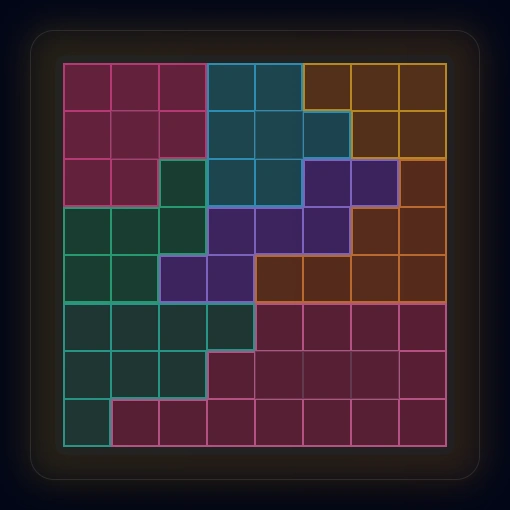
An 8x8 Star Battle grid divided into 8 irregularly shaped regions, each shaded a different color.
The beauty lies in the interaction between three types of constraints -- rows, columns, and regions -- all working simultaneously. A star you place in one region affects its entire row and column, which in turn constrain other regions you had not even considered yet.
Think of it as Sudoku's minimalist cousin. Where Sudoku asks you to place nine different digits, Star Battle asks you to place just one type of piece -- a star. But the no-touching rule creates a web of spatial constraints that is just as rich and satisfying to untangle.
Starstruck on Netflix
If you arrived here after playing Starstruck on Netflix's mobile puzzle games -- welcome. Starstruck is Star Battle, just wearing a different name tag. The rules are identical. Every strategy in this guide applies directly to the Netflix version.
The Complete Rules of Star Battle
Four rules govern every Star Battle puzzle. Master these, and you are ready to tackle any grid.
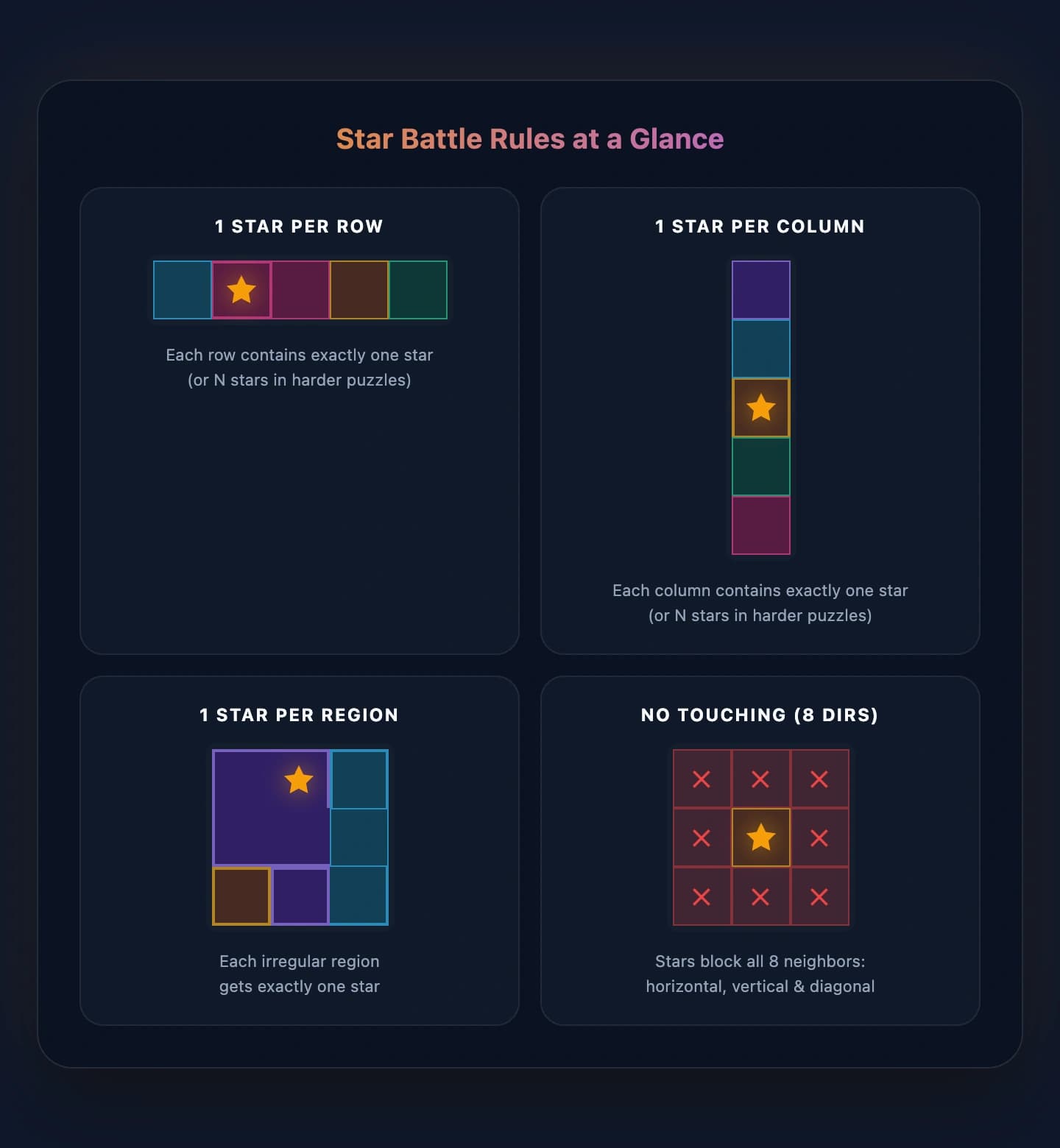
Rule 1: Each Row = N Stars
Every row must contain exactly N stars, where N is the puzzle's star count (1 for beginners, 2 for advanced).
Rule 2: Each Column = N Stars
Every column must also contain exactly N stars. A 1-star 5x5 puzzle has exactly 5 stars total.
Rule 3: Each Region = N Stars
Each irregular region must contain exactly N stars. There are always as many regions as the grid has rows.
Rule 4: No Touching (8-Way)
No two stars can be adjacent horizontally, vertically, or diagonally. Each star creates an exclusion zone in all 8 surrounding cells.
Four rules, infinite puzzles. The no-touching rule is the engine that drives every deduction.
Your First Solve: A Step-by-Step Walkthrough
Let us solve a 1-star 5x5 puzzle together. One star per row, one star per column, one star per region. I will show you exactly what to look for and why each move is logically certain -- no guessing involved.
The Starting Puzzle
Five regions (A through E) with 5 stars to place. Region D has just 3 cells in column 0. Region E has just 3 cells in row 4. These tiny regions are your best friends.
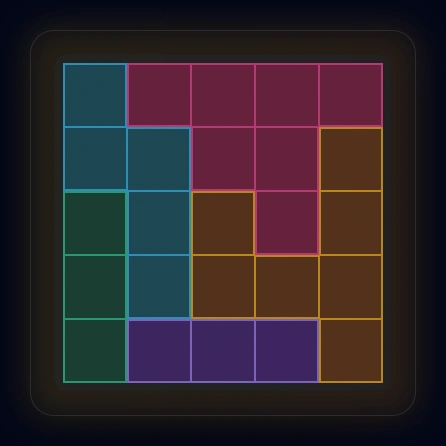
Our 5x5 walkthrough puzzle. Spot the small regions first -- they crack the puzzle open.
Steps 1-3: Small Regions Force a Breakthrough
Region D (3 cells) sits entirely in column 0. Region E (3 cells) sits entirely in row 4. Since E must place its star in row 4, and D has a cell at (4,0) that is also in row 4 -- placing D's star there would leave E with no valid cells. D's star cannot be at (4,0).
Testing (2,0) for D: a star there blocks four of Region B's five cells via the exclusion zone, and the survivor (0,0) is also in column 0 -- already taken. Region B has zero valid cells. Contradiction!
D's star must be at (3,0). It is the only option that does not break the puzzle.
Step 4: Place D's Star
Star at (3,0) satisfies Region D, row 3, and column 0. The exclusion zone blocks (2,0), (2,1), (3,1), (4,0), and (4,1). Region B collapses -- with column 0 complete and two cells blocked by the exclusion zone, B has only one option left: (1,1).
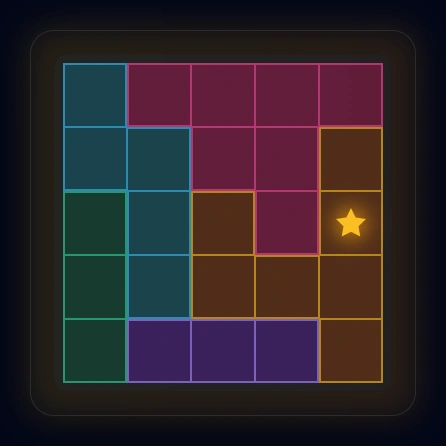
D's star placed. Column 0 and row 3 are complete. Region B is now forced.
Step 5: B Falls into Place
Star at (1,1) satisfies Region B, row 1, and column 1. Its exclusion zone blocks (0,0), (0,1), (0,2), (1,0), (1,2), (2,0), (2,1), (2,2). Two stars down, three to go. Rows 0, 2, 4 need stars. Columns 2, 3, 4 need stars.
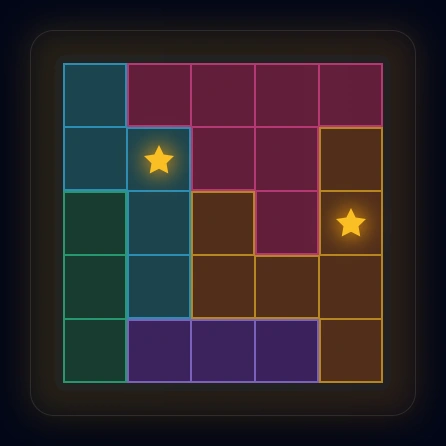
Two stars placed. Columns 0 and 1 complete. The grid is tightening.
Step 6: E is Forced
Region E's cells (4,1), (4,2), (4,3) -- cell (4,1) is blocked by D's star. Testing (4,3): this blocks column 3 for A, forcing A to (0,4), which completes column 4 and leaves Region C with zero valid cells. Contradiction! E's star must be at (4,2).
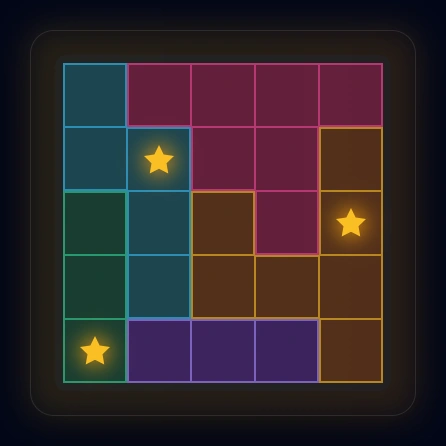
Three stars placed. Columns 0, 1, 2 complete. Rows 1, 3, 4 complete.
Step 7: C and A Fall Like Dominos
Region C's only remaining valid cell is (2,4). That forces Region A to (0,3). Every star found. Every row, column, and region satisfied.
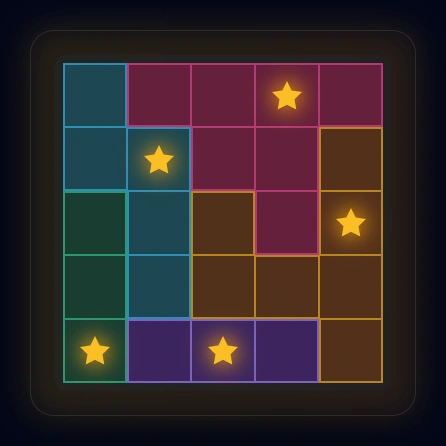
All five stars placed. No guessing required -- every move was forced by the constraints.
What This Walkthrough Teaches
- 1. Start with the smallest regions -- D and E (3 cells each) cracked the puzzle open
- 2. Contradiction testing is powerful -- We proved positions by showing alternatives were impossible
- 3. The no-touch rule cascades -- Each star eliminates surrounding cells, collapsing regions
- 4. Rows and columns work with regions -- Line completion removes candidates across multiple regions
- 5. Small deductions chain into big results -- One forced star led to the next until the puzzle was solved
Essential Beginner Strategies
These techniques form your core toolkit for solving any Star Battle puzzle.
Strategy 1: Start with the Smallest Regions
Always scan for the smallest regions first. A 3-cell region in a 1-star puzzle has only three possible star positions. The fewer options, the easier it is to find forced placements or contradictions.
Strategy 2: Regions Confined to a Single Line
When every cell in a region falls within the same row or column, that region's star must occupy that line. No other region can claim a star in that line. This "reservation" effect ripples across the entire grid.
Strategy 3: Contradiction Testing
When a region has two or three candidate cells, test each one. Ask: "If I place the star here, does another region run out of valid cells?" If a placement leads to zero options for any region, that placement is impossible.
Strategy 4: Exploit the Exclusion Zone
Every star blocks eight cells. On a 5x5 grid, that is nearly a third of the board from a single placement. After placing each star, immediately scan the exclusion zone: did you reduce another region to a single option?
Strategy 5: Track Completed Lines
Once a row or column has its star, every other cell in that line is eliminated. This removes an entire line of candidates across multiple regions. Always propagate completed-line eliminations immediately.
Strategy 6: Match Remaining Regions to Open Lines
When you have placed some stars, count remaining rows, columns, and regions. Each unsolved region needs a star in one of the open rows and one of the open columns -- like assigning people to seats where each person needs their own unique row AND column.
Strategy 7: Region-Line Overlap Analysis
If a region's available cells all fall within a single row, then that region's star must be in that row. This means no other region can claim a star there -- effectively reserving it. This extends to pairs: if two regions can only place their stars in the same two rows, those rows are "claimed."
Strategy Summary
- 1. Hunt the smallest regions -- Fewest options, most forced placements
- 2. Check line-confined regions -- They reserve entire rows or columns
- 3. Test contradictions -- If a placement breaks another region, it is impossible
- 4. Exploit exclusion zones -- Each star blocks 8 neighbors
- 5. Track completed lines -- Eliminate candidates across the grid
- 6. Match regions to open lines -- Like a seating assignment puzzle
- 7. Analyze region-line overlaps -- Reserve rows and columns for specific regions
Common Mistakes and How to Avoid Them
Forgetting Diagonals
The no-touch rule covers all 8 directions. When you place a star, picture a 3x3 box around it -- everything inside is blocked.
Ignoring Small Regions
Large regions look important but tiny 3-cell regions have obvious forced placements. Always scan region sizes first.
Guessing Instead of Deducing
Every Star Battle puzzle is solvable through pure logic. If stuck, re-examine each unsolved region and look for contradiction opportunities.
Not Propagating Constraints
After every placement: (1) mark the exclusion zone, (2) update completed lines, (3) check every unsolved region for forced placements.
Difficulty Progression
Star Battle puzzles scale beautifully. Grid size increases working memory demands, while the jump from 1-star to 2-star puzzles creates a combinatorial explosion of possibilities.
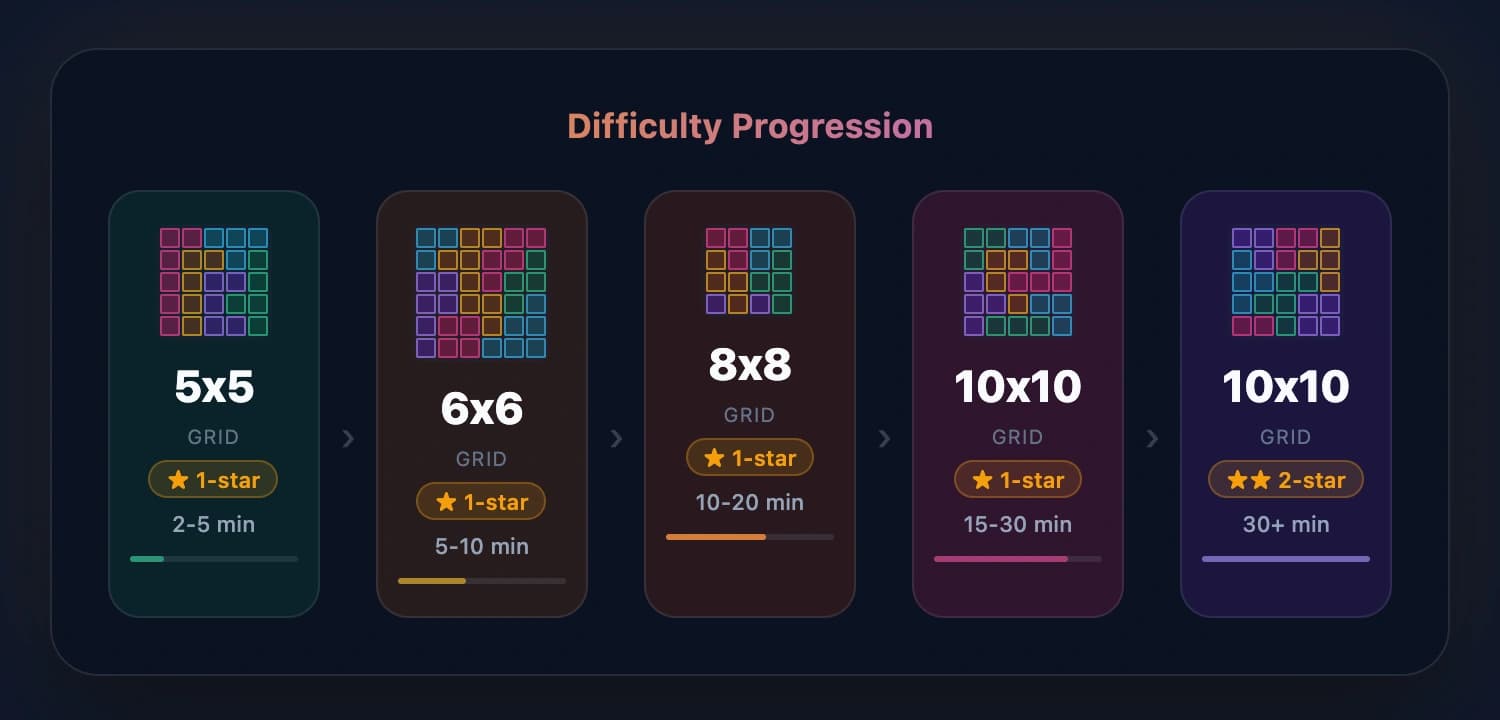
Recommended path: 5x5 1-star (learn rules) → 6x6 1-star (practice contradiction testing) → 8x8 1-star (deeper deduction chains) → 10x10 1-star (master the full toolkit) → 10x10 2-star (enter the advanced world). Each step builds naturally on the previous one.
If You Love Star Battle, Try These Puzzles
Suguru
Irregular regions and diagonal adjacency -- if you love Star Battle's no-touch rule, Suguru will feel like home.
Sudoku
The classic. Shares the fundamental structure of placing items so rows, columns, and regions each contain the right count.
Nonograms
Reveal a hidden picture by filling cells based on clues. The satisfaction of watching a pattern emerge from pure logic is remarkably similar.
Slitherlink
Spatial reasoning and constraint propagation. The pattern recognition skills transfer directly from Star Battle solving.
Your Stars Are Waiting
Open a 5x5 1-star puzzle and scan for the smallest region -- it will have the fewest candidate cells. Test each candidate by checking whether it leaves every other region with at least one valid cell. That first forced placement will cascade into the next. When 5x5 feels routine, move to 6x6 where contradiction testing becomes essential.
Enjoy the logic of Star Battle and Starstruck? Explore our full puzzle collection at Puzzolve -- from spatial reasoning challenges like Suguru and Slitherlink to number-placement classics like Sudoku and Kakuro.
Ready to Find Your Stars?
The strategies are in your head. The no-touch rule is your compass. All that's left is to place that first certain star.
Start Solving Star BattlePut it into practice
Ready to solve Star Battle?
Open a free puzzle and turn the ideas from this guide into your next solve.