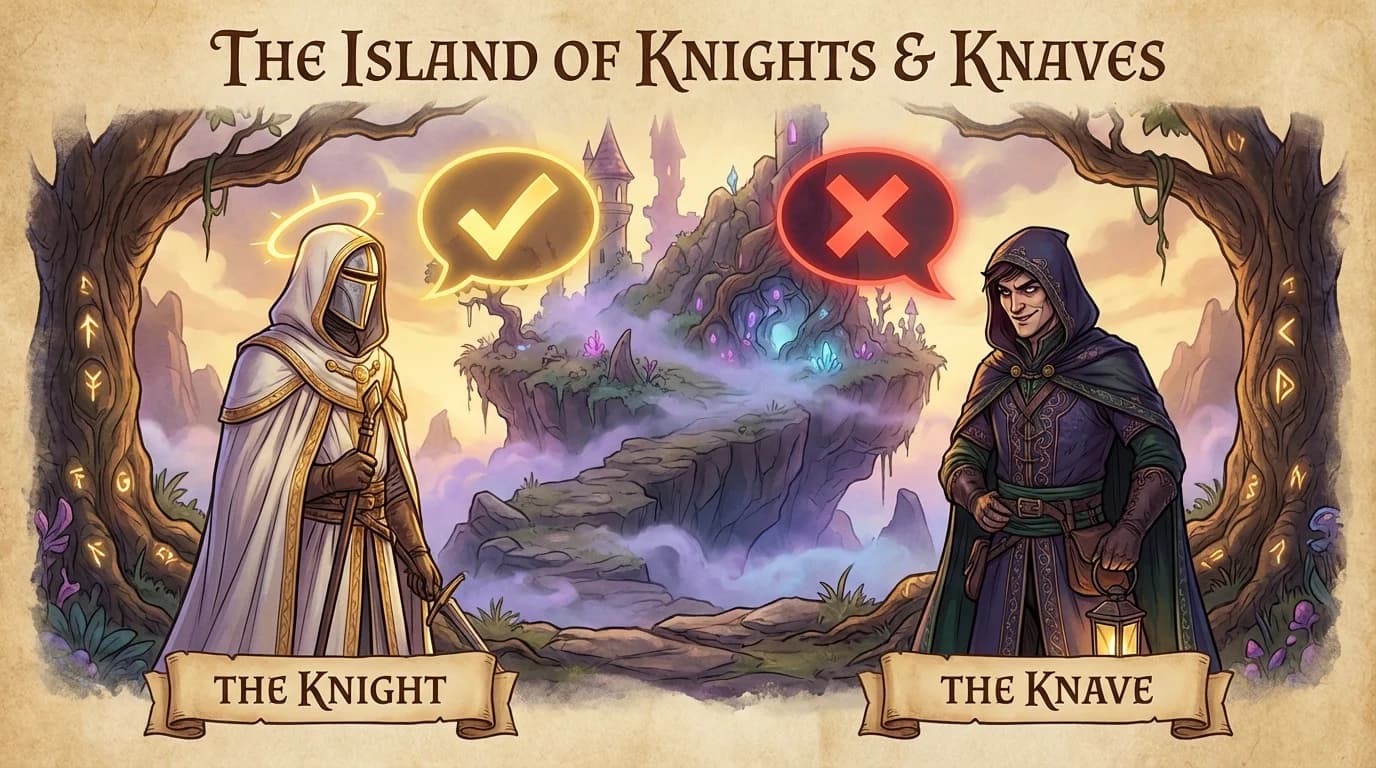
You meet two strangers on an island. One says, "I am a knight." The other points at the first and says, "He's lying." One of them always tells the truth. The other always lies. Can you figure out who is who?
If your brain just flickered with curiosity, you've discovered why these puzzles have captivated people for decades.
Knights and Knaves puzzles belong to a special category of logic puzzles known as Liars and Truth-tellers problems. The premise is elegantly simple: some characters always speak the truth, others always lie. Your job is to figure out who is who based solely on their statements. No physical clues. No outside information. Just pure logical deduction.
These puzzles gained widespread popularity through the work of mathematician and logician Raymond Smullyan, who elevated them from simple brain teasers to sophisticated explorations of mathematical logic in his 1978 book What Is the Name of This Book? Here's a delightful detail: Smullyan was also a professional stage magician. It's fitting, isn't it? A man who spent his career exploring deception and misdirection on stage also created puzzles entirely about detecting truth from lies.
But here's the best part: you don't need a math degree to solve them. You just need patience and a willingness to think carefully about what truth and lies really mean. Let's learn how.
Watch the Tutorial
Prefer watching? This short video walks you through the rules and key techniques.
The Rules: Simpler Than You Think
Knights and Knaves puzzles take place on a fictional island inhabited by two types of people:
That's it. Two rules. The challenge comes from the logical tangles that these simple constraints create.
What Makes These Puzzles Tick
The magic happens when characters make statements about themselves or each other. Consider these scenarios:
- • If a knight says "I am a knight," it's true (and consistent).
- • If a knave says "I am a knight," it's a lie (and also consistent).
- • If a knight says "I am a knave," it's false (contradiction! A knight cannot lie).
- • If a knave says "I am a knave," it's true (contradiction! A knave cannot tell the truth).
Key Insight
The statement "I am a knave" creates a paradox for BOTH types - knights can't say it (they'd be lying) and knaves can't say it (they'd be telling the truth). No one on this island can make this statement. If you ever encounter it in a puzzle, you've found a logical impossibility!
Statement Types You'll Encounter
As you progress through Knights and Knaves puzzles, you'll encounter several types of statements:
- Direct claims: "B is a knight" or "A is a knave"
- Self-references: "I am a knight" or "I am a knave"
- Relationship claims: "A and B are the same type" or "We are different types"
- Counting claims: "There are exactly two knights among us"
Your First Puzzle: A Clean Start
Let's solve a two-person puzzle with a guaranteed unique solution. I'll show you exactly how to reason through each statement.
The Setup
Two islanders, A and B, make the following statements:
- A says: "B is a knave."
- B says: "We are different types."
Who is the knight, and who is the knave?
Step 1: Analyze B's Statement Using a Powerful Shortcut
B says "We are different types." This is a special statement type that we can crack immediately.
- • The statement "We are different types" is true
- • Therefore A must be different from B
- • Since B is a knight, A must be a knave
- • The statement "We are different types" is false
- • Therefore A must be the same type as B
- • Since B is a knave, A must also be a knave
Breakthrough!
In both cases, A is a knave! The "different type" statement always tells us the OTHER person is a knave, regardless of who says it.
Step 2: Verify with A's Statement
We've deduced that A is a knave. Let's check A's statement "B is a knave."
Since A is a knave, this statement must be false. Therefore B is NOT a knave - B is a knight.
Step 3: Confirm the Solution
Solution: A is a knave, B is a knight.
Let's verify everything:
- • A (knave) says "B is a knave" - This is a lie because B is actually a knight. Consistent!
- • B (knight) says "We are different types" - This is true because A is a knave and B is a knight. Consistent!
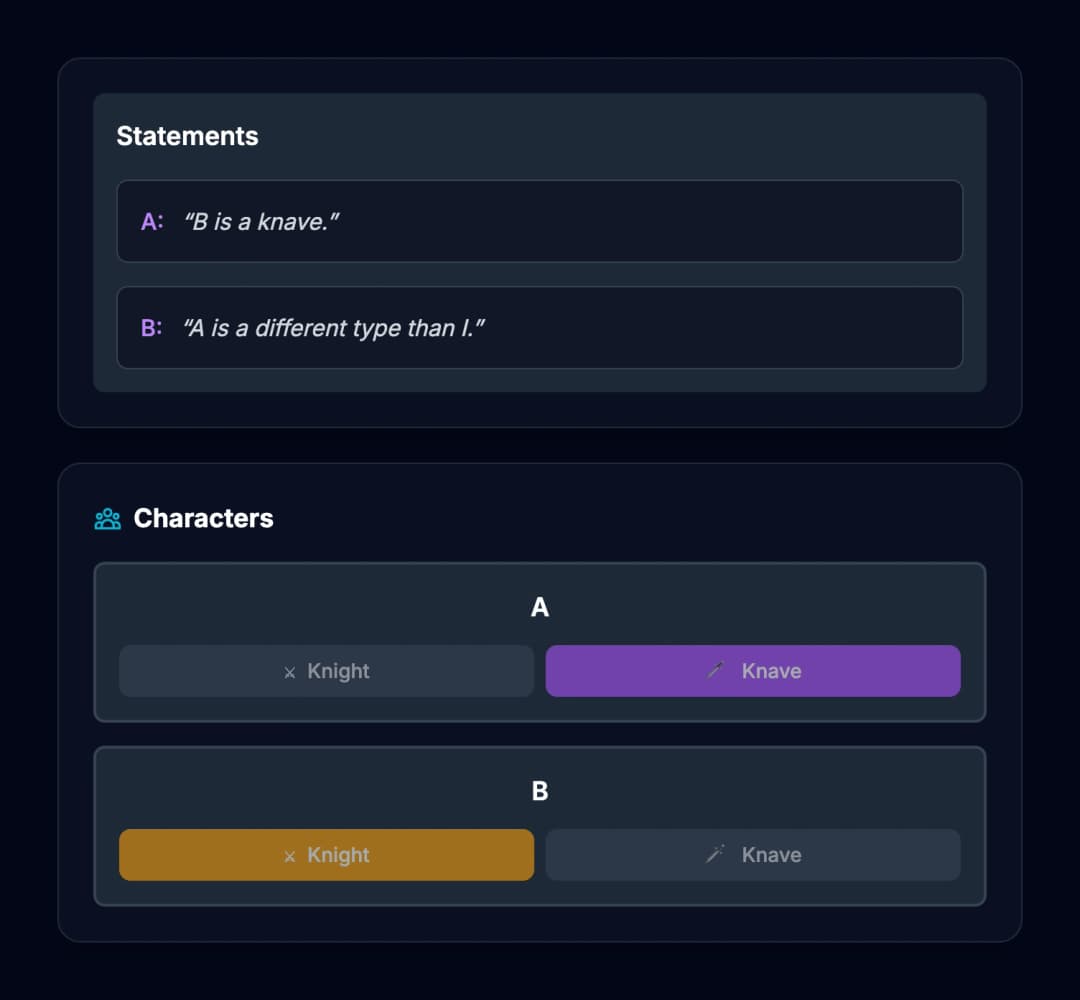
The solved puzzle - A is a knave, B is a knight
The Power Move: "Same Type" and "Different Type"
That puzzle revealed one of the most useful patterns in Knights and Knaves. Let's formalize it.
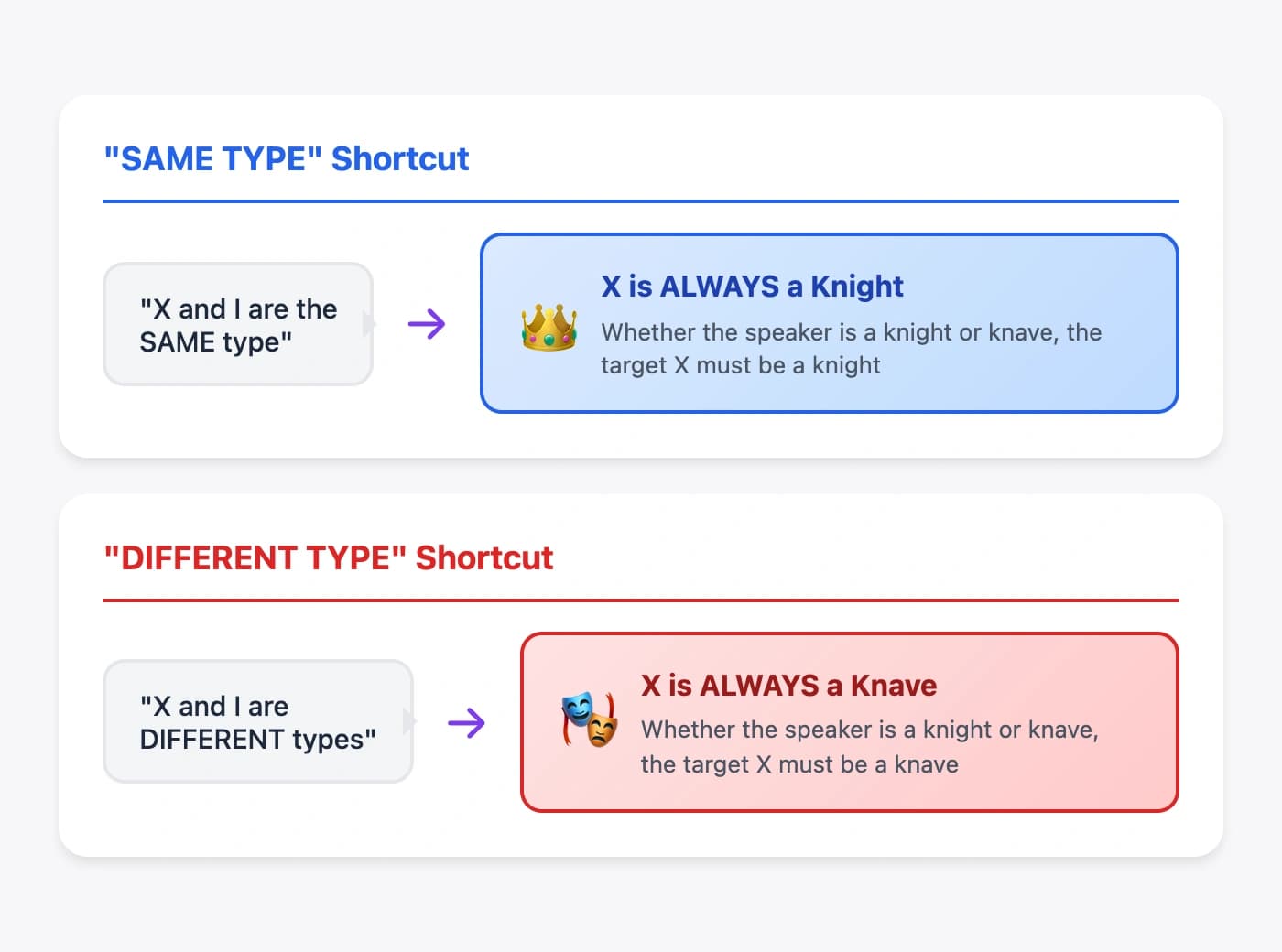
The "Same Type" Guarantee
When anyone says "X and I are the same type," X is ALWAYS a knight.
If a knight says it, it's true, so X shares their type (knight). If a knave says it, it's false, so X is different (also a knight!). This is pure gold.
The "Different Type" Guarantee
When anyone says "X and I are different types," X is ALWAYS a knave.
If a knight says it, it's true, so X is different (knave). If a knave says it, it's false, so X is the same (also a knave!).
Practice: The "Same Type" Shortcut
Now let's see the "same type" shortcut in action.
- A says: "B is a knave."
- B says: "A and I are the same type."
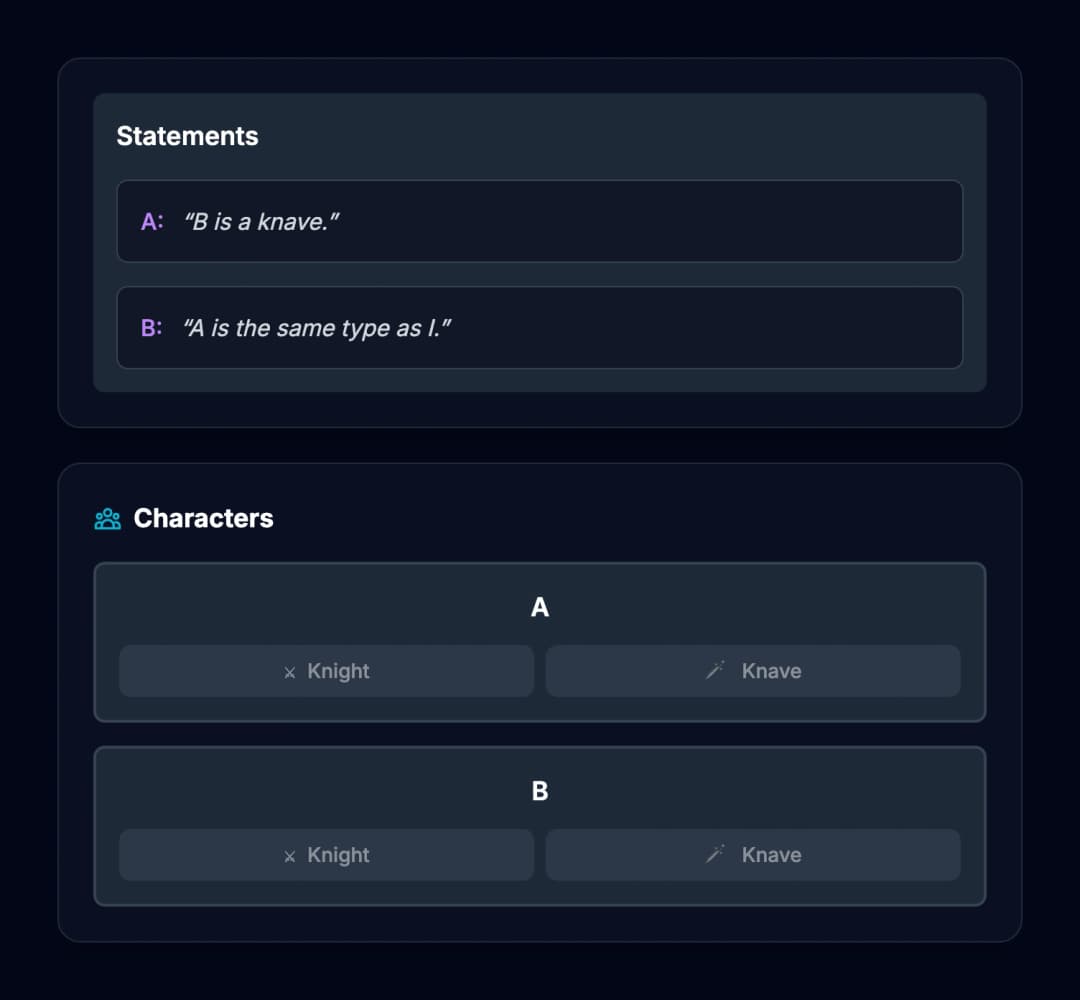
Solving with the Shortcut
B says "A and I are the same type." Using our shortcut: A is a knight (regardless of whether B is a knight or knave).
Now we know A is a knight. Since A says "B is a knave," and knights always tell the truth, this statement must be true. Therefore: B is a knave.
Verification:
- • A (knight) says "B is a knave" - True. B is indeed a knave. Consistent!
- • B (knave) says "A and I are the same type" - False. They're different types. Consistent!
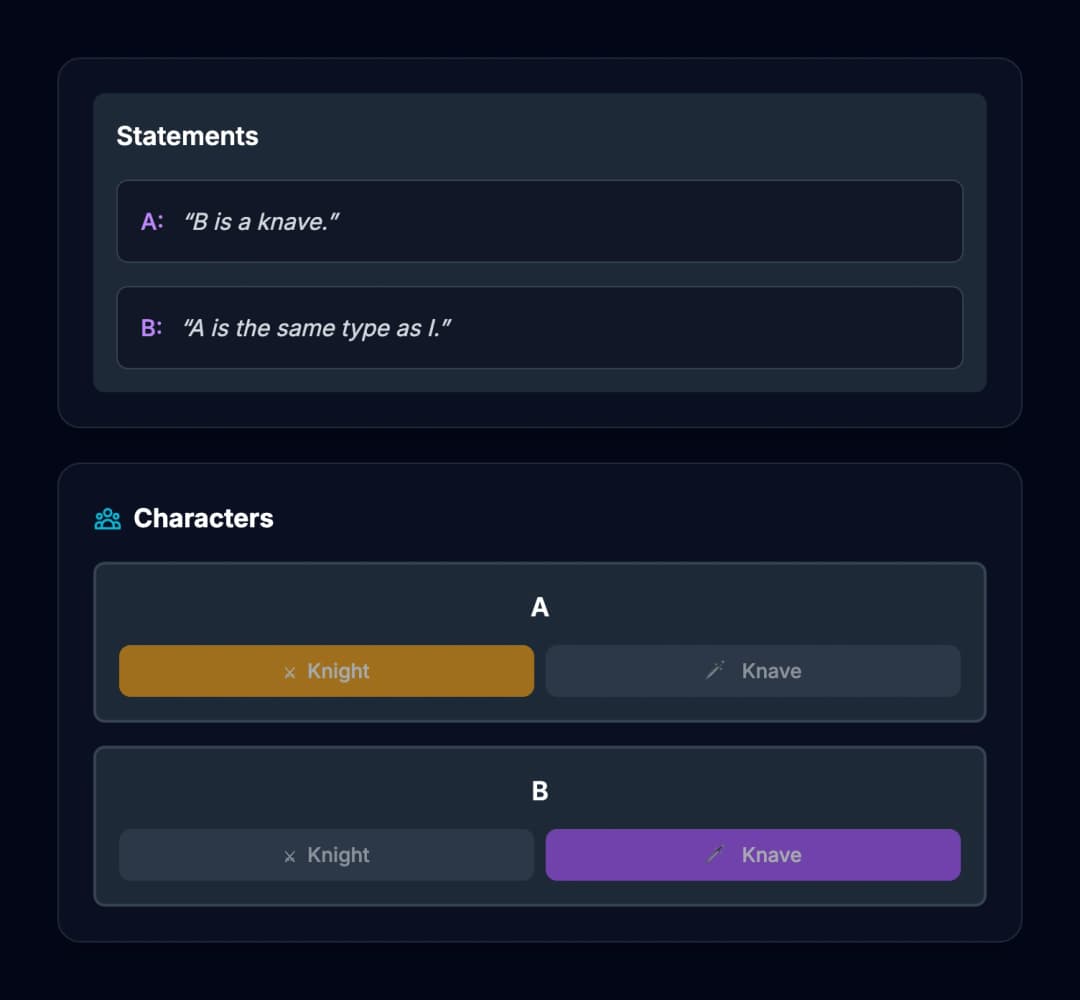
The shortcut revealed A's type immediately, then A's statement revealed B's type
A Three-Character Challenge
Ready for something more complex? Let's tackle a puzzle with three islanders.
Three islanders - A, B, and C - make these statements:
- A says: "B is a knight."
- B says: "C and I are different types."
- C says: "A is a knave."
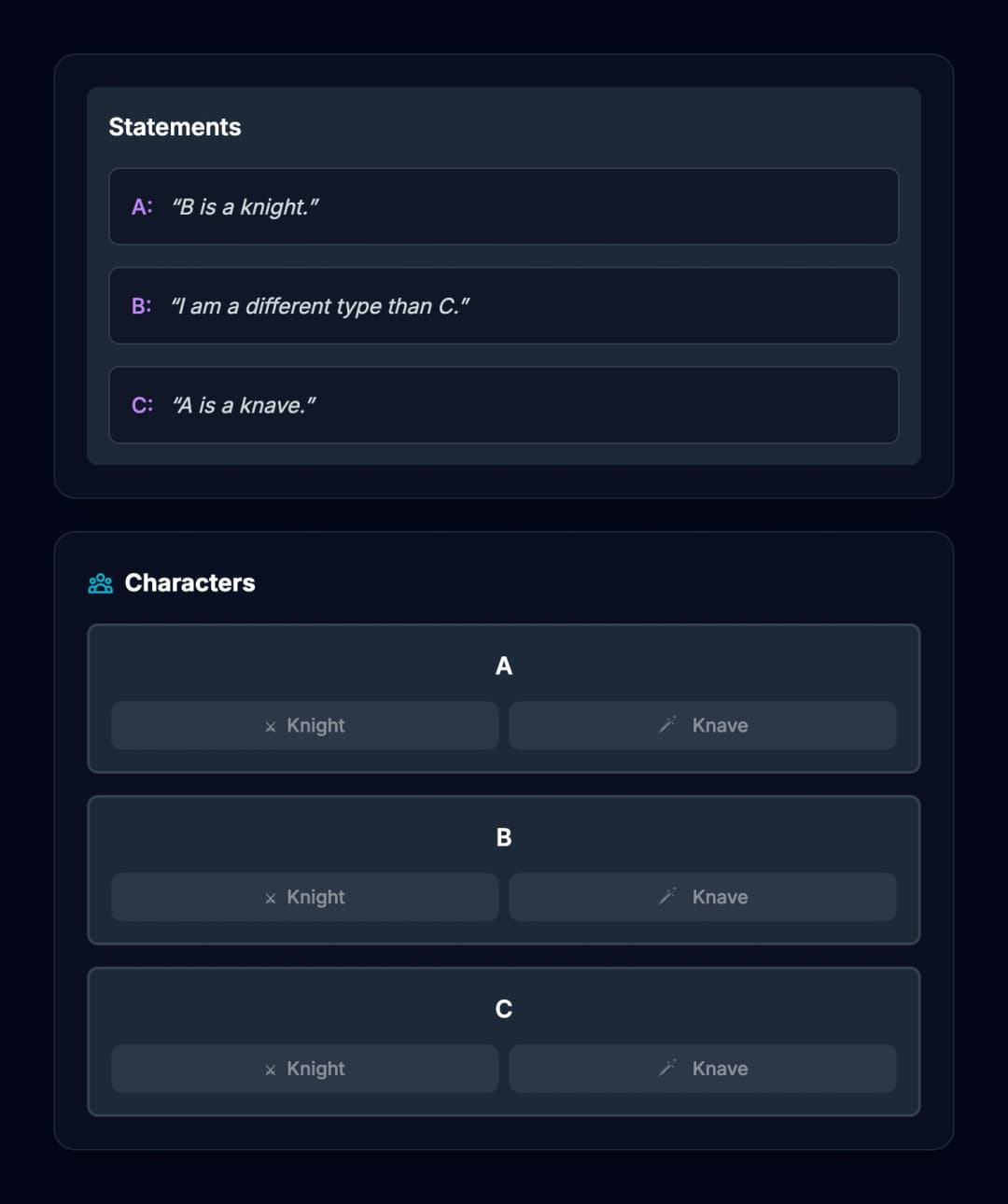
The Deduction Chain
Watch how one deduction leads to another, like dominoes falling:
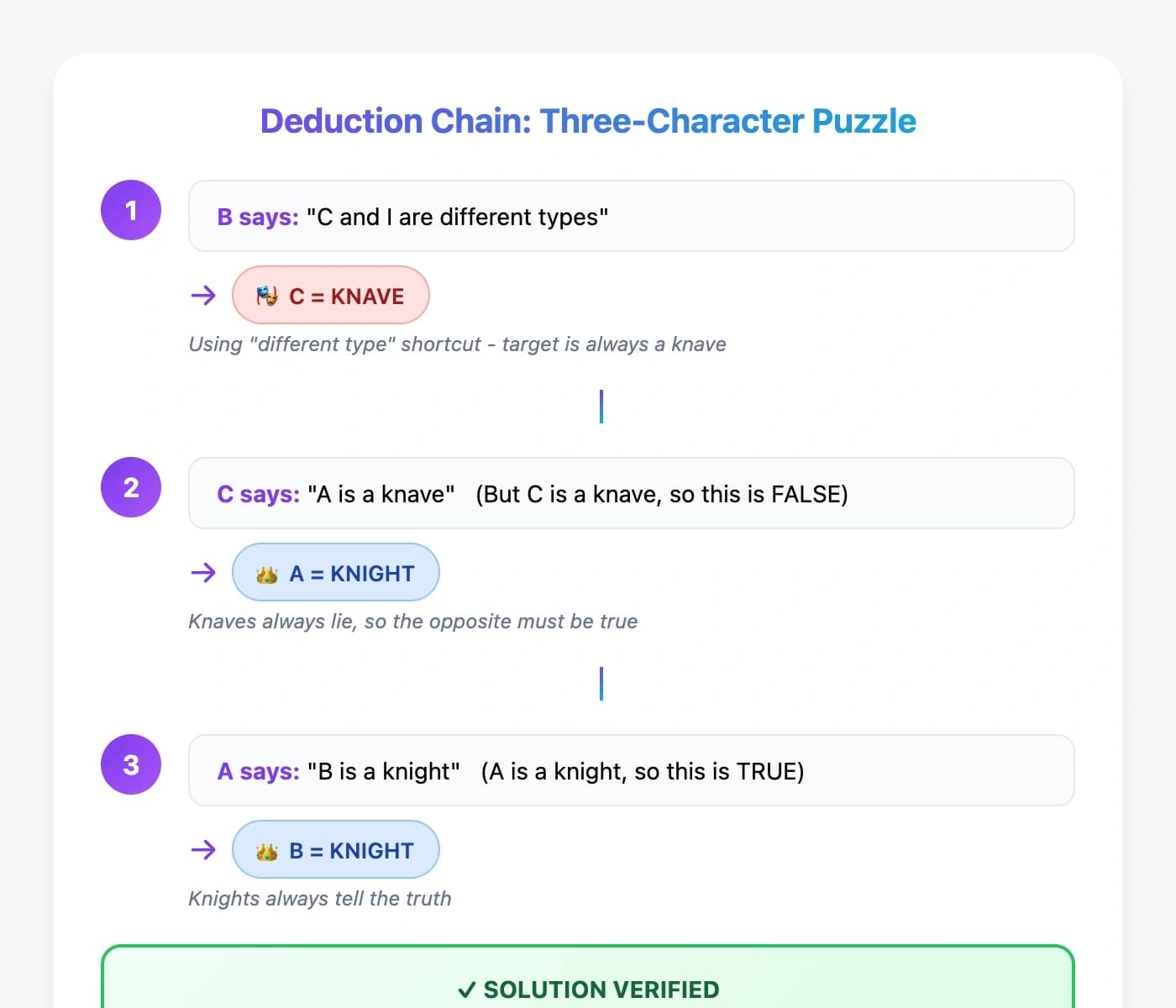
Solution Walkthrough
B says "C and I are different types." Using our shortcut, a "different type" statement always means the other person is a knave. So C is a knave.
Since C is a knave, C's statement "A is a knave" must be false. Therefore A is a knight.
Since A is a knight, A's statement "B is a knight" must be true. Therefore B is a knight.
Verification:
- • A (knight) says "B is a knight" — True. B is indeed a knight. Consistent!
- • B (knight) says "C and I are different types" — True. B is a knight and C is a knave. Consistent!
- • C (knave) says "A is a knave" — False. A is a knight. Knaves lie. Consistent!
Solution: A = knight, B = knight, C = knave.
Essential Strategies for Beginners
Now that you've seen these techniques in action, here's your quick reference guide:
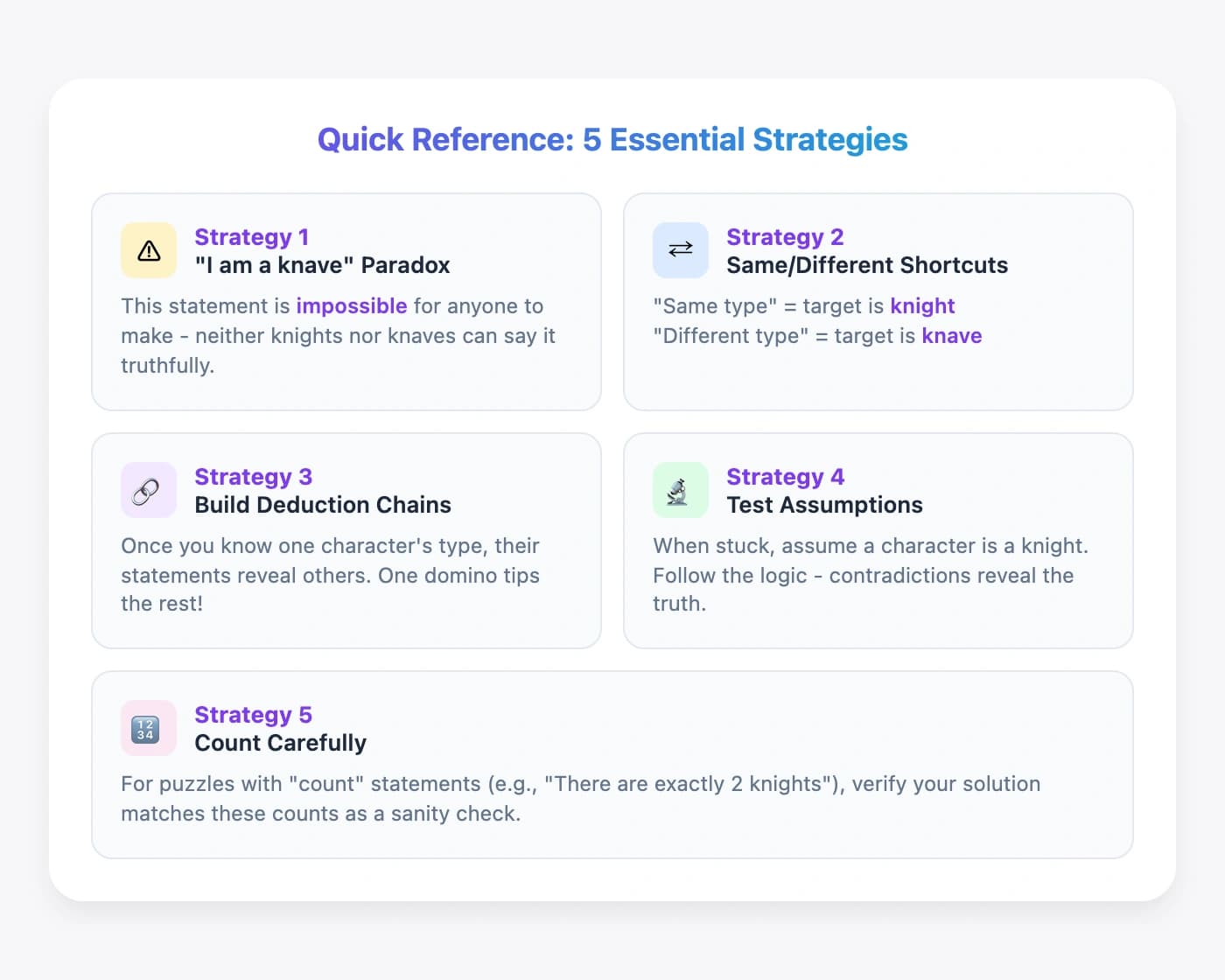
- Use the "same type / different type" shortcut. If anyone says "X and I are the same type," X is always a knight. If they say "X and I are different types," X is always a knave. This works regardless of whether the speaker is a knight or knave.
- Test assumptions systematically. Pick one character, assume they are a knight, and trace the logical consequences. If you reach a contradiction, they must be a knave. Then try the opposite if needed.
- Start with the most informative statement. Look for statements that directly constrain multiple characters or that use the same/different type pattern. Solve these first to create a chain of deductions.
- Verify your solution against every statement. Once you have an assignment, check each statement: knight statements must be true, knave statements must be false. If any statement fails, revisit your reasoning.
- Remember the impossible statement. No one on the island can say "I am a knave"—it creates a paradox for both types. If you see it, the puzzle setup has a special twist or you have misread something.
Common Mistakes and How to Avoid Them
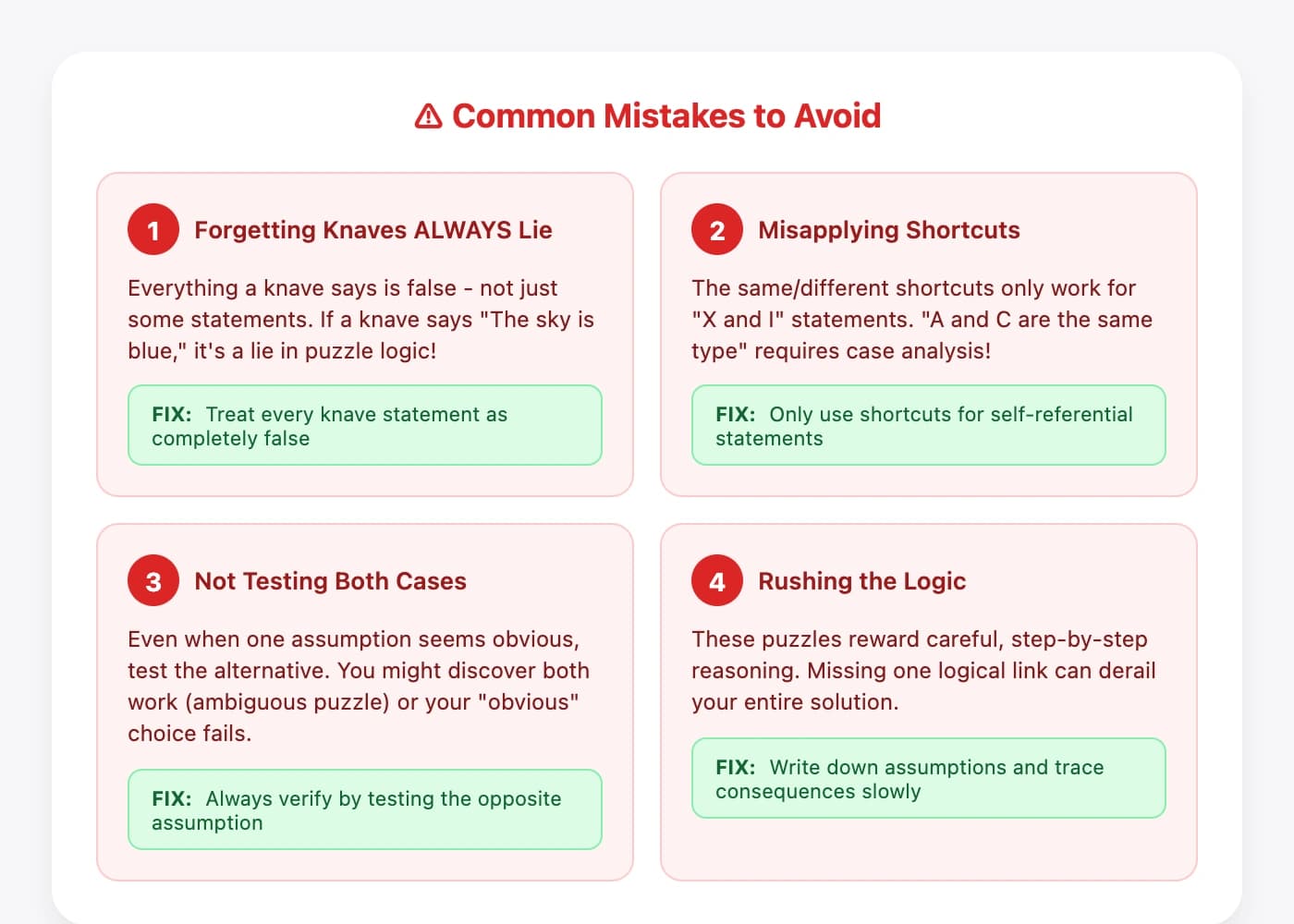
- Assuming "I am a knight" is useful. Both knights and knaves will say "I am a knight"—knights because it is true, knaves because they lie. This statement tells you nothing about the speaker. Do not waste time on it.
- Forgetting that knaves ALWAYS lie. A knave cannot accidentally tell the truth. Every single statement a knave makes must be false. If your solution has a knave making a true statement, something is wrong.
- Not checking all statements at the end. It is easy to determine types for some characters and forget to verify that every statement is consistent. Always do a final check: each knight's statement must be true and each knave's statement must be false.
- Confusing "A says B is a knave" with "B is a knave." A statement is only as reliable as the speaker. If A is a knave, then "B is a knave" is a lie, meaning B is actually a knight. Always consider the speaker's type before trusting a claim.
Practice Tips for Rapid Improvement
- Start with Two Characters: Master two-character puzzles before adding complexity. The logical patterns are identical; more characters just mean more variables to track.
- Verbalize Your Reasoning: Say (or write) things like: "If A is a knight, then A's statement is true, which means B is a knave..." This prevents sloppy shortcuts.
- Look for Anchors: Some statements immediately reveal information (like the same/different shortcuts). Find these first - they give you solid ground to build from.
- Draw a Grid: For puzzles with 3+ characters, sketch a simple table. List characters on one axis and possible types on another. Mark what you know.
- Practice Daily: Three puzzles a day builds pattern recognition faster than weekly marathon sessions.
Why Knights and Knaves Matter
These truth and liar puzzles aren't just entertaining - they train valuable skills:
- Critical thinking: You learn to question assumptions and follow logic wherever it leads.
- Systematic analysis: You develop habits of testing possibilities methodically rather than jumping to conclusions.
- Contradiction detection: You get better at spotting when claims don't add up - useful far beyond puzzle-solving.
- Patience: Some puzzles require working through multiple scenarios before finding the answer.
Fun Fact
The logical structure behind Knights and Knaves puzzles is closely related to Boolean satisfiability (SAT problems) - a fundamental problem in computer science. When you solve a puzzle by testing whether "A is a knight" leads to a consistent solution, you're essentially doing what computer programs do when checking if a set of logical conditions can all be true simultaneously. Raymond Smullyan understood this connection - his puzzles were playful introductions to deep mathematical concepts.
Ready for Advanced Techniques?
Once you've mastered these fundamentals, level up with competition-level strategies: the contradiction method, truth table analysis, graph-based reasoning, and techniques used in Math Olympiads.
Read the Advanced Strategies Guide