A says: "B and I are different types."
B says: "Either A is lying or C is a knight."
C says nothing.
Who is the knight?
This puzzle stumped contestants at a regional math olympiad qualifier. Three simple statements. Two possible types per character. Eight total combinations. And yet most solvers spent fifteen minutes chasing dead ends before finding the answer.
By the end of this guide, you'll solve puzzles like this in under two minutes. The techniques you're about to learn come from competition mathematics, formal logic, and Raymond Smullyan's legendary puzzle books. They transform hard knights and knaves problems from intimidating tangles into elegant exercises in systematic reasoning.
If you've mastered the basics—testing assumptions, using the "same type" shortcut, building deduction chains—you're ready for this next level.
Watch the Basics Tutorial
New to Knights & Knaves? This tutorial covers the foundational rules and solving techniques before you dive into advanced strategies.
The Contradiction Method: Your Most Powerful Tool
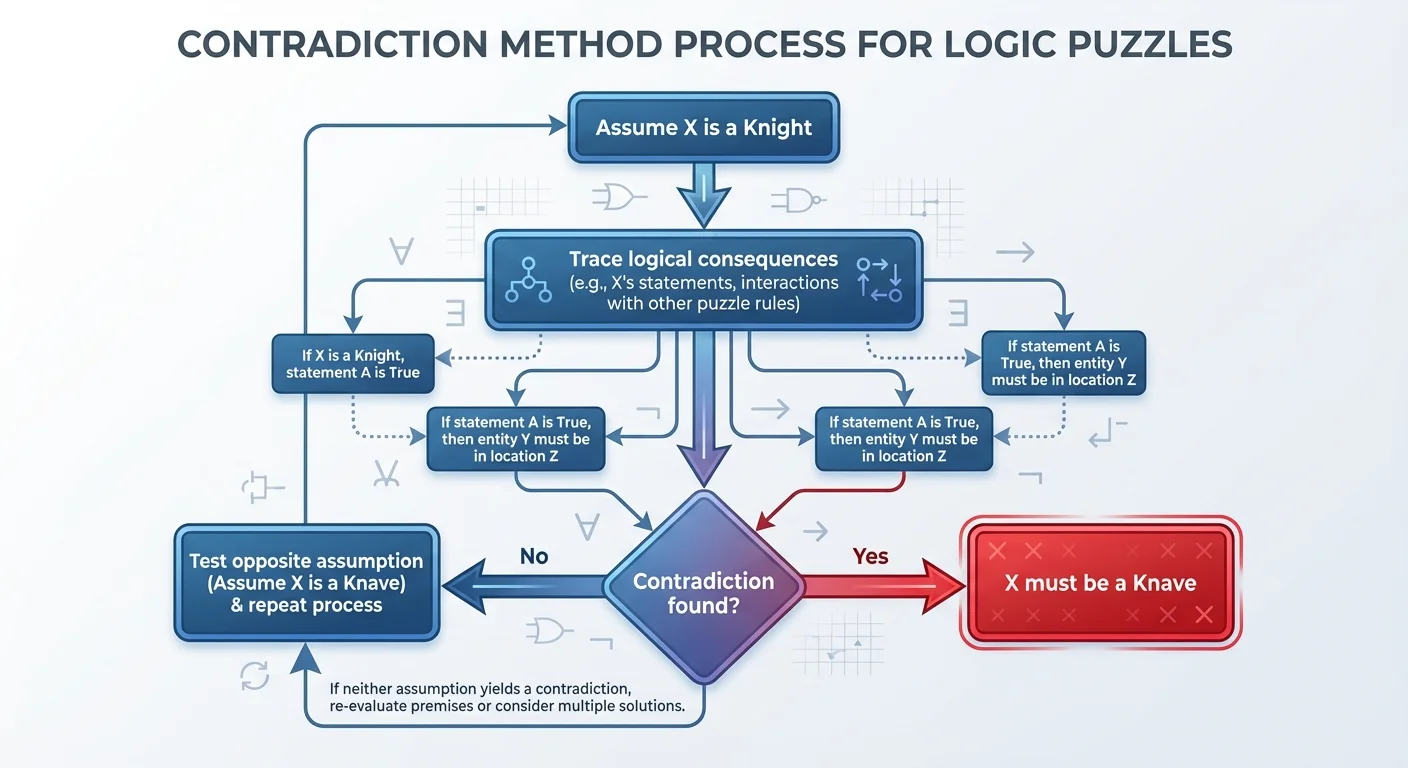
The contradiction method isn't just a fallback when other techniques fail—it's the foundation of rigorous logical proof. In competition mathematics, this technique goes by a fancier name: reductio ad absurdum (reduction to absurdity). The idea is elegant: assume something is true, follow the logical consequences, and if you reach an impossibility, your assumption must have been false.
How It Works
- Make an assumption about a character's type (knight or knave)
- Trace all logical consequences of that assumption
- Look for a contradiction—any statement that would need to be simultaneously true and false
- If you find a contradiction, your assumption was wrong
- If no contradiction emerges, your assumption might be correct (verify by testing the opposite)
The key insight: in a well-designed puzzle, exactly one configuration satisfies all constraints. The contradiction method helps you eliminate the impossible until only the truth remains.
A Worked Example
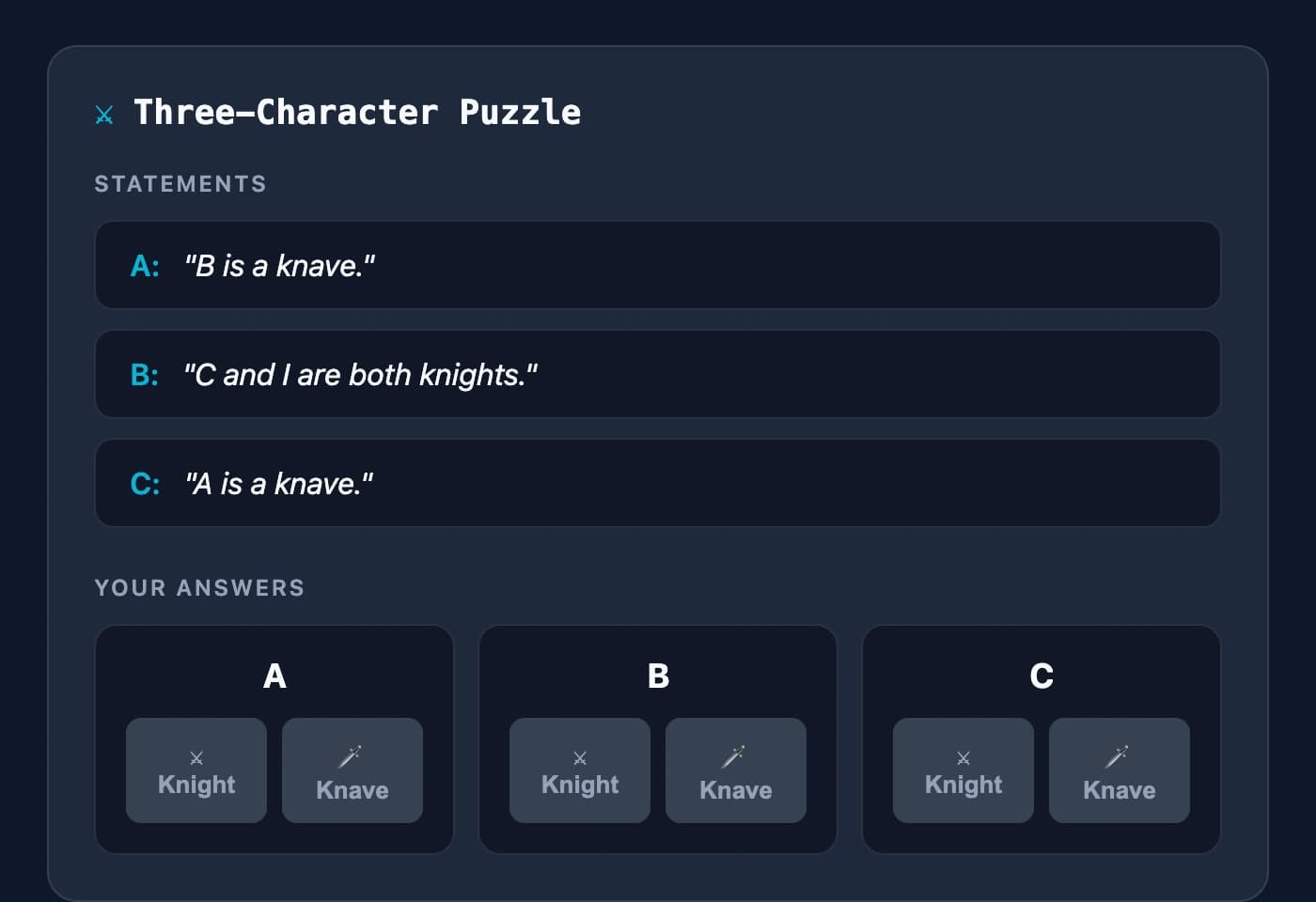
Consider this three-character puzzle:
- A says: "B is a knave."
- B says: "C and I are both knights."
- C says: "A is a knave."
Step 1: Assume B is a knight.
If B is a knight, then B's statement "C and I are both knights" is true. This means C is also a knight.
If C is a knight, then C's statement "A is a knave" is true. So A is a knave.
If A is a knave, then A's statement "B is a knave" is false. So B is a knight.
Check: B is a knight. This matches our assumption. No contradiction yet—let's verify all statements.
- A (knave) says "B is a knave" — B is a knight, so this is false. Knaves lie. Consistent.
- B (knight) says "C and I are both knights" — B is knight, C is knight, so both are knights. True. Knights tell truth. Consistent.
- C (knight) says "A is a knave" — A is a knave. True. Knights tell truth. Consistent.
Result: A = knave, B = knight, C = knight works!
But wait—we should verify this is the only solution.
Step 2: Assume B is a knave.
If B is a knave, then B's statement "C and I are both knights" is false. This means at least one of them is a knave. Since we're assuming B is a knave, the condition is automatically satisfied—but we learn nothing about C yet.
Let's branch on C.
Case 2a: B is a knave, C is a knight.
If C is a knight, then C's statement "A is a knave" is true. So A is a knave.
If A is a knave, then A's statement "B is a knave" is false. So B is a knight.
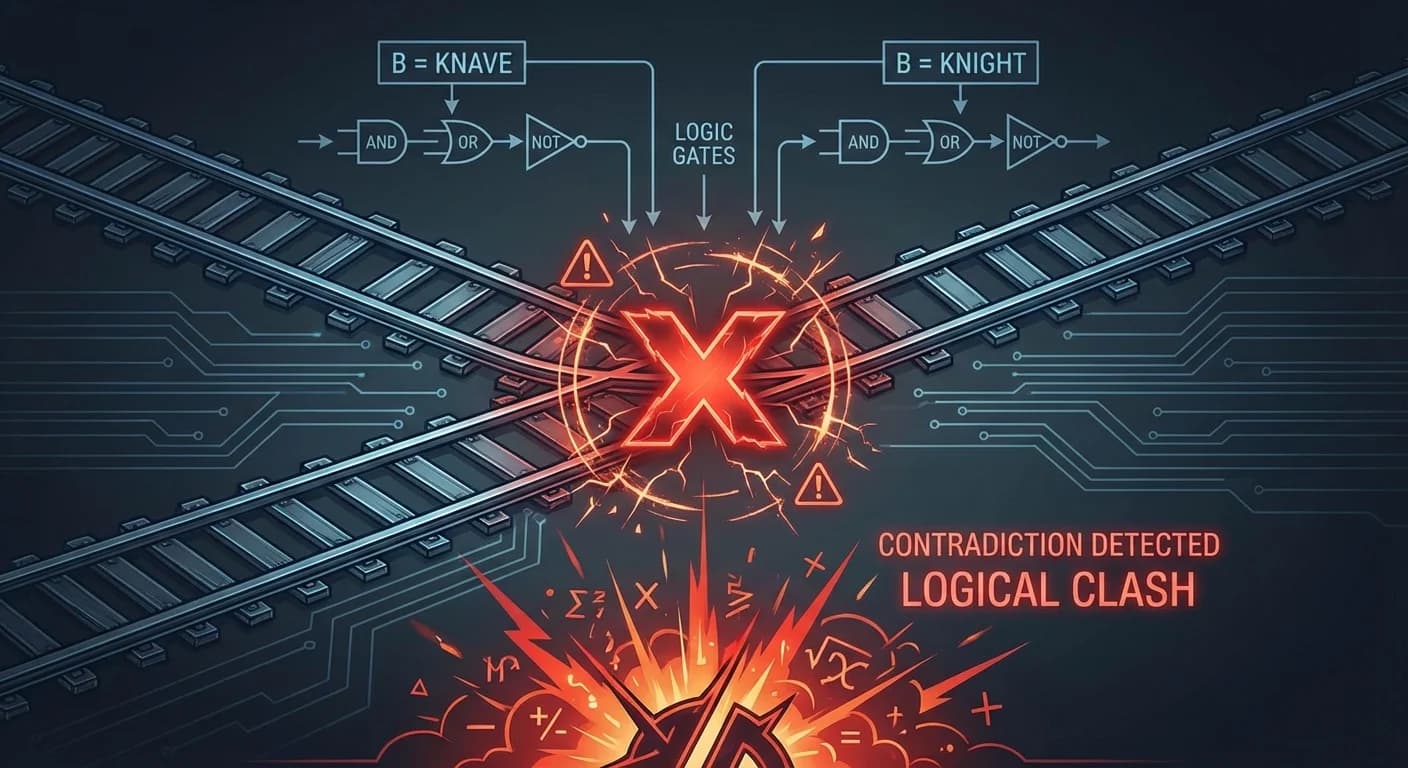
Contradiction! We assumed B is a knave, but deduced B is a knight.
Case 2b: B is a knave, C is a knave.
If C is a knave, then C's statement "A is a knave" is false. So A is a knight.
If A is a knight, then A's statement "B is a knave" is true. So B is a knave. Consistent with our assumption.
Let's verify:
- A (knight) says "B is a knave" — True. Consistent.
- B (knave) says "C and I are both knights" — B is knave, C is knave. This would require both to be knights, which is false. Knaves lie. Consistent.
- C (knave) says "A is a knave" — A is a knight. False. Knaves lie. Consistent.
Result: A = knight, B = knave, C = knave also works!
We have two valid solutions. This puzzle is ambiguous—a useful reminder that not all puzzles have unique solutions. In competition settings, ambiguous puzzles would typically ask you to find all solutions or determine if a unique solution exists.
When to Use It
The contradiction method shines when:
- • You face a puzzle with many interdependent statements
- • Shortcuts like "same/different type" don't immediately apply
- • You need to prove a solution is unique (by showing alternatives lead to contradictions)
- • The puzzle comes from a logic puzzle competition or math olympiad, where rigorous proof is expected
Truth Table Analysis: The Boolean Logic Approach
Truth tables might look intimidating at first glance—all those Ts and Fs can blur together. But here's the thing: this is exactly how computers solve these puzzles. And once you understand the approach, you've got a foolproof method that works on any knights and knaves puzzle, guaranteed.
You might be thinking, "This seems tedious for large puzzles." You're right—and that's exactly why we need the other techniques in this guide. But truth tables remain invaluable when you need absolute certainty or when intuition fails.
The Setup
Each character can be one of two types: knight (True) or knave (False). For n characters, there are 2n possible configurations. A truth table lists every configuration and checks which ones satisfy all constraints.
For a two-character puzzle, that's 4 combinations. For three characters, 8. For five characters, 32.
Building a Truth Table
Let's apply this to a puzzle:
- A says: "B is a knight."
- B says: "A and I are different types."
Step 1: Define variables.
- • Let A = True if A is a knight, False if A is a knave.
- • Let B = True if B is a knight, False if B is a knave.
Step 2: Translate statements into simple rules.
Here's the key insight. For any statement to be consistent, it must match the speaker's type: Knights tell truth, so their statements must be true. Knaves lie, so their statements must be false.
Step 3: Build the table.
| A | B | A's statement? | B's statement? | Valid? |
|---|---|---|---|---|
| Knight | Knight | Same type: Valid | B claims different but they match: Invalid | No |
| Knight | Knave | Different types: Invalid | — | No |
| Knave | Knight | Different types: Invalid | — | No |
| Knave | Knave | Same type: Valid | B lies about being different: Valid | Yes |
Result: A = knave, B = knave is the unique solution.
Why This Matters for Competition
The knights and knaves truth table method is especially valuable in math olympiad logic problems where you need to:
- • Prove that a unique solution exists
- • Handle boolean logic puzzles with compound statements (AND, OR, NOT)
- • Verify your intuitive solution is actually correct
- • Count the total number of valid solutions
The systematic nature of truth tables leaves no stone unturned—every possible world is considered, evaluated, and either accepted or rejected.

Techniques from IMO and Competition Mathematics
Here's where it gets interesting. Hard knights and knaves problems from the International Mathematical Olympiad (IMO) and similar logic puzzle competitions feature structures specifically designed to resist simple solving strategies. The techniques below are what separate casual solvers from competition-level performers.
Technique 1: The Invariant Method
Some statements create logical invariants—facts that must be true regardless of who says them. We touched on this with "same type" and "different type" statements in the basics guide, but competition problems push this further.
The Key Invariants:
- • "X and I are the same type" always means X is a knight
- • "X and I are different types" always means X is a knave
- • "I am a knave" is impossible (creates paradox)
- • "At least one of us is a knave" is always true (only a knight can make this statement consistently)
Wait—that last one deserves explanation. You might wonder how "At least one of us is a knave" can always be true. Follow the logic: If a knight says it, the statement must be true, so at least one person is a knave. If a knave says it, then by lying, the statement would be false, meaning everyone is a knight—but the speaker is a knave, contradiction. Therefore, knaves cannot say this statement, which means anyone who says it must be a knight, and the statement itself is true.
Competition insight: Look for statements that constrain the speaker's type regardless of who else is involved. These are your anchors. When you spot one, circle it—you have just found your foothold.
Technique 2: Graph-Based Reasoning
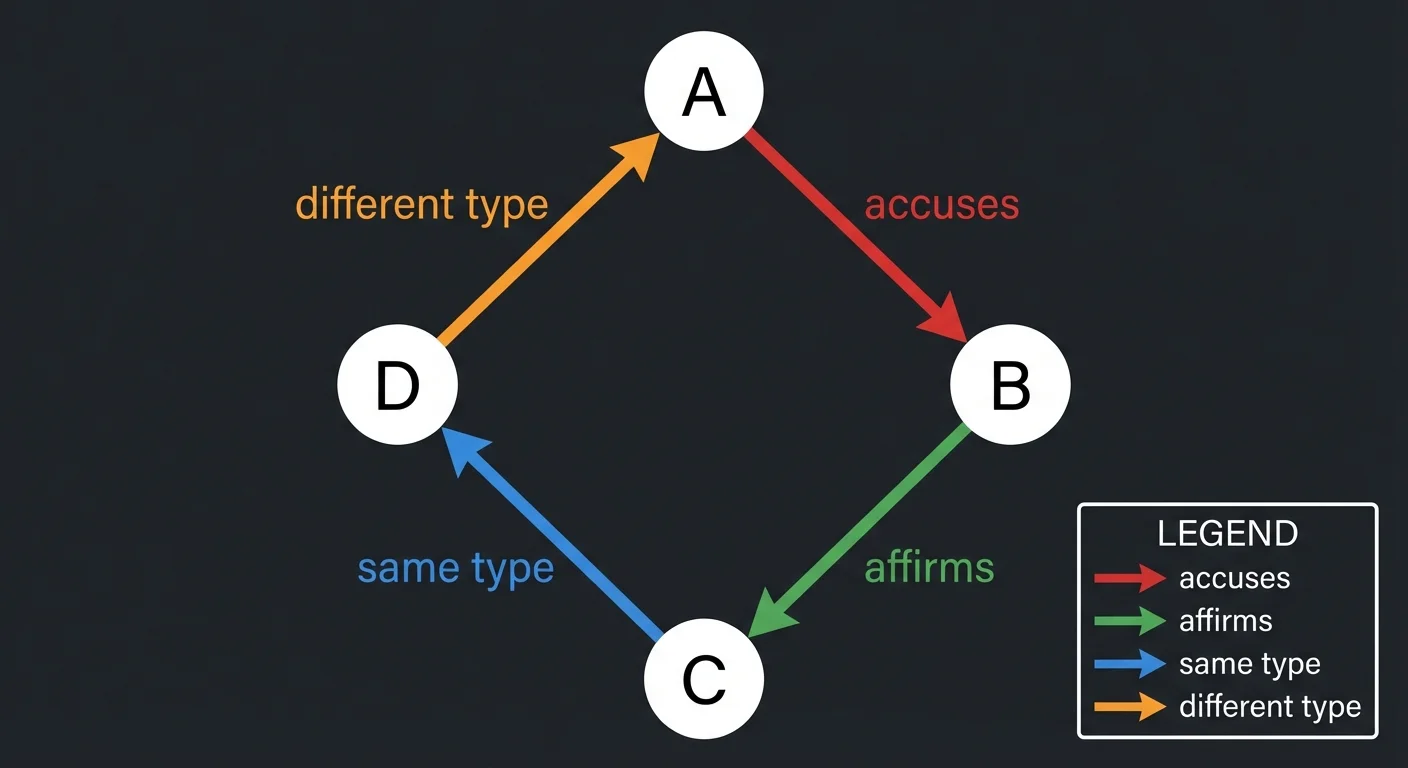
In multi-speaker scenarios with 4 or 5 characters, it helps to visualize the puzzle as a directed graph. Grab a pencil and try this:
- • Draw each character as a circle (node)
- • Each statement creates an arrow from speaker to subject
- • Label the arrow with the claim (accuses = "knave", affirms = "knight", etc.)
Notice what happens when you draw it out. Suddenly you can see structure that was invisible in the text. If A accuses B, and B accuses C, and C accuses A, you have a cycle. Cycles have special properties—an odd-length accusation cycle (where each person accuses the next of being a knave) has no consistent truth assignment and always leads to a contradiction. If you encounter one in a puzzle, double-check that you have correctly identified the cycle, since every valid puzzle must have a solution.
Quick mental check: if A accuses B, B accuses C, and C affirms A, what does that tell you about the cycle? (Hint: it's not a pure accusation cycle anymore—that affirmation changes everything. The affirmation breaks the contradiction pattern and creates a solvable constraint instead.)
Technique 3: Reduction to Smaller Problems
Competition puzzles with many characters can often be decomposed. Look for:
- Independent subgroups: If characters A and B only talk about each other, solve their sub-puzzle separately.
- Bridge characters: A character who connects two otherwise independent groups. Solve one side, then propagate through the bridge.
- Isolated chains: A sequence like A talks about B, B talks about C, C talks about D—solve the chain independently.
This divide-and-conquer approach transforms a 5-character puzzle into, say, a 2-character puzzle plus a 3-character puzzle. Much more manageable.
Technique 4: Counting Constraints
Raymond Smullyan puzzles and olympiad problems sometimes include counting statements: "Exactly two of us are knaves" or "The majority here are knights."
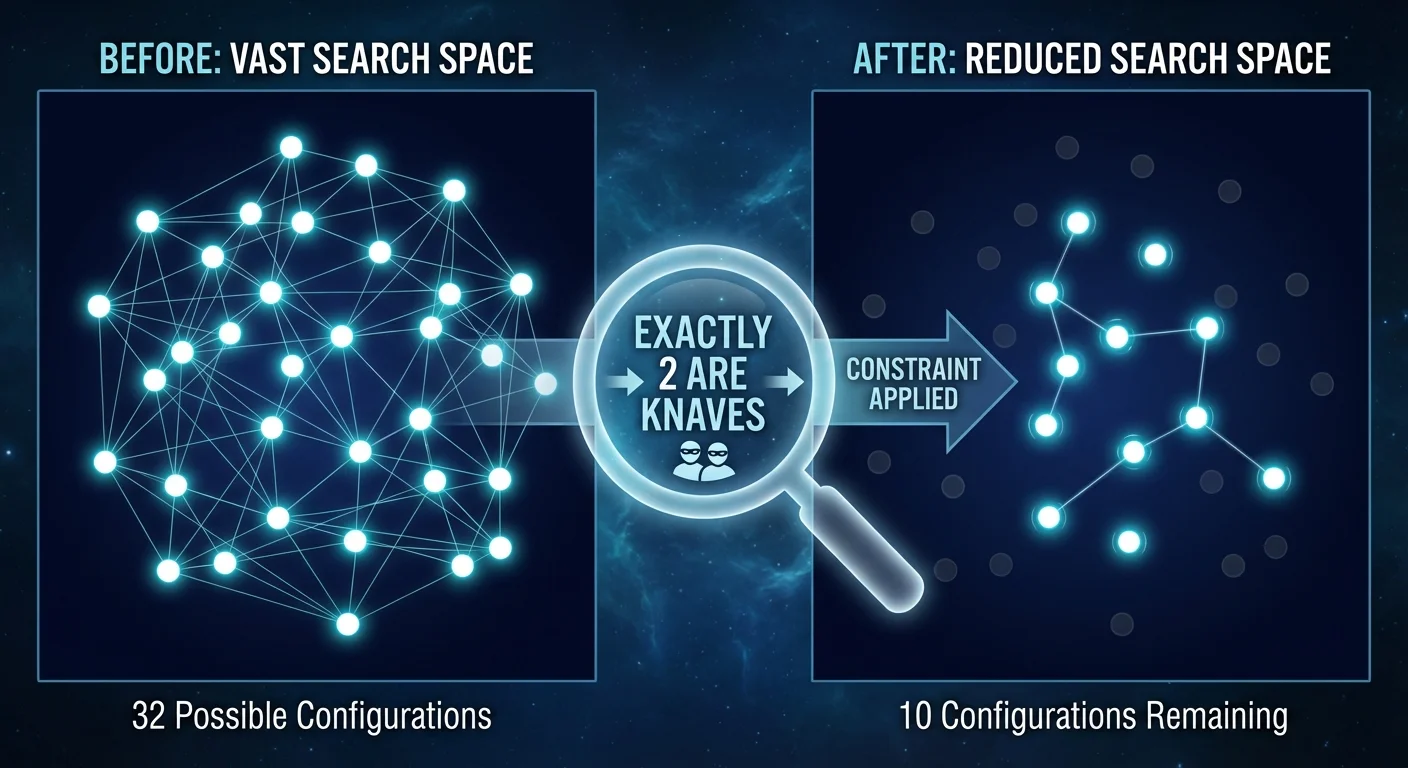
Think of it as eliminating half your suspects before the investigation even begins. Imagine being told "exactly two of these five people are guilty" before hearing their alibis—suddenly you're not searching 32 configurations, you're searching 10. That's the power of counting constraints.
These create global constraints that interact powerfully with individual statements. Strategy:
- Note all counting constraints
- Enumerate configurations satisfying the count (for "exactly 2 of 4 are knaves," that's 6 configurations)
- Filter configurations using individual statements
Counting constraints dramatically reduce the search space.
Raymond Smullyan's Classic Problems Decoded
Raymond Smullyan, the logician and magician who brought these puzzles to worldwide fame, had a particular genius for constructing problems that seem simple but hide deep logical twists. His books—What Is the Name of This Book?, The Lady or the Tiger?, and To Mock a Mockingbird—remain essential reading for puzzle enthusiasts.
Let's decode one of his classic structures.
The Inspector Craig Scenario
Smullyan often framed puzzles as detective investigations. Inspector Craig arrives on the island of knights and knaves and must determine the nature of witnesses based on their testimony. Here's a representative puzzle:
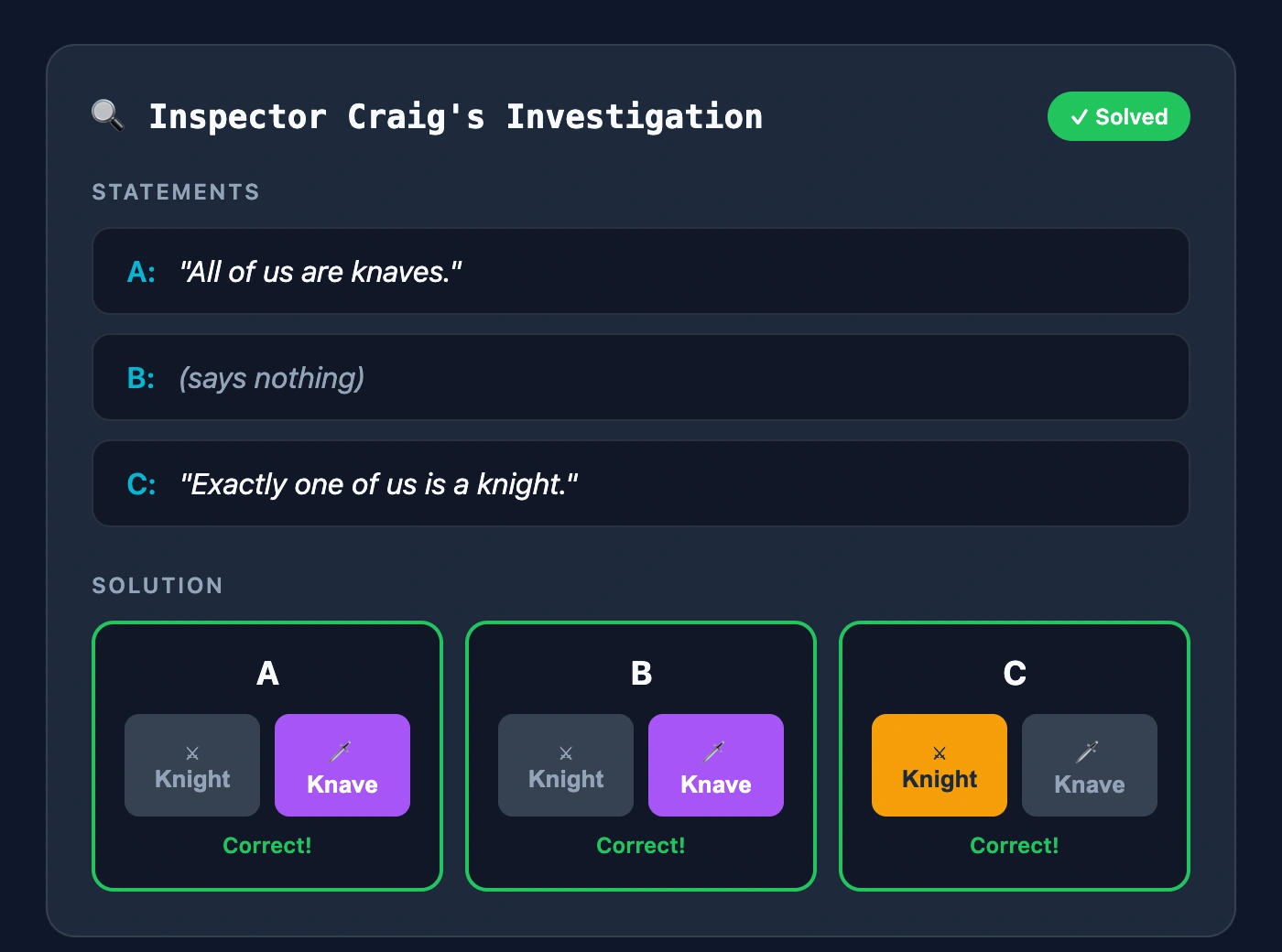
Inspector Craig meets three islanders. A says, "All of us are knaves." B says nothing. C says, "Exactly one of us is a knight."
Analysis:
First, note that A cannot be a knight. If A were a knight, then "All of us are knaves" would be true, making A a knave—contradiction. So A is definitely a knave.
Since A is a knave, "All of us are knaves" is false. This means at least one person is a knight.
Now consider C's statement: "Exactly one of us is a knight."
Case 1: C is a knight. Then "Exactly one of us is a knight" is true. That knight is C. So A and B are both knaves. Let's verify: A is a knave (established). B is a knave. C is a knight. Exactly one knight? Yes, C. A's statement "All of us are knaves" is false (C is a knight). A is a knave. Consistent.
Case 2: C is a knave. Then "Exactly one of us is a knight" is false. So either zero or two-or-more are knights. We know A is a knave. If C is a knave and the count isn't exactly one, then either zero knights (all knaves)—but we proved at least one is a knight, contradiction—or two knights, which is impossible since A and C are both knaves and B alone can't be two knights.
Case 2 fails entirely.
Solution: A = knave, B = knave, C = knight.
Smullyan's puzzles often use "meta" statements about the group that constrain multiple characters simultaneously. Learning to leverage these global statements is key to solving his more intricate creations.
Multi-Speaker Scenarios: Handling Complexity
As you tackle 4-character and 5-character knights and knaves examples, the web of statements can become overwhelming. You look at five characters making claims about each other, and your brain wants to give up before you start. Here's how to tame that complexity.
The Progressive Narrowing Technique
Phase 1: Identify forced characters.
Scan all statements for invariants that immediately determine a character's type. "Same type" statements revealing knights, "different type" statements revealing knaves, impossible self-references, etc.
Phase 2: Apply direct constraints.
For each determined character, propagate implications. If you know A is a knight, then A's statements are true—immediately apply them.
Phase 3: Enumerate remaining possibilities.
After phases 1 and 2, you'll often have reduced a 5-character puzzle to an effective 2 or 3-character puzzle. Use contradiction or truth table analysis on the remaining uncertainty.
Phase 4: Verify the complete solution.
Check every statement against your final answer. In competition settings, verification catches careless errors that cost points. Don't skip this step—you'll be surprised how often a small mistake hides in an otherwise solid solution.
Example: A Five-Character Challenge
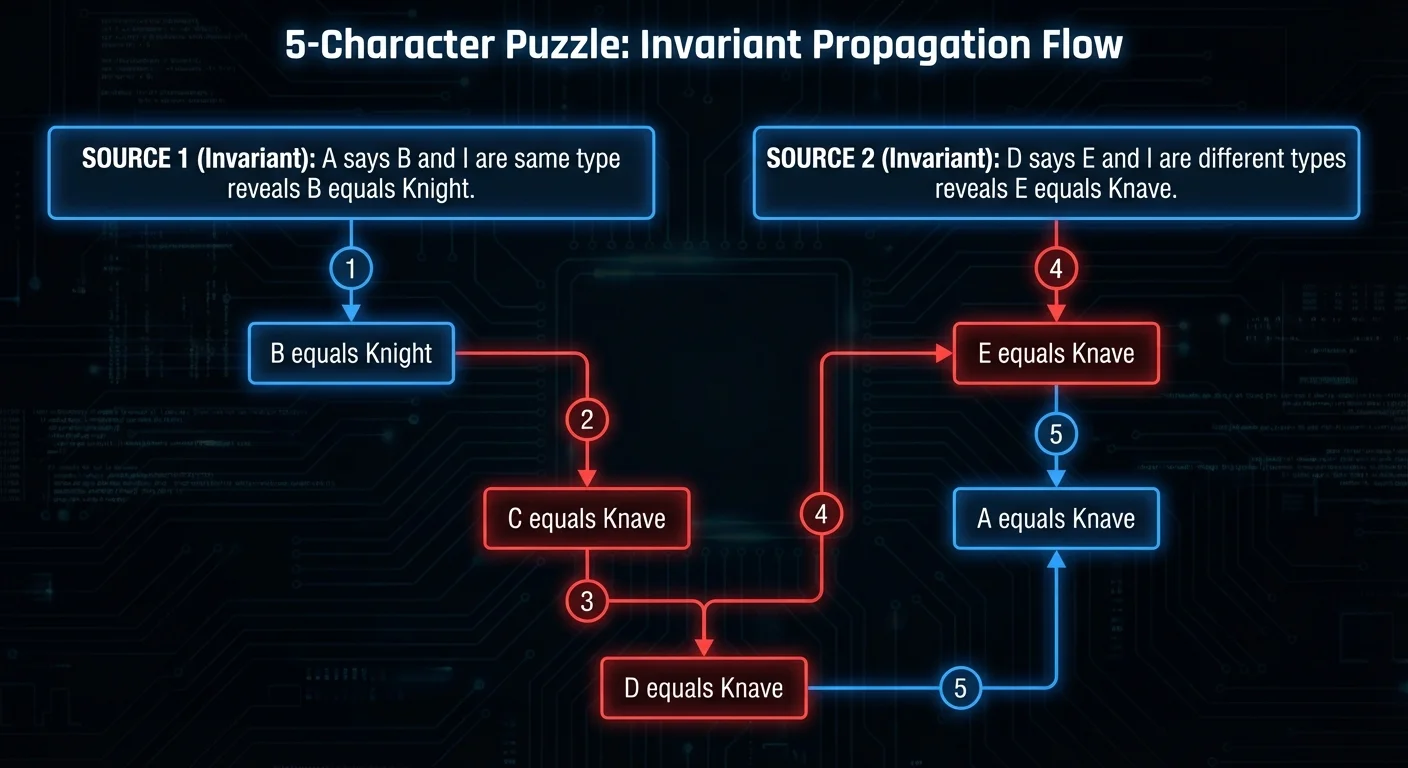
- A says: "B and I are the same type."
- B says: "C is a knave."
- C says: "D is a knight."
- D says: "E and I are different types."
- E says: "A is a knight."
Phase 1: Forced characters.
- • A says "B and I are the same type" — This reveals B is a knight (invariant).
- • D says "E and I are different types" — This reveals E is a knave (invariant).
Phase 2: Propagate constraints.
- • B is a knight, so B's statement "C is a knave" is true. C is a knave.
- • C is a knave, so C's statement "D is a knight" is false. D is a knave.
- • E is a knave, so E's statement "A is a knight" is false. A is a knave.
Phase 3: Verify A's statement. A (knave) says "B and I are the same type." A is a knave, B is a knight—they're different types. The statement is false. Knaves lie. Consistent!
Solution: A = knave, B = knight, C = knave, D = knave, E = knave.
The whole puzzle collapsed quickly once we identified the invariant statements.
The Meta-Level: What These Puzzles Teach
The contradiction method you just learned? Software engineers use it every day. When debugging code, you assume a variable holds a certain value, trace through the logic, and when you hit impossible behavior, you know your assumption was wrong. Knights and knaves puzzles are debugging practice in disguise.
This isn't coincidence. The techniques here—truth tables, contradiction proofs, invariant identification—are foundations of computer science and mathematical logic. Boolean algebra (the mathematics of true/false values) powers every circuit in your phone. Formal verification systems that prove software correctness use exactly the exhaustive case analysis you practiced with truth tables.
Raymond Smullyan understood this connection deeply. For him, truth-teller and liar puzzles weren't just games—they were windows into the structure of logic itself, connected to deep questions about self-reference, paradox, and the limits of formal systems. When you solve a knights and knaves puzzle, you're doing real logic, the same logic that underlies mathematics and computation.
Here's what makes these puzzles quietly profound: they train you to hold uncertainty without anxiety. In a world that constantly demands instant opinions, knights and knaves puzzles teach you to say "I don't know yet—let me work through the possibilities." That patience with ambiguity, that willingness to follow logic wherever it leads, is rarer and more valuable than any specific solving technique.

Put These Strategies to the Test
You now have a toolkit that goes far beyond basic solving:
- Contradiction method: Assume, trace, find the impossibility
- Truth table analysis: Systematic boolean enumeration
- Invariant identification: Statements that lock in types regardless of speaker
- Graph reasoning: Visualize statement relationships
- Progressive narrowing: Decompose complex puzzles into manageable pieces
- Smullyan-style analysis: Handle counting and meta-statements
The next step is practice. Competition-level skill comes from solving dozens of puzzles deliberately, applying specific techniques rather than just intuiting answers.
As you solve, narrate your reasoning aloud. "A's statement is an invariant because... B's claim forces C to be... This creates a contradiction because..." Verbalizing builds mastery faster than silent solving—it's how competition mathematicians train.
Remember that opening puzzle? A says "B and I are different types." B says "Either A is lying or C is a knight." C says nothing. Now you have the tools to crack it. The "different types" statement is your invariant. Work from there.
Opening Puzzle Solution
A says "B and I are different types." By our invariant, a "different types" statement always means the other person is a knave. So B is a knave, regardless of A's type.
Since B is a knave, B's statement "Either A is lying or C is a knight" must be false. An "or" statement is only false when both parts are false. So: "A is lying" is false (meaning A tells the truth, so A is a knight), and "C is a knight" is false (so C is a knave).
Verification: A (knight) says "B and I are different types"—A is a knight, B is a knave, they are different. True. B (knave) says "Either A is lying or C is a knight"—both parts are false, so the statement is false. Knaves lie. Consistent.
Answer: A = knight, B = knave, C = knave.
The world's best logic puzzlers—IMO competitors, Smullyan devotees, puzzle championship winners—all started where you are now: recognizing that the simple rules of knights and knaves contain depths worth exploring.
Your turn.
Looking for the fundamentals first? Start with our Knights and Knaves Beginner's Guide to build a solid foundation before tackling advanced techniques.
Ready for unlimited practice? Our Knights and Knaves collection ranges from gentle 2-character warm-ups to expert-level 5-character challenges.