The Science of Puzzles:
How Logic Games Sharpen Your Mind
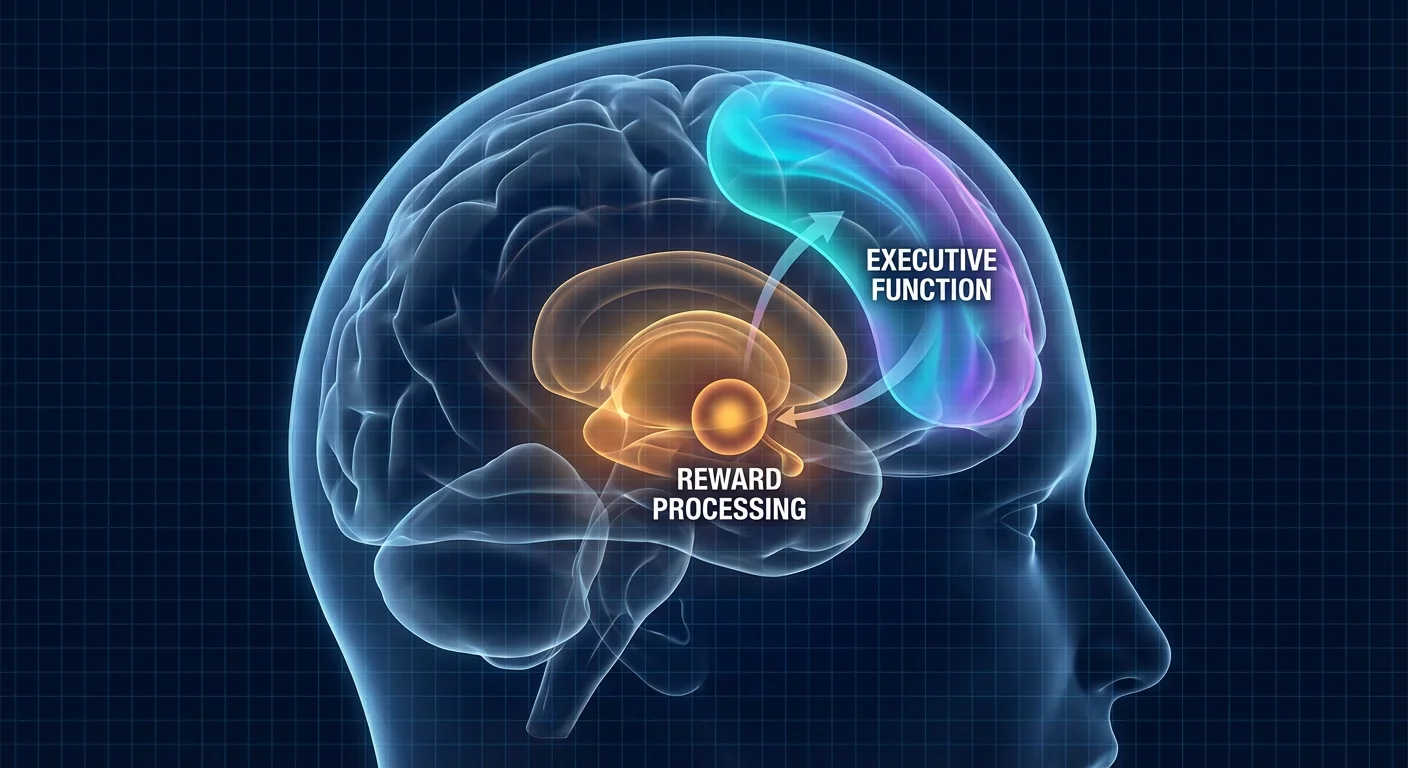
Large observational studies have linked frequent puzzle use with stronger performance on some reasoning and memory tests. Clinical research has also compared traditional crosswords with computerized cognitive games, while brain-imaging studies show that demanding puzzles recruit regions involved in planning, attention, and reward.
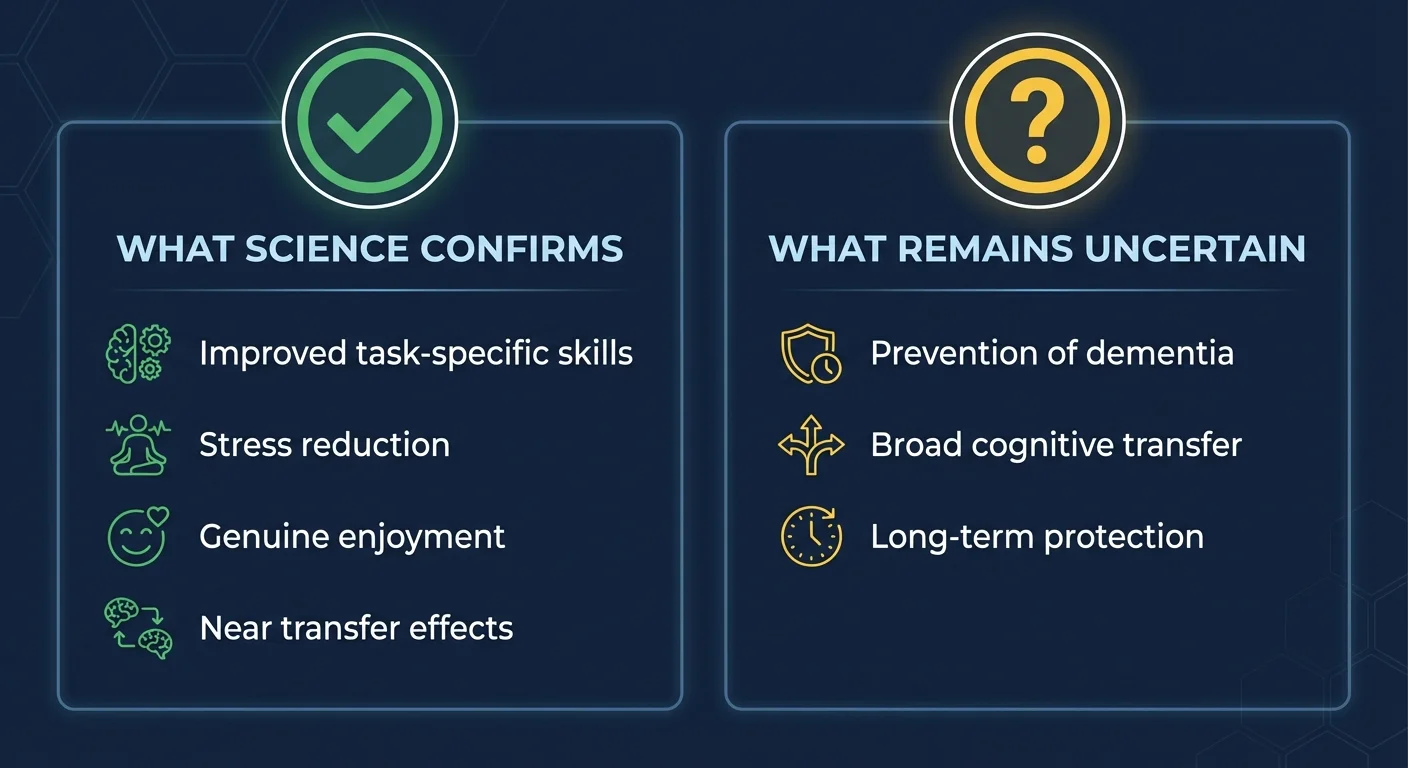
Those findings make puzzles a worthwhile form of challenging recreation, but they do not prove that a daily Sudoku prevents dementia or improves every kind of thinking. The distinction matters: good evidence can tell us what was measured without turning an association into a medical promise.
How to Read the Evidence
Observational studies can show that puzzle habits and test performance occur together, but puzzle enthusiasts may differ in education, health, or lifestyle before the study begins.
Training studies provide stronger evidence of cause and effect, although gains are often largest on the practiced task or a closely related skill. Broad transfer to everyday cognition is harder to establish.
The most defensible conclusion is modest: puzzles can provide enjoyable, sustained practice in attention and problem solving. They complement—rather than replace—physical activity, sleep, social connection, and professional medical care.
Your Brain on Puzzles: The Dopamine Connection
Let us start with that satisfying "aha!" moment. Researchers at Goldsmiths, University of London, used functional MRI to watch what happens in the brain during moments of insight. What they discovered was remarkable: the rush of excitement that accompanies solving a puzzle is produced by an influx of dopamine into the nucleus accumbens, a brain region central to our reward circuitry.
Professor Joydeep Bhattacharya, who led the research, explained that "dopamine is a chemical not just for processing reward, it also stimulates goal-driven approach motivation such as curiosity and learning."
This is why puzzle-solving feels inherently rewarding. Your brain doses itself with the same neurotransmitter associated with food, social connection, and other survival-critical activities. Evolution shaped us to find problem-solving pleasurable because our ancestors' survival depended on it: the ones who enjoyed figuring things out were the ones who found water, escaped predators, and lived to pass on their genes.
Key Insight: The Reward Spike
The nucleus accumbens remains active throughout puzzle-solving, but activity spikes dramatically at the moment of insight. The brain anticipates and prepares for the reward, then delivers it in full when the solution emerges.
The Prefrontal Cortex: Command Center of Logic
While dopamine provides the motivation, the actual work of solving logic puzzles happens primarily in the prefrontal cortex (PFC)—the brain region right behind your forehead that serves as your mind's executive committee. A study published in the journal Neurophotonics used functional near-infrared spectroscopy (fNIRS) to observe brain activation during Sudoku tasks. The researchers observed increased neural activity on their instruments as participants puzzled through grids in real time.
Both the medial and lateral regions of the prefrontal cortex activate when solving Sudoku, with the medial regions playing a distinctive role when considering row and column rules. Harder puzzles trigger broader activation across the PFC, as if the brain is calling in reinforcements. When a puzzle demands more, your brain recruits more resources.
This matters because the prefrontal cortex is responsible for executive functions: planning, decision-making, impulse control, and complex reasoning. It is the part of your brain that distinguishes careful analysis from knee-jerk reaction, that stops you from saying something regrettable, that keeps you on task when distractions beckon.
Neuroplasticity: Puzzles Physically Reshape Your Brain
Perhaps the most exciting discovery in modern neuroscience is neuroplasticity: the brain's ability to form new neural connections throughout life. Far from being a fixed organ that peaks in early adulthood, your brain continuously rewires itself based on how you use it.
Regular engagement with logic puzzles promotes this plasticity by challenging existing neural pathways and encouraging the growth of new ones. Studies demonstrate that consistent brain training puzzles stimulate dendritic sprouting and synaptic strengthening, particularly in regions associated with executive function and memory.
Even more remarkably, neuroscientists have now discovered newly formed neurons in the brains of adults as old as 78. This challenges the long-held belief that you are born with all the neurons you will ever have. The implication for puzzle enthusiasts is profound: regular mental engagement, including puzzle solving, supports the kind of cognitive activity that researchers associate with maintaining brain health.
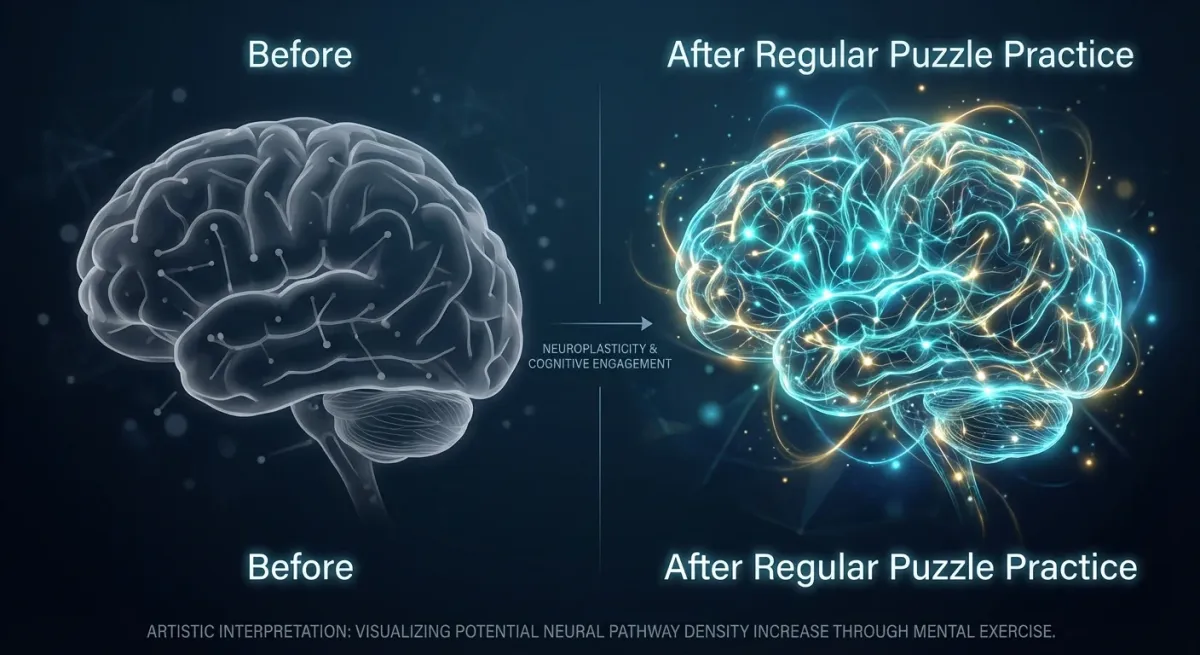
Neural pathway density before and after regular puzzle practice. Regular engagement promotes dendritic sprouting and synaptic strengthening.
The PROTECT Study: Puzzles and Cognitive Age
Some of the most compelling evidence for puzzle benefits comes from the PROTECT study, a massive research project examining cognitive health in adults over 50. Published in the International Journal of Geriatric Psychiatry, the findings analyzed data from over 19,000 participants aged 50 to 93.
Researchers evaluated how often participants performed word and number puzzles, then tested their attention, reasoning, memory, working memory, and processing speed. The results showed highly statistically significant effects: participants who engaged with puzzles more frequently performed better on all cognitive measures.
Crosswords Beat Computer Games: The Duke-Columbia Study
If you have ever wondered whether traditional puzzles offer real advantages over modern "brain training" apps, a landmark 2022 study published in NEJM Evidence provides a clear answer.
Researchers at Columbia University and Duke University Medical Center randomly assigned 107 participants with mild cognitive impairment (MCI) to either crossword puzzle training or computerized cognitive games. The training continued for 78 weeks with regular assessments.
The results favored crossword puzzles on multiple measures. At week 78, cognitive scores declined by an average of 0.89 points among patients in the games group but improved by 0.55 points among those in the crosswords group. Perhaps most importantly, progression to dementia occurred in 10.7% of the crossword group versus 15.7% of the computerized games group.
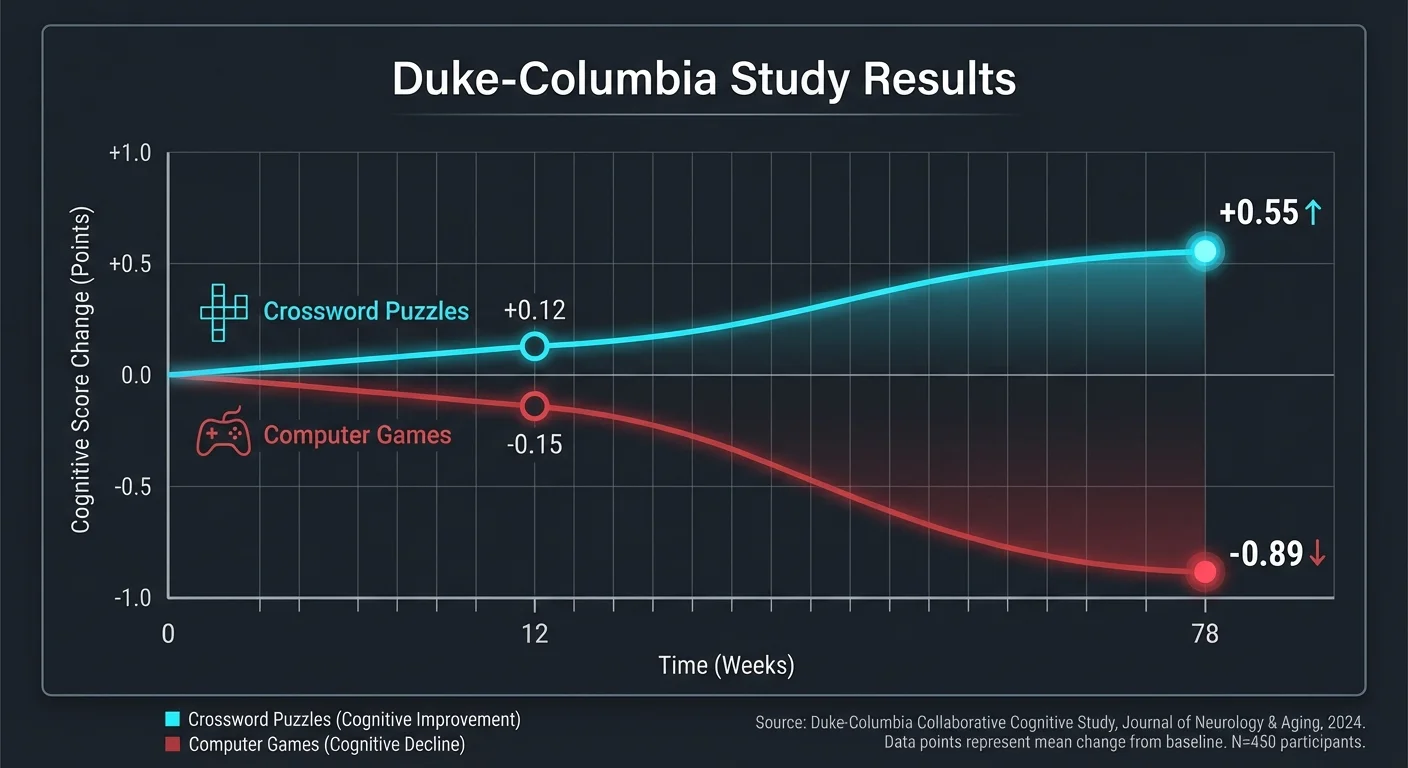
Duke-Columbia Study: Crossword puzzles showed cognitive improvement while computer games showed decline over 78 weeks.
Working Memory: Your Brain's Mental RAM
Ever held a phone number in your head while searching for a pen? Tracked multiple deadlines while planning your week? That is working memory—your brain's RAM, not its hard drive. It is the mental workspace where information is temporarily held and manipulated during complex cognitive tasks, and puzzles push it to its limits in the best possible way.
Puzzles give this system a rigorous workout. A randomized controlled trial published in PLOS One demonstrated that puzzle-based brain training improves executive functions, working memory, and processing speed in young adults. The study found that Tetris, in particular, enhanced attention and visuospatial ability, skills that transfer to everyday tasks like navigating unfamiliar environments or assembling furniture.
Consider what happens when you solve a Kakuro puzzle. You must hold multiple sum targets in mind, evaluate which number combinations satisfy each constraint, and track which digits you have already used in each row and column. This is working memory at full stretch. Similarly, navigating a Pipes puzzle requires mentally rotating segments while tracking the growing network, building the same spatial reasoning you use when parallel parking or figuring out how to fit luggage into a full car trunk.
The Stress Reduction Dimension
Beyond cognitive enhancement, puzzles offer measurable benefits for mental health—and this might be their most underappreciated superpower. Research from the American Psychological Association confirms that cognitively absorbing activities reduce cortisol levels and activate the parasympathetic nervous system, your body's natural relaxation response.
When engaging in a puzzle, the brain enters a state of focused absorption similar to meditation. Cortisol levels drop. The reward system activates through dopamine release. And crucially, the mind cannot multitask: when you are deeply engaged in a Nonogram, tracking row and column clues to reveal a hidden image, you cannot simultaneously ruminate about that awkward thing you said in 2019 or catastrophize about next month's deadline.
This single-pointed focus provides genuine relief from the fragmented attention that dominates modern consciousness. Unlike passive relaxation (scrolling social media, watching television), puzzle-solving combines stress reduction with active engagement—a mental state researchers call "flow." It is rest and exercise at once, relaxation and accomplishment in a single package.
What the Science Actually Shows (and Does Not Show)
Scientific integrity demands acknowledging the limitations of current research. According to Justin Miller, PhD, a neuropsychologist at the Memory and Brain Wellness Center at Harborview Medical Center: "I myself play and enjoy games like Sudoku, chess, crossword puzzles and Wordle. But I'm very transparent in sharing that there is no evidence to support that those types of activities in and of themselves will prevent accelerated brain aging or cognitive decline."
This honest assessment reflects an important distinction between correlation and causation. The Alzheimer's Drug Discovery Foundation notes that while the Bronx 20-year longitudinal Aging Study found crossword puzzle use was associated with a 2.54-year delay in dementia onset, this suggests mental stimulation may help delay symptoms rather than prevent dementia itself.
Cognitive Reserve: Your Brain's Insurance Policy
One well-supported concept is cognitive reserve: the brain's ability to adapt and stay strong even as it ages or faces challenges like disease or injury. Texas A&M researchers found that high-level participation in cognitively stimulating activities consistently correlated with higher cognitive function levels, including better memory, working memory, and attention.
People with greater cognitive reserve essentially have more neural resources to draw upon when facing age-related changes or neurological challenges. While puzzles alone may not prevent dementia, they contribute to building this protective buffer.
The magnitude of this effect can be striking. A 2021 study in Neurology examined adults aged 80 and over. Those with high cognitive activity levels—reading, playing games, solving puzzles—delayed Alzheimer's onset by five years compared to less cognitively active peers. Five years of additional cognitive clarity is not a small thing: it can mean the difference between attending a grandchild's graduation with full presence or missing the experience entirely.
Practical Applications: How to Maximize Cognitive Benefits
With the science established, the practical question emerges: how do you actually capture these benefits? Here are evidence-based recommendations with concrete actions you can take today.
Vary your puzzle diet
Different puzzle types activate different cognitive systems. If you primarily solve Sudoku, add Kakuro to engage arithmetic processing. If you love number puzzles, try Nonograms for visual-spatial reasoning. A simple rule: introduce one new puzzle type each month.
Calibrate your challenge level
The brain adapts to routine challenges. If you are completing Easy Sudoku in under five minutes without using pencil marks, you have stopped growing. Move to Medium difficulty. The sweet spot is puzzles that take 10 to 20 minutes and include at least one moment where you feel genuinely stuck.
Prioritize consistency over intensity
Ten minutes of daily puzzle-solving likely benefits cognition more than a two-hour weekend session. Build puzzles into your routine: morning coffee, lunch break, or the wind-down before bed.
Follow your enjoyment
The dopamine system rewards pleasure. Forcing yourself through puzzles you dislike provides less benefit than engaging enthusiastically with puzzles you love. If Slitherlink frustrates you but Hashi delights you, lean into Hashi.
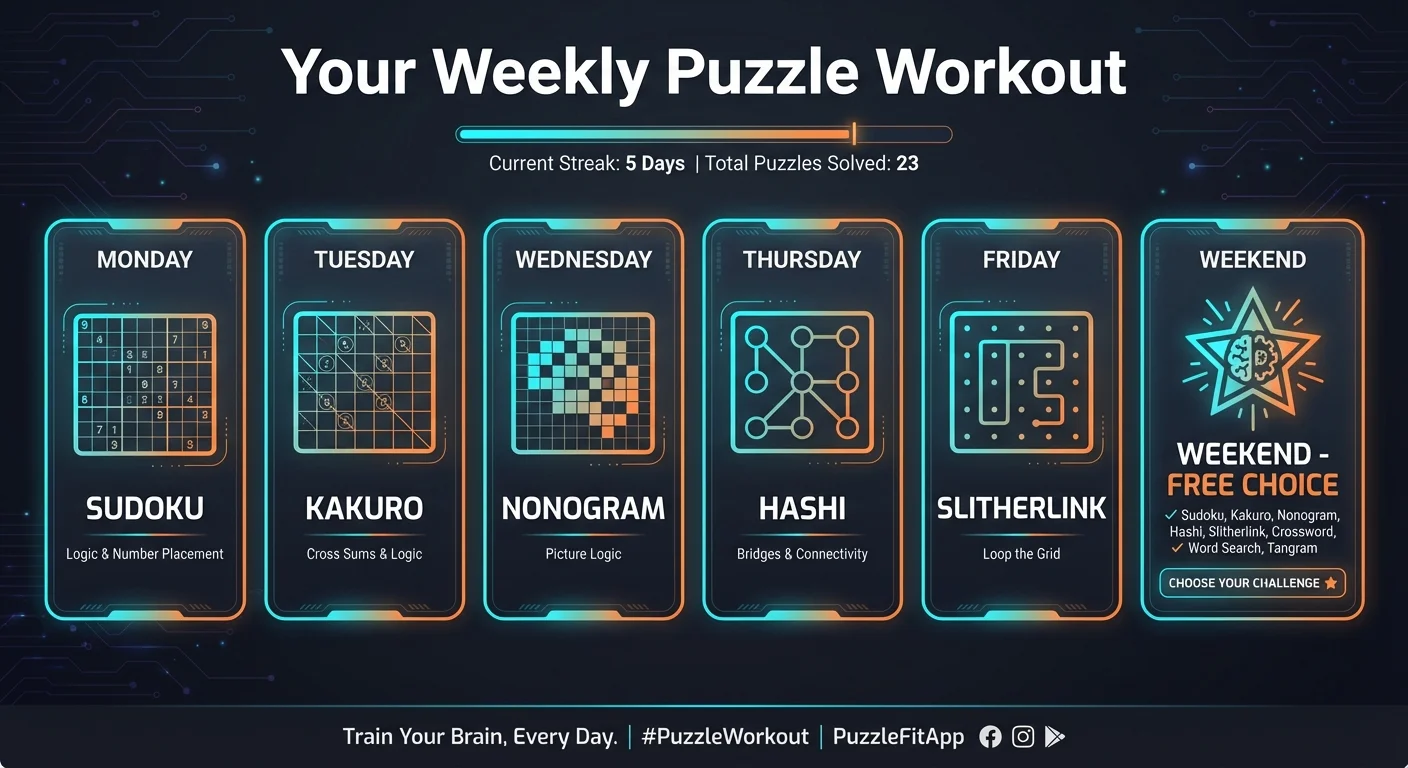
A sample weekly puzzle rotation to engage different cognitive systems throughout the week.
Your Cognitive Workout Menu: Puzzles and Their Brain Benefits
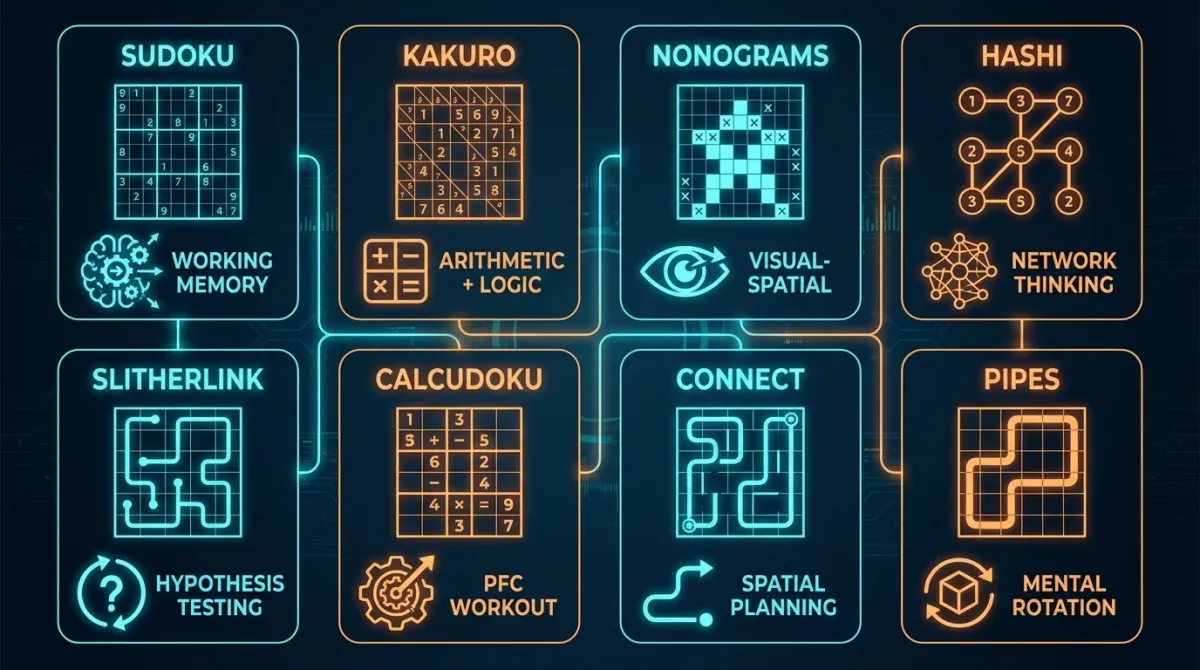
Think of puzzle types as exercises targeting different cognitive muscle groups. Here is what each one trains:
Sudoku
The classic working memory workout. Mental juggling in its purest form.
Kakuro
Sudoku's mathematically inclined cousin. Logic plus arithmetic cardio.
Nonograms
Visual-spatial reasoning and pattern completion through hidden pictures.
Hashi
Network thinking and graph theory made tangible. Strategic planning.
Slitherlink
Hypothesis testing and boundary reasoning. Rigorous if-then thinking.
Calcudoku
Comprehensive prefrontal cortex workout combining arithmetic and logic.
Connect
Pure spatial planning and mental mapping abilities.
Pipes
Mental rotation and network completion. Rotational reasoning.
The Verdict: Why Puzzles Are Worth Your Time
The science of puzzles reveals a nuanced but encouraging picture. Logic puzzles demonstrably activate reward systems, engage executive function networks, and contribute to the cognitive activity that builds neural reserve. They reduce stress, provide genuine enjoyment, and offer a form of mental exercise that humans have found compelling for centuries.
What puzzles cannot do is serve as a magic bullet against cognitive decline. They work best as part of a lifestyle that includes physical exercise, social connection, continuous learning, and proper sleep.
But here is what science confirms: the satisfaction you feel when completing a challenging puzzle is real, neurochemical, and beneficial. The mental workout you experience is genuine. The skills you develop in systematic thinking, pattern recognition, and logical deduction do transfer to similar tasks. And the five-year delay in Alzheimer's onset associated with cognitively active lifestyles suggests that every puzzle you solve contributes to your cognitive future.
Perhaps most importantly: you do not need scientific justification to enjoy puzzles. The fact that they also happen to be good for your brain is a bonus, a pleasant surprise waiting at the intersection of pleasure and health.
Sources and Further Reading
- Goldsmiths University: Aha! Moments and Dopamine
- PMC: Role of Prefrontal Cortex During Sudoku Task
- NEJM Evidence: Crosswords vs. Computer Games in MCI
- Duke Medicine: Crossword Puzzles Beat Computer Games
- ScienceDaily: Regular Puzzles and Sharper Brains
- Texas A&M: Games, Puzzles, and Cognitive Decline
- PLOS One: Brain Training and Executive Functions
- Alzheimer's Drug Discovery Foundation: Puzzles and Dementia
What Are You Waiting For?
The evidence is clear: puzzles are a rewarding way to keep your mind active. Pick your favorite and start solving.
Start Solving PuzzlesPut it into practice
Ready for a fresh challenge?
Pick a free daily logic puzzle and put your problem-solving skills to work.