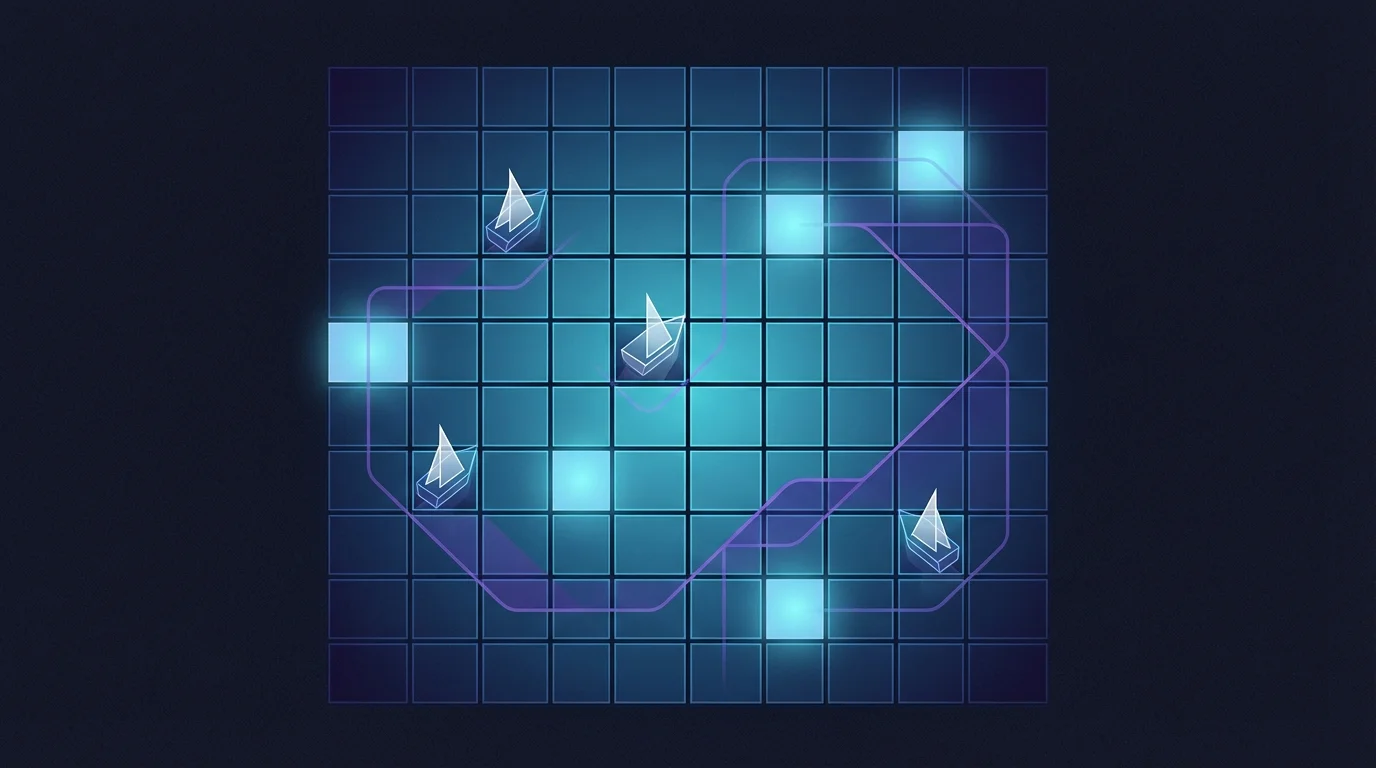
Most people approach Battleships like a treasure hunt--searching for ships. Master solvers flip this logic entirely. They hunt water.
This is the secret of Battleships: it is a game of negative space. Every ship you place creates a halo of water around it--a protective buffer where nothing else can exist. Every zero row floods with empty sea. The fleet does not hide randomly; it hides in the shrinking gaps between certainties. Fill enough water, and the ships have nowhere left to go. They reveal themselves not because you found them, but because you eliminated everywhere else they could be.
That "0" in the row clue? A gift--ten cells of guaranteed water, handed to you before you even start thinking. That column labeled "6" in a 6-cell space? Ships wall-to-wall, no deduction required. Once you learn to see Battleships through this lens, the puzzle transforms from guesswork into a satisfying cascade of logical certainty.
Watch the Tutorial
New to Battleships? This tutorial covers the fundamentals.
Prerequisites: This guide assumes you know the basic rules: ships cannot touch (not even diagonally), and row/column numbers tell you exactly how many ship cells belong in each line. New to Battleships? Start with the puzzle page to learn by playing.
Know Your Fleet
Before you can hunt water effectively, you need to know exactly what is hiding in it. Every ship has a personality. The standard 10x10 Battleships puzzle uses this fleet:
| Ship | Size | Count | Total Cells |
|---|---|---|---|
| Battleship | 4 | 1 | 4 cells |
| Cruiser | 3 | 2 | 6 cells |
| Destroyer | 2 | 3 | 6 cells |
| Submarine | 1 | 4 | 4 cells |
| Total Ship Cells | 20 cells | ||
In a 10x10 grid of 100 cells, exactly 20 contain ships and 80 contain water. That means the sea dominates--80% of the grid is empty. This is why hunting water works: you are filling in the majority of the puzzle, and the ships are just what is left over.
The battleship is the queen of constraints--all four cells of her demanding attention and space. The submarines are stowaways who wait for the chaos to settle, slotting into the final gaps when larger ships have staked their claims. Understanding these personalities helps you prioritize: hunt the queen early, let the stowaways reveal themselves late.
Strategy 1: Zero Rows and Columns--The Gift of Empty Seas
The most powerful opening move in Battleships is also the simplest: any row or column with a clue of "0" contains no ships whatsoever. Fill every cell with water immediately. These are gift rows--free information requiring zero deduction.
This sounds trivial, but it is transformative. A single zero row eliminates 10 cells in one stroke--that is 10% of the entire puzzle solved before you draw your first ship. Two zeros? Twenty cells gone. More importantly, these zero barriers slice through the grid, constraining where ships can fit elsewhere. A horizontal zero row means no ship can span across it vertically. The ripple effects are enormous.
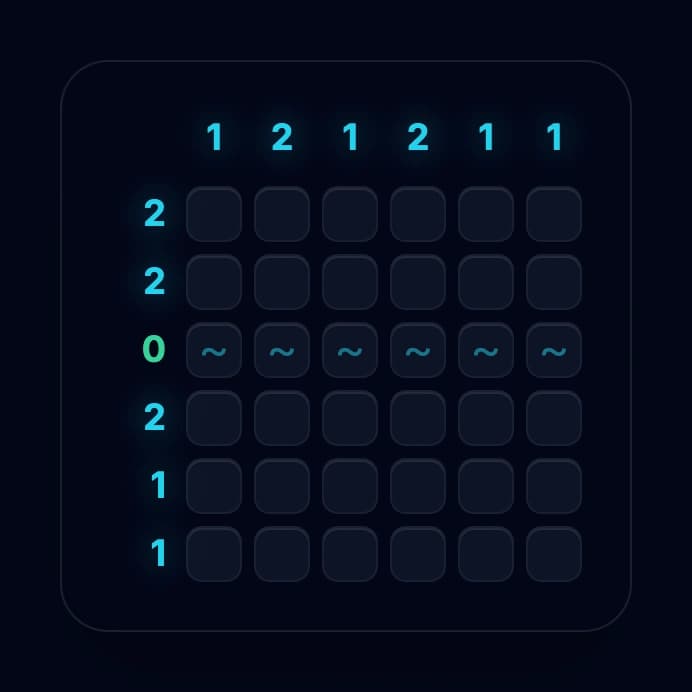
Row clue = 0: Ten cells of free information. Fill with water and move on.
Solver's Habit: Always scan for zeros first. They are free information--guaranteed water that requires zero deduction. Mark them immediately, then enjoy the dopamine hit of a puzzle that is already 10-20% smaller.
Strategy 2: Maximum Count Rows--When Every Cell is a Ship
If zero rows are empty seas, maximum count rows are packed harbors. When a row or column clue equals the number of available cells, every single cell must be a ship. The math leaves no room for water.
If a row needs 4 ships and only has 4 cells remaining (after you have marked water elsewhere), those 4 cells are all ships. No exceptions. The math is absolute. This is the opposite of hunting water--it is finding steel by eliminating everywhere the water could be.
Watch for this pattern as you progress through a puzzle. Early zeros and water propagation from ship placement often reduce rows until clue equals capacity--and suddenly, the entire row clicks into place. It is one of the most satisfying moments in Battleships: the chain reaction of constraints collapsing into certainty.
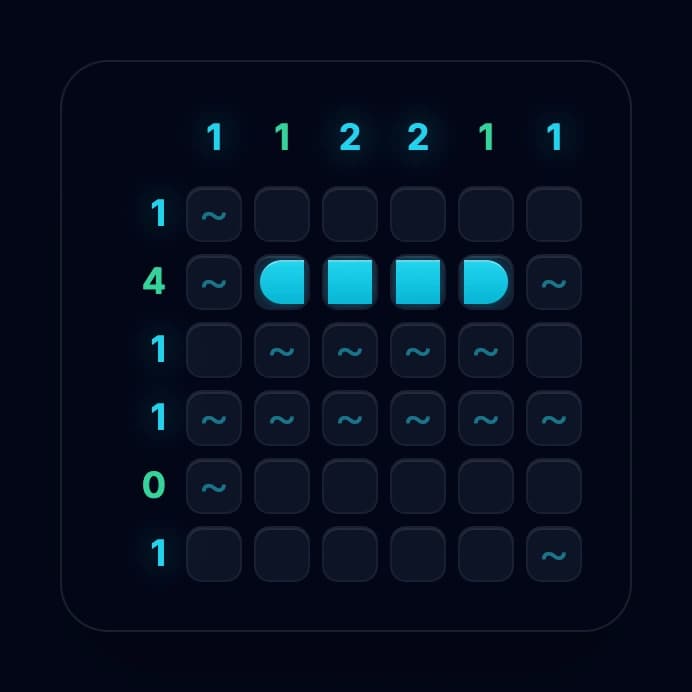
Clue equals empty cells: No room for water, every cell is steel.
Strategy 3: The Battleship Fit Test--Finding the Queen
Now that you understand how zeros and maximums work, let us talk about the most important ship in your fleet. The battleship--all 4 cells of her--is the queen of constraints. At any moment, ask yourself: "Where can the battleship possibly fit?"
She is demanding. This magnificent 4-cell vessel needs four consecutive horizontal or vertical cells, with water buffers on all sides. She cannot squeeze into tight corners or broken gaps. As you mark water and place smaller ships, the number of valid battleship positions shrinks dramatically. Sometimes it shrinks to exactly one--and that is when you pounce.
The Elimination Process
- Scan each row: Can 4 consecutive empty cells fit here?
- Check each column: Same question, vertical orientation
- Remember the buffer: The battleship needs water on both ends too
- If only one location works--place it immediately
Finding the battleship early is a massive win. Her 4-cell length plus surrounding water buffer eliminates enormous portions of the grid. Place the queen, and her subjects fall into line.
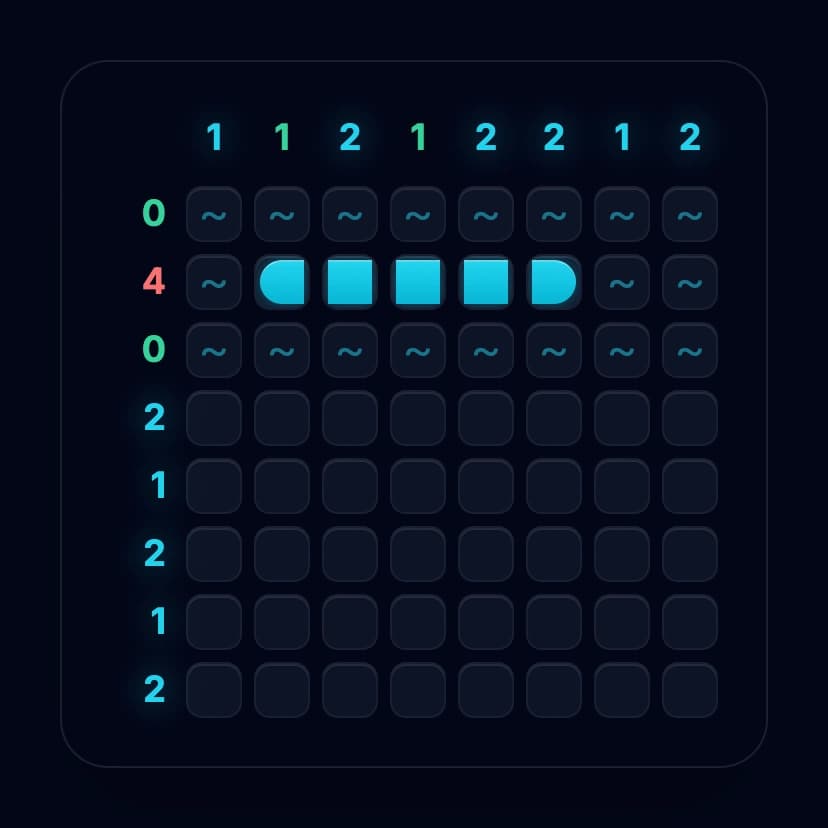
The queen has one throne: place her immediately.
Pro Tip: Do the same analysis for cruisers (3 cells) once the battleship is placed. Work down the fleet by size--larger ships are easier to constrain than smaller ones, and each placement makes the next one easier.
Strategy 4: Water Surrounds Ships--The Cascade Effect
Here is where the negative-space philosophy becomes a superpower. Every ship segment forces water in its diagonal neighbors. This is the no-touching rule in action, and exploiting it aggressively is what separates fast solvers from slow ones.
The moment you place any ship cell, mark all four diagonal neighbors as water. Do this immediately, every time, without exception. Think of it like dropping a stone in a pond--the ripples spread outward. Each ship placement triggers water, which constrains other placements, which triggers more water. Before you know it, half the grid fills itself.
Water Buffer Zones by Ship Type
| Ship Type | Ship Cells | Water Cells Created |
|---|---|---|
| Submarine | 1 | 8 (entire perimeter) |
| Destroyer | 2 | 10 |
| Cruiser | 3 | 12 |
| Battleship | 4 | 14 |
Notice how the battleship creates 14 water cells? That is 3.5 water cells per ship cell. Placing ships is simultaneously placing water--you are doing two jobs at once. This is why Battleships feels so satisfying when it clicks: every move does double duty, and the grid starts solving itself.
Try This: Quick Arithmetic Challenge
A row has clue 5. You have already placed 2 ship cells in that row. The row has 4 empty cells remaining.
- 1. How many more ship cells does this row need?
- 2. How many of the 4 empty cells are water?
Reveal Answer
The row needs 5 - 2 = 3 more ship cells. With 4 empty cells and 3 needed for ships, exactly 1 cell is water. Now check column clues for those 4 cells--one of them might already be satisfied, revealing which cell is the water.
Strategy 5: Ship Segment Identification--Reading the Clues
Many puzzles give you a head start with hint cells--ship segments already revealed. These are not random gifts; they are storytellers. Each segment type tells you exactly how to extend the ship. Learning to read them fluently accelerates your solve dramatically.
Round End (Ship Cap)
A rounded or pointed end is a ship saying "I stop here." Water goes on the capped side; the ship continues in the opposite direction. An end piece pointing left has water to its left and ship to its right. These are directional arrows pointing toward more steel.
Square Middle Segment
A square or flat-sided segment is a ship saying "I continue both ways." If it is horizontal, ship cells exist both left AND right. This guarantees at least a 3-cell ship--you are looking at a cruiser or the battleship, never a destroyer or submarine.
Dot (Submarine)
A dot or circle is a complete submarine--a 1-cell ship, alone in the sea. Surround it entirely with water (all 8 neighbors) and check it off your fleet list. One stowaway found, three more lurking somewhere.
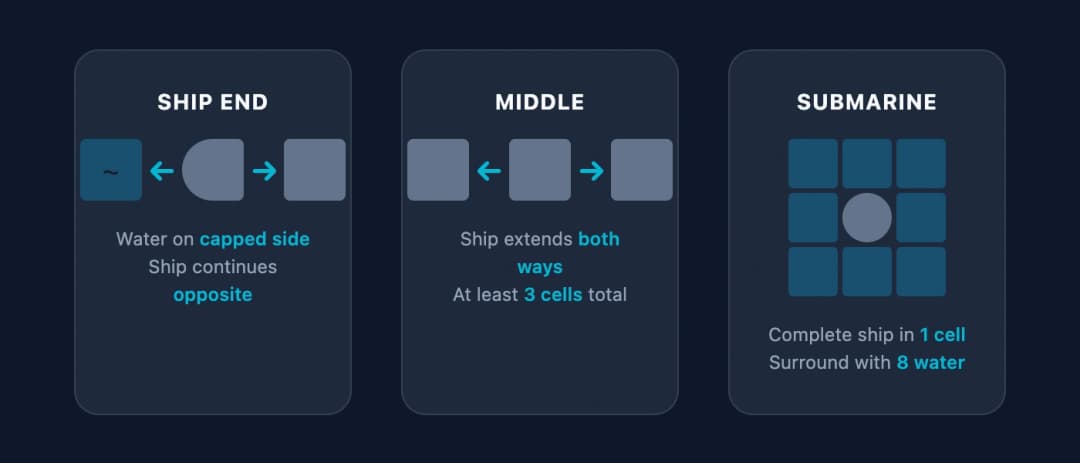
Every segment speaks. Caps say "stop", middles say "continue", dots say "done."
Strategy 6: Fleet Tracking--Know What You Are Hunting
As you place ships, it is easy to lose track of what remains. Keep a mental (or physical) checklist of ships as you find them. This discipline prevents two critical errors: accidentally "finding" ships that do not exist in your fleet, and overlooking ships you still need to place.
Fleet Checklist:
- [ ] Battleship (4 cells)
- [ ] Cruiser #1 (3 cells)
- [ ] Cruiser #2 (3 cells)
- [ ] Destroyer #1 (2 cells)
- [ ] Destroyer #2 (2 cells)
- [ ] Destroyer #3 (2 cells)
- [ ] Submarine #1 (1 cell)
- [ ] Submarine #2 (1 cell)
- [ ] Submarine #3 (1 cell)
- [ ] Submarine #4 (1 cell)
When you identify a complete ship--meaning both ends are capped--check it off. When you see three consecutive cells with the clue satisfied, you have found a cruiser. Mark it. This discipline prevents the frustrating late-puzzle realization that you have placed an impossible fleet.
Strategy 7: Row/Column Arithmetic--The Numbers Never Lie
This is the bread and butter of intermediate solving, and it connects directly to our negative-space philosophy. Count placed ship segments versus the row/column clue to find remaining ships needed--then figure out where the water must go.
If a row is labeled "5" and you have already placed 3 ship cells, that row needs exactly 2 more. If only 2 empty cells remain in that row--they must both be ships. Fill them in. If 4 empty cells remain, you know 2 are ships and 2 are water. Now cross-reference with column clues to figure out which is which.
The Arithmetic Process
- Note the row/column clue (ships needed)
- Count already-placed ship cells in that line
- Subtract: clue minus placed equals remaining needed
- Count empty cells in the line
- If empty equals remaining--all empties are ships
- If empty equals remaining plus known water needed--use other constraints
Example: Row clue is 4. You have placed 2 ship cells. Remaining needed: 2. Empty cells in row: 3. One cell is water, two are ships. Now look at column clues for those 3 cells--often one column is already satisfied (meaning water) or needs ships (meaning ship).
Strategy 8: The "Only Fit" Technique--Forcing Placements
Sometimes the constraints tighten so much that a ship can only fit in one location. When this happens, place it immediately--no hesitation, no second-guessing. This sounds obvious, but systematically checking for "only fit" scenarios is a powerful habit that separates methodical solvers from frustrated ones.
Worked Example
You have placed the battleship and both cruisers. You still need 3 destroyers (2-cell ships). Looking at the grid, you find:
- Row 2 has exactly 2 consecutive empty cells, needs exactly 2 ships
- Column constraints confirm both cells can be ships
- No other 2-cell gap exists in row 2
That is a forced destroyer. Place it, mark surrounding water, update your fleet checklist. The "only fit" technique cascades--each placement creates new constraints that may force another ship.
Strategy 9: Endgame Submarine Hunt--Catching the Stowaways
Remember those stowaways we mentioned? Submarines--the four 1-cell ships--are often the last pieces placed, and that is exactly as it should be. Because they are tiny and create no directional constraints, they are nearly impossible to pin down early. Do not waste time hunting them. Let the chaos settle first.
By endgame, the grid is mostly filled. Rows and columns that still need ships have very few empty cells. The stowaways have nowhere left to hide--they slot into the remaining gaps almost automatically.
Submarine Hunting Technique
- Count how many submarines remain (start with 4)
- Find rows/columns still needing exactly 1 ship
- In those lines, identify isolated empty cells (no adjacent empty cells)
- Isolated cells needing a ship are submarines
- If a cell is adjacent to another empty cell, it might be part of a larger ship--check constraints
When you place a submarine, remember to surround it with water. In the endgame, this often completes multiple rows and columns simultaneously--a satisfying domino effect that signals you are close to victory.
Common Mistakes to Avoid
Even experienced solvers fall into these traps. Knowing them helps you avoid frustrating dead ends.
Forgetting Diagonal Water
The most common error: placing a ship cell and forgetting to mark its diagonal neighbors as water. This leads to invalid configurations later when you accidentally place ships that touch diagonally. Make diagonal water marking an automatic habit--do it the instant you place any ship cell.
Losing Track of Fleet Composition
Mid-puzzle, you find three consecutive ship cells and think "cruiser!" But wait--have you already placed both cruisers? If so, those three cells must be part of the battleship, meaning a fourth cell exists somewhere. Always know what ships remain in your fleet before making assumptions.
Hunting Submarines Too Early
Submarines are seductive because they are simple--just one cell. But they are nearly impossible to place with confidence early in a puzzle. Resist the urge to guess at submarine locations. Place the larger ships first, let the grid fill with water, and the submarines will reveal themselves in the endgame.
Putting It All Together: A Solving Framework
Here is how to approach any Battleships puzzle systematically:
Phase 1: Opening Moves
Mark all zero rows and columns as water. Read any hint cells and mark their forced water (diagonals, capped ends). Calculate total ship cells needed versus placed to orient yourself.
Phase 2: Large Ship Hunting
Apply the battleship fit test. Where can 4 consecutive cells exist? If only one location works, place it. Repeat for cruisers (3 cells). Large ships constrain the puzzle most.
Phase 3: Arithmetic Sweep
For each row and column, calculate: clue minus placed equals remaining. When remaining equals empty cells, fill them all with ships. When a row or column is satisfied, fill remaining empties with water.
Phase 4: Cascade and Complete
Each placement triggers water. Water triggers new "maximum count" rows. New ships trigger more water. Ride this cascade. Hunt remaining destroyers and submarines with the "only fit" technique.
Quick Reference: Key Patterns
| Pattern | Action |
|---|---|
| Row/Column clue = 0 | All cells are water |
| Clue = remaining empty cells | All empty cells are ships |
| Ship end revealed | Water on capped side, ship continues opposite |
| Middle segment revealed | Ship extends both directions along axis |
| Submarine (dot) revealed | Surround with water (all 8 cells) |
| 3 consecutive ships, clue = 3 | Cap both ends with water (it is a cruiser) |
| Only one location for battleship | Place it immediately |
From Hunter to Master
Battleships rewards systematic thinking. The fleet is not hiding randomly--it is constrained by arithmetic, geometry, and the no-touching rule. Every clue is a gift. Every placed ship is a cascade of information. Every cell of water narrows the possibilities.
The strategies in this guide will transform your solving from hesitant searching to confident deduction. Zero rows become instant wins. Maximum count rows become obvious. The battleship fit test becomes second nature. Water propagation becomes automatic. And those submarines? They stop being elusive and start being inevitable.
Remember where we started: most people search for ships. You now know to hunt water instead. Fill the sea, and the fleet has nowhere left to hide. The ships do not reveal themselves because you found them--they reveal themselves because you eliminated everywhere else they could possibly be.
The water is closing in. The fleet is out of options. Start hunting.