Sudoku Strategies:
Essential Techniques Beyond the Basics
You have been staring at the same grid for ten minutes. Every cell has three candidates. Nothing works. You scan the rows again. The columns. The boxes. Nothing. The puzzle sits there, smugly unsolved, daring you to guess.
Do not guess.
Every stuck Sudoku puzzle is a locked door. Behind it: the solution. The key? One of perhaps a dozen techniques, each designed for a specific type of lock. Naked pairs crack one kind. X-wings crack another. The solver who knows only scanning will bang against that door forever. The solver who carries the full keyring? Every door opens. Every puzzle falls. No guessing required—just the right technique at the right moment.
Watch the Tutorial
Prefer watching? This quick tutorial covers the fundamentals of Sudoku solving.
Prerequisites
This guide builds on concepts from our beginner's guide—understanding Sudoku rules, using pencil marks, and basic scanning. If any of these feel unfamiliar, start there first.
Which Technique Should You Try Next?
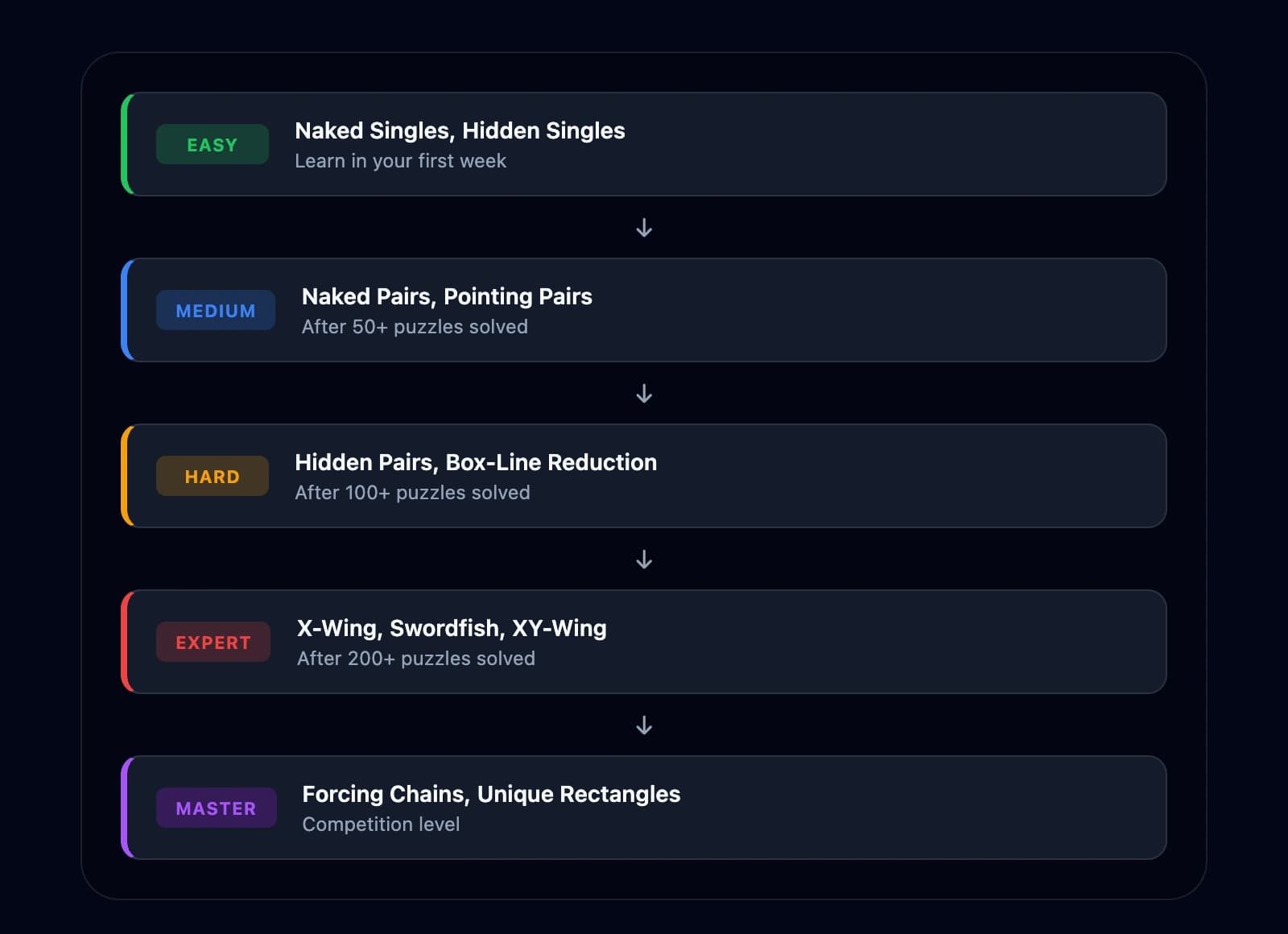
Advanced solving is not about searching for every named pattern at once. Work from the cheapest deduction to the most expensive, and move down this ladder only when the earlier checks produce no placement or elimination.
After any successful elimination, return to the top of the ladder. Difficult puzzles often collapse into singles once one advanced pattern removes the right candidate.
The Foundation: Thinking in Candidates
Before we explore advanced techniques, we need to shift how we think about Sudoku. Beginners see empty cells. Advanced solvers see candidates.
Every empty cell has a set of possible values—digits that could legally go there based on current constraints. These candidates are the raw material for every advanced technique.
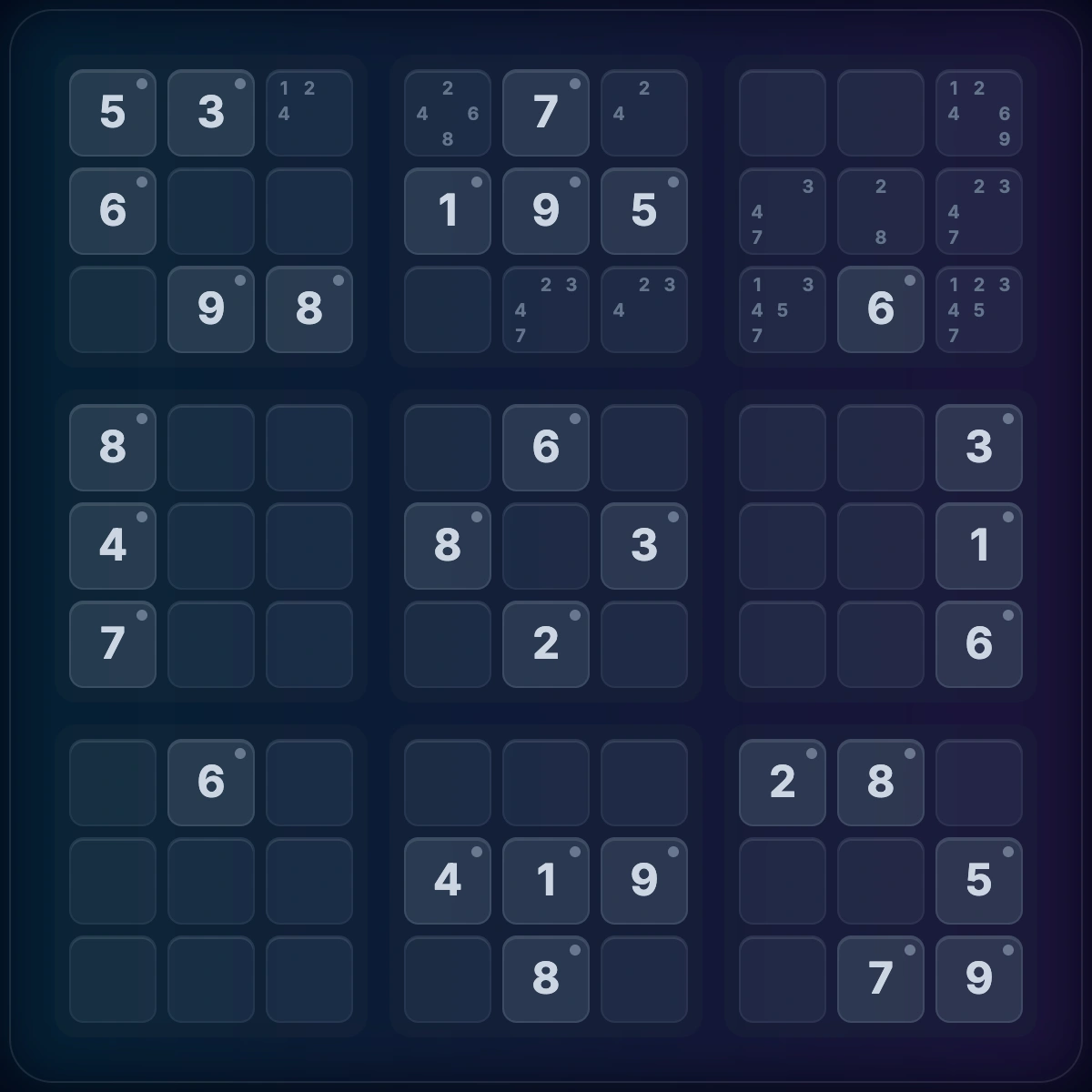
Pencil marks reveal the candidates—the only values each cell could possibly contain.
The fundamental insight: every technique either places a digit or eliminates a candidate. Placements feel more satisfying, but eliminations are often more powerful. Remove the right candidate, and a cascade of placements follows.
Quick-Reference Cheat Sheet
Candidate Notation
- Pencil marks = possible values
- Elimination = removing a candidate
- Placement = setting final value
- Unit = any row, column, or box
Key Insight
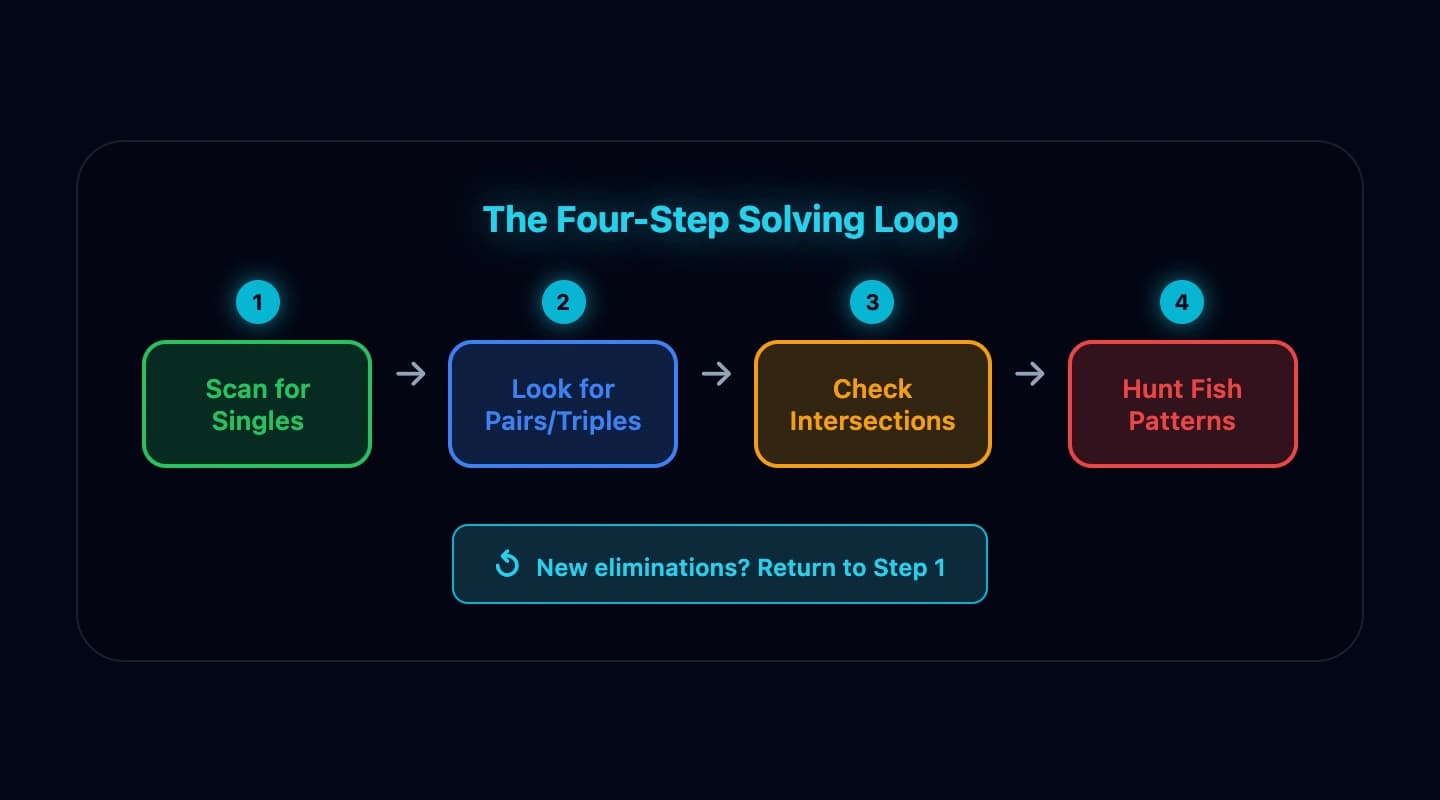
After each placement, return to Step 1. Eliminations often create new singles.
Technique 1: Naked Singles
The naked single is the simplest technique and the foundation of all Sudoku solving. A cell has a naked single when only one candidate remains after considering all constraints.
How It Works
Check a cell's row, column, and box. Cross off every digit that already appears in any of these three units. If only one digit survives, place it.
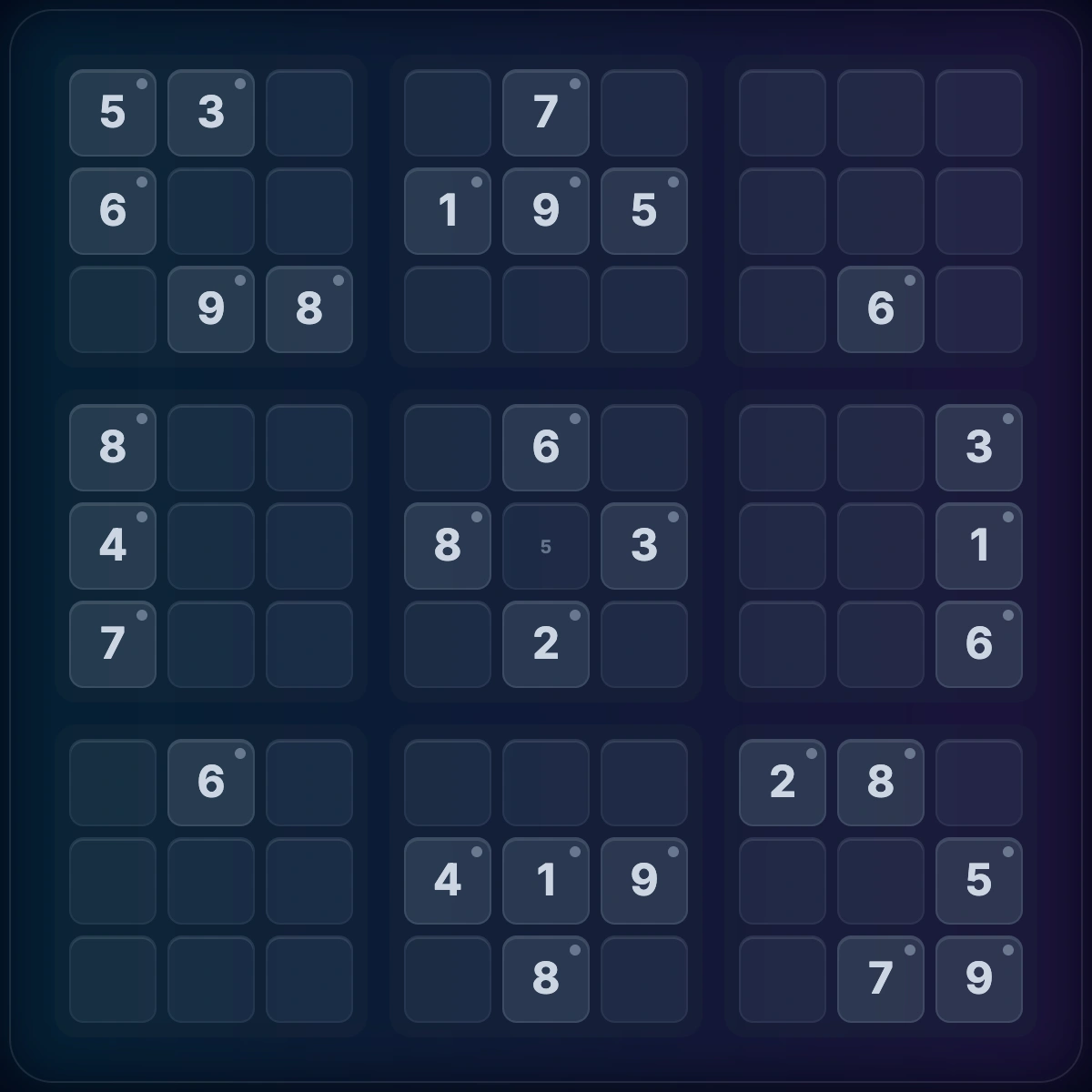
The center cell has only one possible value after checking row, column, and box constraints.
The Cascade Effect
A common breakthrough moment: placing a 7 in the corner forces a 3 in the adjacent cell, which completes a row revealing a 9, which forces a 1, and suddenly half the puzzle fills itself. A chain of seven placements from one initial deduction—that is the cascade effect, and it is what makes singles so powerful.
Practice this technique: Try our Easy Sudoku puzzles to build speed with naked singles before moving to more advanced techniques.
Technique 2: Hidden Singles
While naked singles ask "what can go in this cell?", hidden singles ask "where can this digit go?" It is the same logic from the opposite direction.
How It Works
Pick a digit (say, 7) and examine a row, column, or box. Find all cells where 7 could potentially go. If only one cell can accept 7, place it there—even if that cell has other candidates.
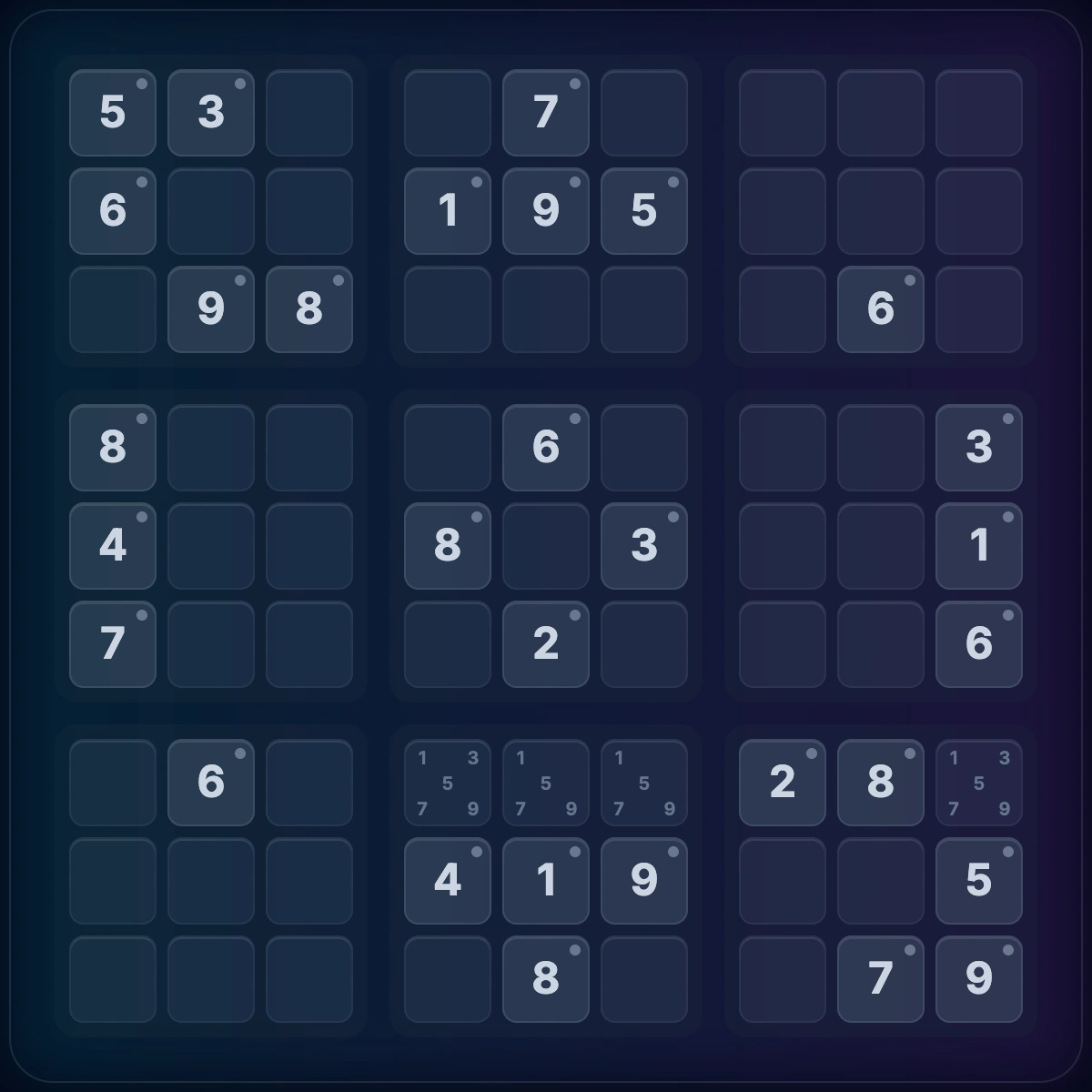
The digit is "hidden" among other candidates, but it has nowhere else to go in this box.
Why Hidden Singles Matter: Hidden singles often unlock puzzles where naked singles stall. You might stare at a cell with five candidates thinking "I cannot place anything here"—but one of those candidates has nowhere else to go in its row.
Systematic Scanning: Develop a rhythm: for each box, mentally check digits 1 through 9. "Where can 1 go? Multiple places. Where can 2 go? Multiple places. Where can 3 go? Only here!"
Technique 3: Naked Pairs
Here is where Sudoku gets interesting. Naked pairs do not place digits directly—they eliminate candidates, setting up future placements.
How It Works
A naked pair occurs when two cells in the same unit (row, column, or box) contain exactly the same two candidates and no others.
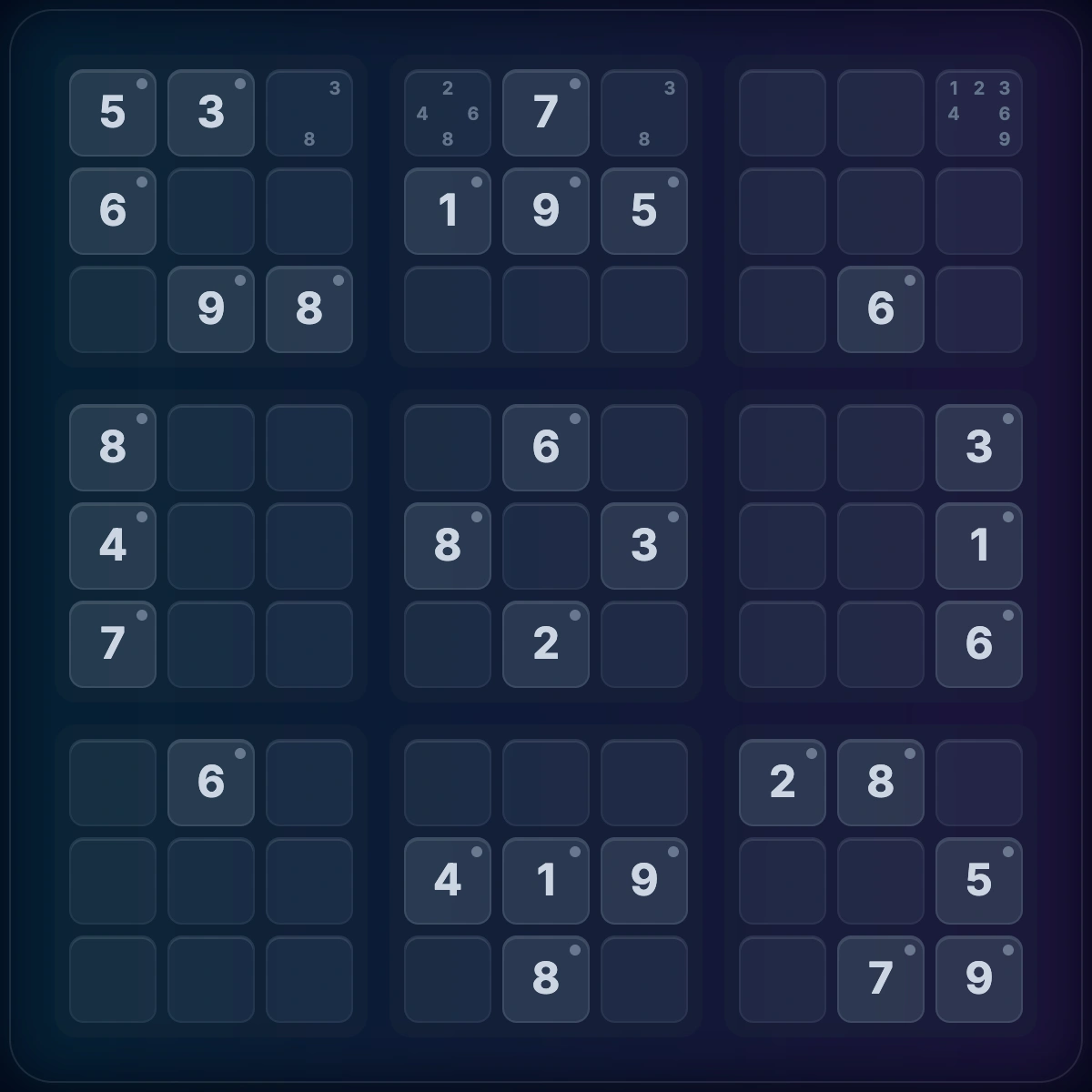
Two cells in this row contain only {3, 8}—a locked pair that claims both digits.
The Logic
Two cells. Two digits. A locked pair.
We do not know which cell gets 3 and which gets 8, but we know for certain: those two cells WILL contain 3 and 8. Therefore, NO other cell in that row can be 3 or 8.
The elimination: Remove 3 and 8 from the candidates of every other cell in the row.
Naked Triples: The same logic extends to three cells. If three cells in a unit contain only candidates from a set of three digits, those three digits are claimed by those cells.
Practice this technique: Our Medium Sudoku puzzles frequently require naked pairs to solve.
Technique 4: Hidden Pairs
Hidden pairs are the inverse of naked pairs. Where naked pairs are obvious (cells with only two candidates), hidden pairs are disguised among other candidates.
How It Works
A hidden pair exists when two candidates appear in exactly two cells within a unit—even if those cells have other candidates too.
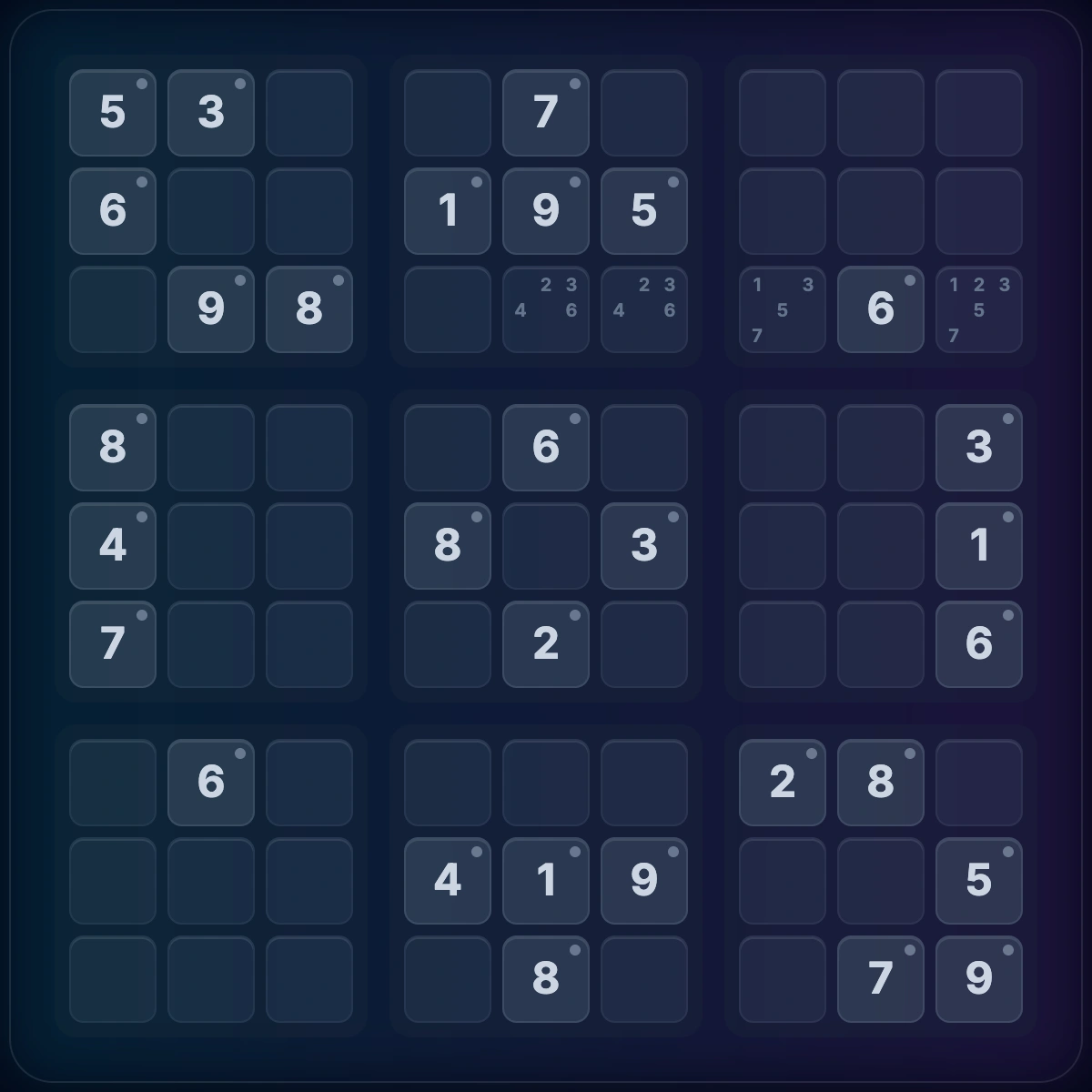
Digits 4 and 6 can only appear in exactly two cells—a hidden pair. Remove other candidates from those cells.
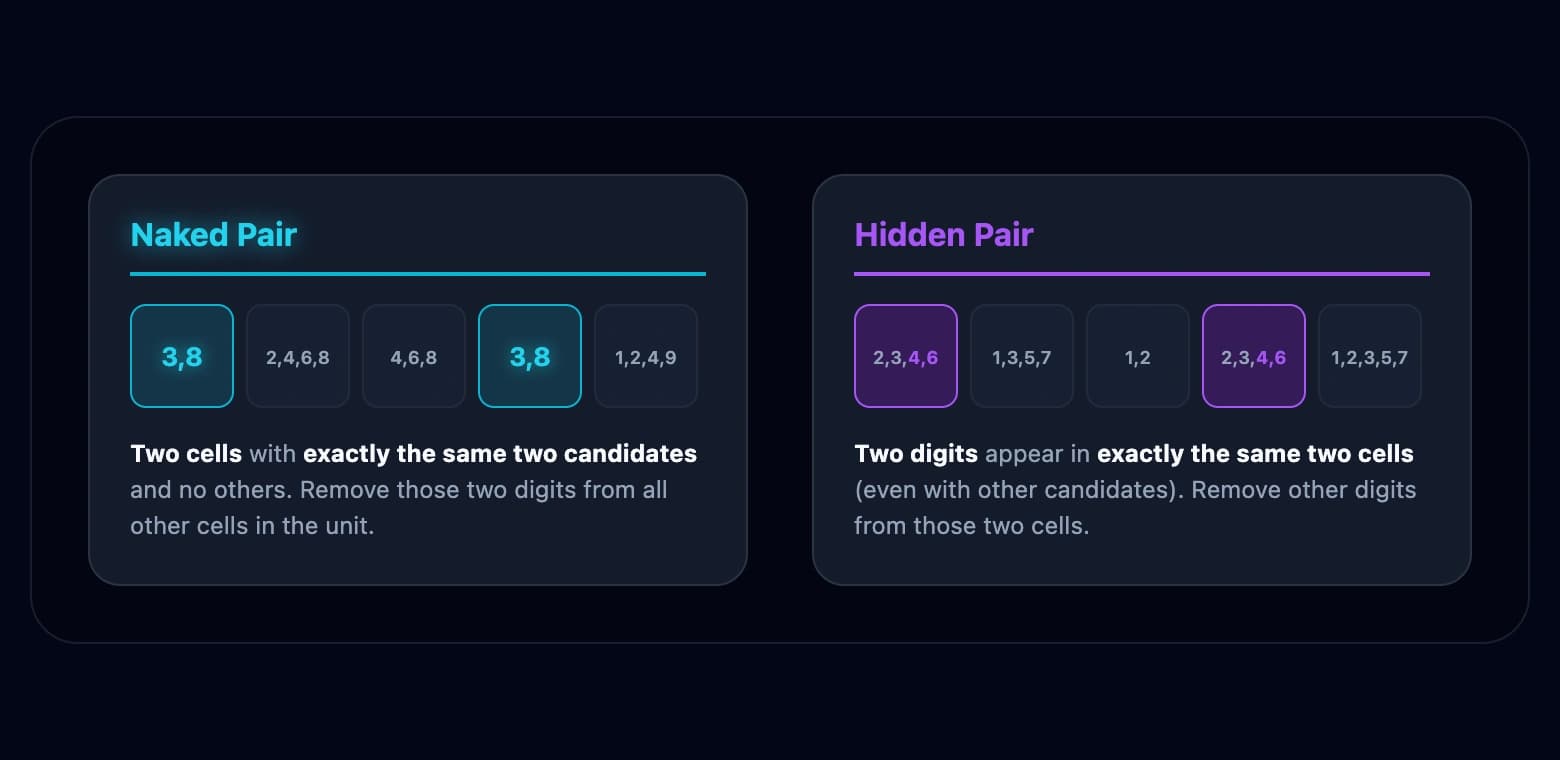
Naked pairs: focus on the cells. Hidden pairs: focus on the digits.
Hidden pairs are easy to overlook. A pair of 1 and 7 in column 3, where both digits can only appear in rows 2 and 8, is all it takes. Eliminating the other candidates from those two cells can crack a stalled puzzle wide open.
Technique 5: Pointing Pairs
Pointing pairs bridge the gap between boxes and lines. They use box constraints to eliminate candidates from rows or columns.
How It Works
When a candidate within a box is restricted to a single row (or column), that candidate can be eliminated from that row (or column) outside the box.
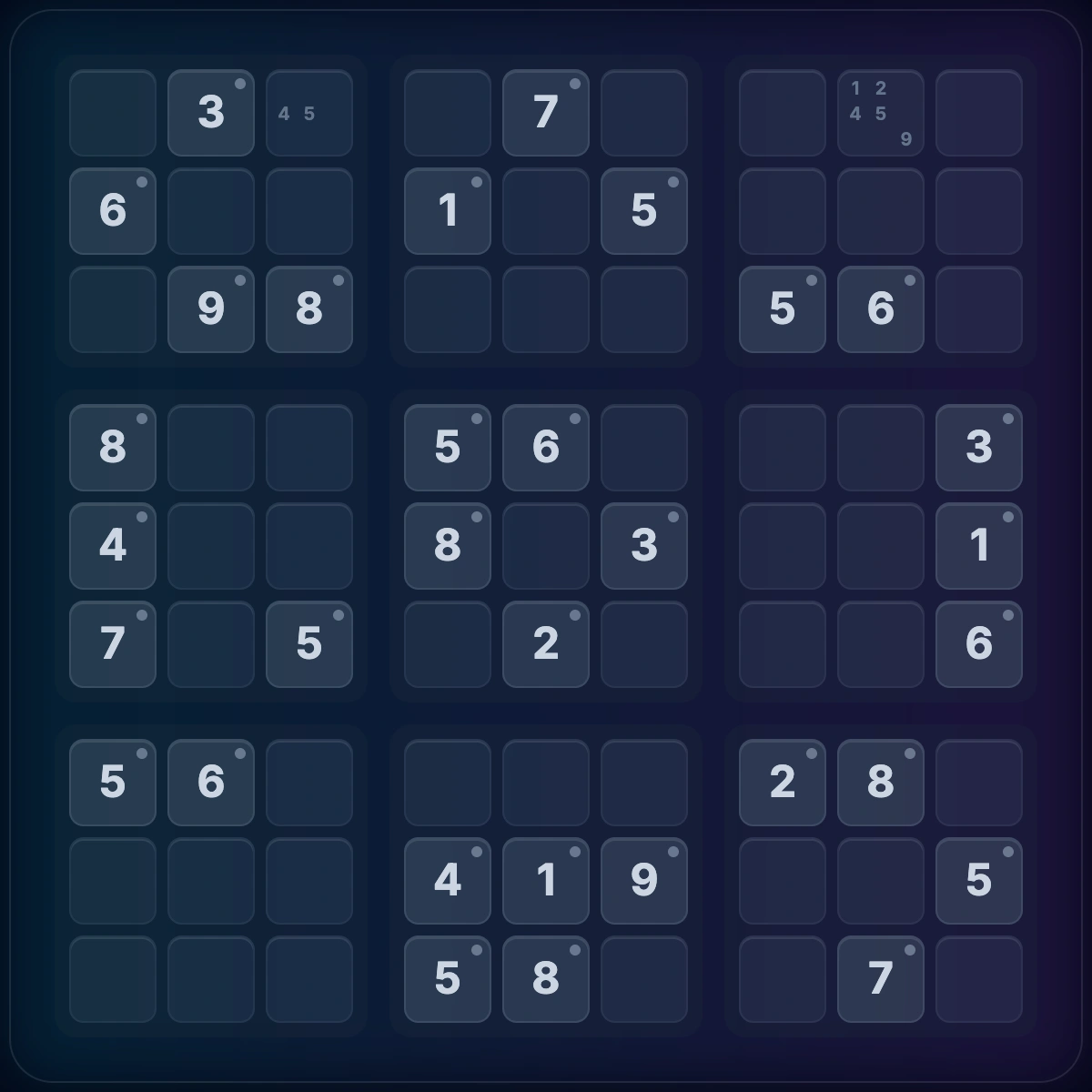
The digit 5 in Box 1 can only go in row 1—eliminate 5 from row 1 cells outside this box.
The Logic
A pointing pair says: "The box claims this digit for this line." Since Box 1 must contain a 5, and that 5 must be in row 1, we know row 1's 5 is somewhere in Box 1. Therefore, 5 cannot appear anywhere else in row 1.
Pointing pairs are one of the most commonly overlooked techniques. When progress stalls, a methodical check of every box for pointing pairs is one of the most productive things a solver can do. More often than not, there is one waiting.
Technique 6: Box-Line Reduction
Box-line reduction is the reverse of pointing pairs. Instead of a box pointing to a line, a line restricts a box.
How It Works
When a candidate within a row (or column) is confined to a single box, that candidate can be eliminated from other cells in that box.
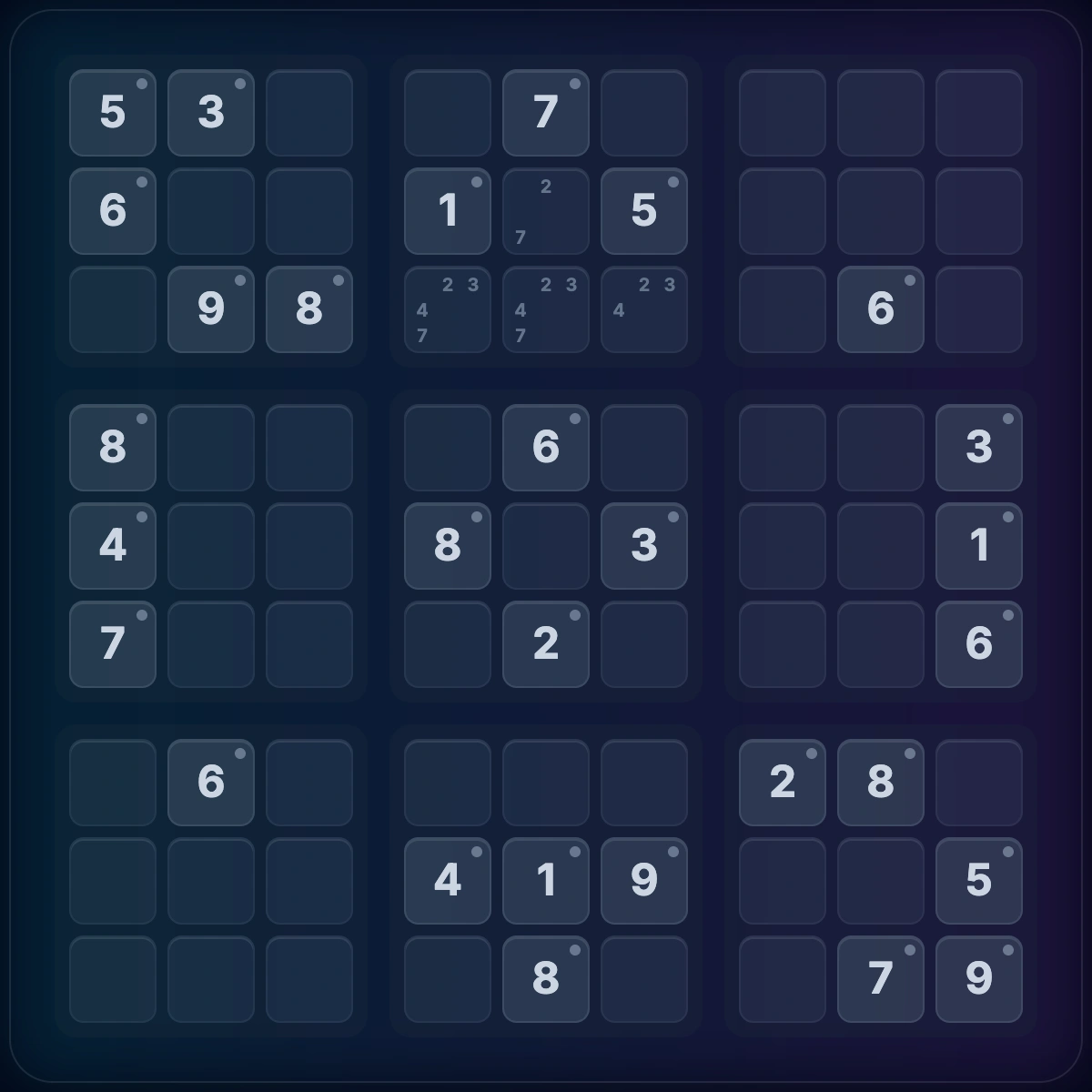
The digit 7 in row 2 can only go in Box 2—eliminate 7 from other cells in Box 2.
Pointing Pairs vs. Box-Line Reduction
Box restricts line
(eliminate from line outside box)
Line restricts box
(eliminate from box outside line)
Practice these techniques: Our Hard Sudoku puzzles are designed to require pointing pairs and box-line reduction.
Pattern-Based Techniques: Fish Patterns
The techniques above focus on individual units—rows, columns, and boxes examined one at a time. Now we move to pattern-based techniques that span multiple rows and columns simultaneously.
These techniques are called "fish patterns" because their visual shapes resemble aquatic creatures when drawn on a grid. Fish patterns are rarer but powerful—when you spot one, it often breaks open a puzzle that seemed completely stuck.
Technique 7: X-Wing
X-wings are elegant, powerful, and surprisingly common in Hard and Expert puzzles.
How It Works
An X-wing forms when a candidate appears in exactly two cells in each of two different rows, AND those cells align in the same two columns.
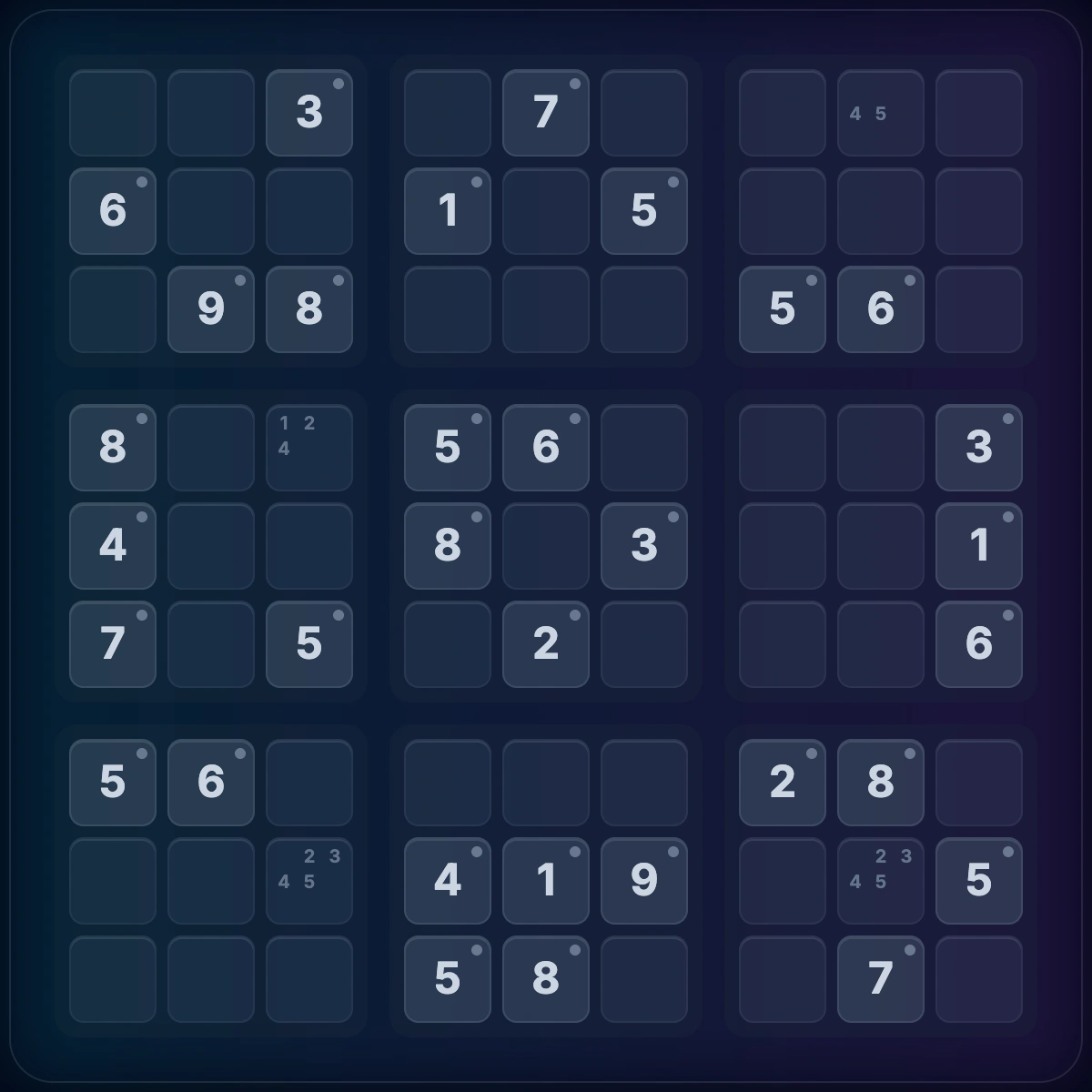
X-Wing pattern: digit 5 forms a rectangle at the intersection of rows 1,8 and columns 3,8.
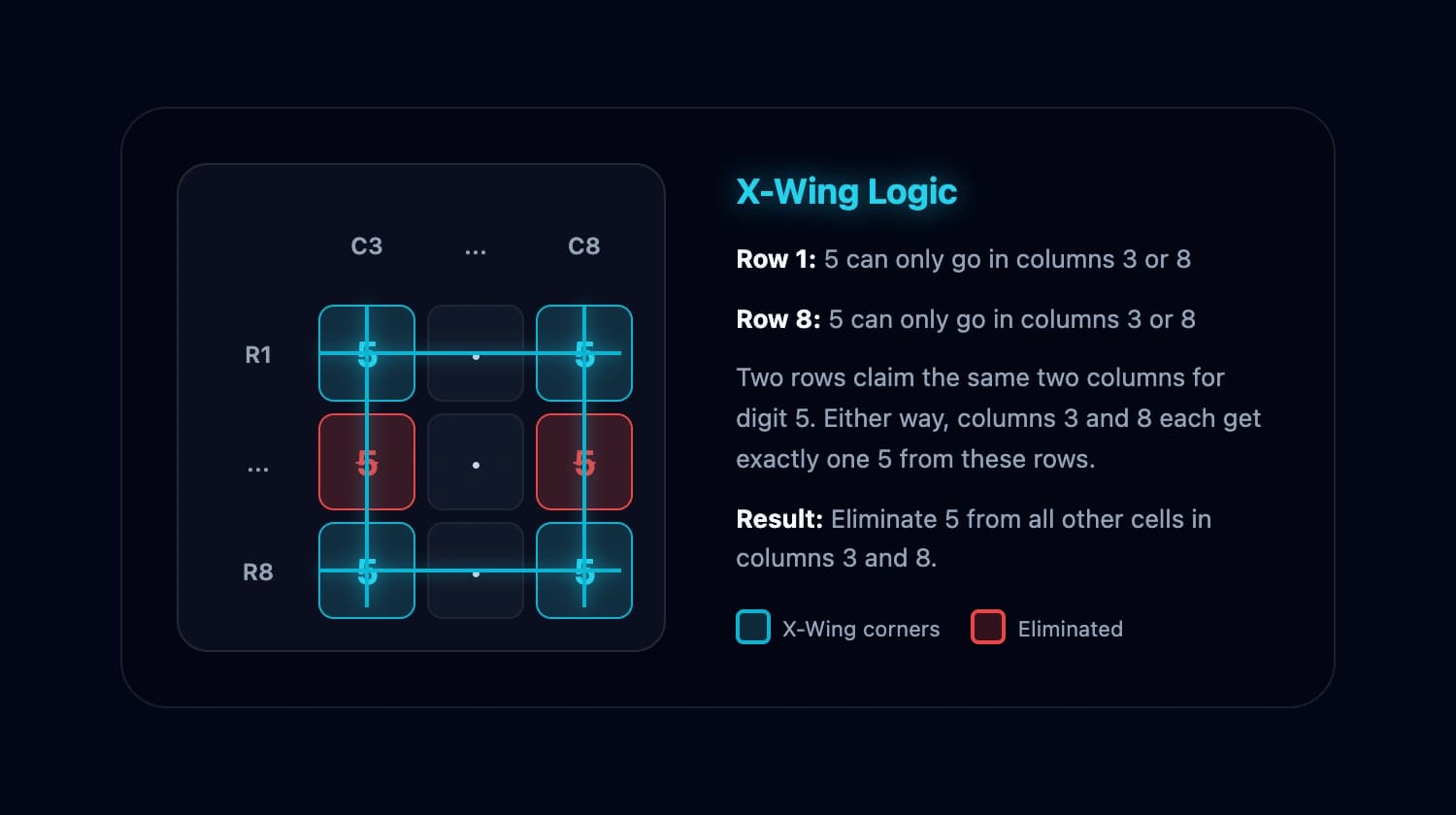
The X-Wing guarantees: columns 3 and 8 each receive exactly one 5 from these rows.
Spotting a first X-wing is a milestone for any solver. A 9 appearing only in columns 1 and 6 of rows 3 and 7 allows four 9s to be eliminated from those columns, often triggering a chain reaction that solves several cells at once. It shifts how you see the grid—not as isolated cells, but as interconnected patterns waiting to emerge.
Technique 8: Swordfish
Swordfish extends the X-wing concept from two rows to three. It is rarer but devastating when found.
How It Works
A swordfish occurs when a candidate appears in two or three cells in each of three rows, AND all those cells fall within the same three columns.
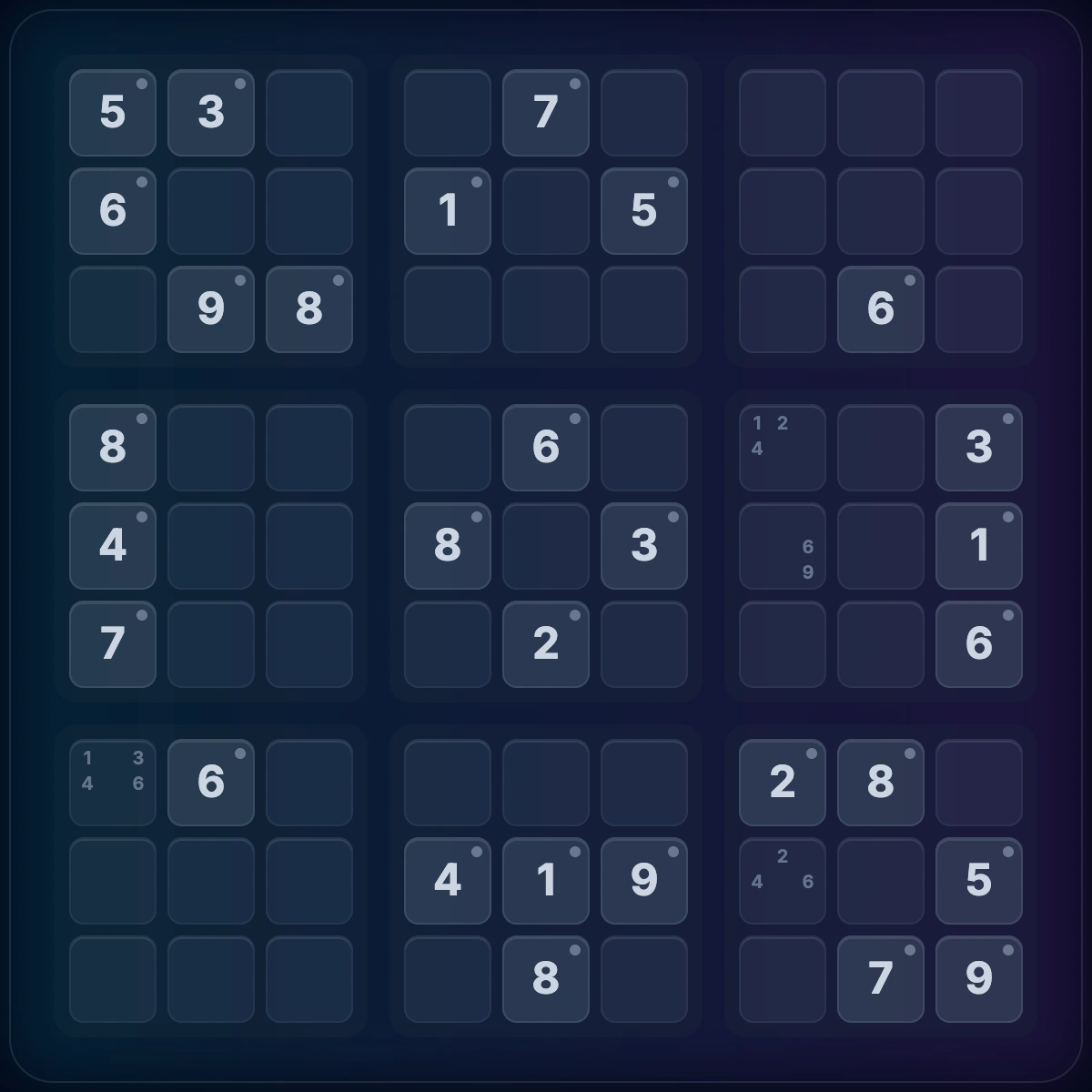
Swordfish pattern: digit 6 in rows 2, 5, 8 is confined to columns 1, 4, 7.
Why Swordfish Is Harder to Spot
Unlike X-wings, which form a perfect rectangle, swordfish patterns are irregular. Not every row needs a candidate in every column. The key is to focus on the column constraint: if three rows have their candidates confined to just three columns, you have a swordfish regardless of the exact cell distribution.
Swordfish patterns are rare enough that finding one feels like a genuine accomplishment. Most puzzles will never require one. But on an Expert grid where every other technique has stalled, spotting that irregular three-row pattern forming across three columns is one of the most satisfying deductions in Sudoku.
Practice fish patterns: Our Expert Sudoku puzzles are designed to require X-wings and occasionally swordfish.
Putting It Together: A Complete Solving Strategy
Techniques in isolation are helpful. Techniques combined into a systematic approach are transformative.
The Difficulty Ladder
Easy puzzles
Naked singles and hidden singles are sufficient. You should never need anything more advanced.
Medium puzzles
Add naked pairs and pointing pairs. Most medium puzzles yield to these four techniques.
Hard puzzles
Hidden pairs and box-line reduction become essential. X-wings occasionally appear.
Expert puzzles
X-wings are common, swordfish appear regularly. You may need XY-wing, unique rectangles, and coloring techniques.
When You Are Stuck
Stuck despite using all techniques? Before assuming the puzzle requires methods beyond your current skill:
Many solvers have spent thirty minutes stuck on an Expert puzzle, convinced they need chains or uniqueness techniques, only to find a hidden pair hiding in plain sight. The lesson: thoroughness beats complexity. Recheck your basic techniques before reaching for advanced ones.
Practice Roadmap
Building technique fluency requires deliberate practice. Here is your progression plan:
Week 1-2: Singles Mastery
Solve Easy and Medium puzzles focusing exclusively on singles. Mark every candidate before placing anything. Track how often you miss hidden singles on first scan.
Week 3-4: Pairs and Intersections
Graduate to Medium and Hard puzzles. Before placing any digit, scan every row, column, and box for naked pairs. Check each box for pointing pairs.
Week 5-6: Fish Patterns
Move to Hard and Expert puzzles. After exhausting singles and pairs, for each candidate, find rows with only 2-3 possible cells. Check if any two rows share the same two columns (X-wing).
Ongoing: Speed and Recognition
Time yourself. Track improvement. The goal is not just technique knowledge but pattern recognition—seeing X-wings without consciously searching, spotting hidden pairs at a glance.
The No-Guessing Guarantee
Here is the beautiful truth about Sudoku: every published puzzle from a reputable source is solvable through pure logic. No guessing. No trial and error. No "let me try a 5 here and see what happens."
If you find yourself wanting to guess, you have missed something. A technique you have not applied. A pattern you have not seen. A candidate that should have been eliminated.
Guessing is admitting defeat. Logic is the victory.
The solver who has mastered the full toolkit—who knows when to use naked pairs versus hidden pairs, who spots X-wings without searching, who instinctively checks intersections—that solver handles every challenge. Every puzzle falls. Pure logic, pure satisfaction.
Your Practice Path
Start with Medium puzzles if you are new to pairs and intersections. Focus on finding one naked pair per puzzle.
Progress to Hard puzzles once pairs feel automatic. This is where box-line reduction becomes essential.
Challenge yourself with Expert puzzles when you want to hunt for X-wings. Finding your first X-wing in the wild is a milestone—celebrate it.
The puzzles are waiting. You now have the techniques.
Ready to Put These Techniques to Work?
The techniques are in your head. The patterns are waiting to emerge. All that's left is to feel the cascade flow through an entire grid.
Start Solving SudokuPut it into practice
Ready to solve Sudoku?
Open a free puzzle and turn the ideas from this guide into your next solve.