Sliding Puzzle:
A Complete Beginner's Guide to Tile Arrangement
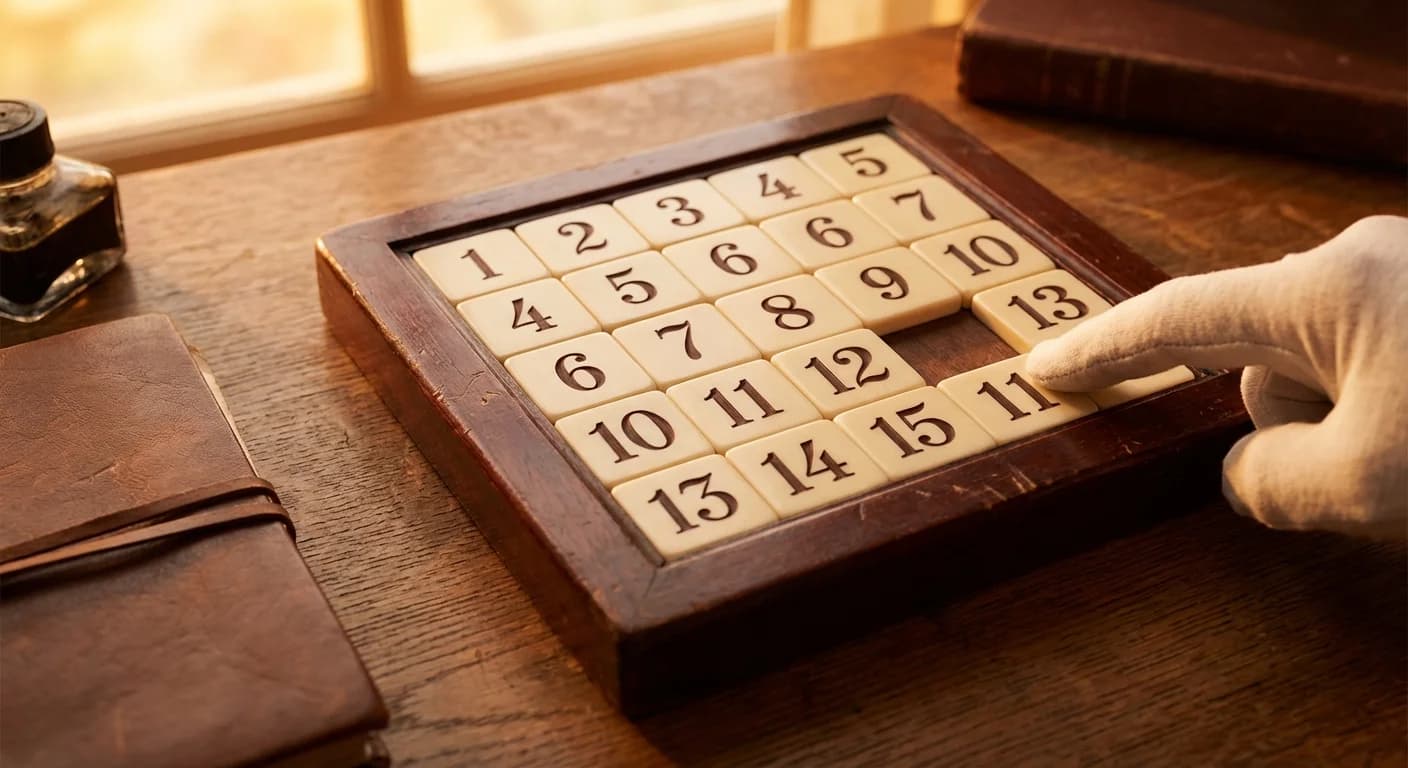
In 1880, America went absolutely mad for a puzzle. Newspapers ran articles about it. Employers complained workers could not focus. Ship captains banned it from vessels because sailors neglected their duties.
The cause of this nationwide obsession? A simple wooden tray containing 15 numbered tiles and one empty space.
The Sliding Puzzle—also known as the 15 Puzzle, the Gem Puzzle, or the Boss Puzzle—is one of the oldest and most enduring mechanical puzzles ever created. Invented in 1874, it predates Rubik's Cube by a full century. Yet its appeal remains undiminished: the satisfying click of tiles sliding into place, the gradual emergence of order from chaos, the triumphant moment when that final piece slots home.
The concept is beautifully simple: slide tiles around until they are in numerical order. No rotating, no lifting, no tricks—just sliding tiles into the empty space, one move at a time. Yet that simplicity conceals surprising depth. Solving a scrambled puzzle requires strategy, spatial reasoning, and patience.
The rules take thirty seconds to learn. This guide will transform you from frustrated tile-shuffler to confident solver, with systematic methods that work every time.
Watch the Tutorial
Prefer watching? This quick tutorial walks you through the rules and basic techniques.
What Exactly Is a Sliding Puzzle?
A Sliding Puzzle presents you with a grid of numbered tiles and one empty space—your trusty gap, your partner in crime, the unsung hero of every solve. Your mission: rearrange the tiles into numerical order by sliding them into this gap, one at a time.
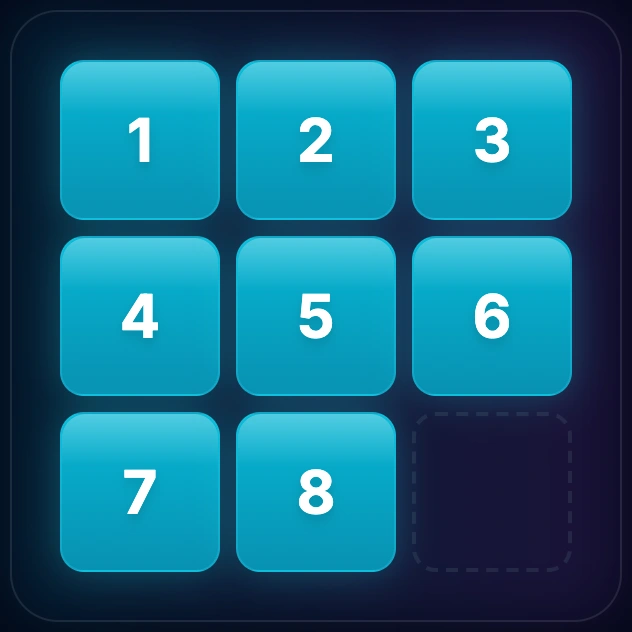
A solved 3x3 (8-puzzle)—tiles 1 through 8 in order, empty space in the bottom-right.
In the classic 4x4 version—the famous "15 Puzzle"—you have tiles numbered 1 through 15, plus one empty space. Numbers flow left to right, top to bottom, with the empty space in the bottom-right corner.
Think of it like a miniature parking lot where you need to rearrange cars, but there is only one empty spot. You cannot lift cars over each other—you can only drive them forward, backward, left, or right into the vacant space.
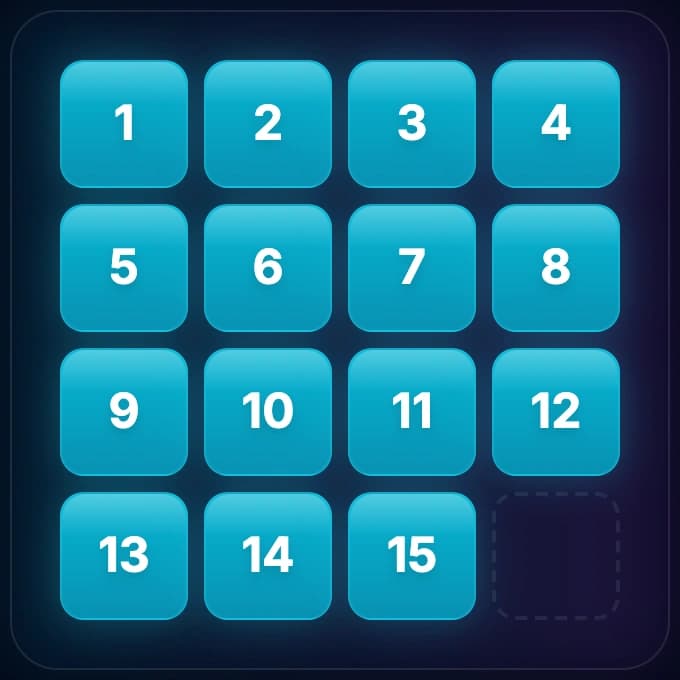
The classic 15 Puzzle—the configuration that drove Victorian America to distraction.
The Complete Rules of Sliding Puzzles
Five rules govern every Sliding Puzzle. They are elegantly simple, yet their interaction creates genuine challenge.
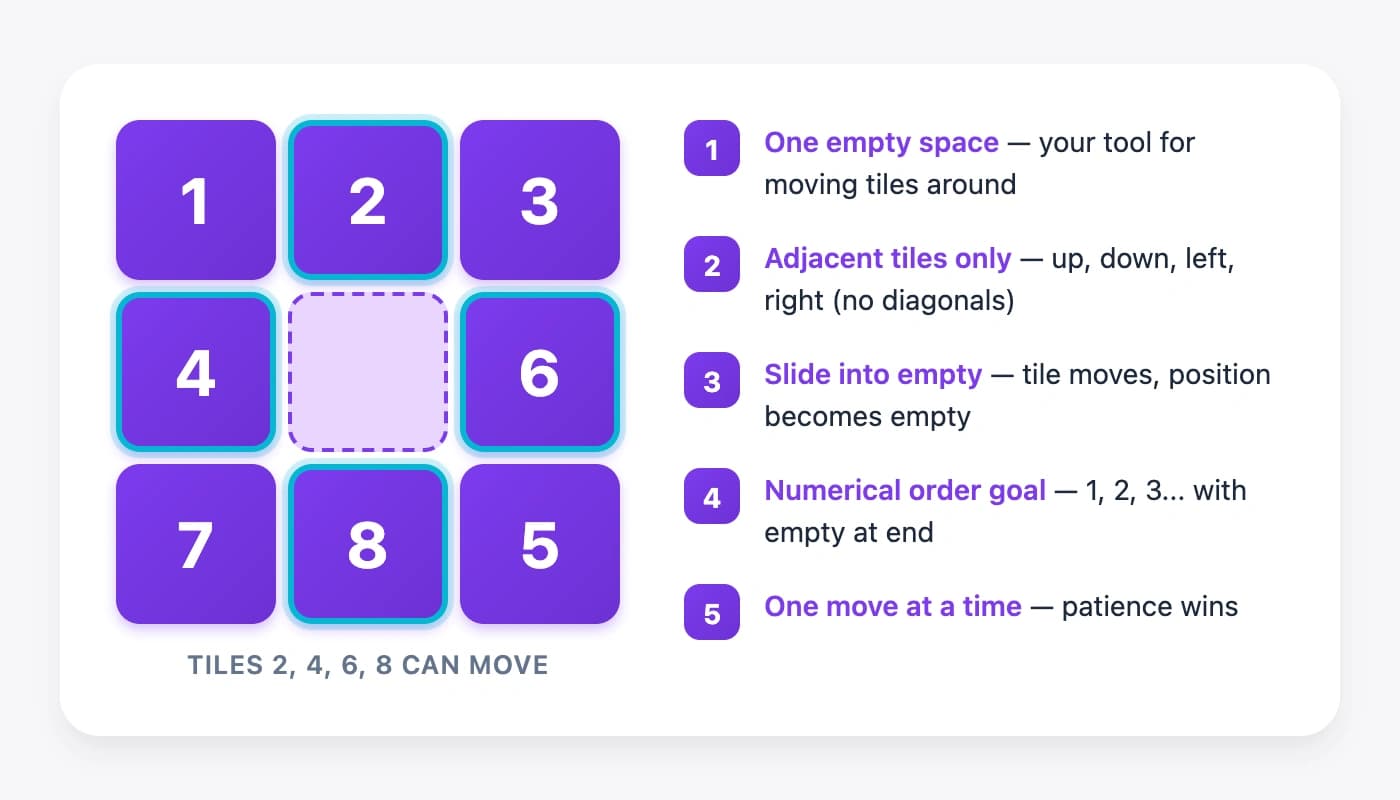
The five rules visualized—tiles 2, 4, 6, and 8 are adjacent to the empty space and can move.
Rule 1: One Empty Space
The grid contains one empty space (no tile). This gap is your tool—without it, no movement would be possible. Treat it well. It is doing most of the work.
Rule 2: Adjacent Tiles Only
Only tiles directly adjacent to the empty space can move. "Adjacent" means sharing an edge—directly above, below, left, or right. Diagonal does not count.
Rule 3: Slide Into the Empty Space
When you move a tile, it slides into the empty space. The tile's original position then becomes the new empty space. Every move is essentially swapping a tile with the gap.
Rule 4: Numerical Order Goal
Your objective is to arrange all tiles in numerical order: 1, 2, 3... reading left to right, top to bottom. The empty space should end up in the bottom-right corner.
Rule 5: One Move at a Time
You can only move one tile per turn. No simultaneous moves, no multi-tile slides. Patience and planning win over frantic clicking.
Grid Sizes: From Training Wheels to Expert Challenge
3x3 (8 tiles) — The Training Ground
Perfect for learning the fundamentals without overwhelming complexity. Most people can solve a 3x3 within a few minutes once they know the basic technique.
4x4 (15 tiles) — The Classic
The original "15 Puzzle" that sparked a nationwide obsession in the 1880s. This is the standard competitive size, and where the real fun begins.
5x5 (24 tiles) — The Challenge
Twenty-four tiles demand serious planning. Mistakes are more costly because returning to a good state takes longer.
6x6 (35 tiles) — Expert Territory
Thirty-five tiles require patience and careful attention. Reserved for dedicated enthusiasts and people who enjoy beautiful suffering.
The Fascinating History of the Sliding Puzzle
The puzzle first appeared in 1874, created by Noyes Chapman, a postmaster from Canastota, New York. Chapman applied for a patent but never successfully obtained one—the design was considered too simple to patent.
However, the puzzle only became famous through Sam Loyd, a renowned puzzle creator who falsely claimed to have invented it. Loyd's promotional genius sparked the 1880 craze, and for decades he received credit for the invention.
The Impossible Configuration
Part of the 1880 frenzy centered on a specific challenge: starting with tiles in order but with 14 and 15 swapped. Mathematicians eventually proved it was literally impossible—only half of all random configurations can be solved.
Your First Solve: A Visual Walkthrough
Time to put theory into practice. I'll guide you through solving a scrambled 3x3 puzzle, explaining every strategic decision.
The Starting Puzzle
Here is a scrambled 3x3 puzzle. It looks chaotic, but we will tame it systematically.
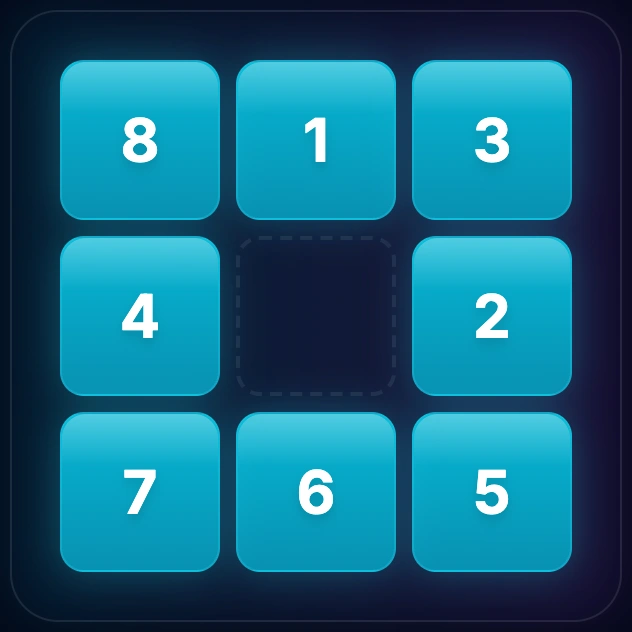
Our starting puzzle—tiles scattered, but notice tile 3 is already in position.
The Row-by-Row Method
The most reliable solving strategy is the Row-by-Row method:
- Solve the top row first (tiles 1, 2, 3)
- Never move the top row again
- Solve the second row (tiles 4, 5, 6)
- Never move the first two rows again
- Solve the remaining 2x2 section
This layered approach turns one complex problem into several simpler ones.
Step 1: Positioning Tile 1
Tile 1 belongs in the top-left corner. Our first task: maneuver the empty space next to tile 1, then slide tile 1 toward its home.
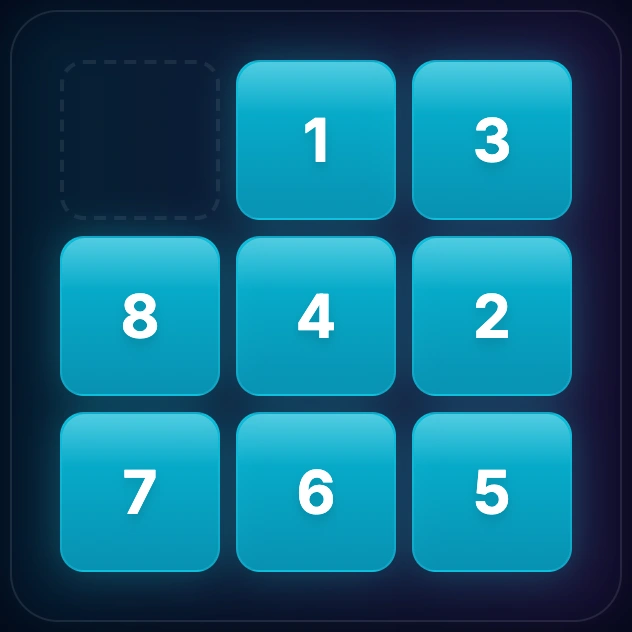
The empty space is now in the corner, tile 1 is ready to slide into position.
Key Insight
To move a specific tile, you often need to move the empty space next to it first. Think of the empty space as your cursor—position it strategically, then make your move.
Step 2: Completing the Top Row
Now we position tiles 2 and 3. With tile 1 in place, we work on getting tile 2 next to it. Sometimes, while positioning one tile, others fall into place naturally.
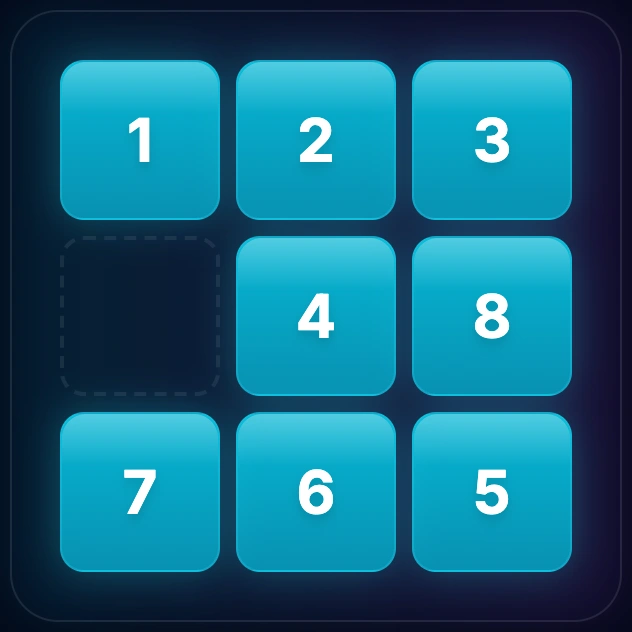
Top row complete! Tiles 1, 2, 3 are locked in position. We never touch them again.
Step 3: Solving the Second Row
With the top row sacred (never to be disturbed), we now have a simpler problem: a 2x3 grid to solve. Tile 4 needs to go to the left side of the second row.
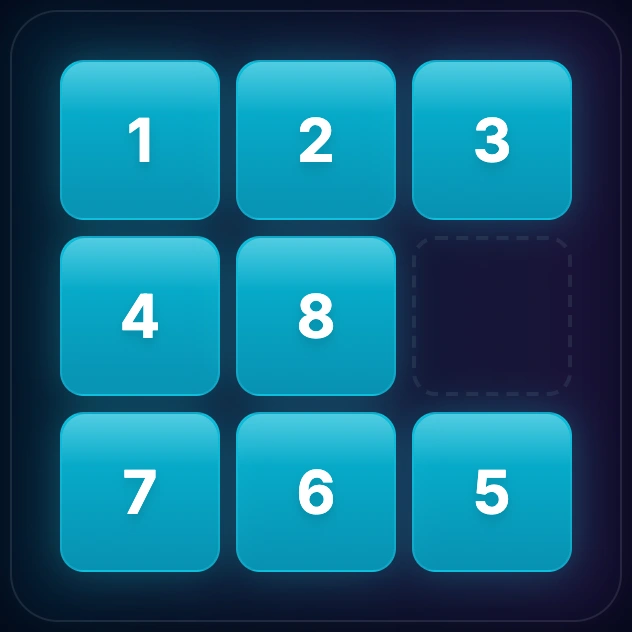
Tile 4 is in position! Notice the top row remains untouched.
The Moment of Victory
As we position the remaining tiles, the puzzle resolves itself. Tiles 5, 6, 7, and 8 fall into place, and the empty space ends up exactly where it belongs.
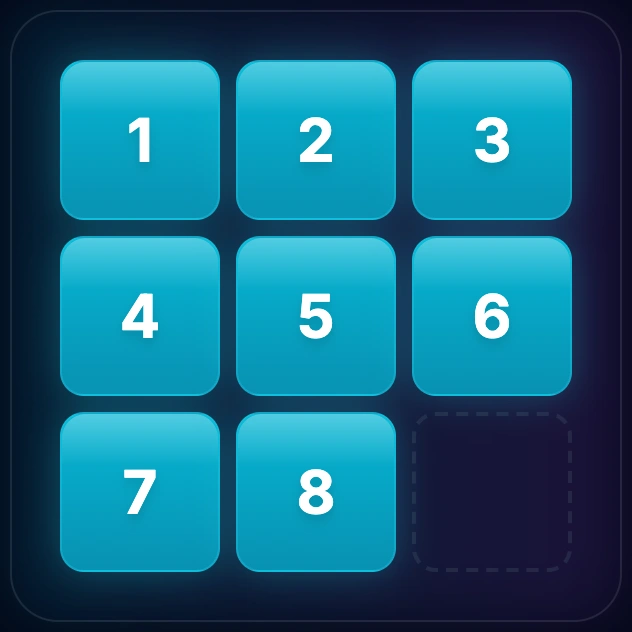
Every tile in order. The same satisfaction that made Victorian sailors neglect their ships.
The Circular Movement Pattern
One technique deserves special attention because it appears constantly in sliding puzzle solving: circular movement. This pattern involves moving three or four tiles in a loop around the empty space, allowing you to reposition multiple tiles while maintaining control.
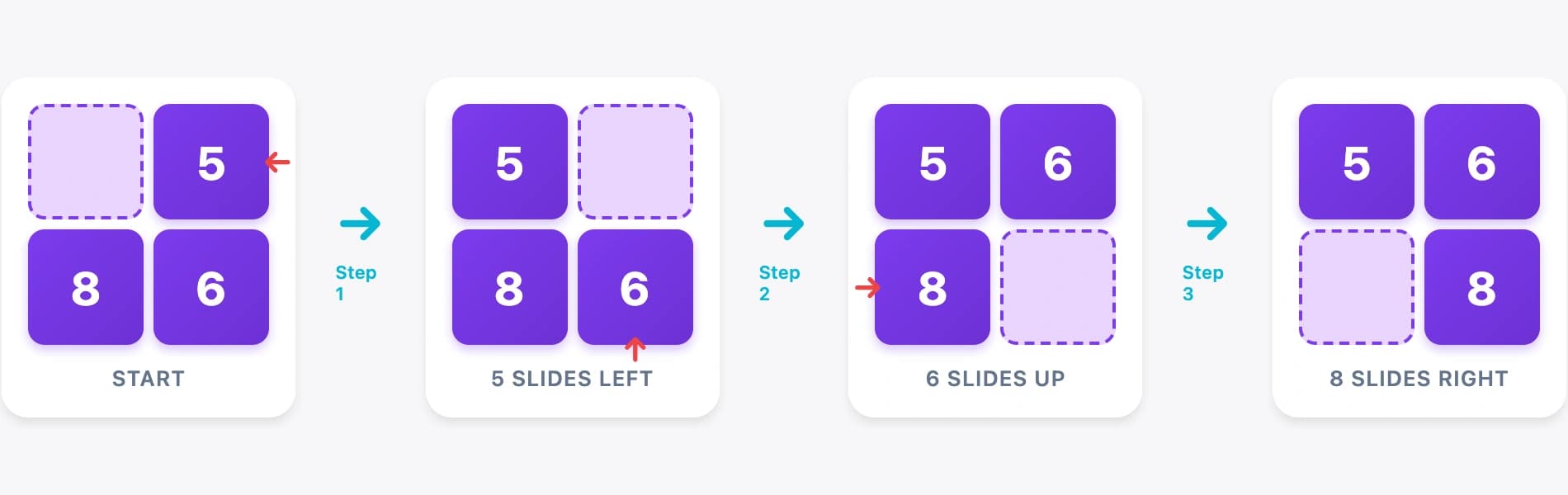
The 3-tile circle: tiles rotate clockwise as each slides into the empty space.
With practice, you will execute these circular patterns instinctively, flowing from one to the next as tiles glide into position. It starts to feel less like problem-solving and more like a dance—one where your partner is an empty square.
Common Mistakes and How to Avoid Them
Mistake 1: Disturbing Completed Rows
You place tiles 1, 2, 3 perfectly, then accidentally slide tile 2 while working on the second row. Fix: Before every move, check whether it will disturb completed sections.
Mistake 2: Working on Random Tiles
You see tile 7 and think "Let me just fix that real quick." Fix: Stick to the Row-by-Row method. Solve in order: tile 1, then 2, then 3, then move to the next row.
Mistake 3: Going Too Fast
You slide tiles rapidly without thinking, then find yourself worse off than before. Fix: Slow is smooth, and smooth is fast. Each move should have a purpose.
Mistake 4: Giving Up on the Last Section
The final 2x2 seems impossible. Fix: The last section is always solvable if you reached it correctly. Use circular movement patiently.
Pro Tips for Consistent Success
Expert Strategies
- Plan before moving: Take ten seconds to find key tiles before you start sliding.
- Move the empty space, not the tiles: Think "I need to move the empty space next to tile 5" rather than "I need to move tile 5."
- Watch for quick wins: If a tile is one position away from home, grab it early.
- Practice the 3x3 until automatic: When you can solve it in under a minute without thinking hard, you've internalized the method.
Ready to Start Sliding?
You now have everything you need: five clear rules, the Row-by-Row method for systematic solving, circular movement patterns for tile manipulation, and the corner strategy for the final section.
Remember as you solve: work from top to bottom, left to right. Once a row is complete, never disturb it. Position the empty space, then slide your target tile. The tiles are waiting. The gap is your tool. Slide by slide, order will emerge from chaos.
Now make history repeat itself—one satisfying click at a time.
Quick Reference
- Row-by-Row: Solve top row first, then second row, then final section
- Never disturb completed rows
- Move the empty space to position tiles
- Circular movement for multi-tile repositioning
- Every puzzle is solvable (if generated correctly)
Ready to Slide Your First Tiles?
The Row-by-Row method is in your head. The rules are crystal clear. All that's left is to start sliding and feel that satisfying click.
Start Solving NowPut it into practice
Ready to solve Sliding Puzzle?
Open a free puzzle and turn the ideas from this guide into your next solve.