Magic Square Puzzle:
A Complete Beginner's Guide to Sum Symmetry
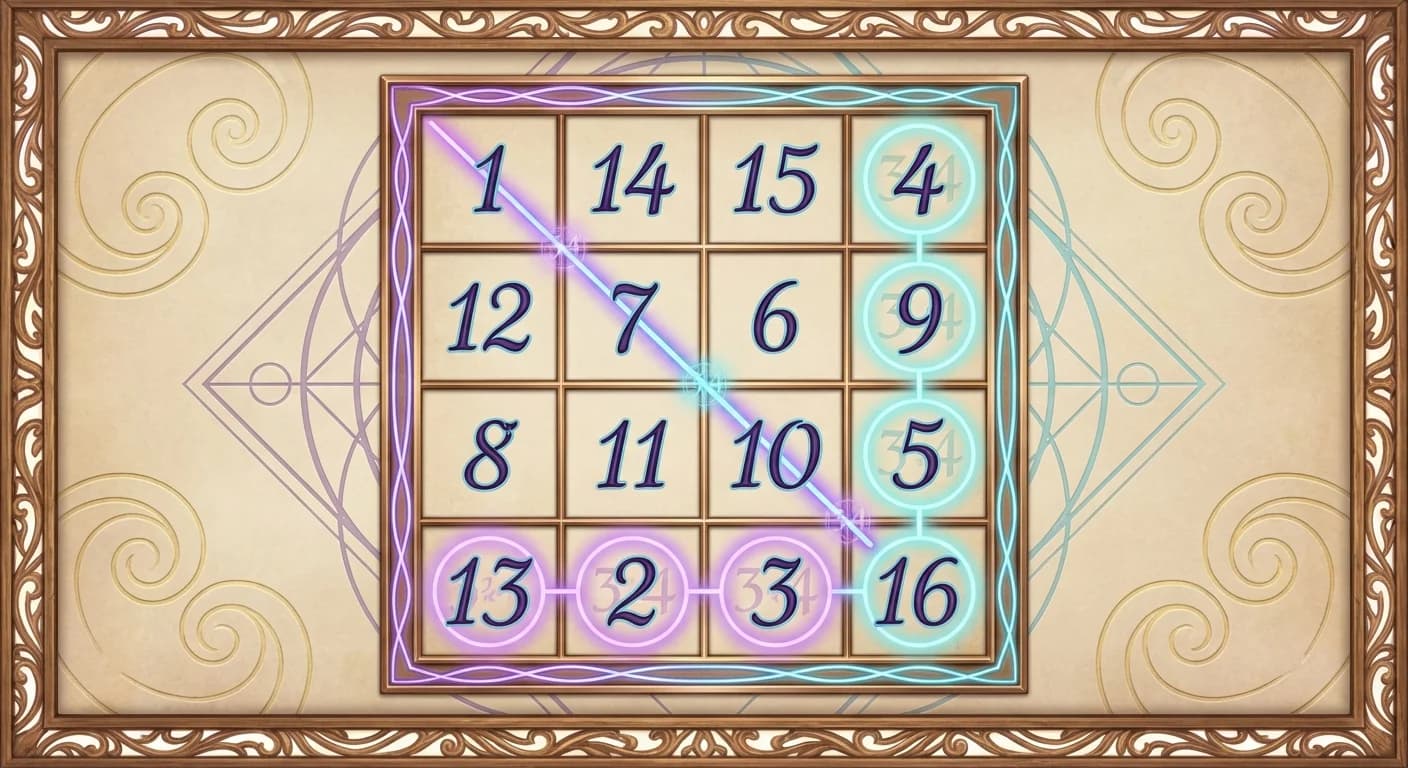
In 1514, the German artist Albrecht Dürer finished an engraving called "Melencolia I." Among its symbols of mathematics and creativity--compasses, scales, a brooding angel--one detail has fascinated people for five centuries: a 4x4 grid of numbers tucked into the upper right corner.
Every row sums to 34. Every column sums to 34. Both diagonals sum to 34. The four corners sum to 34. The center four squares sum to 34. (Note: the corners and center four summing to 34 are special properties of Dürer's particular square, not requirements of all 4x4 magic squares.) Dürer even embedded the year he created the piece: the bottom row's middle numbers are 15 and 14.
This is a magic square--one of the oldest mathematical puzzles in human history, and one of the most elegantly satisfying to solve.
Watch the Tutorial
Prefer watching? This short video walks you through the rules and key techniques.
What Exactly Is a Magic Square Puzzle?
A magic square is a grid filled with distinct numbers arranged so that the sum of numbers in each row, each column, and both main diagonals equals the same value--the "magic constant."
In the standard 4x4 magic square puzzle, you fill a grid using the numbers 1 through 16--each number exactly once. Your target sum is 34. Every complete row must equal 34. Every complete column must equal 34. Both main diagonals (corner to corner) must equal 34.
When you achieve this, something remarkable happens: the numbers are not just placed correctly--they are in perfect balance. This is what makes magic squares feel... magical.
The Fascinating History of Magic Squares
Magic squares are not just puzzles--they are artifacts of human mathematical curiosity spanning millennia.

Ancient China (~2200 BCE): The oldest known magic square, the Lo Shu, appears in legend as a pattern on a turtle's shell. Every row, column, and diagonal of this 3x3 grid sums to 15. For over four thousand years, this simple grid has been considered a symbol of cosmic balance.
Islamic Golden Age (10th century): Scholars in Baghdad developed systematic methods for constructing magic squares of any size. Their mathematical rigor transformed magic squares from mystical symbols into objects of serious study.
Renaissance Europe (1514): Dürer's "Melencolia I" brought magic squares to European artistic consciousness, connecting mathematical elegance with artistic expression.
The Mathematics Behind the Magic
Why is 34 the magic constant for a 4x4 grid? This is not arbitrary--it emerges from pure mathematics.
The Magic Constant Formula
Magic Constant = n(n² + 1) / 2
For a 4x4 grid: 4 × (16 + 1) / 2 = 4 × 17 / 2 = 34
Intuitively: Numbers 1-16 sum to 136. Divided by 4 rows = 34 per row.
The Paired Numbers Insight
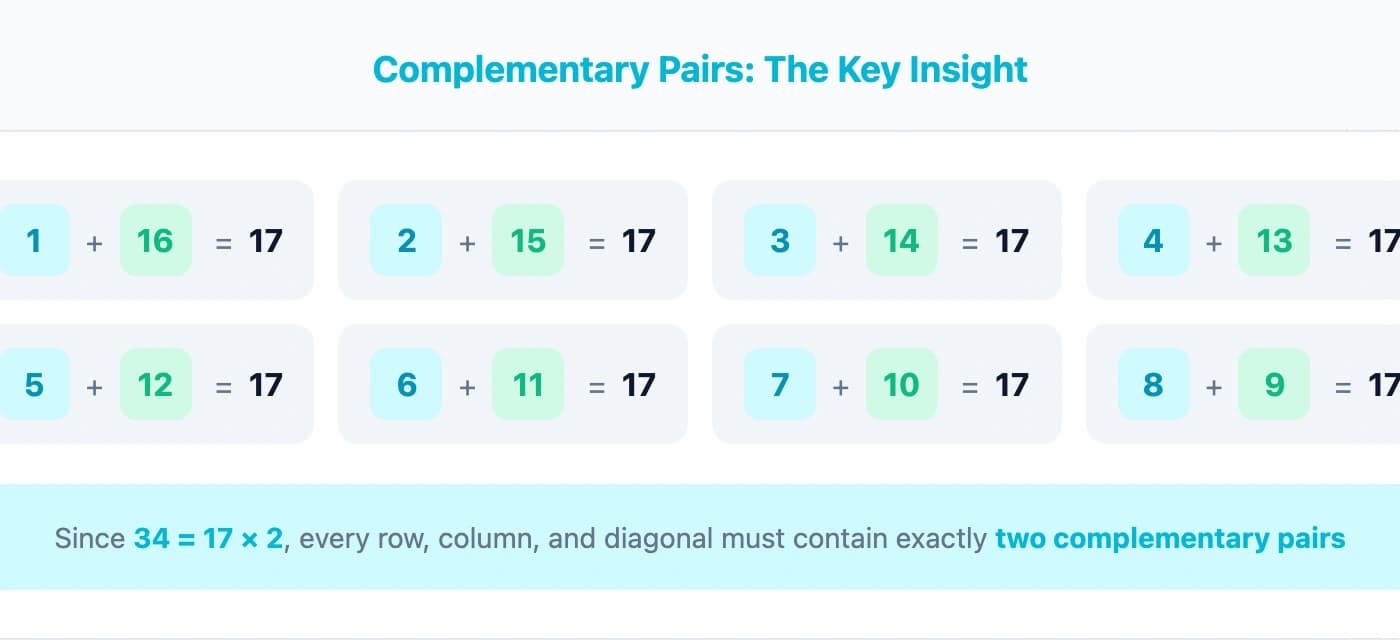
In a 4x4 magic square, numbers form complementary pairs that always sum to 17. This insight transforms solving from trial-and-error into targeted deduction.
The Complete Rules of Magic Square Puzzles
Five rules govern every standard 4x4 magic square puzzle. Master these, and you are ready to solve.
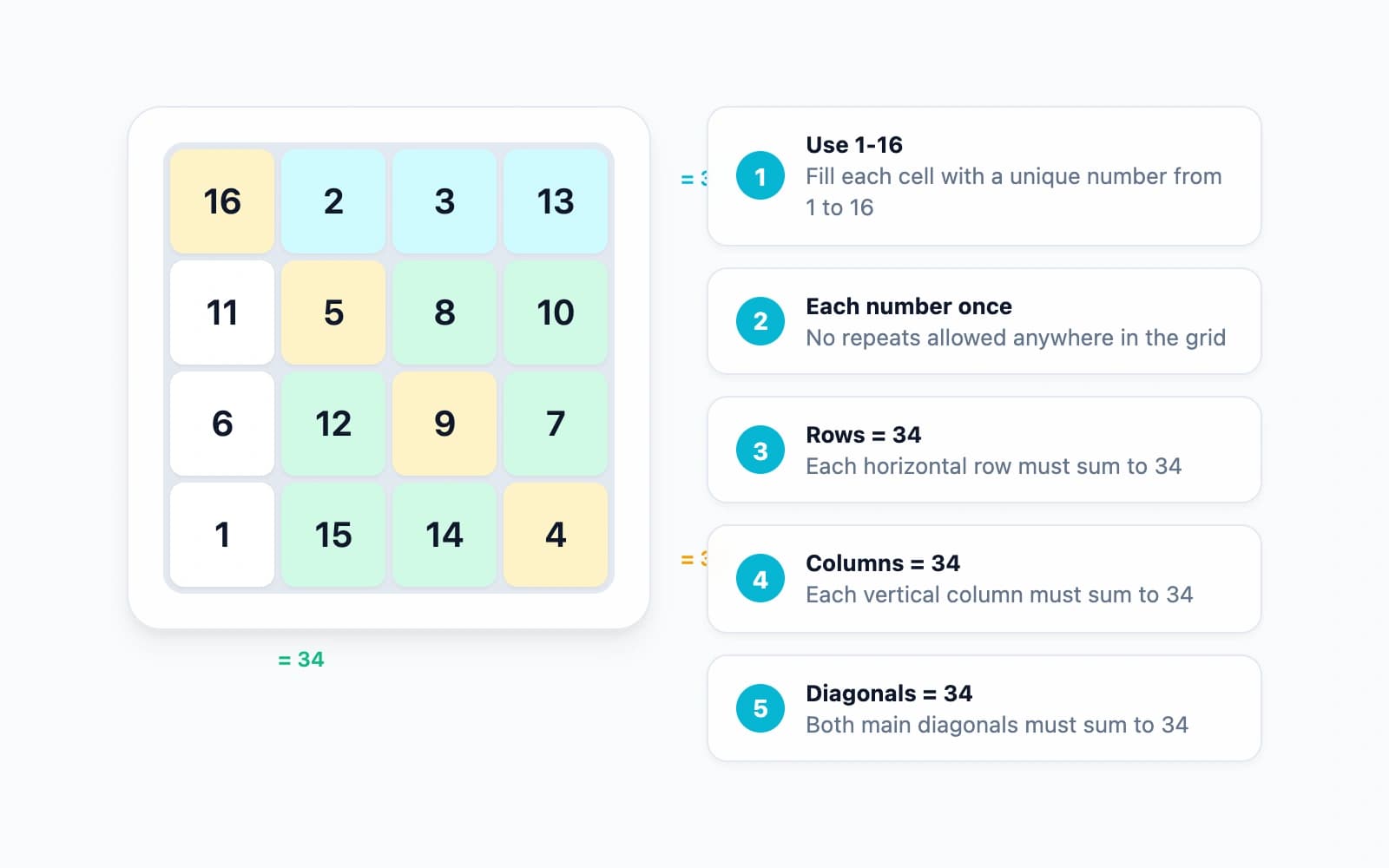
- Use each number from 1 to 16 exactly once. Every number appears in the grid, and no number may be repeated.
- Every row must sum to 34. The four numbers in each horizontal row add up to the magic constant.
- Every column must sum to 34. The four numbers in each vertical column add up to the magic constant.
- Both main diagonals must sum to 34. The top-left to bottom-right diagonal and the top-right to bottom-left diagonal each total 34.
- No number may be repeated. If you place a 7 in one cell, no other cell can contain a 7.
Your First Solve: A Complete Walkthrough
Time to put theory into practice. I will guide you through solving a 4x4 magic square puzzle, explaining every deduction. No guessing--just logic flowing from the rules and the magic constant.
The Starting Puzzle
You are given four numbers on the main diagonal; your task is to place the remaining twelve so that every row, column, and diagonal sums to 34.
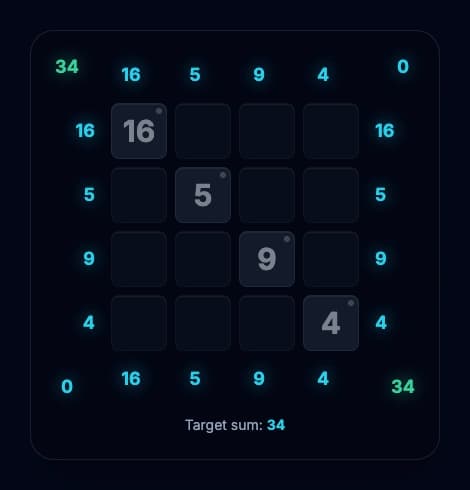
Given: Position 0 = 16, Position 5 = 5, Position 10 = 9, Position 15 = 4. Notice: the main diagonal already sums to 34!
Phase 1: Analyze What We Know
The main diagonal (16 + 5 + 9 + 4 = 34) is already complete! Our available numbers are: 1, 2, 3, 6, 7, 8, 10, 11, 12, 13, 14, 15.
| Row | Sum Needed | Column | Sum Needed |
|---|---|---|---|
| Row 0 | 18 | Column 0 | 18 |
| Row 1 | 29 | Column 1 | 29 |
| Row 2 | 25 | Column 2 | 25 |
| Row 3 | 30 | Column 3 | 30 |
Phase 2: Using the Paired Numbers Insight
Since 16, 5, 9, and 4 are on the main diagonal, their complements (1, 12, 8, 13) might form the anti-diagonal. Let's check: 1 + 12 + 8 + 13 = 34. Yes!
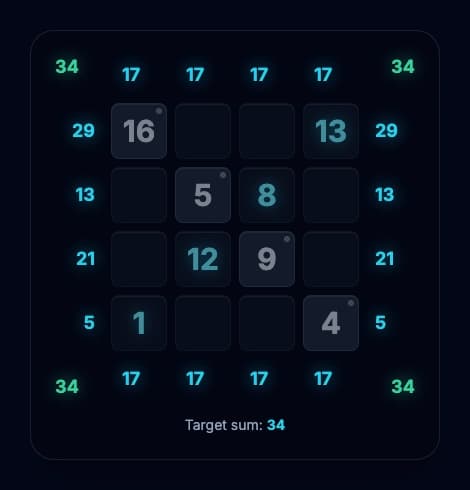
Anti-diagonal hypothesis: positions 3, 6, 9, 12 filled with 13, 8, 12, 1.
Phase 3: Filling the Remaining Cells
Now we use row and column constraints to determine the remaining values. Row 0 needs positions 1 and 2 to sum to 5 (only 2 + 3 works). Cross-referencing with column constraints pins down the exact positions.
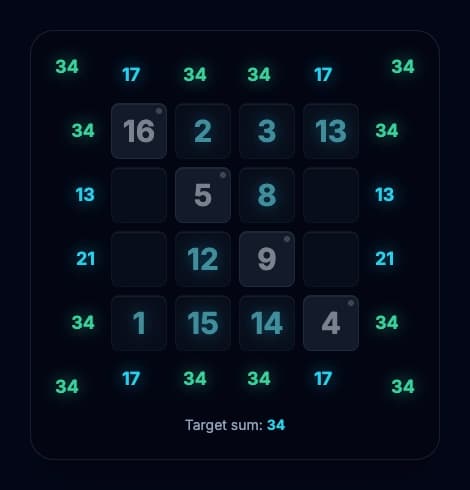
Row 0: [16, 2, 3, 13], Row 3: [1, 15, 14, 4]. The cascade begins!
The Completed Grid
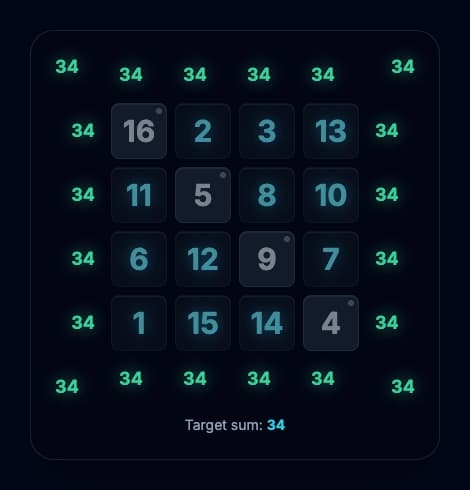
Row 0: [16, 2, 3, 13] | Row 1: [11, 5, 8, 10] | Row 2: [6, 12, 9, 7] | Row 3: [1, 15, 14, 4]
Every constraint satisfied. The magic is complete! Sixteen cells, zero guesses, pure deduction.
Essential Beginner Strategies
Strategy 1: Calculate What's Missing
For any row, column, or diagonal with some numbers filled, calculate what sum the remaining cells must provide. If three cells contain 16, 2, and 3, the fourth must be 34 - 21 = 13.
Strategy 2: Use Paired Numbers
Complementary pairs sum to 17. Since 34 = 17 × 2, every row, column, and diagonal contains exactly two pairs. If you know one member of a pair is in a row, look for its complement.
Strategy 3: Cross-Reference Row and Column
Every cell sits at the intersection of one row and one column (and possibly a diagonal). Use all applicable constraints simultaneously. If row analysis says "7 or 10" and column analysis says "7 or 14," the answer must be 7.
Strategy 4: Start with the Most Constrained
If a row has three numbers filled, the fourth is forced. Find the most constrained line and work from there.
Common Mistakes to Avoid
Mistake 1: Forgetting the Diagonals
You fill all rows and columns correctly but forget the diagonals must also sum to 34. Check diagonal constraints early, not just at the end.
Mistake 2: Reusing a Number
Under pressure, you accidentally place a number that is already on the grid. Keep a running list of placed numbers.
Mistake 3: Not Using the Magic Constant
You try to solve by pattern-matching instead of using the fundamental constraint that everything sums to 34. The magic constant is your anchor.
Practice Puzzle
Ready to apply what you have learned? Here is a 4x4 magic square designed for beginners.
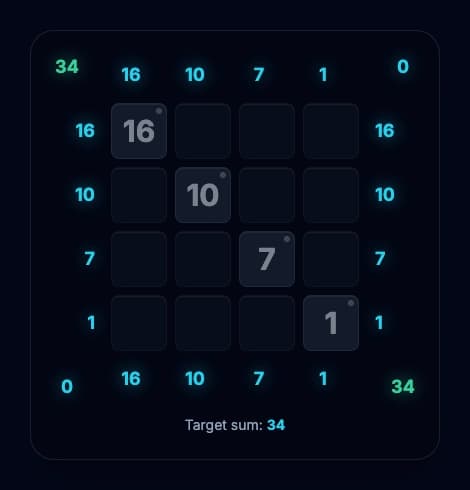
Given: Position 0 = 16, Position 5 = 10, Position 10 = 7, Position 15 = 1. Main diagonal already sums to 34!
Your Magic Awaits
Among logic puzzles, magic squares occupy a special place. When you complete one, you have not just filled a grid--you have created perfect numerical balance. Every direction you look, the sum is the same.
The rules are simple enough for children to understand, yet the puzzles can challenge adults. You now have everything you need: the magic constant is 34, pairs sum to 17, and every row, column, and diagonal must balance.
For over four thousand years, humans have been arranging numbers into magic squares. Ancient Chinese sages saw cosmic harmony. Medieval scholars saw mathematical beauty. Renaissance artists saw creative potential.
Now it is your turn to see the magic.
Ready to Find Perfect Balance?
The techniques are in your head. The magic constant awaits. All that's left is to arrange those numbers into perfect harmony.
Start Solving Magic SquarePut it into practice
Ready to solve Magic Square?
Open a free puzzle and turn the ideas from this guide into your next solve.