Calcudoku Puzzle:
A Complete Beginner's Guide to Math Cages
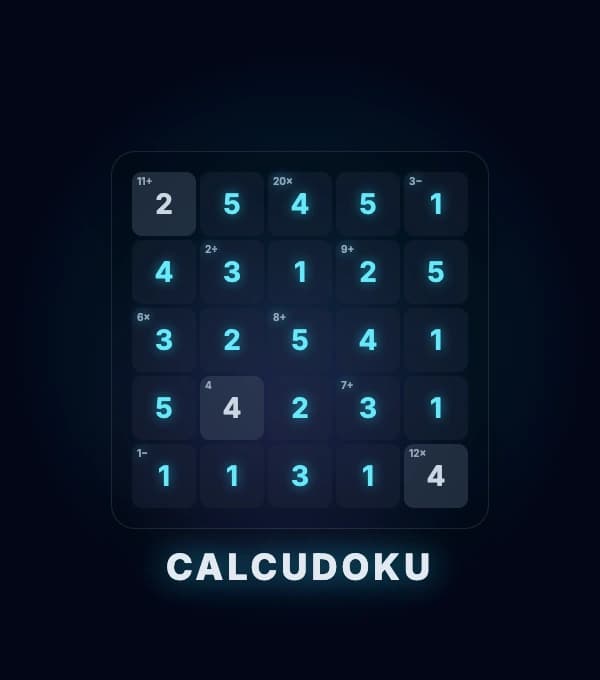
Calcudoku extends the no-repeat logic of Sudoku by adding arithmetic cages with operations. Instead of scattered starting numbers, you face "cages" marked with targets like "12x" (digits must multiply to 12) or "7+" (digits must sum to 7).
Your brain switches constantly between mathematical reasoning and Latin square logic -- figuring out which digits satisfy the arithmetic while ensuring no repeats in any row or column.
You might know this puzzle by another name. When Japanese educator Tetsuya Miyamoto created it in 2004, he called it "KenKen" (meaning "cleverness squared" in Japanese). He designed it to help his students develop logical thinking and arithmetic skills simultaneously. The puzzle was so effective that it spread from Tokyo classrooms to newspapers worldwide--by 2008, The New York Times, The Times of London, and hundreds of other publications featured daily KenKen puzzles. The puzzle picked up the name "Calcudoku" along the way, though both names refer to the same satisfying brain workout.
Here is the beautiful secret: despite the math, Calcudoku is fundamentally a logic puzzle. The arithmetic sets up the constraints. The logic delivers the solution.
Watch the Tutorial
Prefer watching? This short video walks you through the rules and key strategies.
What Exactly Is a Calcudoku Puzzle?
A Calcudoku puzzle presents you with a square grid divided into groups of cells called "cages." Each cage displays a target number and an arithmetic operation (+, -, x, or /). Your mission: fill every cell with a digit so that each row and column contains every number exactly once (like Sudoku), while the numbers in each cage combine using the specified operation to produce the target.
The beauty of Calcudoku lies in the interplay between two constraint systems. The Latin square rules (no repeats in rows or columns) limit where numbers can go. The cage arithmetic further restricts which numbers are even possible. When both systems agree on only one option for a cell, you have found certainty.
Calcudoku vs Sudoku: A Quick Comparison
| Aspect | Sudoku | Calcudoku |
|---|---|---|
| Grid structure | Rows, columns, AND 3x3 boxes | Rows and columns only (no boxes) |
| Regional constraint | Fixed 3x3 boxes | Variable-size cages with math targets |
| Starting clues | Given numbers scattered in grid | Cage targets and operations |
| Math required | None (just digit placement) | Basic arithmetic (+, -, x, /) |
The Complete Rules of Calcudoku
Five rules govern every Calcudoku puzzle. Master these, and you are ready to tackle any grid.
Rule 1: Fill 1 to N
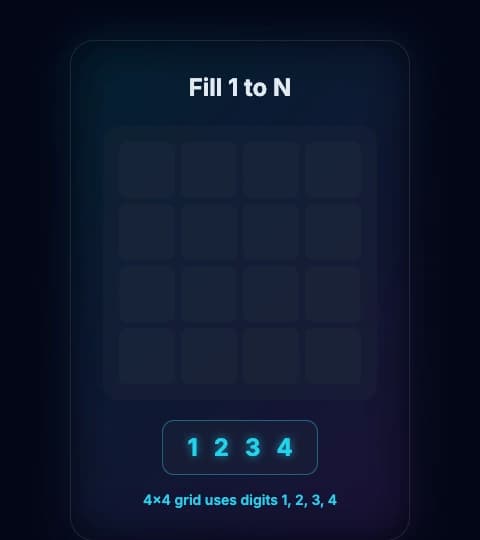
For an NxN grid, use digits 1 through N. A 4x4 grid uses 1, 2, 3, 4. A 6x6 grid uses 1 through 6.
Rule 2: No Row Repeats
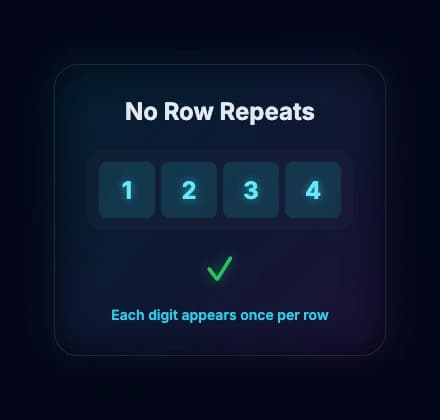
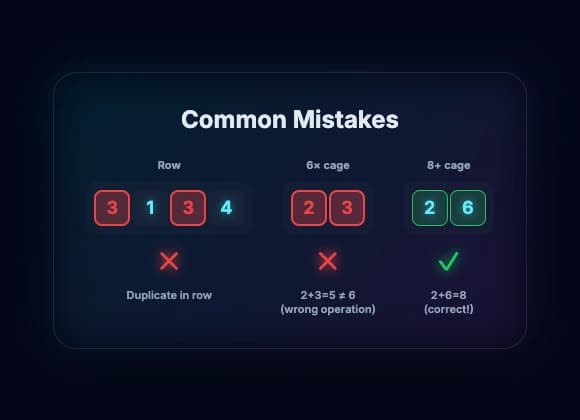
Each row must contain every digit exactly once. If you place a 3 somewhere in a row, no other cell can be 3.
Rule 3: No Column Repeats
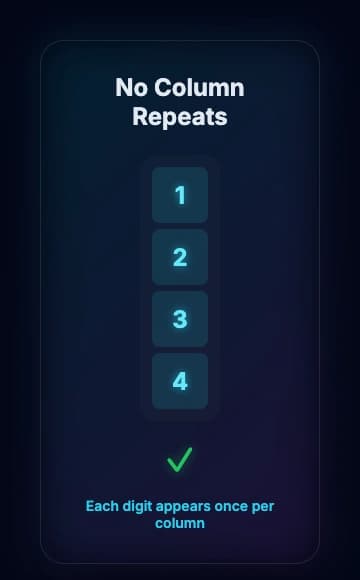
Each column must also contain every digit exactly once. Unlike Sudoku, there are no 3x3 box regions.
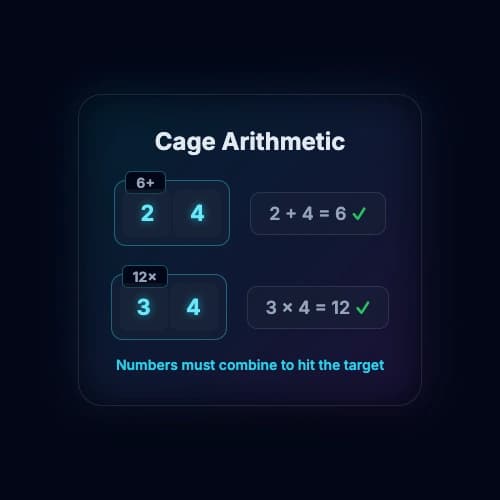
Rule 4: Cage Arithmetic
Numbers in each cage must combine using the specified operation (+, -, x, /) to equal the target.
Rule 5: Cages Can Repeat (Sometimes)
Digits CAN repeat within a cage, as long as the repeated digits are not in the same row or column. An L-shaped cage spanning two rows can have two 3s--one in each row.
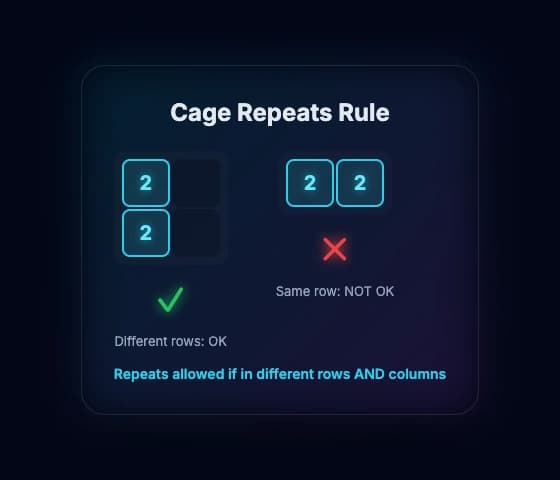
This rule trips up everyone at least once. Consider yourself warned.
Understanding the Four Operations
Before we solve our first puzzle, let us build fluency with each arithmetic operation.
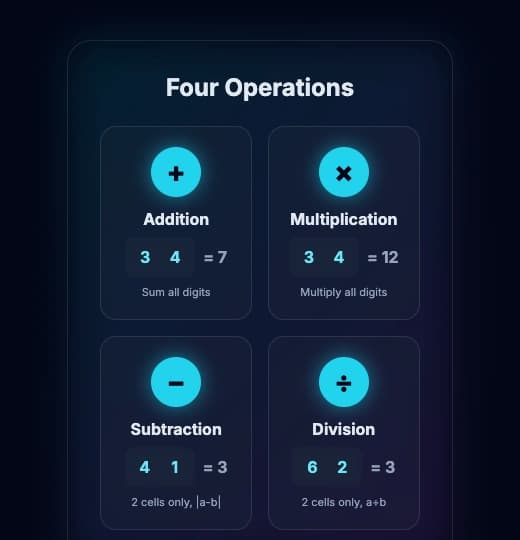
The multiplication secret: Multiplication cages are often easier than they look because they have fewer valid combinations than addition cages. A "12x" cage has only a handful of factorizations. Get excited when you see multiplication!
Your First Solve: A Complete Walkthrough
Time to put theory into practice. I will guide you through solving a 4x4 Calcudoku, explaining every deduction. My promise: no guessing, no hoping--just pure logic flowing from the rules.
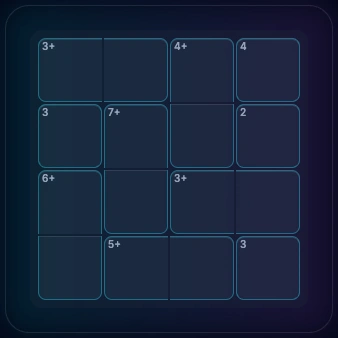
Our starting puzzle: 4x4 grid with 10 cages. Digits 1-4 in each row and column.
Phase 1: Harvest the Single Cells
Single-cell cages are free information--they equal their target directly! In our puzzle:
| Cell | Target | Value |
|---|---|---|
| (0,3) | "4" | 4 |
| (1,0) | "3" | 3 |
| (1,3) | "2" | 2 |
| (3,3) | "3" | 3 |
Four placements from four single cells. Already the grid is taking shape.
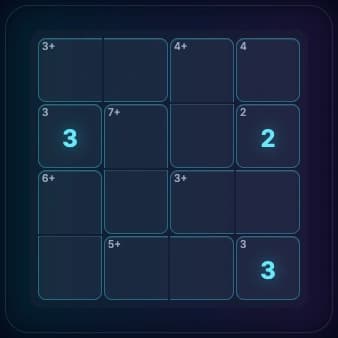
Single-cell cages give us 4 free placements immediately.
Phase 2: Analyze the Two-Cell Cages
Now let us determine what each remaining cage can contain. For two-cell addition cages in a 4x4:
| Cage | Target | Possible Digits |
|---|---|---|
| A "3+" | 3 | {1, 2} only (1+2=3) |
| B "4+" | 4 | {1, 3} only (1+3=4) |
| E "7+" | 7 | {3, 4} only (3+4=7) |
| G "6+" | 6 | {2, 4} only (2+4=6) |
| H "3+" | 3 | {1, 2} only |
| I "5+" | 5 | {1, 4} or {2, 3} |
Phase 3: Cross-Reference and Deduce
Now the magic begins--using row, column, and cage constraints together.
Column 3 analysis: Contains (0,3)=4, (1,3)=2, (3,3)=3. Missing digit: 1 at cell (2,3).
Cage H cascade: The "3+" cage at (2,2)-(2,3) needs {1, 2}. With (2,3)=1, cell (2,2) must be 2.
Row 2 analysis: Contains (2,2)=2, (2,3)=1. Missing: 3 and 4 in cells (2,0) and (2,1). Cage G needs {2, 4} at (2,0)-(3,0). Since (2,0) must be 3 or 4, and Cage G needs 2 or 4, cell (2,0) = 4.
If you followed that cascade--one deduction leading to another--you are already thinking like a Calcudoku solver.
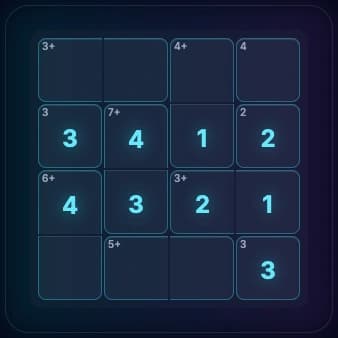
Mid-solve: Rows 1 and 2 nearly complete. The cascade continues.
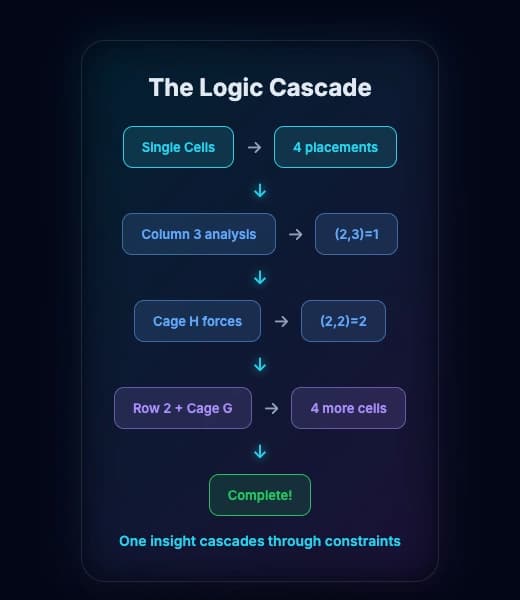
One insight cascades through the constraints until the grid solves itself.
The Completed Grid
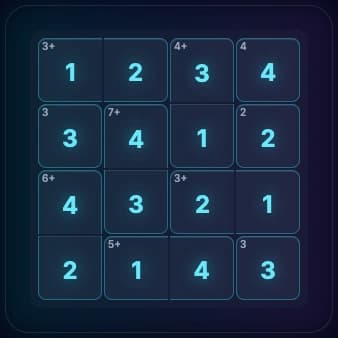
Solution: Row 0: [1,2,3,4] | Row 1: [3,4,1,2] | Row 2: [4,3,2,1] | Row 3: [2,1,4,3]
Verification: Every row and column contains 1, 2, 3, 4 exactly once. Every cage's arithmetic checks out. Sixteen cells, ten cages, zero guesses.
Essential Beginner Strategies

Quick Strategy Summary
- 1. Single cells first -- Free information, always start here
- 2. List cage possibilities -- Know what digits can go where
- 3. Small cages = big payoff -- Two-cell cages have limited options
- 4. Min/max analysis -- Calculate bounds to eliminate combinations
- 5. Row/column completion -- One empty cell = forced placement
- 6. No-repeat tactic -- Same-row cells in a cage can't share digits
- 7. Cross-reference -- Combine row needs + column needs + cage constraints
Common Mistakes to Avoid
Practice Puzzle
Ready to apply what you have learned? Here is a 4x4 Calcudoku designed for beginners.
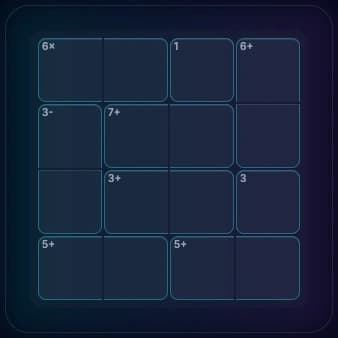
Hints: Find single cells first. The "6x" cage can only be 2x3. The "7+" cage must be 3+4.
Difficulty Progression

Your Math Cages Await
Start with a 4x4 grid: fill in every single-cell cage immediately, then list the possible digits for each two-cell cage. Cross-reference those lists with row and column needs, and the puzzle will cascade from there. Once 4x4 feels routine, move to 5x5 where multiplication cages become your best friends.
Ready to Crack Your First Cage?
The techniques are in your head. The math is elementary. All that's left is to place that first certain digit and watch the cascade unfold.
Start Solving CalcudokuPut it into practice
Ready to solve Calcudoku?
Open a free puzzle and turn the ideas from this guide into your next solve.