Skyscrapers Strategies:
Visibility Patterns for Skyline Mastery

Skyscrapers is the only puzzle where you think in three dimensions while solving on a flat grid. Every number is a building height. Every clue is a viewpoint. The solver who struggles sees numbers. The solver who flows sees skylines—towers rising and falling, blocking and revealing.
A clue of 1 means the tallest building stands first—blocking everything behind it. A clue of N means buildings ascend perfectly from shortest to tallest. These two patterns alone solve half of most Skyscrapers puzzles. But mastery comes from reading clue pairs: when opposite clues constrain the same row, the combination often forces a unique arrangement.
Watch the Tutorial
Prefer watching? This tutorial covers the basics of Skyscrapers to get you started.
Prerequisites
This guide builds on concepts from our beginner's guide—understanding Skyscrapers rules, visibility counting, and basic clue analysis. If any of these feel unfamiliar, start there first.
The Foundation: Visibility Counting
Before we dive into advanced strategies, let us cement how visibility counting works. This mental skill must become automatic.
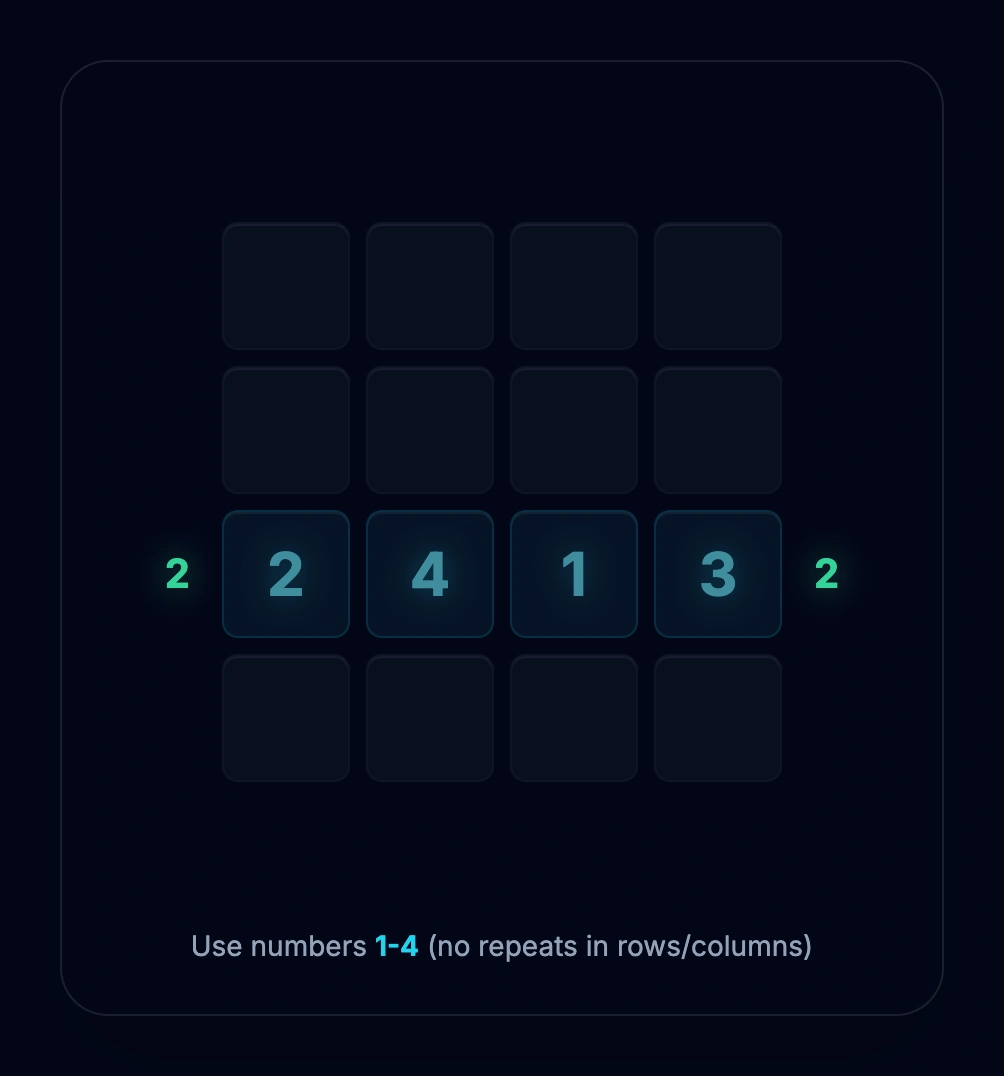
Looking at row [2, 4, 1, 3] from the left:
- See 2 (first building, always visible)
- See 4 (taller than 2)
- Skip 1 (hidden behind 4)
- Skip 3 (hidden behind 4)
Visibility from left = 2.
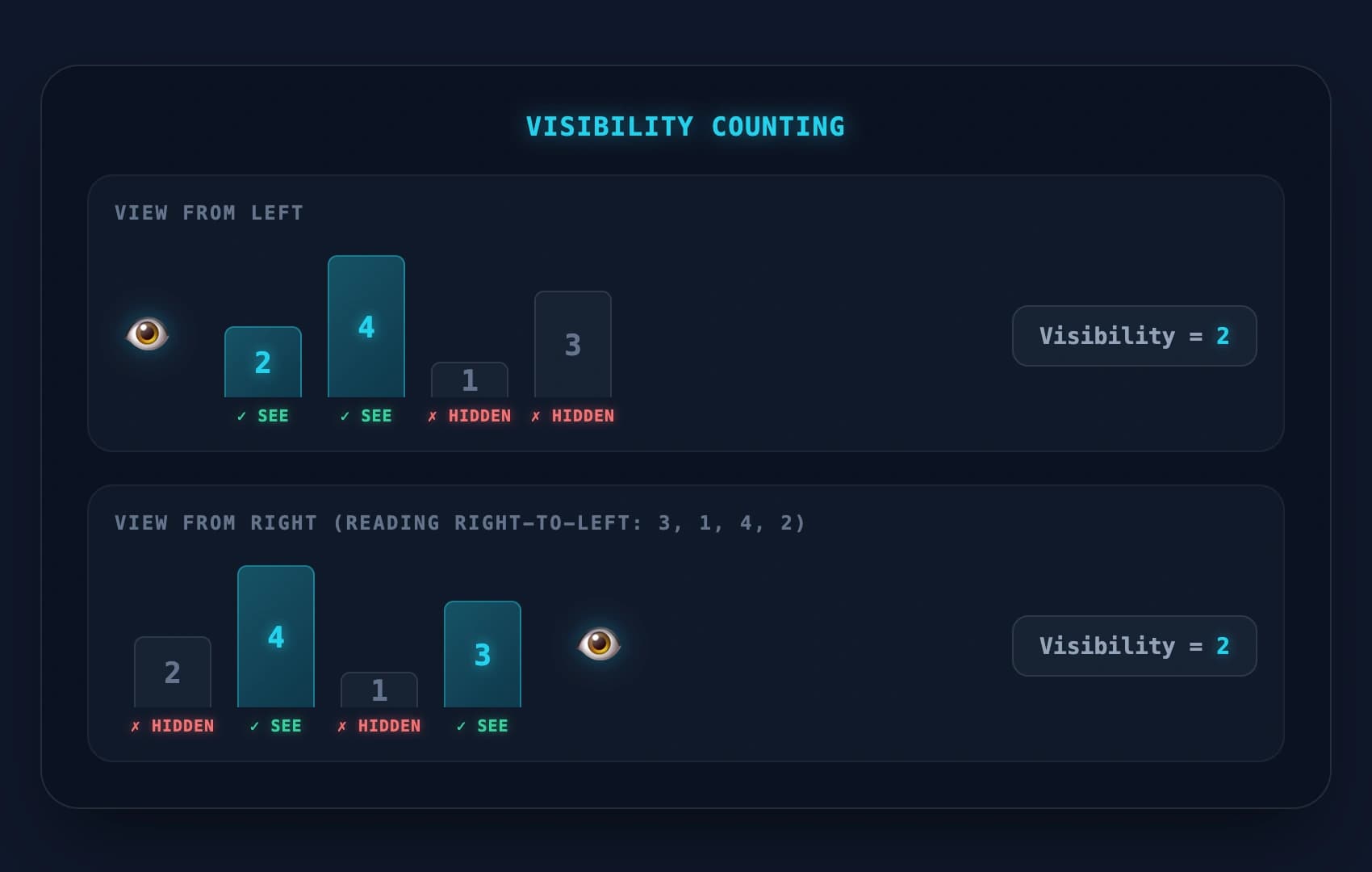
The same row produces visibility = 2 from both ends because the tallest building (4) sits in the interior.
Strategy 1: The Clue of 1 Rule
This is your most powerful starting move. A clue of 1 means only one building is visible from that edge. The only building that can hide all others behind it is the tallest: N in an NxN grid.
The Rule
Clue = 1 forces the first cell to contain N (the maximum height).
- In a 4x4 puzzle, clue = 1 means the first cell is 4.
- In a 5x5 puzzle, clue = 1 means the first cell is 5.
- In a 6x6 puzzle, clue = 1 means the first cell is 6.
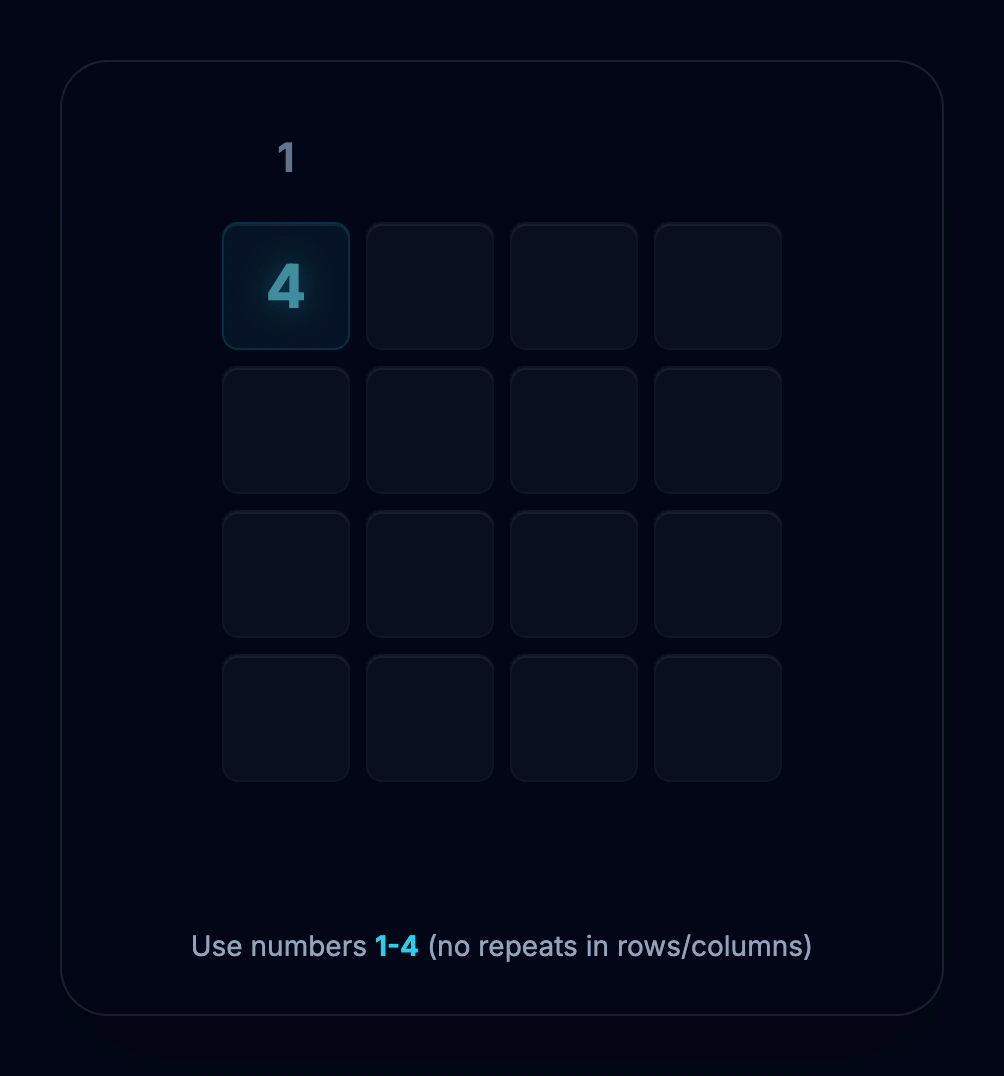
A clue of 1 at the top forces a 4 in the first cell of that column.
Why This Is So Powerful
Placing the tallest building immediately eliminates N from that entire row and column (Latin square rule), satisfies the clue completely, and often creates cascades as other clues now have fewer possibilities. Always scan for clues of 1 first. They are your anchor points.
Strategy 2: The Clue of N Rule
The opposite extreme is equally powerful. A clue of N (equal to the grid size) means you can see every single building. The only way to see all buildings is if none blocks another—which requires strictly ascending order.
The Rule
Clue = N forces the row to be [1, 2, 3, ..., N] from that direction.
- In a 4x4 puzzle, clue = 4 forces [1, 2, 3, 4].
- In a 5x5 puzzle, clue = 5 forces [1, 2, 3, 4, 5].
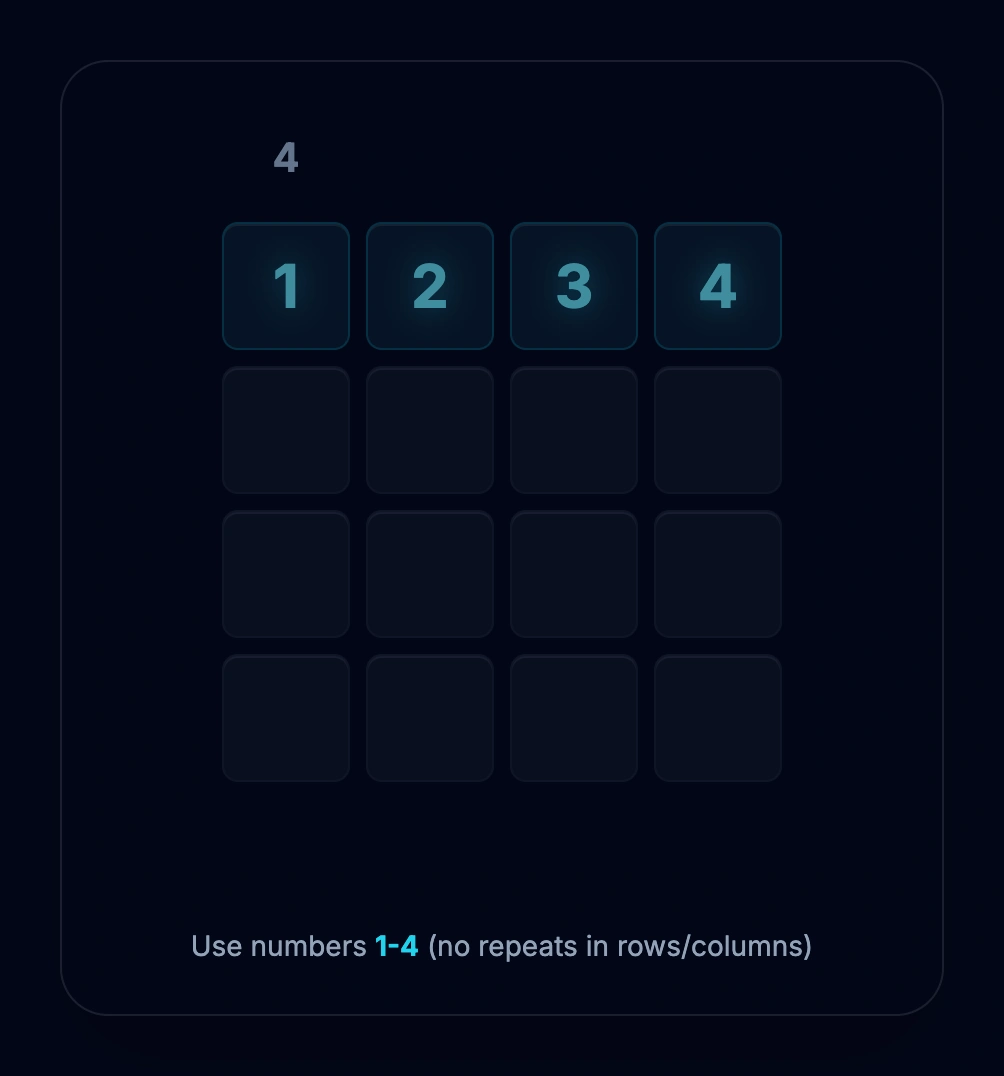
A clue of 4 forces the entire row to be [1, 2, 3, 4] in ascending order.
Strategy 3: Opposite Clue Pair Analysis
Here is where Skyscrapers solving transforms from mechanical to elegant. Every row and column has two clues—one at each end. These clues are not independent; they constrain each other. Mastering clue-pair analysis is the single biggest leap in solving ability.
The Sum Constraint
Consider what happens when you add opposite clues together. The insight: Low sum clue pairs are more constrained than high sum pairs.
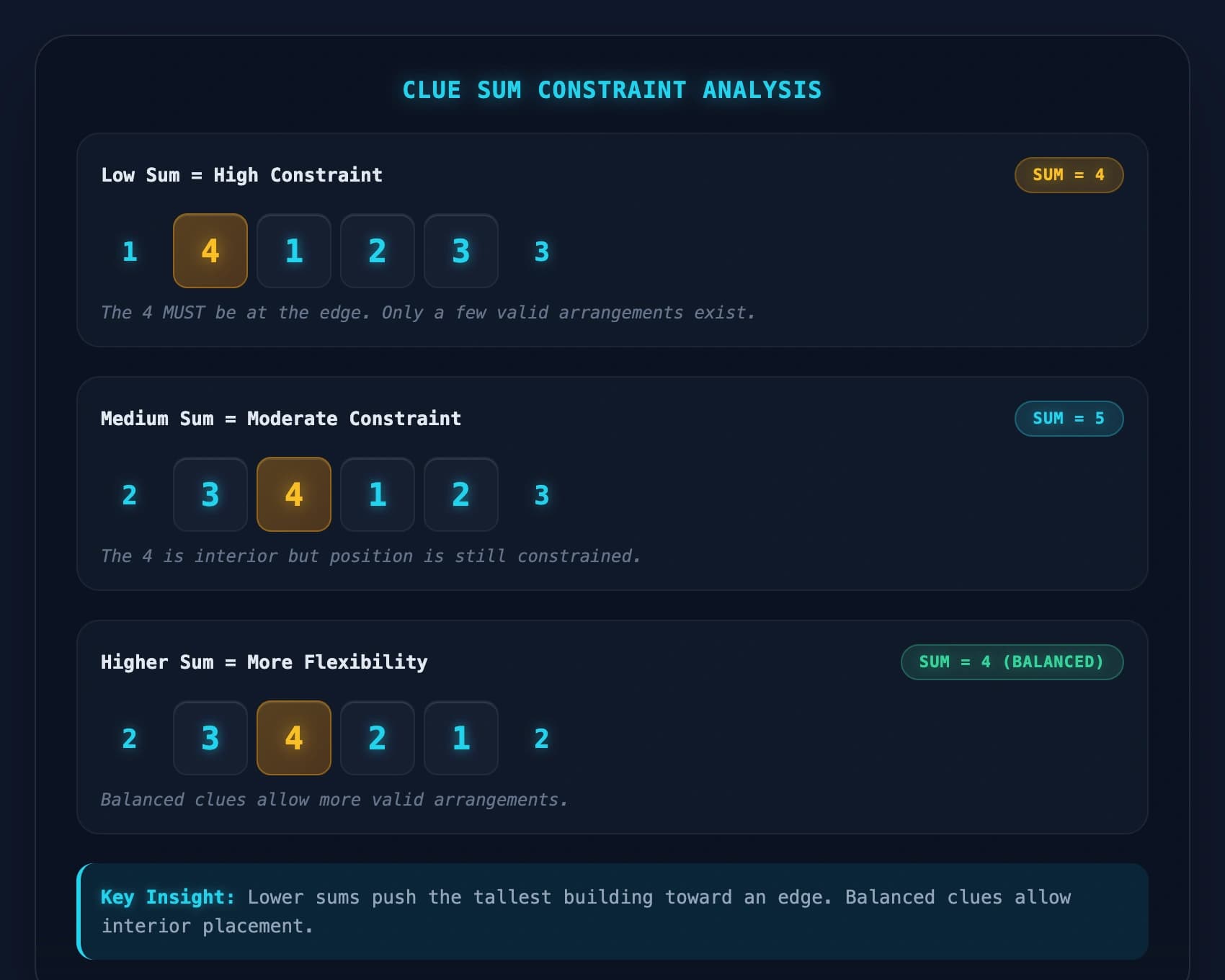
The 1-and-N Pair
The most constrained pair possible: one clue is 1, the opposite is N. In a 4x4 grid, clues (1, 4) force the row to be exactly [4, 3, 2, 1] reading from the 1-clue side.
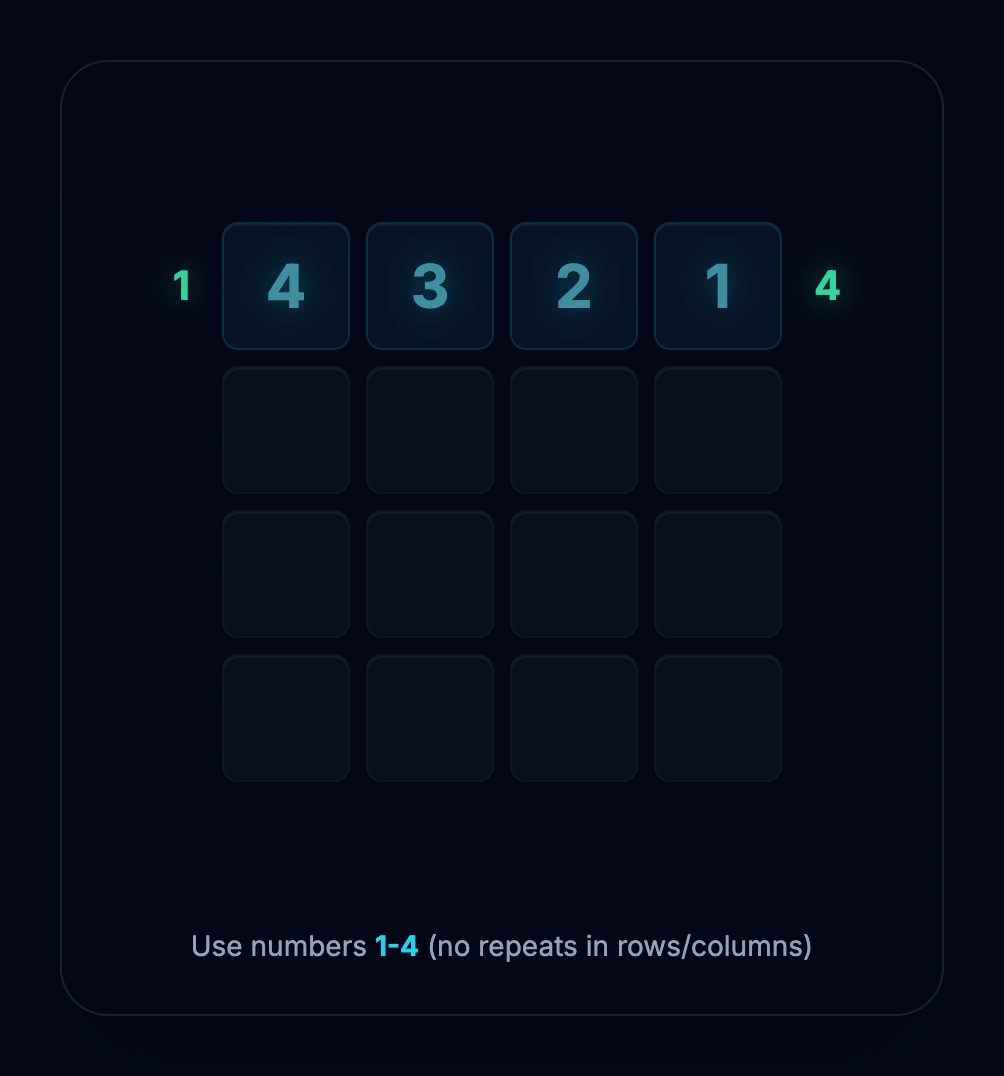
Clue = 1 says the 4 is first. Clue = 4 requires ascending from the other end. The only solution: [4, 3, 2, 1].
Strategy 4: The 2-Opposite-1 Pattern
This pattern is worth memorizing. When one clue is 1 and the opposite clue is 2:
The Rule
Clue pair (1, 2) forces the tallest building (N) at one end, and N-1 in the first position from the 2-clue side.
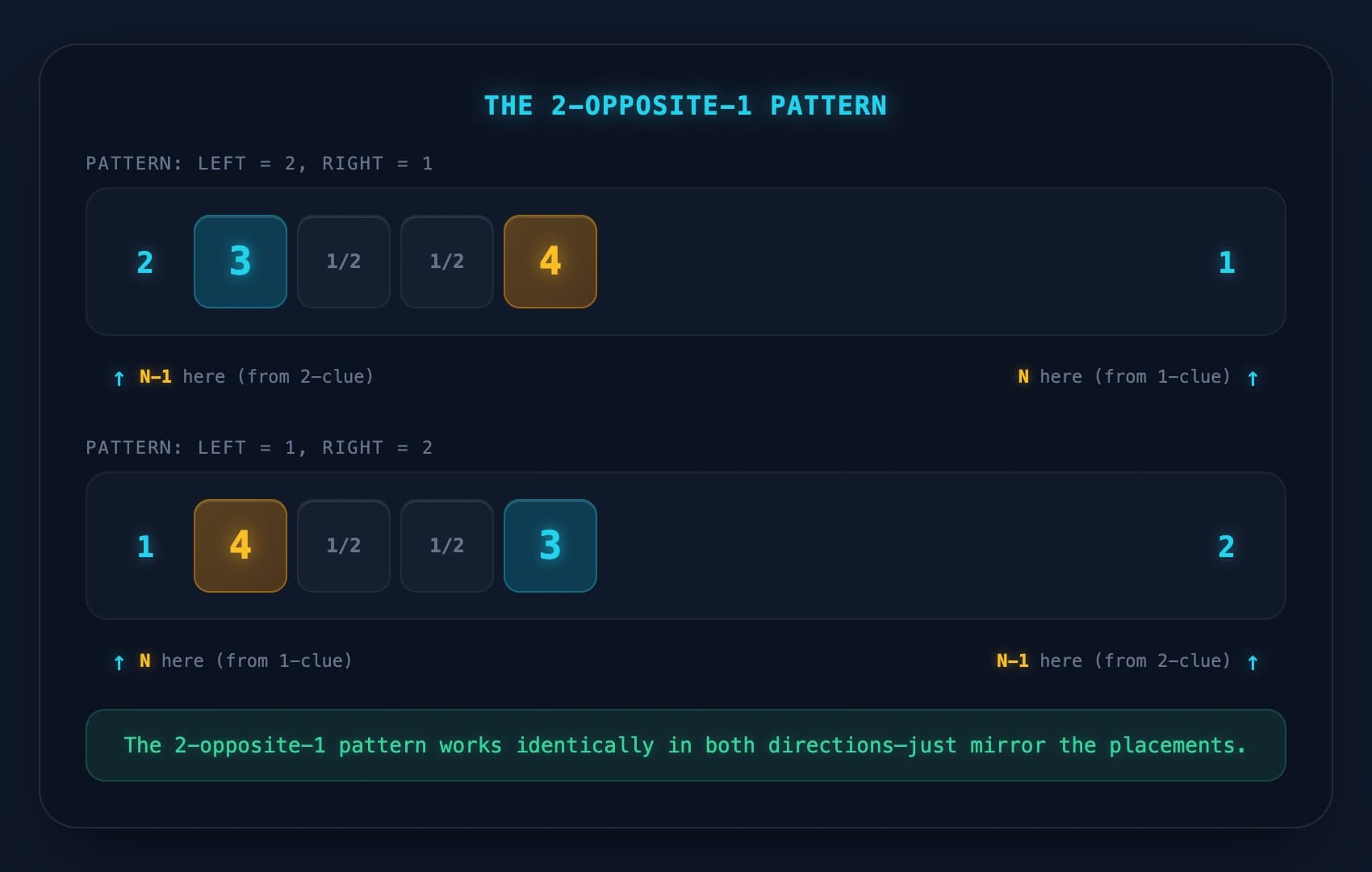
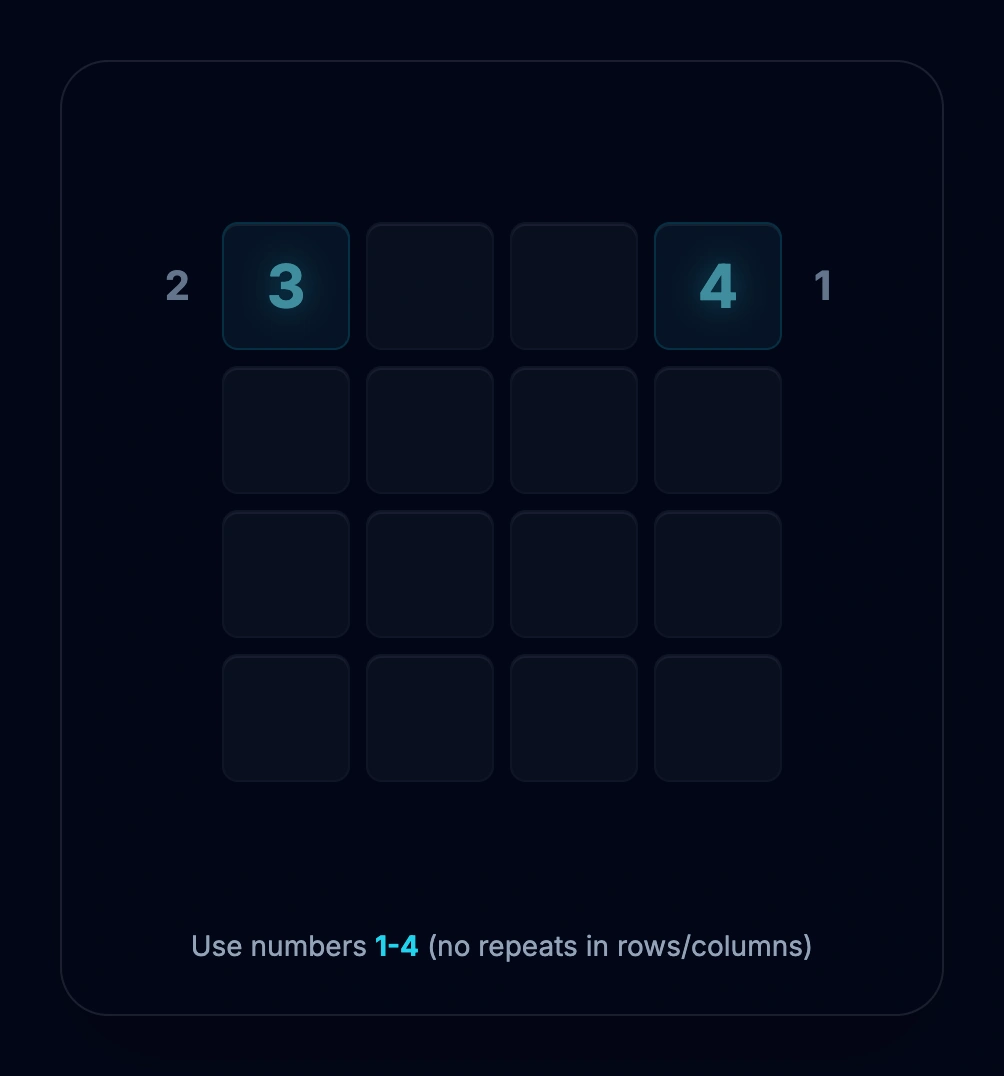
The row starts with 3 (from the 2-clue side) and ends with 4 (from the 1-clue side).
Try It Yourself
You have a 5x5 row with these clues: Left = 2, Right = 1
Which two cells can you fill in immediately, and with what values?
Reveal Answer
The rightmost cell must be 5 (clue of 1 forces N). The leftmost cell must be 4 (clue of 2 forces N-1). The row looks like [4, ?, ?, ?, 5].
Strategy 5: Latin Square Integration
Never forget: Skyscrapers is built on Latin square rules. Each number 1 through N appears exactly once in every row and exactly once in every column. The visibility clues add constraints, but the Latin square foundation often provides the final deductions.
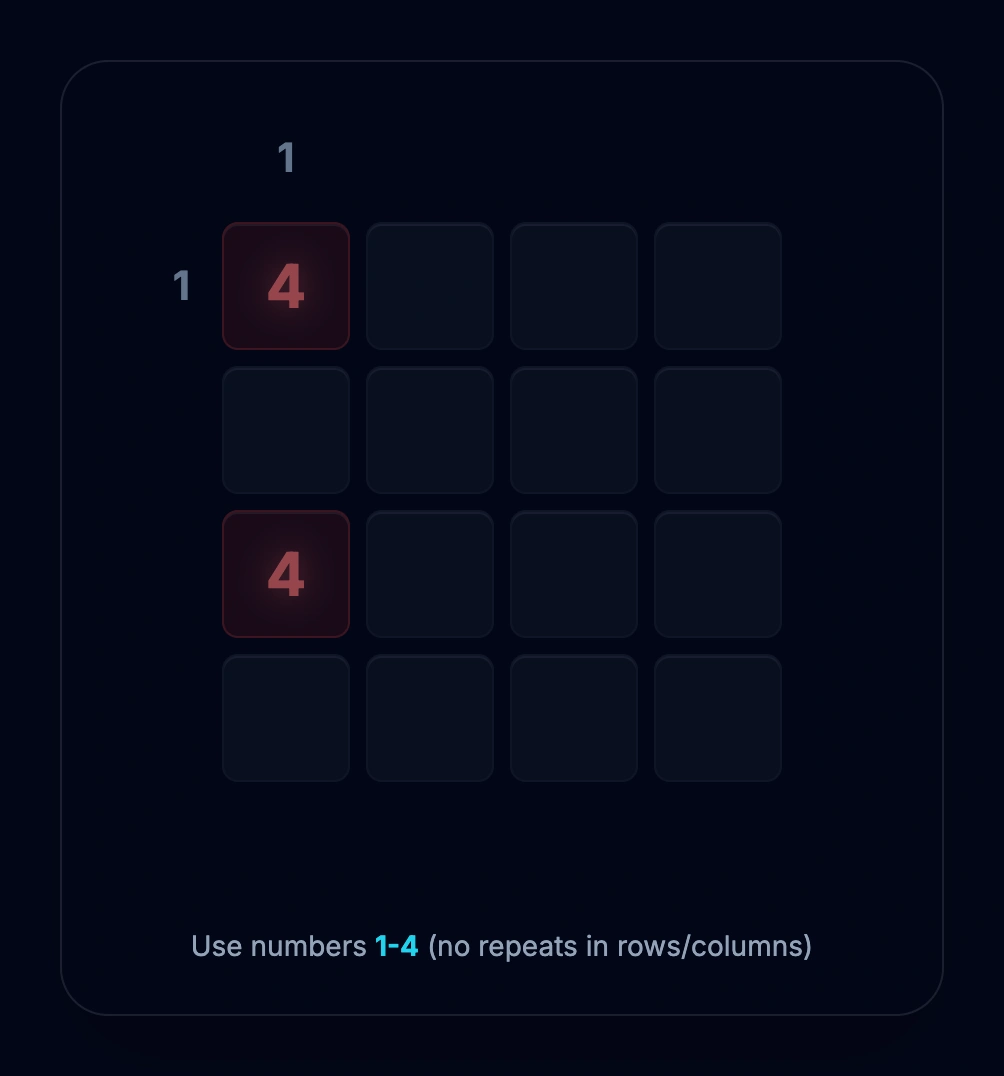
When a 4 is placed, it eliminates 4 from the entire row and column.
Hidden Singles
Sometimes a digit can only go in one place within a row or column—not because of visibility, but because Latin square logic eliminates all other positions. When stuck on visibility logic, switch to Latin square scanning.
Strategy 6: Elimination by Visibility
This technique asks: "If I place X here, does it violate any clue?" If yes, X is impossible in that cell.
The Process
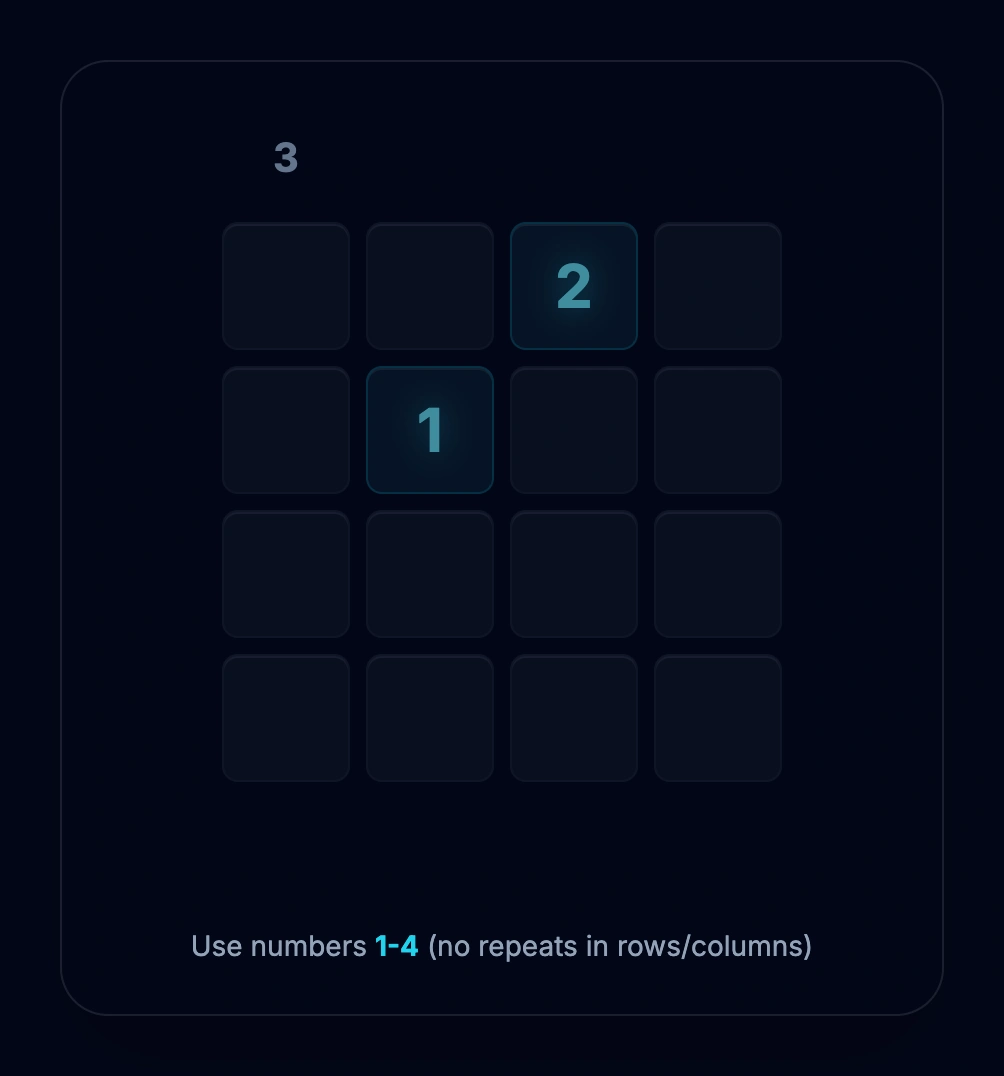
The top clue is 3. Testing candidates for (0,0) eliminates values that would produce wrong visibility.
Strategy 7: Middle Cell Deduction
When you know the edge cells of a row, the middle cells often follow quickly. The 1-clue and N-clue rules give you edges. The 2-opposite-1 pattern gives you edges. Build your solution from the boundaries inward.
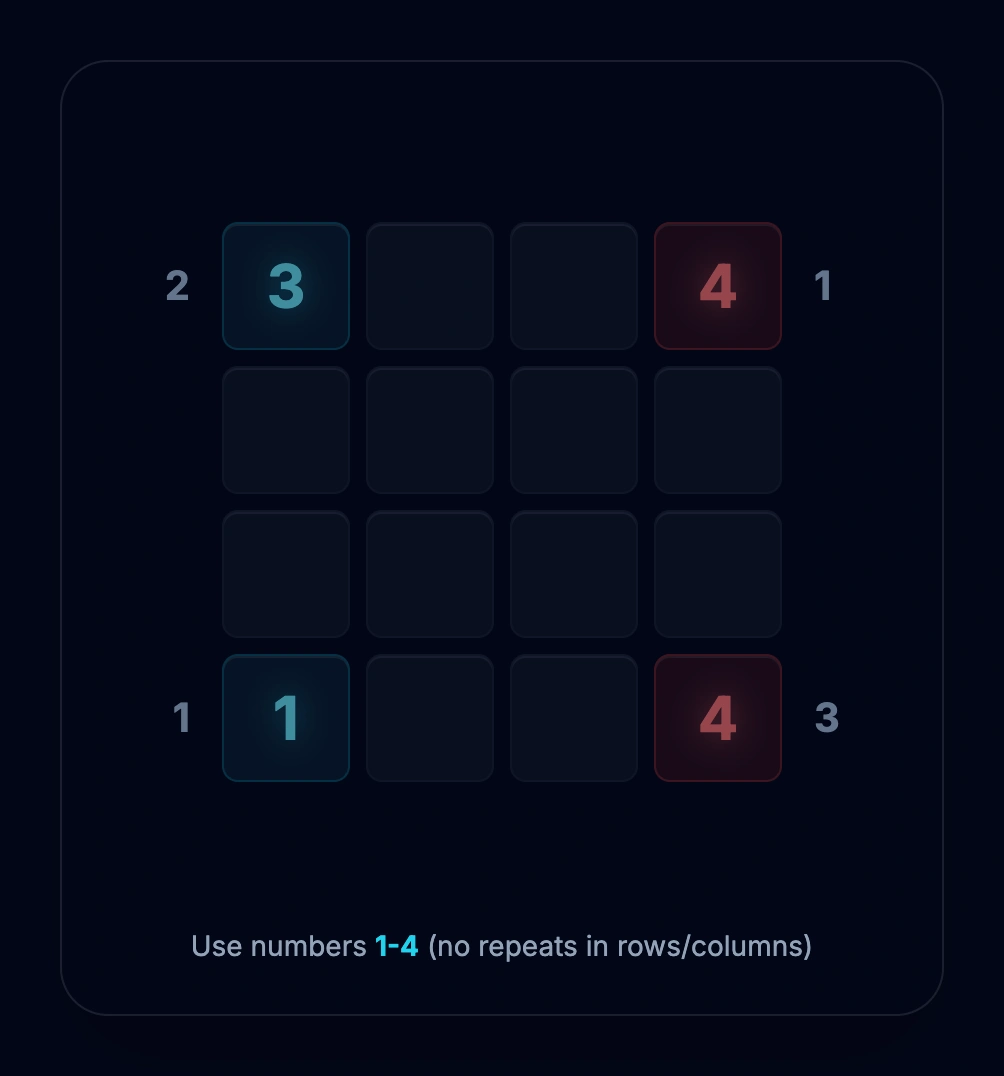
Edges solved; middle cells have limited possibilities.
The Two-Value Test
When a row has exactly two empty cells, you have only two arrangements to consider. Test each against the visibility clues. Often only one works.
Strategy 8: The Clue of 2 Analysis
Clues of 2 are the most flexible and therefore most interesting to analyze. They allow many arrangements, so you must combine them with other constraints.
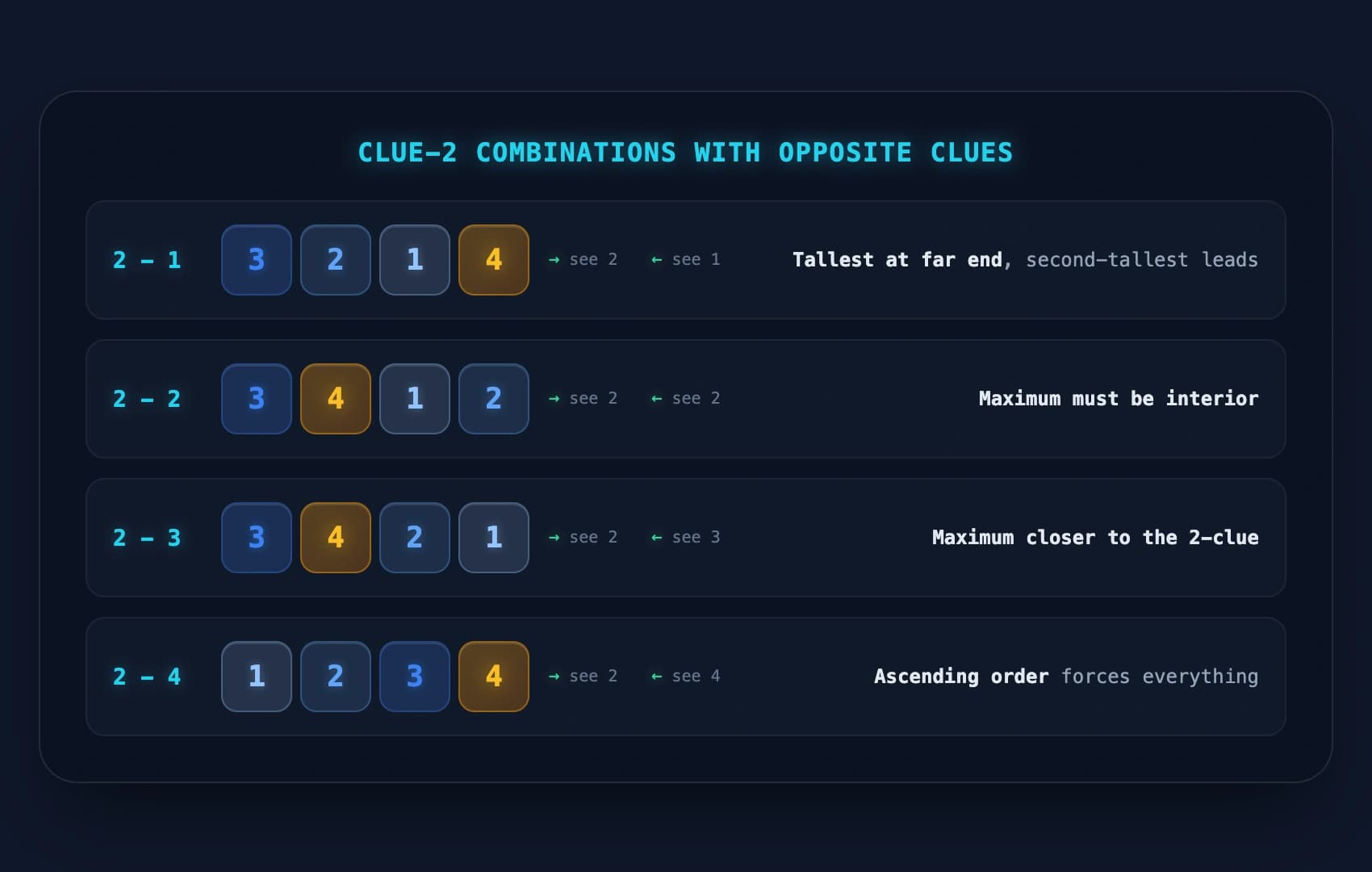
The opposite clue constrains which patterns are valid for clue = 2.
Strategy 9: Large Grid Techniques (5x5 and Beyond)
As grids grow larger, the mathematics of visibility expand dramatically. Pure pattern recognition gives way to systematic analysis.
The Clue Sum Method for Larger Grids
Rule of thumb: In an NxN grid, prioritize rows and columns where the clue sum is N+1 or less. These are your most constrained lines.
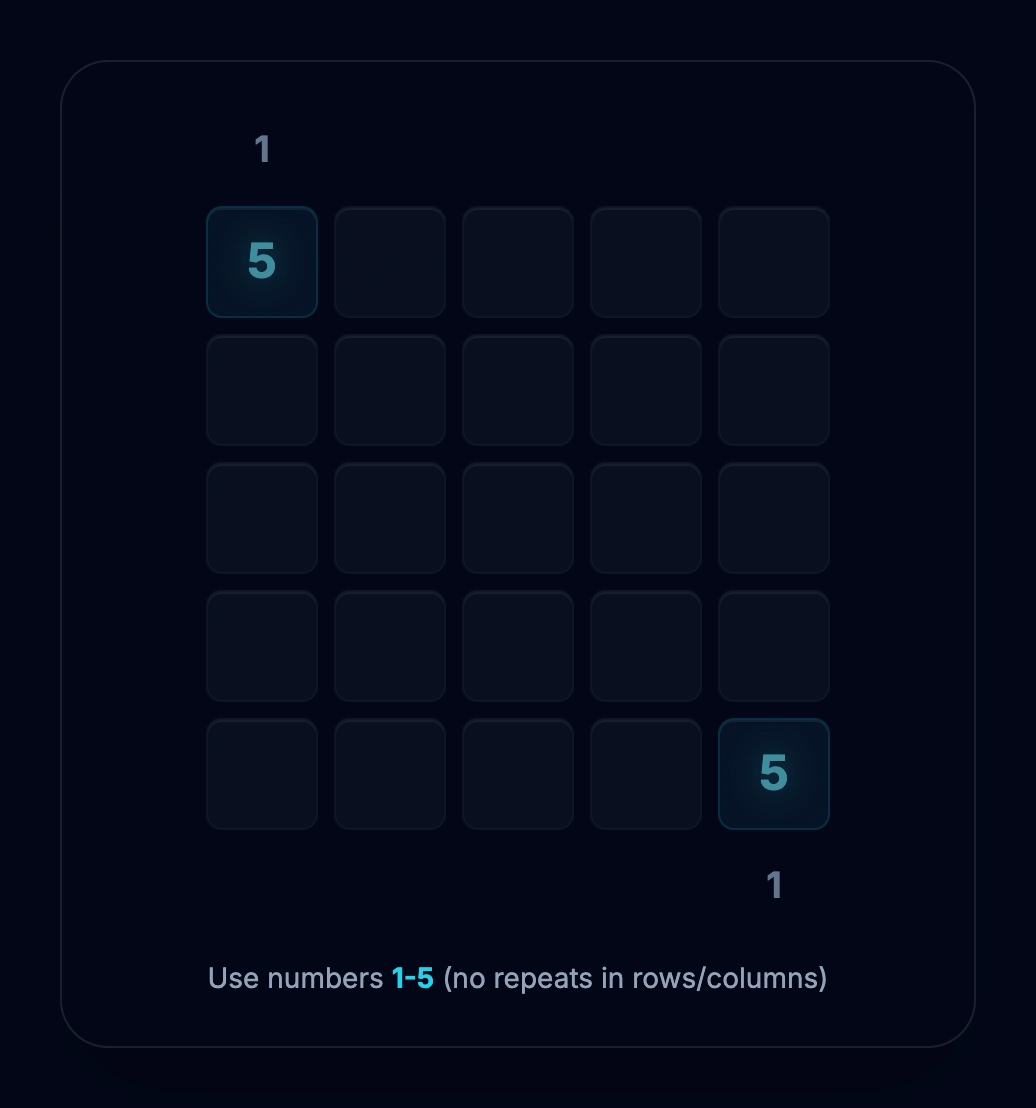
Clues of 1 at top-left and bottom-right force 5s in those positions—a common pattern in symmetric puzzles.
Strategy 10: The Candidate Tracking Method
For complex puzzles, systematic candidate tracking transforms chaos into clarity.
Naked Pairs in Skyscrapers
Just like Sudoku, Skyscrapers can have naked pairs—two cells in a row that both have exactly the same two candidates. No other cell in that row can be either of those values.
Putting It All Together: A Worked Example
Let us solve a 4x4 puzzle using our full toolkit.
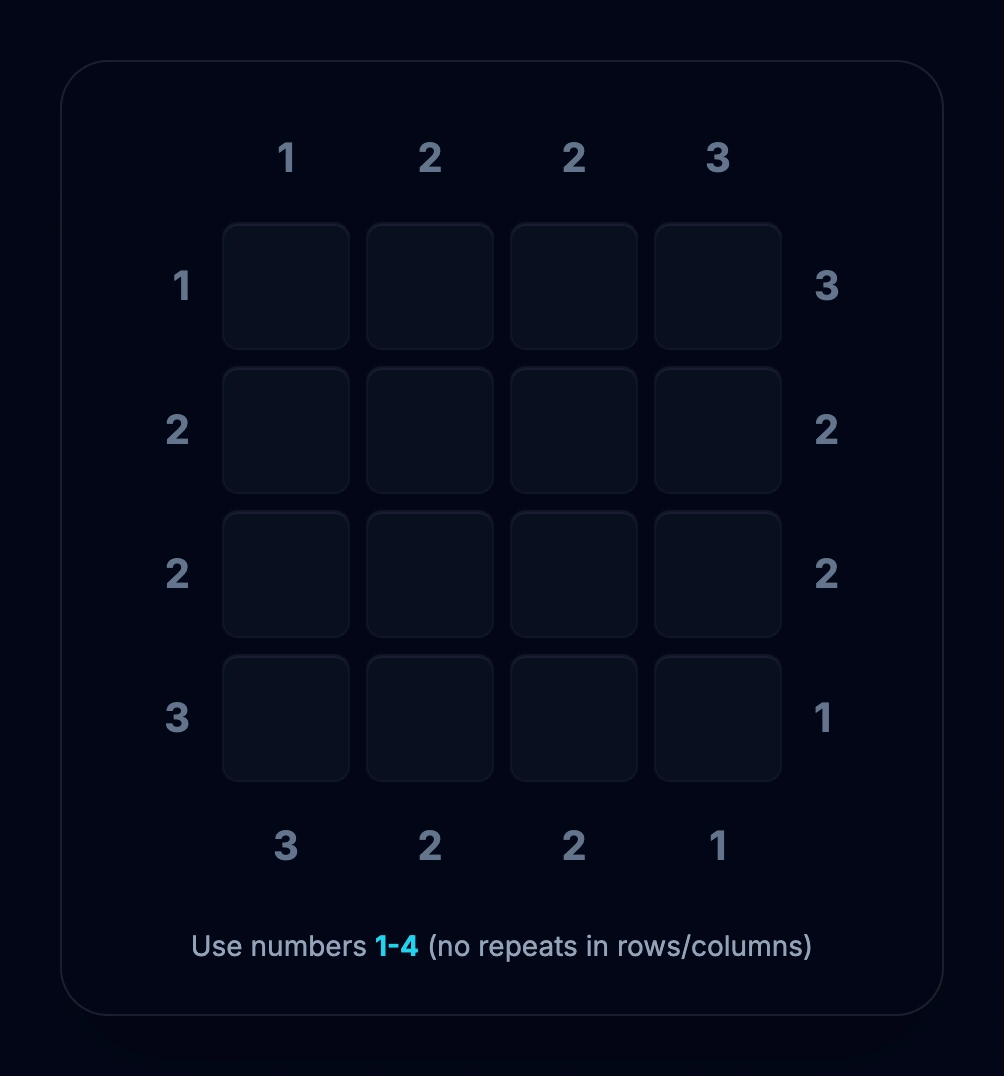
Starting puzzle: Top: 1, 2, 2, 3 | Bottom: 3, 2, 2, 1 | Left: 1, 2, 2, 3 | Right: 3, 2, 2, 1
Step 1: Find the 1-Clues
Scan all edges for clues of 1—these give us immediate placements. Top clue = 1 at column 0, bottom clue = 1 at column 3, left clue = 1 at row 0, right clue = 1 at row 3. This places 4s at (0,0) and (3,3).
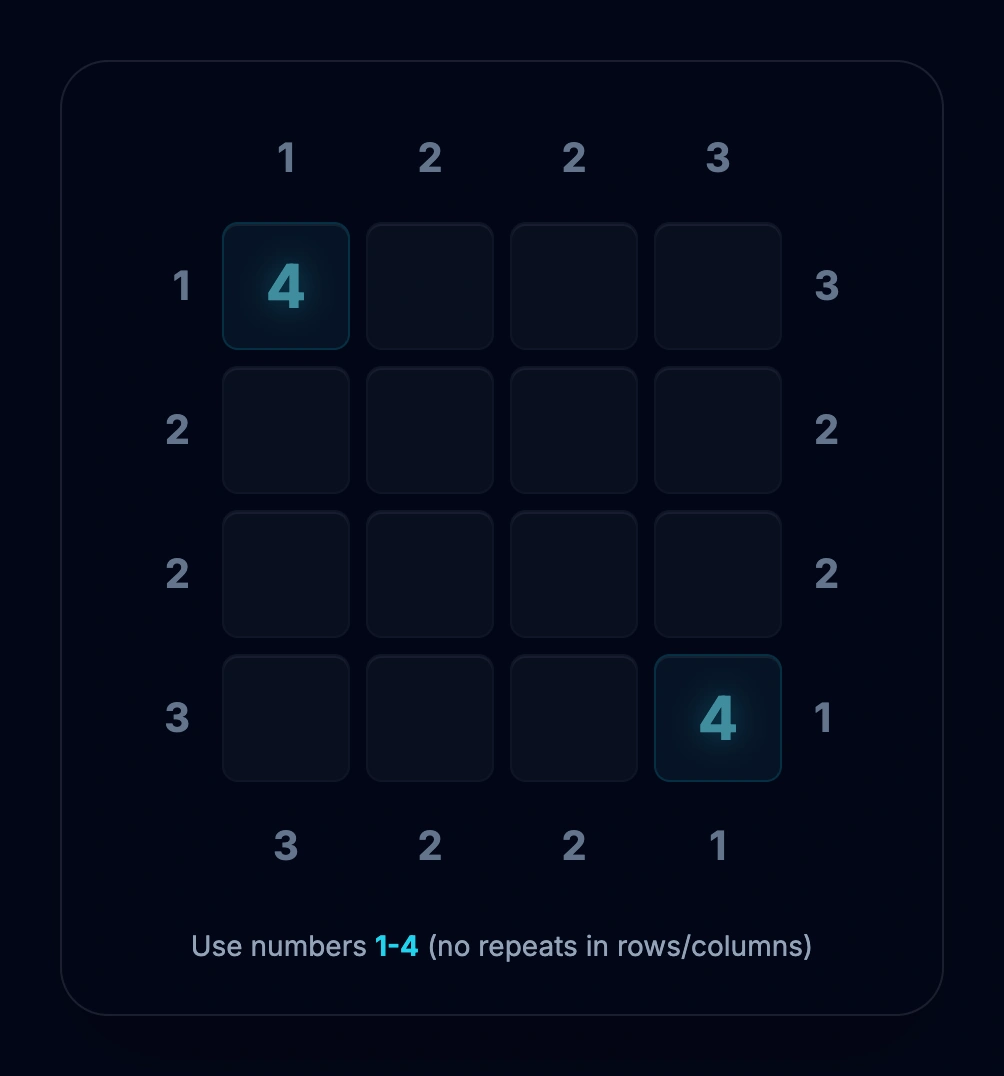
Two 4s placed with zero effort—the clue-of-1 rule at work.
Step 2: Use Symmetry and Complete
Notice the puzzle's diagonal symmetry: Top clues [1,2,2,3] match Left clues [1,2,2,3]. Using opposite clue pair analysis and symmetry recognition, we complete the solution.
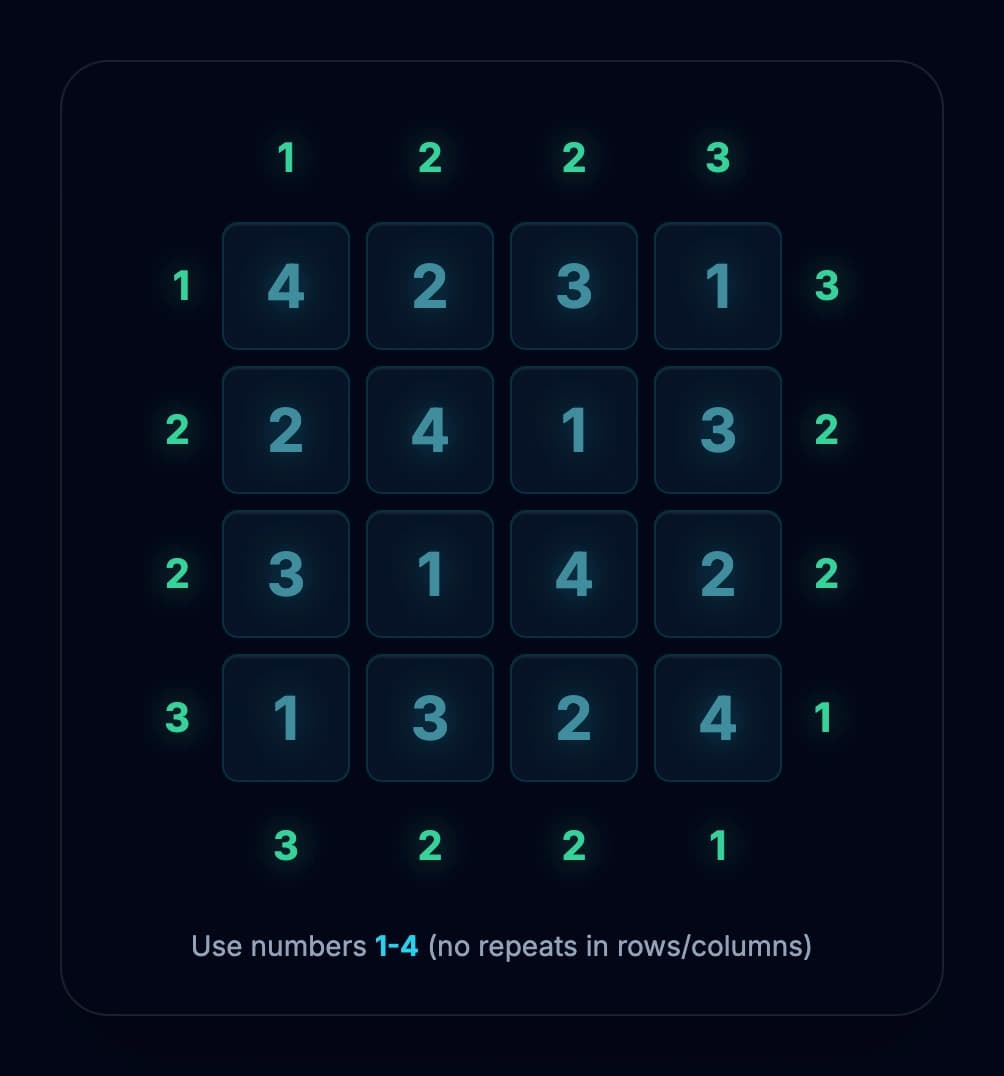
Solution verified: All 16 clues satisfied.
Common Mistakes and How to Avoid Them
Mistake 1: Ignoring the Opposite Clue
You satisfy one clue but forget to check the other end. Fix: Always verify both clues for every row and column before committing.
Mistake 2: Forgetting Latin Square Constraints
You focus so hard on visibility that you place duplicate numbers. Fix: After each placement, immediately scan the row and column for conflicts.
Mistake 3: Miscounting Visibility
Fix: Trace visibility slowly and deliberately. Ask: "Is this taller than everything before it?" Yes = visible. No = hidden.
Mistake 4: Not Using Clue Pairs
You treat each clue independently instead of recognizing their combined constraint. Fix: For each row and column, consider both clues together.
Quick-Reference Strategy Summary
Immediate Placements
- Clue = 1: First cell = N (tallest)
- Clue = N: Row is [1, 2, 3, ..., N]
- Clue pair (1, N): Row is [N, N-1, ..., 2, 1]
Clue Pair Analysis
- Clue pair (1, 2): N at far end, N-1 at near start
- Clue pair (2, 2): Maximum (N) is interior
- Low sum pairs: More constrained, solve first
Solving Order
- Place all clue-of-1 and clue-of-N cells
- Analyze opposite pairs with low sums
- Apply Latin square eliminations
- Use visibility elimination on remaining cells
- Test two-arrangement rows systematically
The Journey to Mastery
You now have the complete toolkit for Skyscrapers mastery: visibility counting, clue-of-1 and clue-of-N rules, opposite pair analysis, the 2-opposite-1 pattern, Latin square integration, and systematic elimination.
But knowledge alone does not make a master. The real transformation happens when these techniques become automatic—when you see a clue of 1 and your hand moves to place the N before conscious thought, when opposite clue pairs reveal their constraints at a glance, when the skyline assembles itself in your mind's eye.
Practice these strategies on 4x4 grids first, then progress to 5x5 and 6x6 where the same principles apply with more room for clue-pair interactions. The more puzzles you solve, the faster these patterns will emerge at a glance.
Ready to Apply These Strategies?
Start with 4x4 puzzles to internalize the clue-pair patterns. Focus on finding every clue of 1 first, then analyzing opposite pairs systematically. As the patterns become automatic, graduate to 5x5 and 6x6 grids where the mathematics expand but the principles remain the same.
Stand at each edge. Count what you would see. Build your perfect skyline.
Ready to Build Your Skyline?
The techniques are in your head. The patterns are waiting to emerge. All that's left is to stand at the edge and see what rises.
Start Solving SkyscrapersPut it into practice
Ready to solve Skyscrapers?
Open a free puzzle and turn the ideas from this guide into your next solve.