Skyscrapers Puzzle:
A Complete Beginner's Guide to Building Skylines

Imagine standing at the edge of a miniature city, peering down a street lined with buildings of different heights. Some towers loom tall enough to dominate your view. Others hide behind their taller neighbors, completely invisible from where you stand. The skyline you see depends entirely on where you're standing and what's blocking what.
Now imagine you're the architect of that city, and someone hands you a cryptic blueprint: "From the north, you should see exactly two buildings. From the south, three. From the east, one." Your job is to figure out exactly how tall each building should be so that every viewpoint matches perfectly.
That's Skyscrapers in a nutshell—also known as Towers—a puzzle where you become the master planner of a tiny metropolis, using visibility clues to deduce the only possible arrangement of towers.
The puzzle likely emerged from the logic puzzle traditions of Japan and Europe, though its exact origins remain somewhat unclear. What we do know is that Skyscrapers belongs to the Latin Square family—cousins of Sudoku—where every number appears exactly once in each row and column. But unlike Sudoku's abstract box constraints, Skyscrapers gives you something wonderfully concrete to imagine: actual buildings casting shadows over their shorter neighbors.
The rules take thirty seconds to learn. The satisfaction of placing that final tower and watching every clue click into place? That never gets old.
Watch the Tutorial
Prefer watching? This short video walks you through the rules and key techniques.
What Exactly Is a Skyscrapers Puzzle?
A Skyscrapers puzzle presents you with an empty grid (typically 4x4 or 5x5) surrounded by clue numbers on all four sides. Your mission: fill the grid with building heights so that each visibility clue is satisfied.
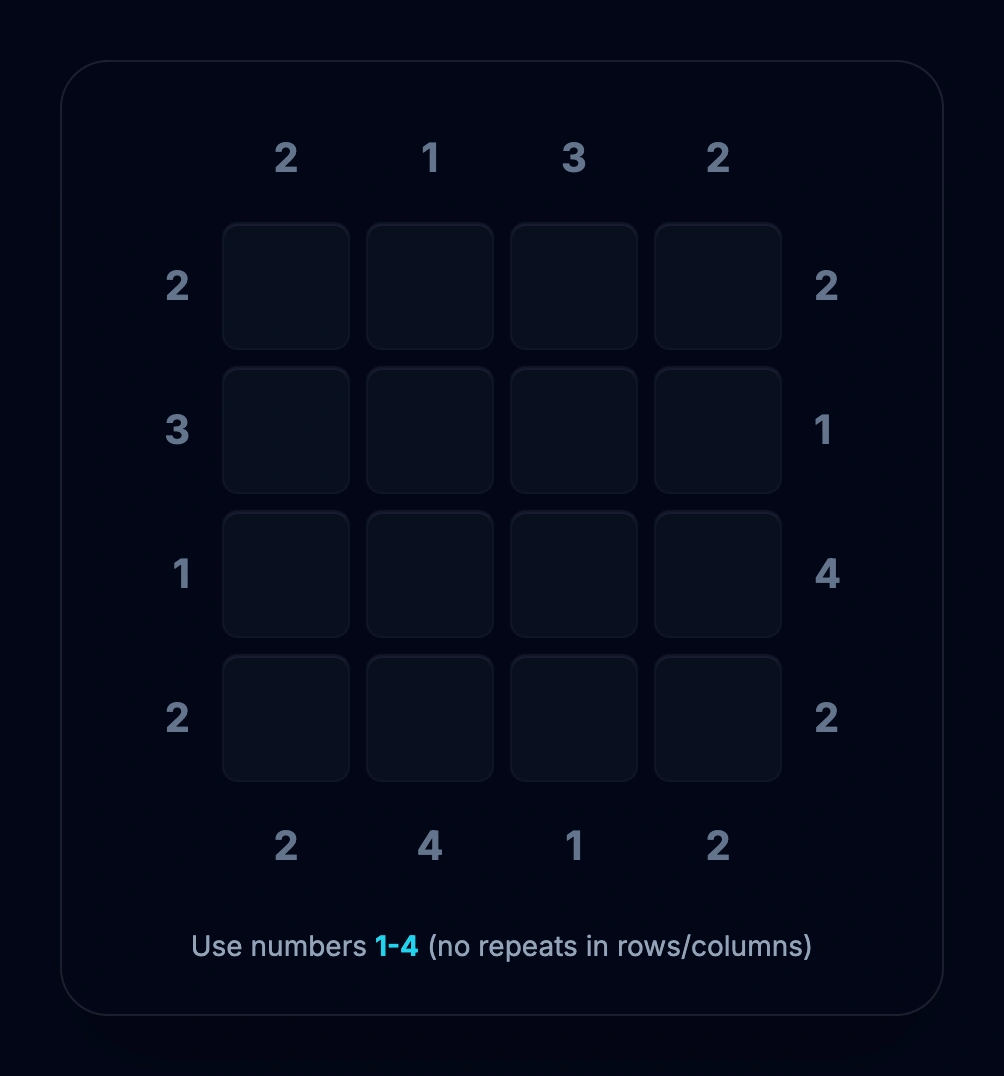
A typical Skyscrapers puzzle—fill the grid so each clue shows how many buildings are visible from that edge.
The numbers inside the grid represent building heights. In a 4x4 puzzle, you'll use heights 1, 2, 3, and 4. The clue numbers outside the grid tell you how many buildings are visible when looking into that row or column from that edge.
Here's the key insight: taller buildings block shorter ones. When you look across a row, you can only see a building if nothing taller stands between you and it. A height-4 tower blocks everything behind it. A height-1 building hides behind almost anything.
Think of it like standing in Manhattan and looking down a street. You might count three visible buildings—not because there are only three buildings, but because the tall ones in front obscure the shorter ones behind them.
The Complete Rules of Skyscrapers
Three rules govern every Skyscrapers puzzle. Master these, and you're ready to solve.
Rule 1: Fill with Heights 1 to N
In an NxN grid, use the numbers 1 through N exactly once in each row and column. For a 4x4 puzzle, that means every row contains 1, 2, 3, and 4. Every column also contains 1, 2, 3, and 4. No repeats allowed—just like Sudoku.
Rule 2: Visibility Clues Must Match
The number outside each row or column tells you exactly how many buildings are visible from that direction. A "3" means you can see exactly three buildings when looking from that edge. A "1" means only one building is visible.
Rule 3: Taller Blocks Shorter
When counting visible buildings, a taller building blocks all shorter buildings behind it. Looking at [3, 1, 4, 2] from the left: you see 3, the 1 hides, you see 4 (new tallest), the 2 hides. Total: 2 visible.
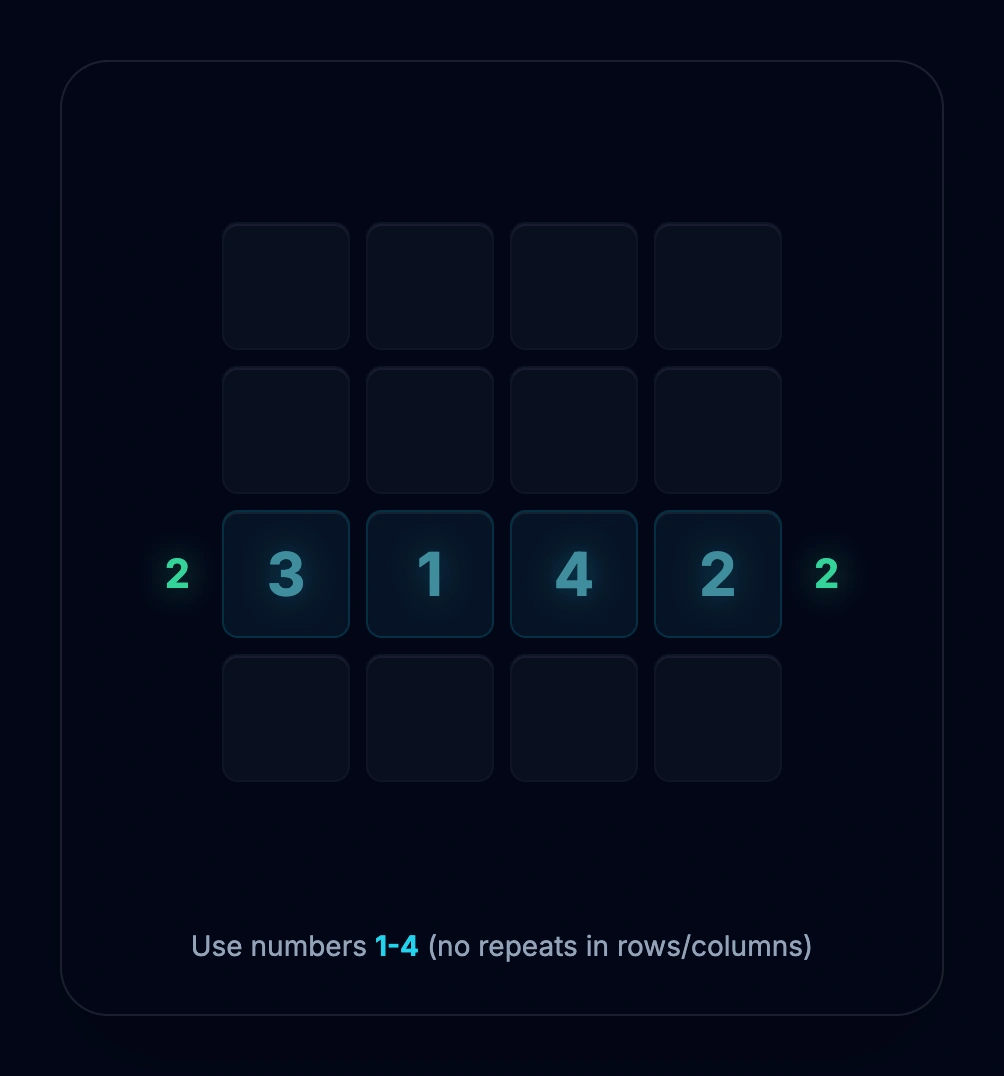
Row [3, 1, 4, 2]—from the left you see 3 then 4 (2 buildings visible), from the right you see 2 then 4 (2 visible).
Two Patterns That Unlock Every Puzzle
Pattern 1: Clue = Grid Size → Ascending Order
A clue of 4 in a 4x4 grid means buildings go [1, 2, 3, 4]. Only way to see all four.
Pattern 2: Clue = 1 → Maximum Height First
A clue of 1 means one visible building—the first one blocks the rest. Only the tallest (N) can do that.
These two patterns alone will solve most beginner puzzles. Let's see them in action.
Your First Solve: A Visual Walkthrough
Let's solve a puzzle together. I'll show you exactly what to look for and why each move is logically certain—no guessing required.
The Starting Grid
Here's our practice puzzle: a 4x4 grid with elegant symmetry that showcases the key patterns. Notice the clues mirror across the diagonal—this will help us verify our logic as we solve.
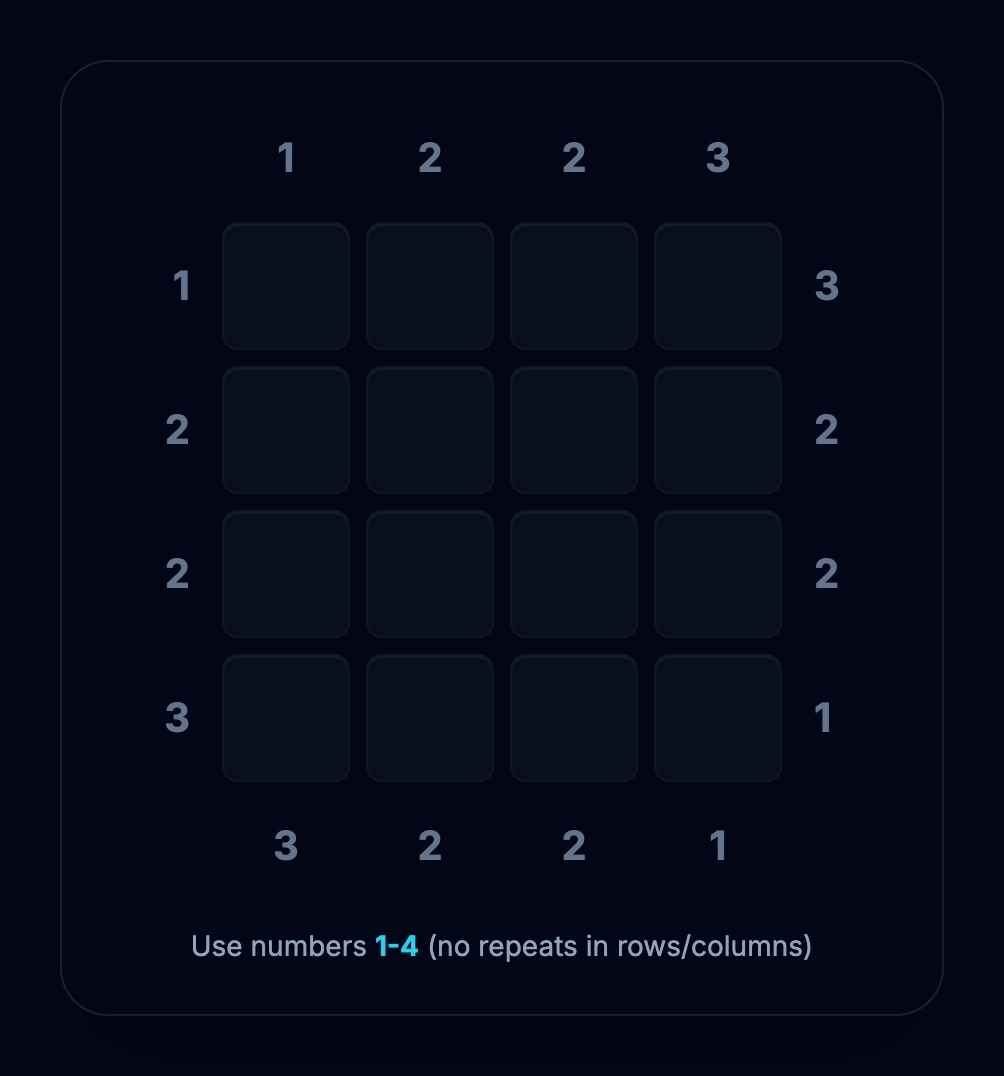
Our practice puzzle—can you spot where Pattern 2 (Clue of 1) applies?
Step 1: Apply Pattern 2 (Clue of 1)
Four clues equal 1, and they work in pairs. The top clue of 1 at column 0 means looking down, only one building is visible—the tallest (4) must be at the top. The left clue of 1 at row 0 confirms this same position.
Similarly, the bottom clue of 1 at column 3 and right clue of 1 at row 3 both point to position (3,3) needing a 4.
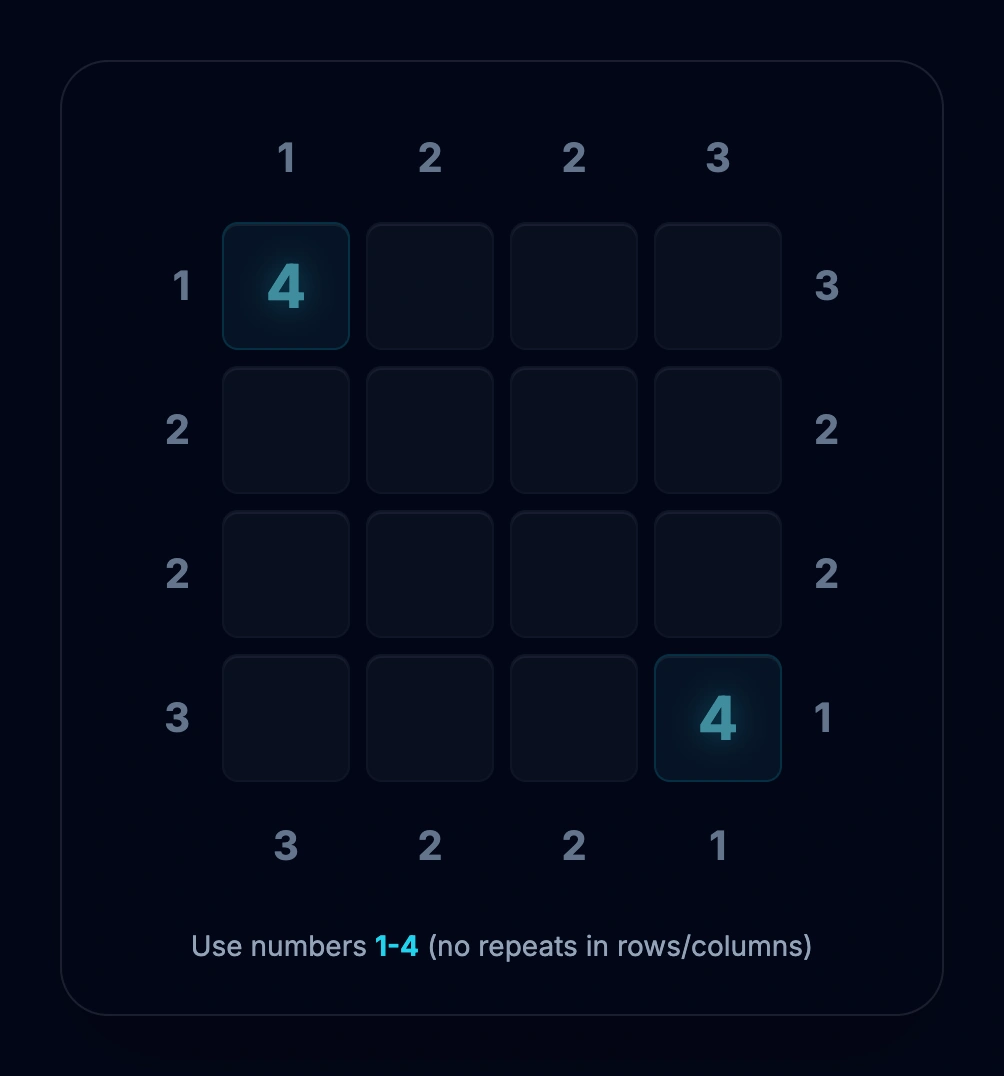
Step 1: The symmetric clues of 1 force 4s at opposite corners.
Step 2: Use Clues of 3 to Determine Column 0
The bottom clue for column 0 is 3. We already have 4 at the top. Here's the key insight: the 4 will always be visible from the bottom (it's the tallest). So we need exactly 2 more visible buildings among the remaining positions.
Since we need high visibility, we want larger numbers near the bottom where they can be seen before anything blocks them. Testing [1, 3, 2] from bottom to top gives us 3 visible buildings. This also satisfies the top clue of 1!
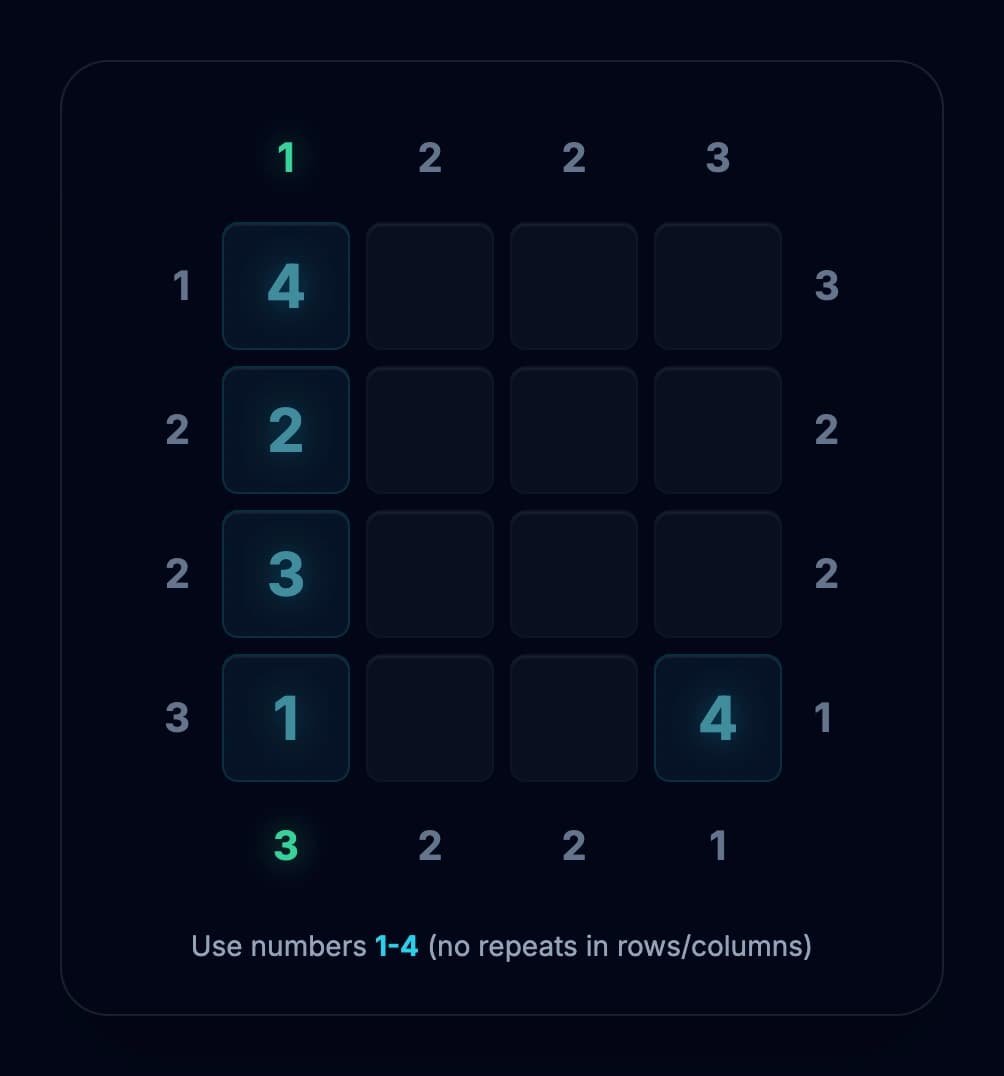
Step 2: Column 0 = [4, 2, 3, 1] satisfies both top (1) and bottom (3) clues.
Step 3: Apply Symmetry to Complete Edges
By the puzzle's diagonal symmetry, row 0 mirrors column 0: [4, 2, 3, 1] from left to right. Similarly, column 3 = [1, 3, 2, 4] and row 3 = [1, 3, 2, 4].
Verify row 0: Left clue of 1 (only 4 visible) ✓. Right clue of 3 (see 1, then 3, then 4) ✓. The logic holds perfectly.
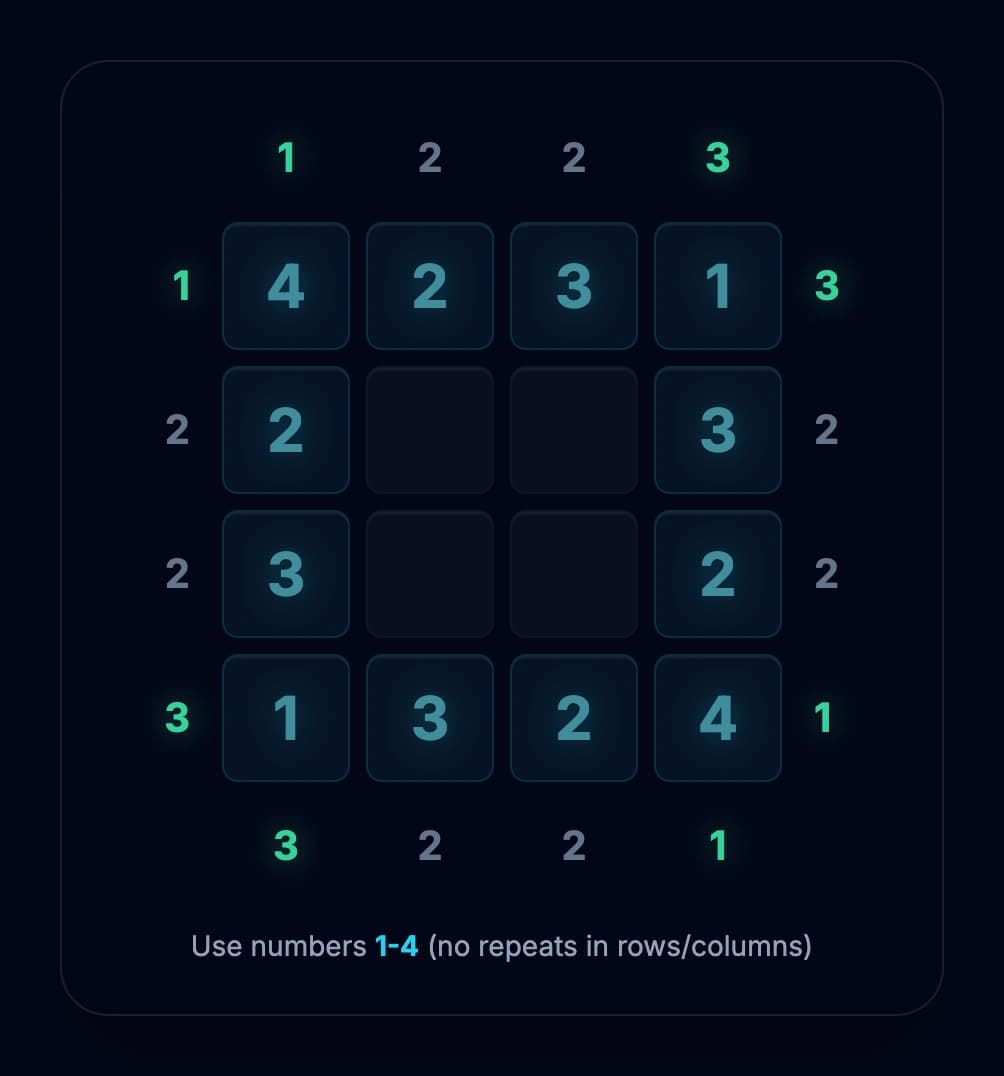
Step 3: Row 0, column 3, and row 3 complete using symmetry.
Step 4: Complete the Middle Rows
Row 1 has [2, _, _, 3]. Missing values are 1 and 4. The left clue is 2—we need exactly 2 buildings visible. If row 1 = [2, 4, 1, 3]: See 2, see 4 (taller), 1 hides, 3 hides. Count = 2 ✓
By symmetry, row 2 = [3, 1, 4, 2]. That completes the grid!
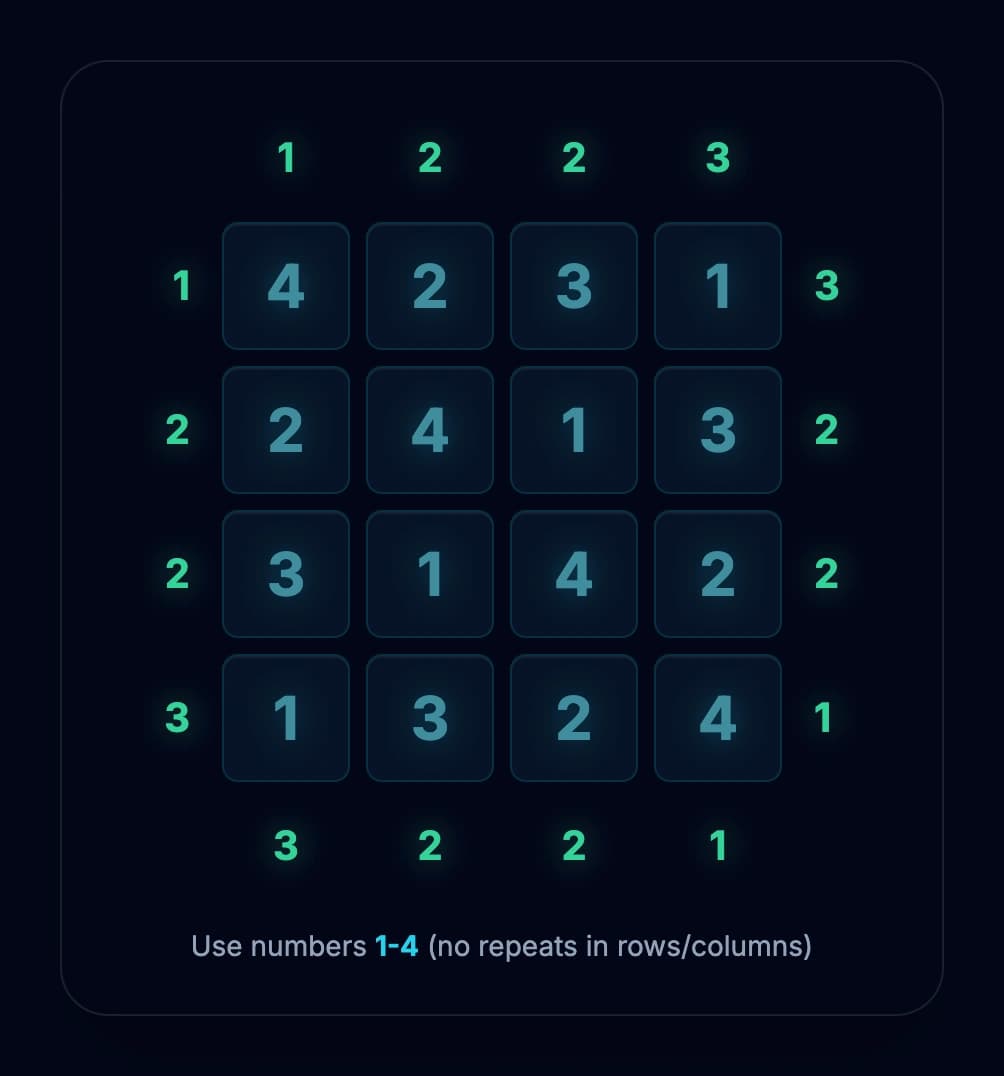
The completed puzzle—every clue satisfied through pure logic!
Key Strategies
- Always scan for 1s first — they're your anchor points that unlock the rest
- Treat opposite clues as partners — if a line doesn't satisfy both ends, your arrangement is wrong
- Verify each line before moving on — catching errors early prevents cascading mistakes
Common Mistakes and How to Avoid Them
Mistake 1: Counting Visibility in the Wrong Direction
You count visibility from the wrong end, placing the 4 at the wrong position. Fix: Always trace from the clue's position INTO the grid. A top clue looks down. A left clue looks right.
Mistake 2: Satisfying One Clue While Breaking the Other
You satisfy one clue but ignore the constraint from the opposite end. Fix: After placing numbers, verify BOTH clues for that row or column.
Mistake 3: Violating Latin Square Rules
You focus so much on visibility that you accidentally repeat a number. Fix: After each placement, quick-scan the row and column to confirm no duplicates.
Mistake 4: Forgetting That Middle Buildings Matter
You assume clues only affect edge positions. In [2, 4, 1, 3], that 4 in position 2 hides BOTH the 1 and 3 when looking from the left. Fix: Remember that visibility is cumulative.
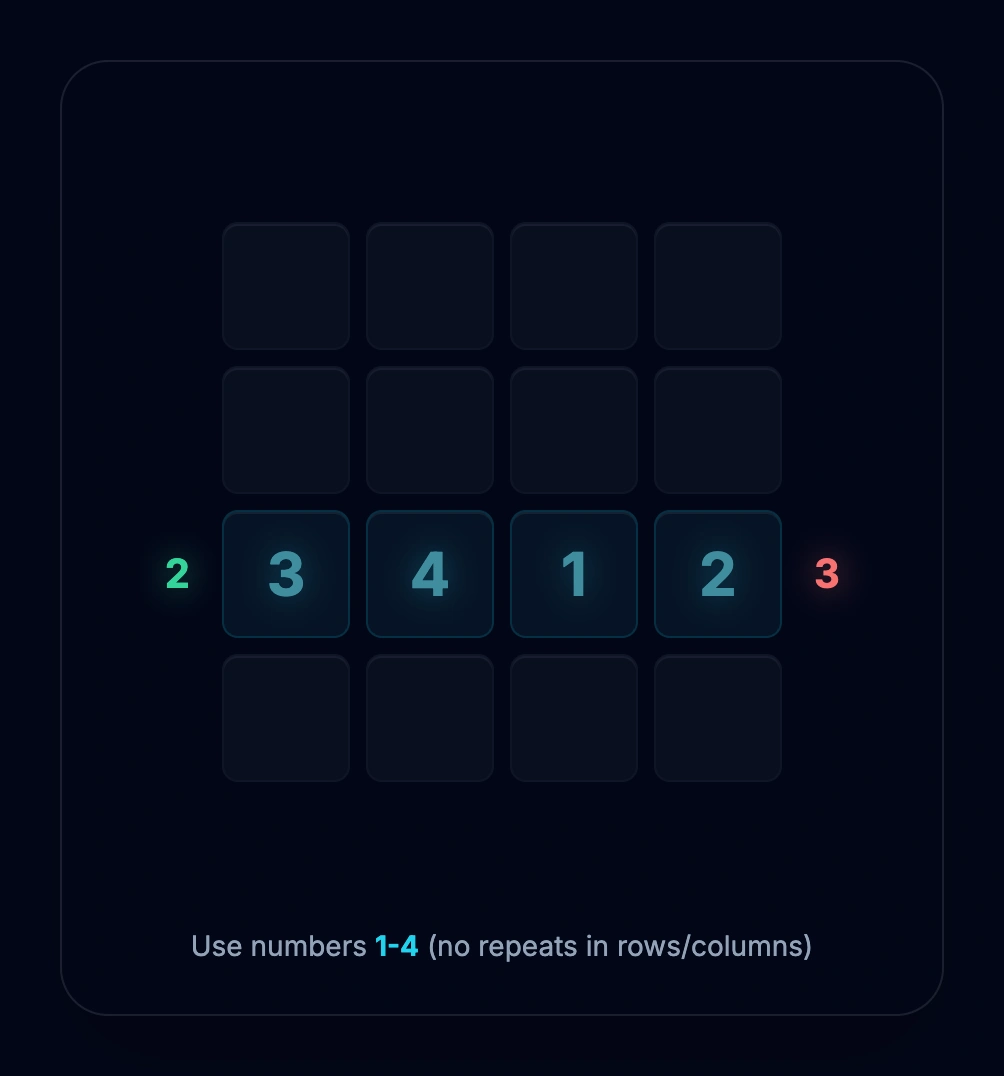
Row [3, 4, 1, 2] satisfies left clue (2) but fails right clue (should be 3, actually 2).
Difficulty Progression: Your Path Forward
Skyscrapers puzzles scale beautifully from gentle introductions to serious challenges. Think of it like urban planning: 4x4 is a small town where you know every building, 5x5 is a city district that requires real mapping, and 6x6+ is where you're designing Manhattan.
4x4 Grids — Beginner
Perfect for learning. With only 4 buildings per line, you can often spot patterns instantly. Most 4x4 puzzles solve in under 5 minutes once you know the techniques.
5x5 Grids — Intermediate
More numbers mean more subtle visibility patterns. Clues of 2 and 3 become more ambiguous. Expect 5-15 minutes for comfortable solves.
6x6 and Beyond — Advanced
Enthusiast territory, often requiring 20-40 minutes as the mathematics of visibility expand dramatically and pure pattern recognition gives way to deeper logical chains.
What Makes Skyscrapers Special
Skyscrapers offers something unique in the puzzle world: visual logic. Unlike pure number puzzles, you can literally imagine standing at each edge and counting buildings. This mental imagery makes the puzzle accessible in a way that abstract constraints never can.
It's also the perfect "gateway puzzle" for Sudoku lovers looking to expand their horizons. The Latin Square foundation is familiar, but the visibility mechanic adds a layer of spatial reasoning that engages different parts of your brain.
And there's something deeply satisfying about the metaphor itself. You're not just filling in numbers—you're designing a skyline where every viewpoint tells a coherent story.
Ready to Build Your First City?
You now understand everything needed to solve Skyscrapers puzzles. The rules are intuitive. The strategies are logical. The satisfaction of watching every clue click into place—each visibility count matching perfectly as your skyline takes shape—is waiting for you.
Here's a parting thought: Next time you're in a real city, look down a street and count how many buildings you can actually see. Notice how the tall ones dominate and the short ones hide. That instinct you're using? It's exactly what Skyscrapers transforms into a puzzle.
Every solved Skyscrapers puzzle is a perfect skyline you designed from scratch—one where every building has its place and every view tells a story.
Quick Reference
- Clue = 1: Tallest building (N) goes first
- Clue = N: Buildings go in ascending order [1, 2, ..., N]
- Always verify both clues for each row/column
- Latin Square rules — no repeats in any row or column
Ready to Build Your First Skyline?
The patterns are in your head. The rules are crystal clear. All that's left is to start placing towers and watch your city take shape.
Start Solving SkyscrapersPut it into practice
Ready to solve Skyscrapers?
Open a free puzzle and turn the ideas from this guide into your next solve.