Pipes Strategies:
Network Flow Techniques for Seamless Connections

In Pipes, the edges are not limitations—they are solutions. A corner piece has one valid orientation. An edge piece has half the usual options. The boundary of the puzzle is a wall of constraints that ripples inward, forcing pipe after pipe into position.
The solvers who struggle are the ones who start in the middle, rotating tiles at random, hoping connections will materialize. The ones who flow through effortlessly? They have mastered the outside-in technique. They know that by the time they reach the center, the puzzle has already solved itself.
This is the shift from beginner to intermediate solver: recognizing that Pipes puzzles (also called Net, Plumber, or FreeNet puzzles) are not about finding connections—they are about recognizing constraints. Every pipe type, every grid position, every neighboring cell creates limitations. String enough limitations together, and only one orientation remains possible.
Watch the Tutorial
New to Pipes? This tutorial covers the fundamentals.
Prerequisites
This guide builds on our beginner's guide, which covers the five rules, pipe types, and introductory strategies. If corner-first solving and basic connectivity propagation feel unfamiliar, start there.
What You'll Learn
- •Corner Certainty Principle: Why corner pipes have exactly one valid orientation
- •Edge Exclusion: How boundary constraints eliminate possibilities instantly
- •Dead-End Prevention: Recognizing invalid configurations before you make them
- •The Must-Connect Rule: Handling incoming connections from neighbors
- •Outside-In Solving: The four-phase systematic approach
- •Constraint Chains: Multi-cell deductions that cascade through the grid
The Corner Certainty Principle
Let me state this as clearly as possible: a corner pipe in a corner cell has exactly one valid orientation. No analysis needed. No consideration of neighbors. Just rotate and move on.
Why? A corner cell can only connect in two directions—toward the interior of the grid. The other two directions face the grid boundary, where connections are impossible. A corner pipe (L-shaped, two adjacent openings) must orient so both openings point inward.
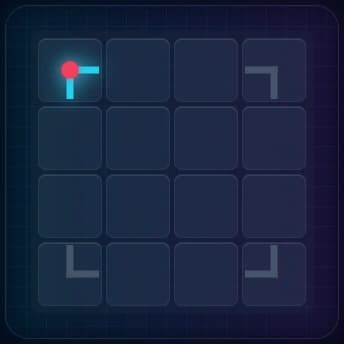
Corner pipes in corner cells have exactly one valid orientation. All four corners here are immediately solvable.
This is not a strategy—it is a guarantee. Corner pipes in corners are solved the moment you look at them. Experienced solvers solve all four corners in under 3 seconds. The pattern is that automatic.
The Corner Constraint for Other Pipe Types
The corner cell constraint extends to every pipe type, not just corner pipes:
| Pipe Type | Valid Orientations in Corner | Notes |
|---|---|---|
| Corner (L) | 1 | Completely determined |
| End | 2 | Check neighbors to resolve |
| T-Junction | 2 | Check neighbors to resolve |
| Straight | Special | Rare in corners; check for wrap mode |
| Cross | 0 | Cannot exist in corners (standard mode) |
Edge Constraints: Three Neighbors, Tighter Logic
Edge cells (not corners) have three valid connection directions instead of four. This 25% reduction in possibilities sounds modest until you realize it compounds across the entire perimeter of the grid.
The Edge Exclusion Rule
For any pipe on an edge:
This single rule eliminates orientations before you consider anything else.
Edge Patterns by Pipe Type
The Highway Rule
A straight pipe on any edge must run parallel to that edge. Top or bottom edge: straight pipes are horizontal. Left or right edge: straight pipes are vertical. This is a logical certainty—no exceptions in standard Pipes. These edge-parallel straight pipes often form the "highways" of your network, running along the perimeter before the flow diverts inward.
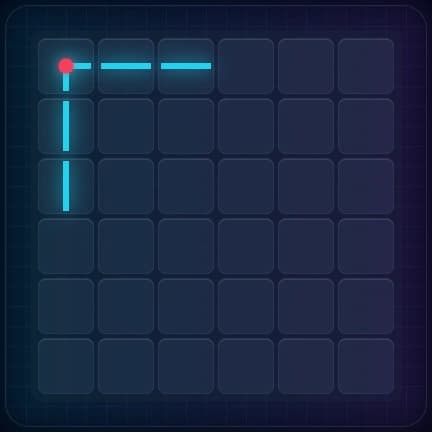
Straight pipes on edges must run parallel to the edge—forming the perimeter "highways" of the network.
Dead-End Prevention: The Wall Rule
Here is a fundamental truth that governs every Pipes move: a pipe opening facing a wall (grid boundary) or a closed pipe side is invalid.
This seems obvious, but its implications ripple through entire puzzles.
The Principle
Every opening must connect. An opening facing a wall connects to nothing. Therefore, no opening can face a wall.
The same logic applies to closed pipe sides. If Pipe A's blocked side faces Pipe B, then Pipe B cannot have an opening facing Pipe A. That opening would connect to nothing—a wall, effectively.
Identifying Dead Ends Before They Form
Scan for situations where an orientation would create a dead end:
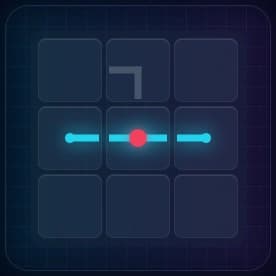
The horizontal straight pipe in the center can only connect through its left and right openings. End pipes on the sides correctly point at the straight pipe's openings.
The Dead-End Chain Reaction
When you identify that a pipe cannot face a certain direction (dead end), that constraint often determines the pipe's entire orientation. And that determined orientation becomes a new constraint for neighboring pipes, which may resolve their orientations, which constrains their neighbors...
This chain reaction is how experienced solvers "see" solutions propagate across the grid. Each dead-end constraint generates new constraints. The puzzle solves itself in cascading waves.
The Must-Connect Rule: Receiving What Faces You
If a neighboring pipe has an opening facing your cell, your pipe must receive it. You cannot turn away.
This is the flip side of dead-end prevention. Where dead-end prevention says "do not point at walls," the must-connect rule says "accept all incoming connections."
The Principle Stated Clearly
Imagine Cell A contains a pipe with an opening pointing toward Cell B. Cell B's pipe must have an opening pointing back toward Cell A. There is no escape—the incoming connection must be received.
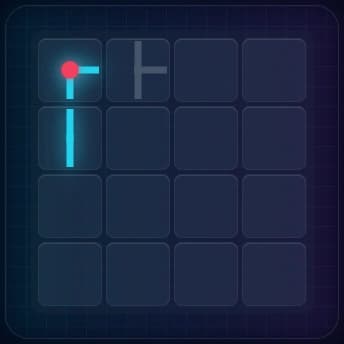
The corner pipe in the top-left opens right and down. The T-junction to its right must have an opening facing left to receive the connection.
Multi-Directional Must-Connect
The most powerful deductions happen when a cell receives openings from multiple directions. Think of it as an interview—the more neighbors demanding your attention, the fewer ways you can satisfy them all:
Working Outside-In: The Systematic Solving Order
Random clicking is the enemy of progress. Strategic solving order is the friend.
The outside-in technique exploits a simple truth: boundary cells are more constrained than interior cells. Start where constraints are tightest, then propagate inward.
Phase 1: Corners (Immediate)
Solve all four corners first. Corner pipes in corners are determined. Other pipe types in corners are heavily constrained. This takes seconds and establishes anchor points.
Phase 2: Edges (Fast)
Work along each edge, from solved corners outward. The corner's opening toward adjacent cells creates must-connect constraints. Combined with edge exclusion, often only one orientation works.
Phase 3: Edge-Adjacent Interior (Methodical)
The cells just inside the edges are next. They border solved edge cells, so they receive must-connect constraints from multiple directions. Work inward one layer at a time.
Phase 4: Deep Interior (Often Automatic)
By the time you reach the center cells, they are surrounded by solved pipes. Multiple must-connect constraints typically determine them completely.
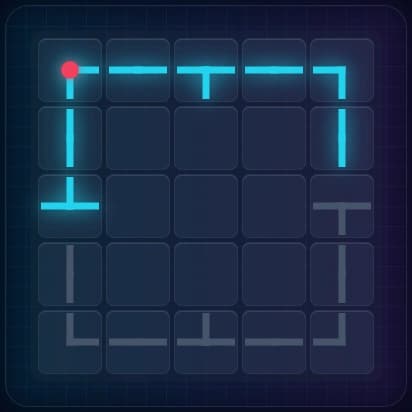
Corners (Phase 1) and edges (Phase 2) solved. The interior remains—but constraints from the perimeter will cascade inward.
| Phase | Cells | Constraints Used |
|---|---|---|
| 1 | Corners | Corner certainty principle |
| 2 | Edges | Edge exclusion + incoming connections from corners |
| 3 | Edge-adjacent interior | Forced connections from edges |
| 4 | Deep interior | Surrounded by solved neighbors |
T-Junction Analysis: Three Openings, One Blocked Side
T-junctions are the diplomats of Pipes puzzles—they must face three neighbors while politely giving one the cold shoulder. Three openings allow branching; one blocked side creates asymmetry. Mastering T-junctions means understanding which way that cold shoulder must face.
The Blocked-Side Principle
A T-junction's blocked side must face something that does not need to receive a connection:
- The grid boundary (on edges)
- An empty cell
- A neighbor pipe's blocked side
- An end pipe's back
If three of the four neighboring cells need connections, the T-junction must open toward all three. The fourth neighbor receives the blocked side.
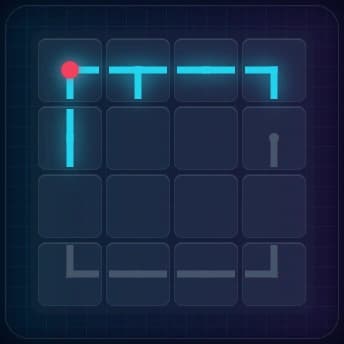
The corner pipe in the top-left opens right, forcing the adjacent T-junction to have an opening facing left. The T's blocked side faces the top boundary.
Cross Pipe Placement: The Four-Way Constraint
Cross pipes are the divas of the pipe world—they demand attention from every direction. Opening in all four directions seems like flexibility, but it is actually the tightest constraint in the puzzle. A cross pipe needs four neighbors who can all connect to it. Miss one, and the diva cannot perform.
The Cross Pipe Requirement
A cross pipe is valid only if:
- It is not on any edge or corner (would have openings facing the boundary)
- All four neighbors can receive a connection
This makes cross pipes rare and powerful. When you see a cross pipe, you learn about its neighbors: every neighbor must have an opening toward the cross pipe.
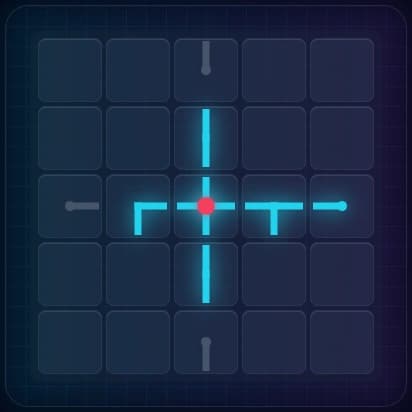
The cross pipe in the center demands connections from all four neighbors. This cascades into orientation requirements for each surrounding pipe.
The Single Path Principle: Tree Structure Enforcement
Pipes networks must form trees—connected graphs with no cycles. This sounds abstract but has concrete implications.
No Loops Allowed
If connecting a pipe would create a cycle (a path that returns to its starting point), that connection is forbidden.
Watch for situations where you are about to close a loop:
- Three pipes already form a U-shape
- The fourth pipe could complete the square
- That fourth connection would create a cycle
- Therefore, the fourth pipe must orient differently
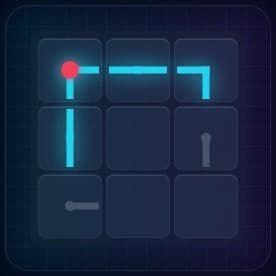
End pipes terminate branches instead of creating loops. If these were corner pipes connecting to each other, they would form an illegal cycle.
Constraint Chain Analysis: Multi-Cell Deductions
Have you ever solved one cell and watched three neighbors instantly resolve? That cascade—where solving one pipe triggers a chain reaction across the grid—is constraint propagation in action. Learning to trigger it deliberately is what separates intermediate from advanced solvers.
The Two-Cell Forced Pair
Consider two adjacent cells where:
- Cell A's only valid orientations all open toward Cell B
- This forces Cell B to open toward Cell A
- Cell B's remaining valid orientations (those opening toward A) may be limited
Sometimes, a two-cell analysis resolves both cells completely.
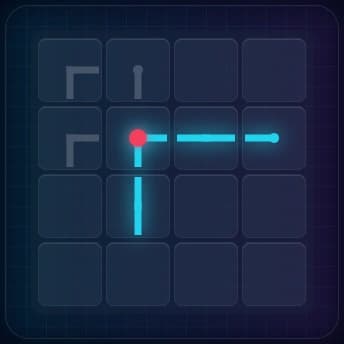
The corner pipe must open right (due to edge constraints), forcing the adjacent straight pipe to be horizontal to receive the connection.
Chain Propagation Strategy
- Find a cell with few valid orientations
- For each valid orientation, propagate its constraints to neighbors
- Check if any neighbor becomes impossible under some orientations
- Eliminate those orientations from the original cell
- Repeat with the refined possibilities
This is essentially constraint propagation, the algorithmic technique that underlies all logical puzzle solving. Do it mentally and you solve faster; do it systematically and you solve harder puzzles.
Pattern Recognition: Instant Deductions
After sufficient practice, certain configurations become instantly recognizable. Here are patterns worth memorizing:
Putting It All Together: A Systematic Framework
When approaching any Pipes puzzle:
Phase 1: Instant Solves
- Solve all corner pipes (corner certainty principle)
- Solve all edge straight pipes (edge-parallel rule)
- Identify cross pipe locations (must be interior, all neighbors must connect)
Phase 2: Edge Propagation
- Work along each edge from corners
- Apply must-connect from solved corners
- Apply edge exclusion to remaining ambiguity
- Solve edge T-junctions and corner pipes by elimination
Phase 3: Interior Propagation
- Work inward layer by layer
- Apply must-connect from solved edges
- Check for dead-end prevention
- Watch for loop formation
Phase 4: Constraint Chains
- For stubborn cells, analyze constraint chains
- Consider two-cell and three-cell interactions
- Use cross pipe identification for four-way cascades
Phase 5: Verification
- Trace the network from source to all endpoints
- Verify: single connected network?
- Verify: no loops?
- Verify: all openings connect?
Common Mistakes and Fixes
Mistake: Starting in the Center
Problem: Center cells have four possible connection directions. Without boundary constraints, many orientations seem valid.
Fix: Always start at corners. Work edges. Arrive at the center with constraints from all sides.
Mistake: Ignoring Dead-End Prevention
Problem: You orient a pipe without checking if its openings face walls (boundaries, empty cells, or blocked pipe sides).
Fix: Before committing to any orientation, verify every opening has somewhere to go.
Mistake: Missing Must-Connect Requirements
Problem: A neighboring pipe opens toward your cell, but you orient away from it, leaving its opening unconnected.
Fix: Always check adjacent solved pipes. If they open toward you, you must receive.
Mistake: Creating Loops
Problem: You complete a satisfying-looking ring of pipes, then realize loops are forbidden.
Fix: Track the network structure mentally. Before connecting two regions, ask: "Are these already connected elsewhere?" If yes, do not create another connection.
Mistake: Forgetting Empty Cells Are Walls
Problem: You orient a pipe toward an empty cell, expecting some connection.
Fix: Empty cells are impenetrable. Treat them as grid boundaries for adjacent pipes.
From Technique to Flow
The strategies in this guide are not separate tricks to apply sequentially. They are different lenses for seeing the same underlying truth: every pipe is constrained by its position, its neighbors, and the network structure.
At first, you will consciously apply rules: "This is a corner, so I use corner certainty. This is an edge, so I apply edge exclusion. This neighbor opens toward me, so I must receive."
With practice, these become automatic. You will stop thinking "corner certainty principle" and simply see that the corner pipe has one orientation. You will stop thinking "must-connect rule" and simply see that the neighboring pipe determines yours.
This is the shift from calculation to recognition. The puzzle stops being a problem to solve and becomes a pattern to see. Constraints ripple visibly from boundaries to center. Chain reactions cascade without conscious effort. The network flows into place.
The pipes connect themselves. You just have to learn how to watch.
Practice Recommendation
Our Pipes puzzle collection offers grids from 5x5 to 12x12. Start with medium-sized puzzles (7x7 or 8x8) where edge constraints are powerful but interior complexity offers practice. Focus on corner certainty and edge propagation until they are automatic, then graduate to larger grids where constraint chains become essential.
The network is waiting to flow. Start at the corners.
Ready to Master the Flow?
Corner certainty is in your toolkit. The outside-in method is ready. Open a puzzle, solve the corners, and watch the network connect itself.
Start Solving PipesPut it into practice
Ready to solve Pipes?
Open a free puzzle and turn the ideas from this guide into your next solve.