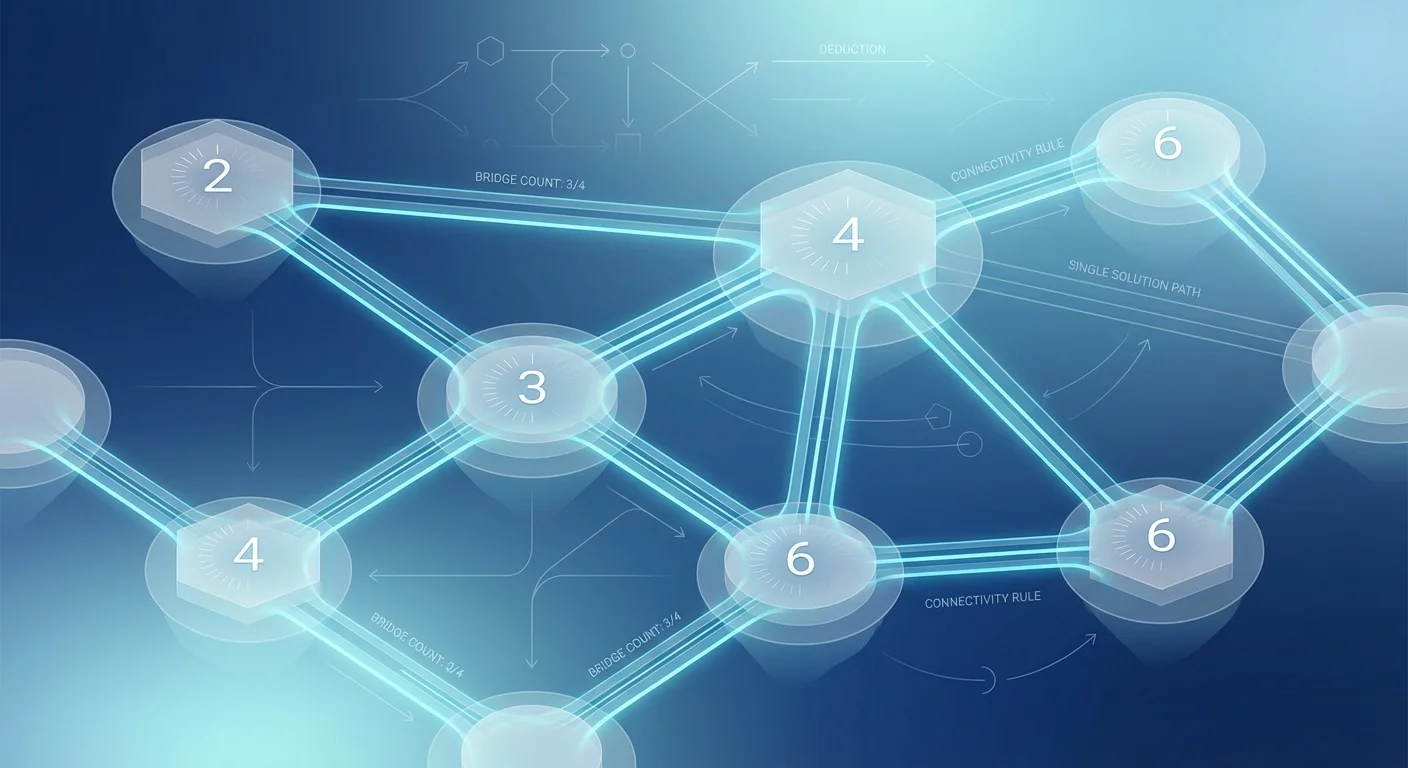
In Hashi, the islands with the highest numbers aren't the hardest—they're the easiest. An 8 is a gift: four neighbors, two bridges each, done. A 4 in the corner? Solved before you think. The real skill is knowing how these certainties cascade into the ambiguous middle, turning "I have no idea" into "It can only be this."
That moment when you stare at a Hashi grid full of islands and see nothing but chaos? It doesn't have to be that way. The best solvers don't calculate—they recognize. An 8 in the corner means four double bridges, instantly placed. A 3 on the edge with only two neighbors? One connection is forced. These patterns turn impossible-looking puzzles into flowing chains of logical deductions.
Watch the Tutorial
New to Hashi? Start with this overview.
Prerequisites: This guide assumes familiarity with basic Hashi rules. If you need a refresher, check our beginner's guide first.
The Maximum Bridge Rule: When Numbers Tell You Everything
Here's the foundational insight that unlocks Hashi: when an island's number equals its maximum possible bridges, every connection is forced. No thinking required—just draw.
The formula is simple: Count the island's neighbors, multiply by 2 (since each neighbor can receive at most 2 bridges). If that equals the island's number, fill every connection to capacity.
The Legendary 8
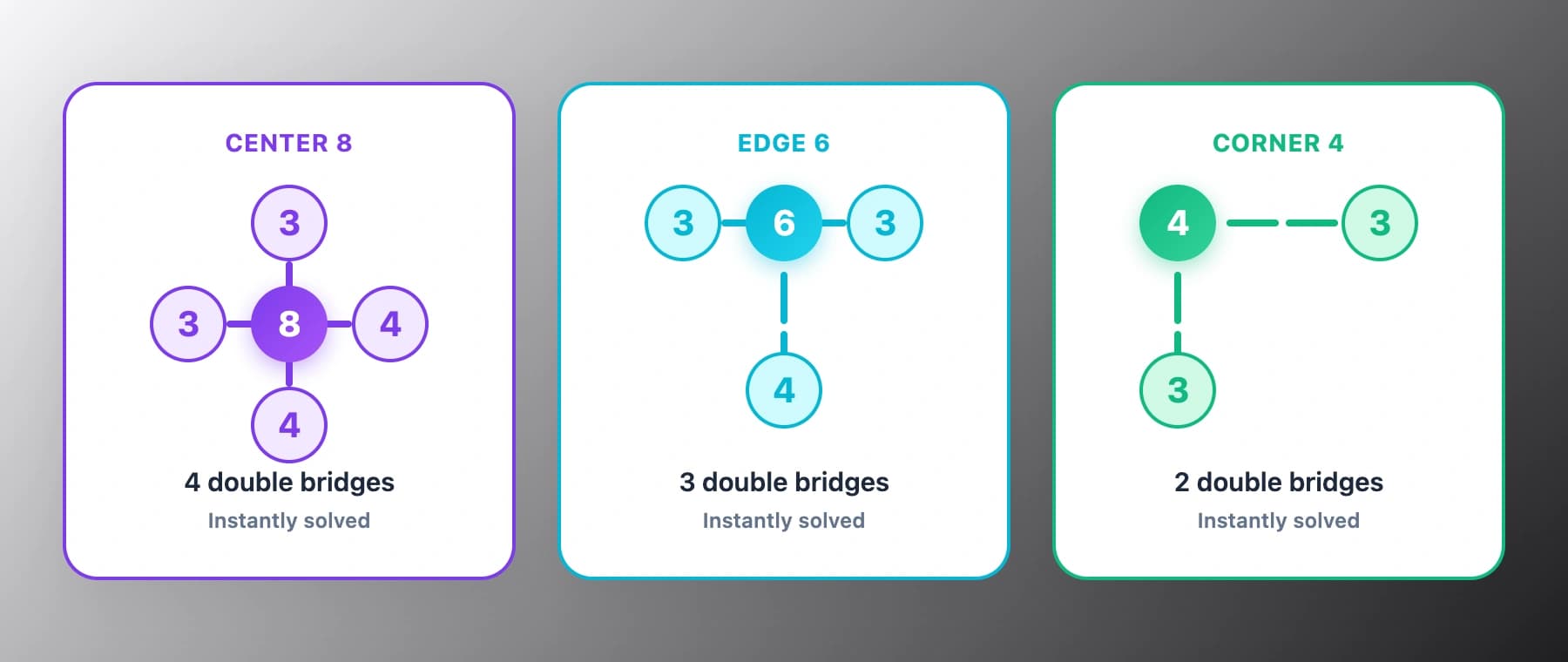
An island labeled "8" is the most generous gift a Hashi puzzle can offer. Eight bridges, four directions, two bridges per direction. The math is airtight:
- 4 neighbors times 2 bridges maximum = 8 bridges possible
- Island needs exactly 8 bridges
- Therefore: double bridges in all four directions
When you see an 8, don't hesitate. Draw four double bridges immediately. You've just solved five islands' worth of constraints in one move—the 8 itself plus significant progress on its four neighbors.
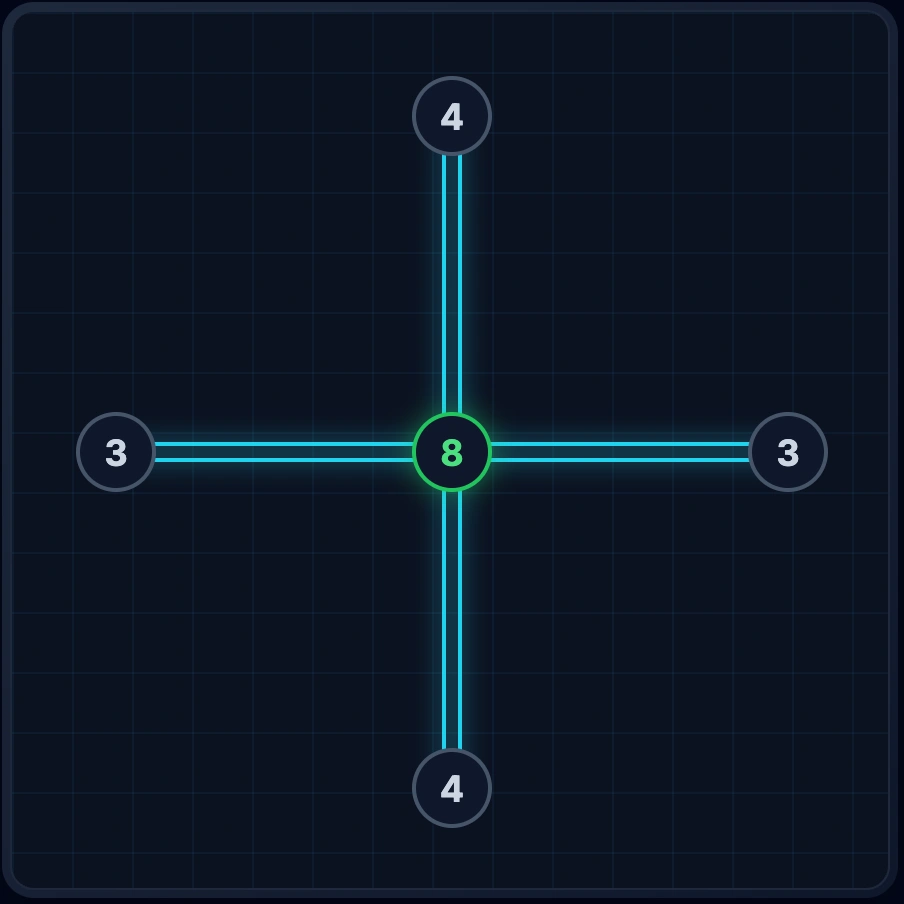
The legendary 8: double bridges in all four directions
The 7 and 6 Patterns
The same logic extends to slightly smaller numbers:
Island 7 (four neighbors): Maximum is 8, needs 7. You can't reach 7 using only three directions (max would be 6), so all four directions must have at least one bridge. Three directions get double bridges, one gets single. Which gets the single? That depends on neighbor constraints—but you can place at least one bridge in every direction immediately.
Island 6 (four neighbors): Maximum is 8, needs 6. At minimum, three directions must be used (3 directions times 2 = 6). But watch the neighbors—often you can deduce exactly which three.
Key Insight: Whenever an island's requirement exceeds half its maximum capacity, every direction must receive at least one bridge. An island needing more than it can get from any subset of neighbors must use all available directions.
The Corner Principle: Where Possibilities Vanish
Corners are where Hashi puzzles reveal their secrets. A corner island has exactly two neighbors—up and right, or down and left, depending on which corner. This brutal limitation makes many corner islands instantly solvable.
The Perfect Corner 4
A "4" in any corner is completely solved the moment you see it:
- 2 neighbors times 2 bridges maximum = 4 bridges possible
- Island needs exactly 4 bridges
- Therefore: double bridges to both neighbors
No analysis needed. No consideration of the rest of the puzzle. Just draw two double bridges and move on.
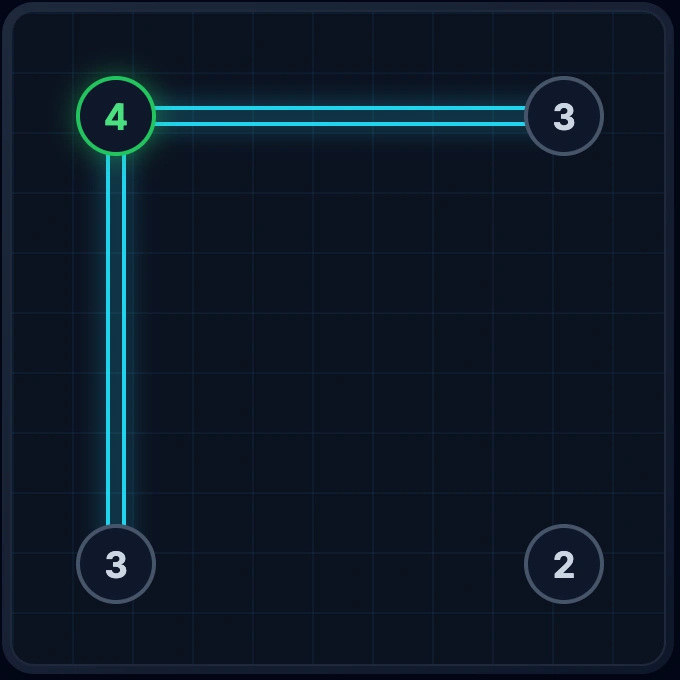
Corner 4: double bridges to both neighbors, instantly solved
The Corner 3 and 2
A "3" in a corner is almost as generous. Two neighbors, needs 3 bridges. The only configuration: one neighbor gets a double bridge, the other gets a single. You can place at least one bridge in each direction immediately—the ambiguity is only whether to add the second bridge left or down.
A corner "2" provides information too. Two neighbors, needs exactly 2 bridges. Either one bridge to each neighbor, or a double bridge to one and nothing to the other. The "double to one" scenario is rare—it would mean completely ignoring one neighbor, which often creates connectivity problems elsewhere.
| Corner Value | Neighbors | Immediate Deduction |
|---|---|---|
| 4 | 2 | Double bridges both directions (solved!) |
| 3 | 2 | At least one bridge each direction |
| 2 | 2 | Usually one bridge each direction |
| 1 | 2 | Exactly one bridge to one neighbor |
The Edge Principle: Three Directions, Tighter Constraints
Edge islands (not in corners) have exactly three neighbors. This middle ground between corners and center islands creates its own set of powerful patterns.
The Edge 6
An island labeled "6" on any edge is completely solved:
- 3 neighbors times 2 bridges maximum = 6 bridges possible
- Island needs exactly 6 bridges
- Therefore: double bridges to all three neighbors
Like the corner 4 and the center 8, the edge 6 requires zero thought. Three double bridges, instantly placed.
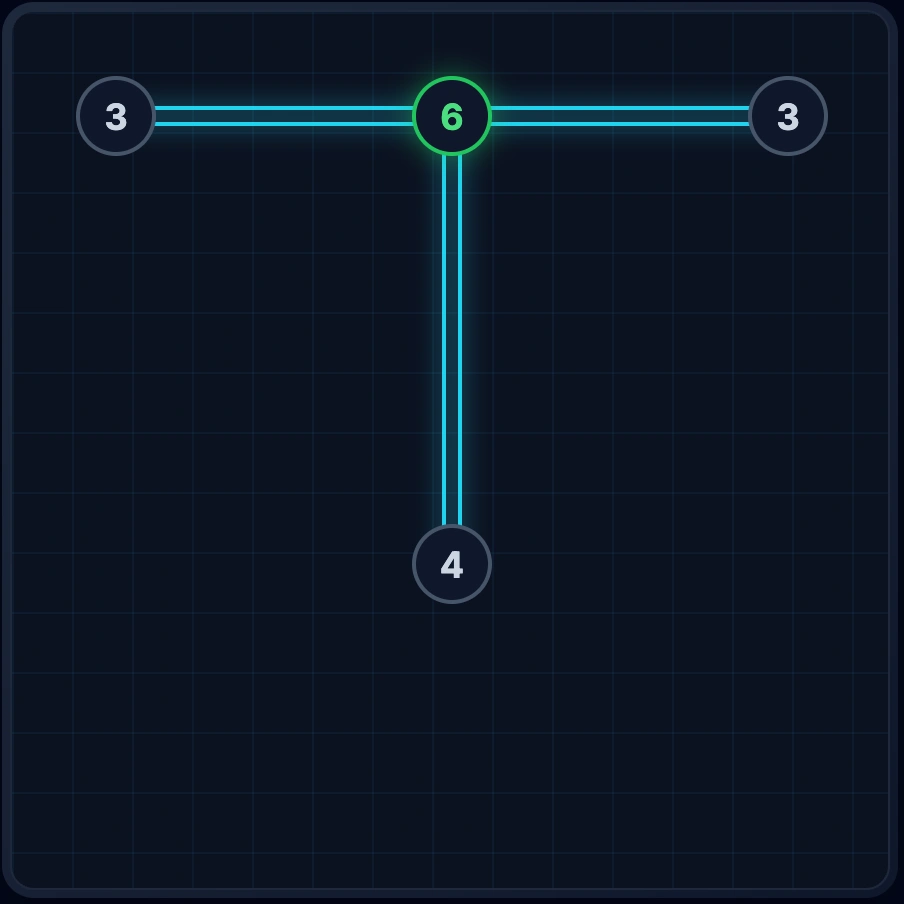
Edge 6: double bridges to all three neighbors
Edge 5 and 4
An edge "5" with three neighbors mirrors the center "7" pattern. Maximum is 6, needs 5. You can't reach 5 with only two directions (max 4), so all three directions must have at least one bridge. Two directions get doubles, one gets a single.
An edge "4" requires careful analysis. Maximum is 6, needs 4. Multiple configurations exist: two doubles and a zero (2+2+0), or one double and two singles (2+1+1). The "double, double, zero" configuration is often impossible because ignoring a neighbor entirely tends to break connectivity.
| Edge Value | Neighbors | Immediate Deduction |
|---|---|---|
| 6 | 3 | Double bridges all directions (solved!) |
| 5 | 3 | At least one bridge each direction |
| 4 | 3 | At least one bridge each direction |
| 3 | 3 | No forced bridges from this rule alone |
Isolation Prevention: The Connectivity Constraint
Here's where Hashi transcends simple arithmetic and becomes genuinely elegant. Every puzzle must end with all islands connected in a single network. This requirement—often forgotten by beginners—eliminates countless "mathematically valid" but practically impossible configurations.
The Isolation Test
Before placing any bridge, ask: "If I don't place a bridge here, can this island still connect to the rest of the network?"
If the answer is no—if removing this bridge possibility would strand an island—then the bridge is required. Not because of the numbers, but because of connectivity.
Worked Example: The Forced Connection
Imagine a "1" island in the corner of the grid. It has two neighbors: a "2" directly adjacent, and a "4" farther away. The "2" sits between the "1" and the rest of the puzzle.
If the "1" doesn't connect to the "2", it would have to connect to the "4" somehow. But wait—if the "1" connects to the "4" instead of the "2", how does the "2" connect to anything else? The "2" might become isolated.
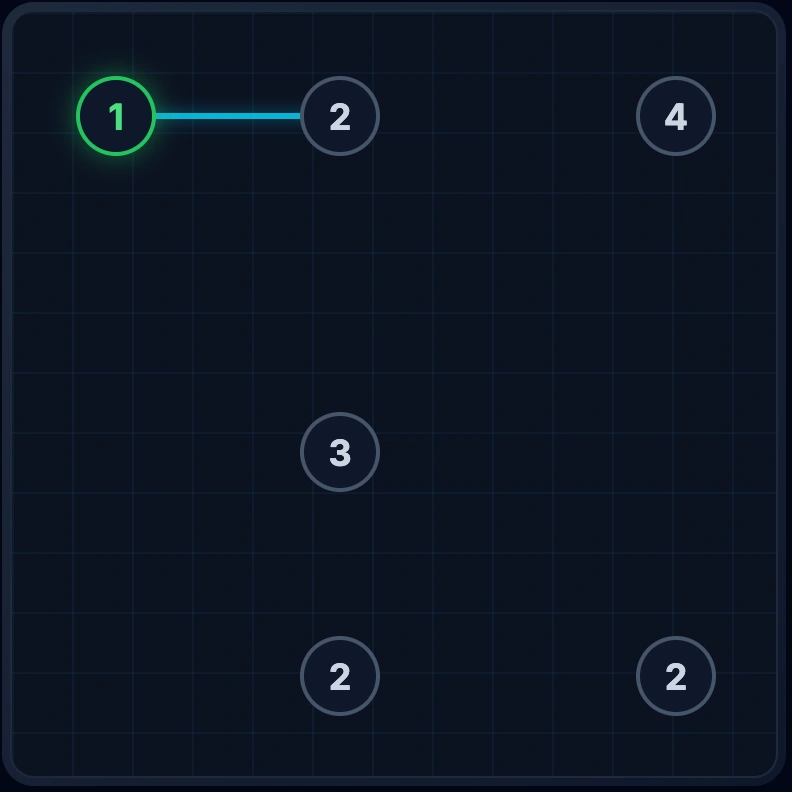
The 1 must connect to the 2 to prevent isolation
Key Insight: This type of reasoning—"if I don't connect here, something else gets stranded"—is what separates advanced solvers from beginners. Numbers tell you how many bridges; connectivity tells you which bridges.
The "Only Path" Technique: Network Flow Analysis
This advanced technique asks: "How will this island eventually connect to the greater network?" Sometimes an island's only viable connection route forces specific bridges, even when the island's number alone doesn't mandate them.
Worked Example: The Stranded Region
Consider a small group of islands in a puzzle corner, connected to the main grid only through a single island. That connecting island is the only path from the corner region to everywhere else.
If the connecting island is a "3" with four neighbors—three in the corner region, one toward the main grid—at least one bridge must go toward the main grid. The corner region literally cannot connect otherwise.
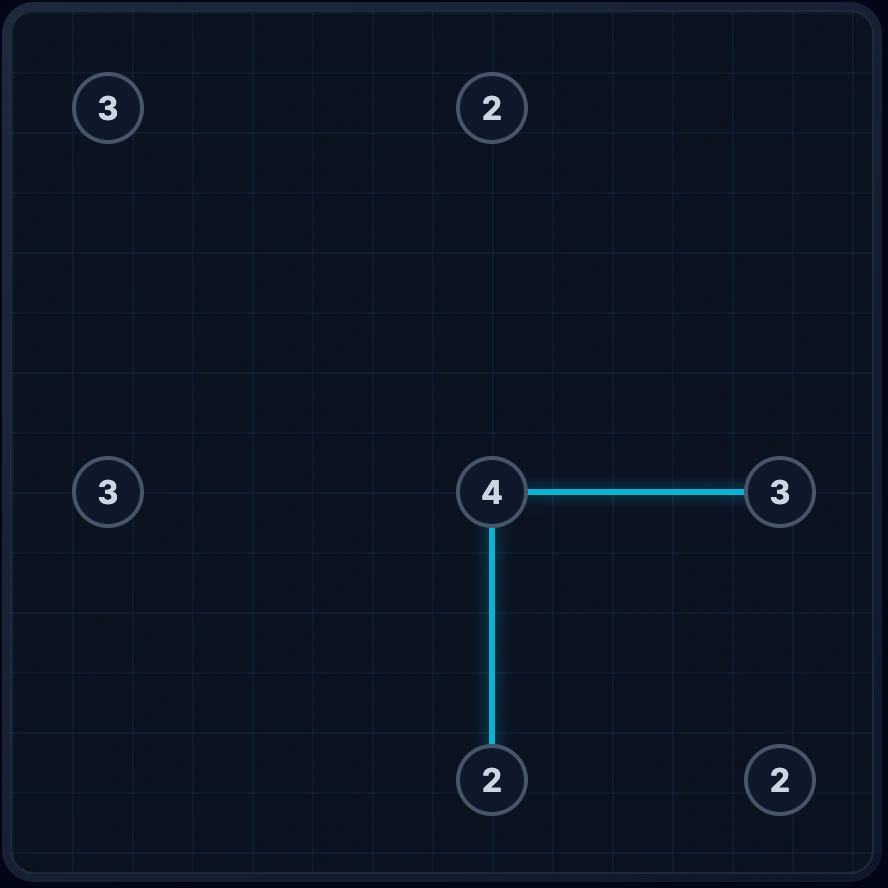
The "only path" bridge is forced by network topology
This deduction has nothing to do with the numbers. It's pure network topology.
Neighbor Capacity Analysis: When Supply Meets Demand
Here's a powerful technique that combines arithmetic with network awareness: analyze whether an island's neighbors can actually supply its required bridges.
The Principle
An island needs X bridges. Its neighbors can provide Y bridges total (sum of their remaining capacities). If X equals Y, every neighbor must contribute their maximum remaining capacity.
Worked Example: The Saturated Island
Imagine an island labeled "5" with three neighbors:
- Neighbor A: already has 3 bridges placed, labeled "4" (can give 1 more)
- Neighbor B: no bridges yet, labeled "2" (can give at most 2)
- Neighbor C: no bridges yet, labeled "3" (can give at most 2)
Total available from neighbors: 1 + 2 + 2 = 5. The island needs exactly 5. Every neighbor must contribute their maximum: one bridge from A, two from B, two from C. All three connections are forced.
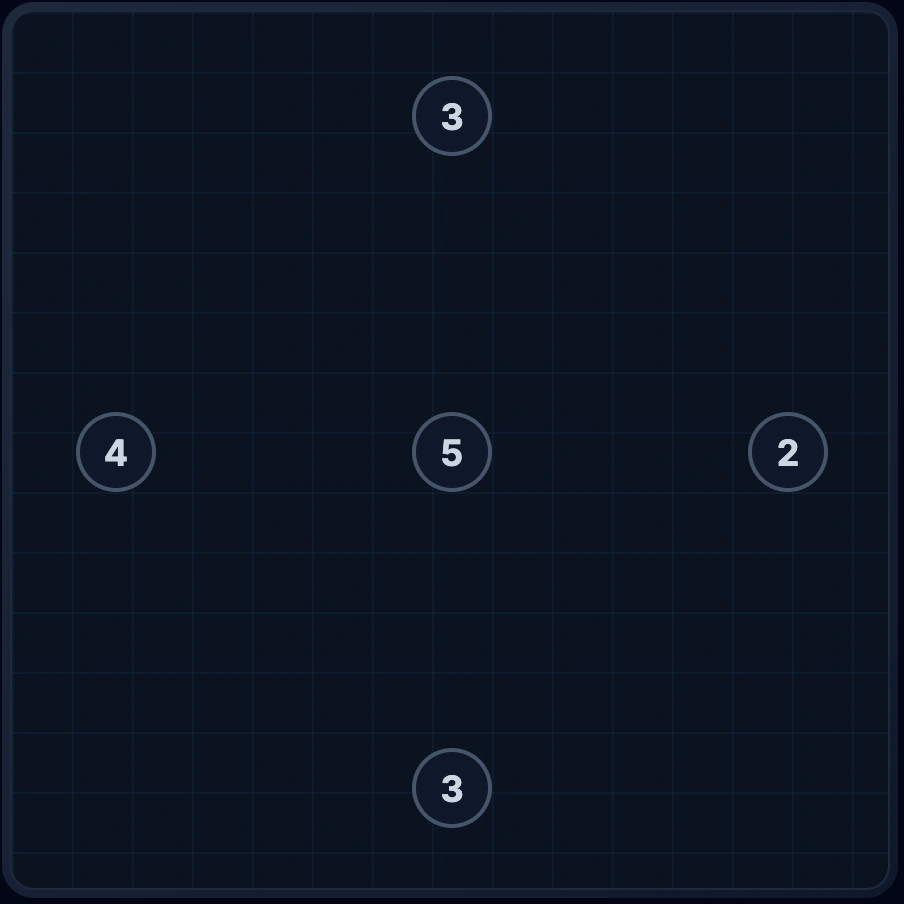
When supply equals demand, all connections are forced
Quick Calculation Method
- How many more bridges does this island need?
- For each neighbor, how many bridges can they still provide?
- Does supply exactly equal demand?
If yes, all remaining connections are forced. If supply exceeds demand, look for other constraints.
The 1-Island Trap: Maximum Constraint, Minimum Connections
Islands labeled "1" are deceptively powerful. They connect to exactly one neighbor with exactly one bridge. This means:
- Once you know which neighbor the "1" connects to, it's completely solved
- Any neighbor that definitely receives a bridge from the "1" has that bridge locked in
- Two adjacent "1" islands create interesting constraints
The Adjacent 1s Rule
Can two "1" islands connect to each other? Only if doing so doesn't isolate them both.
If two "1" islands are neighbors and connecting them would leave both disconnected from the rest of the puzzle, they cannot connect. Each must find a different neighbor.
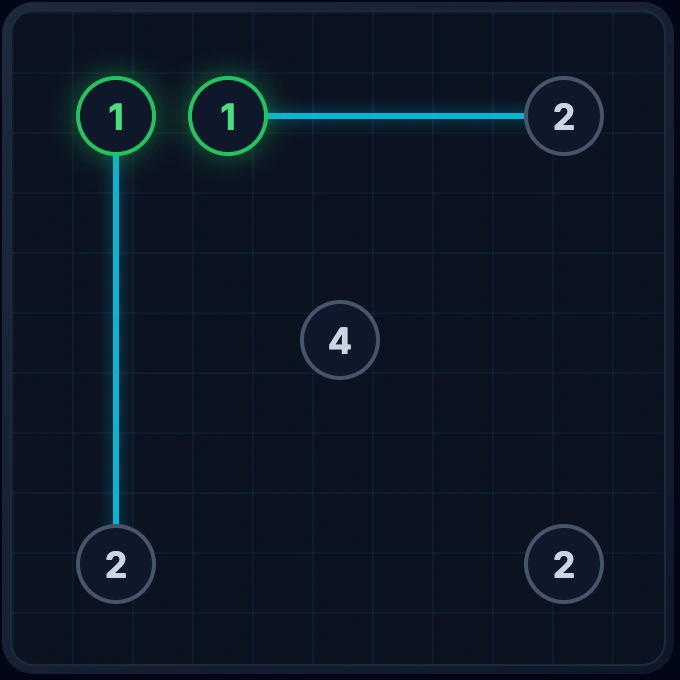
Adjacent 1s usually cannot connect to each other
A "1" island adjacent to a larger island often resolves ambiguity. A corner "3" with two neighbors—one being a "1" island—must distribute as (1,2). The "1" can only accept one bridge, so the other neighbor must receive both remaining bridges.
Common Patterns Cheat Sheet
Here's your quick reference for instant pattern recognition:
Connectivity Patterns
| Situation | Deduction |
|---|---|
| Island's only path to network | Bridge in that direction is forced |
| Adjacent 1-islands | Usually cannot connect to each other |
| Bottleneck island | Must maintain bridges in both directions |
| Neighbor capacity equals requirement | All remaining connections are forced |
Putting It All Together: A Solving Framework
When you approach any Hashi puzzle, follow this systematic process:
Phase 1: Instant Patterns
Scan the entire grid for immediate solves: Any 8s in the center? Draw all double bridges. Any 6s on edges? Draw all double bridges. Any 4s in corners? Draw all double bridges. These require zero analysis.
Phase 2: Forced Minimums
Check remaining high-value islands. Which islands need more than half their maximum? Place at least one bridge in every available direction for these. Note which directions might get a second bridge.
Phase 3: Connectivity Analysis
Now examine the network: Are any regions at risk of isolation? Which islands serve as bottlenecks? Do any 1-islands constrain their neighbors? Place bridges forced by connectivity, not arithmetic.
Phase 4: Capacity Analysis
As bridges accumulate: Recalculate remaining capacities frequently. Check for islands where supply exactly equals demand. Let forced moves cascade into new forced moves.
Phase 5: Endgame Cleanup
With most bridges placed: Count remaining bridges needed. List possible configurations for ambiguous regions. Eliminate impossibilities. Place final bridges with certainty.
From Recognition to Flow
The journey from Hashi beginner to confident solver is really about building pattern recognition. At first, you calculate: "This island needs 4, has 2 neighbors, 2 times 2 equals 4, so double bridges both ways."
Eventually, you just see it. A 4 in the corner is solved before conscious thought engages. An 8 anywhere is four double bridges, automatic. A 3 on the edge with 2 neighbors gets at least one bridge each direction, no hesitation.
This is what mastery feels like: the patterns become invisible because they're instantaneous. Your attention frees up for the genuinely interesting parts—the connectivity puzzles, the neighbor capacity calculations, the elegant cascades of forced moves.
The strategies in this guide aren't tricks to memorize. They're ways of seeing that, once internalized, make Hashi feel less like problem-solving and more like reading. The puzzle tells you what to do. You just have to know how to listen.