Magic Square Strategies:
Mastering the Art of Perfect Sums
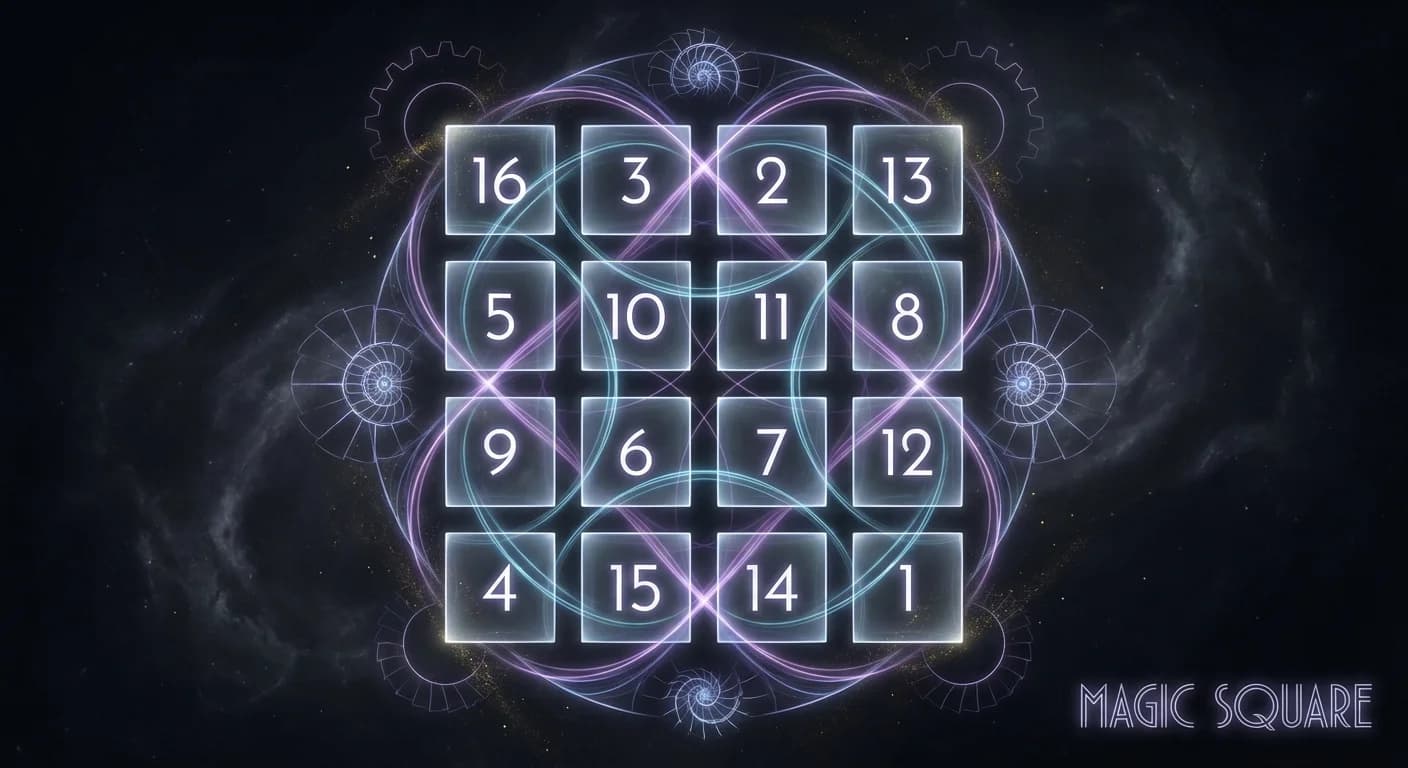
You have solved your first dozen Magic Square puzzles. You understand that every row, column, and diagonal must sum to 34. You have discovered the magic of paired numbers, where 1 and 16, 2 and 15, 3 and 14 all sum to 17.
And yet.
Some puzzles that should take two minutes stretch into ten. You find yourself guessing, erasing, guessing again. The constraint "everything sums to 34" feels both obvious and unhelpful, like being told the answer to a maze is "go from start to finish."
Here is what separates intermediate solvers from beginners: structured thinking about possibilities. Not just knowing that rows sum to 34, but systematically mapping which combinations can fill each row. Not just recognizing paired numbers, but understanding why certain numbers must occupy certain positions.
Watch the Tutorial
Prefer watching? This tutorial covers the basics of Magic Square to get you started.
Prerequisites
This guide builds on concepts from our beginner's guide, covering the magic constant of 34, paired numbers summing to 17, and basic row-column deduction. If any of these feel unfamiliar, start there first.
The Fundamental Shift: From Arithmetic to Analysis
Beginners approach Magic Square arithmetically: "This row has 16 and 5, so the remaining two cells need to sum to 13. What two numbers from my available set sum to 13?"
This works. But it treats each calculation as an isolated event, missing the deeper structure.
Intermediate solvers approach Magic Square analytically: "Which numbers appear in the most constraints? Where must they go based on the puzzle's geometry? How do the constraints interact?"
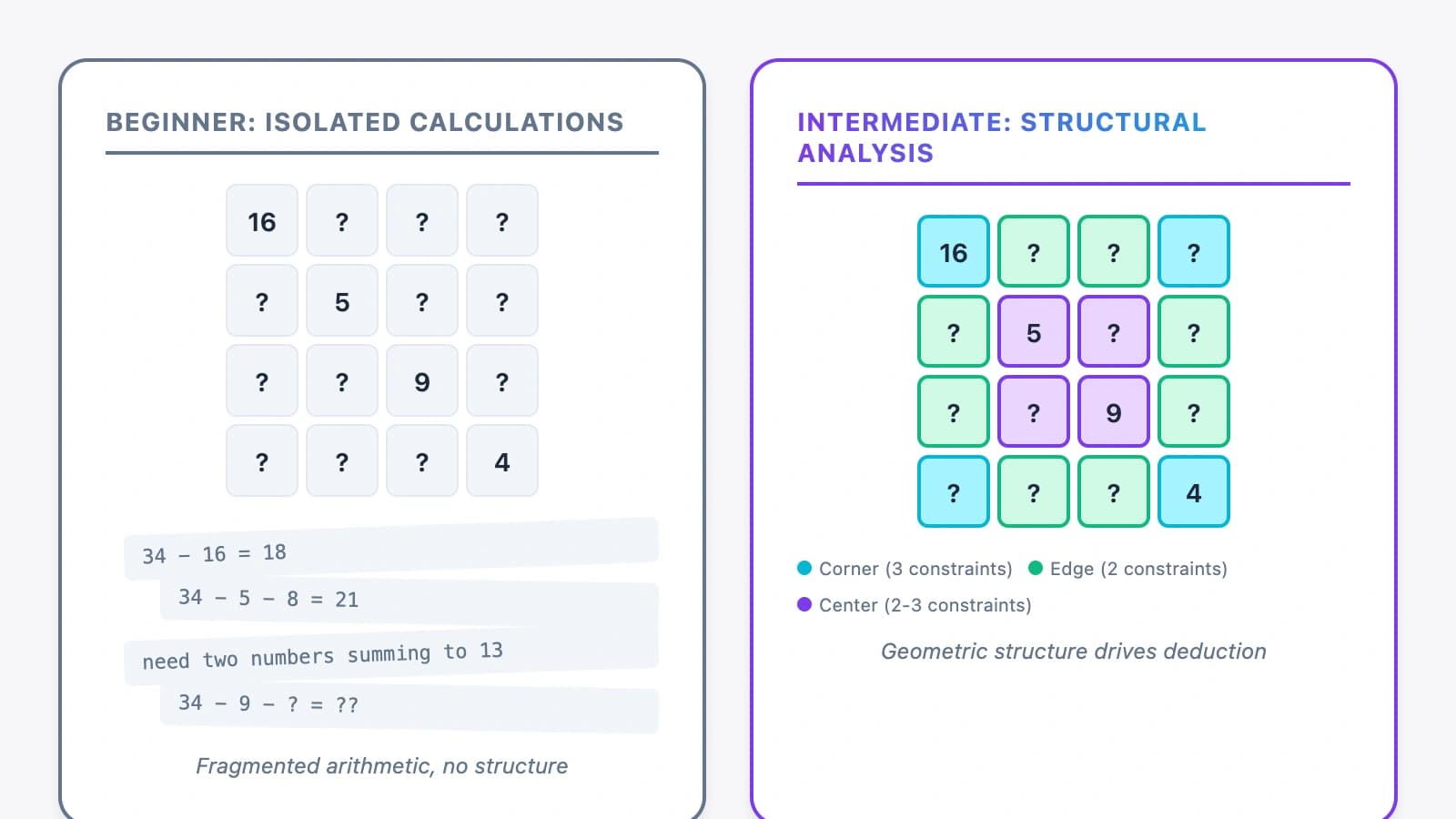
The shift is subtle but powerful. You are no longer just calculating what fits. You are understanding why certain placements are necessary.
Strategy 1: The Exhaustive Possibilities Method
This is the technique that transforms guessing into certainty.
Before placing any number, create a complete list of all valid three-number combinations that sum to your target. For a 4x4 Magic Square with a magic constant of 34, you need combinations where four numbers (including any given values) sum to 34.
Building the Possibility Table
Let us say you have a puzzle where position 0 contains 16, and you need to fill positions 1, 2, and 3.
Required sum for positions 1, 2, 3: 34 - 16 = 18
Available numbers: 1, 2, 3, 5, 6, 7, 8, 9, 10, 11, 12, 13, 14, 15 (assuming only 4 and 16 are placed)
That is thirteen valid combinations for just this one row. Seems overwhelming, right?
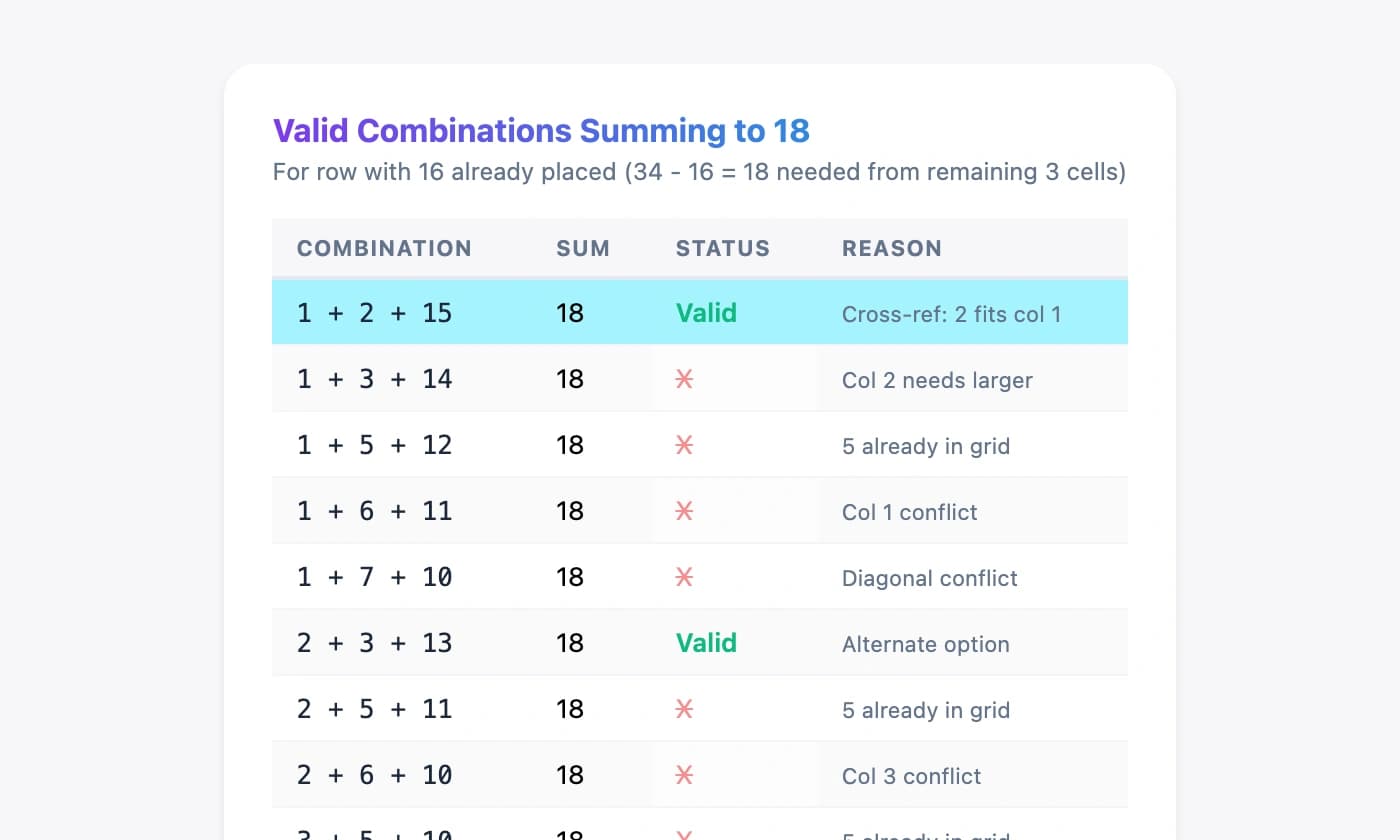
Here is where it gets powerful: when you cross-reference with column constraints, most of these combinations become impossible.
Cross-Referencing to Eliminate Options
Position 1 sits in Column 1. If Column 1 has its own constraints (perhaps another cell is filled), you can eliminate any combination where the number in position 1 violates that column's requirements.
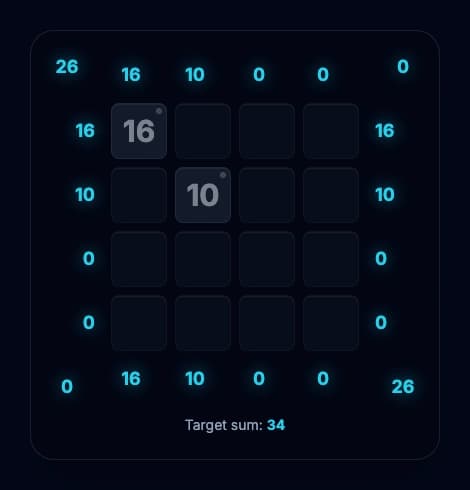
Row 0 analysis intersects with Column 1 constraints. Each placement must satisfy both simultaneously.
Key Takeaway
Build exhaustive lists of valid combinations, then cross-reference with intersecting constraints to eliminate impossibilities.
Strategy 2: Frequency Analysis and The Placement Rule
This technique comes from mathematical analysis of the magic square structure itself. It answers a deceptively simple question: Why do certain numbers belong in corners versus edges versus the center?
Counting Constraint Membership
In a 4x4 magic square, each cell participates in a certain number of "equations" (rows, columns, and diagonals that must sum to 34).
| Cell Type | Positions | Constraints |
|---|---|---|
| Corner cells | 0, 3, 12, 15 | 3 (row + column + diagonal) |
| Edge midpoints | 1, 2, 4, 7, 8, 11, 13, 14 | 2 (row + column) |
| Center cells | 5, 6, 9, 10 | 3 (row + column + diagonal) |
The Frequency Principle
Here is the insight that accelerates solving: numbers that appear in more valid combinations have more flexibility in placement.
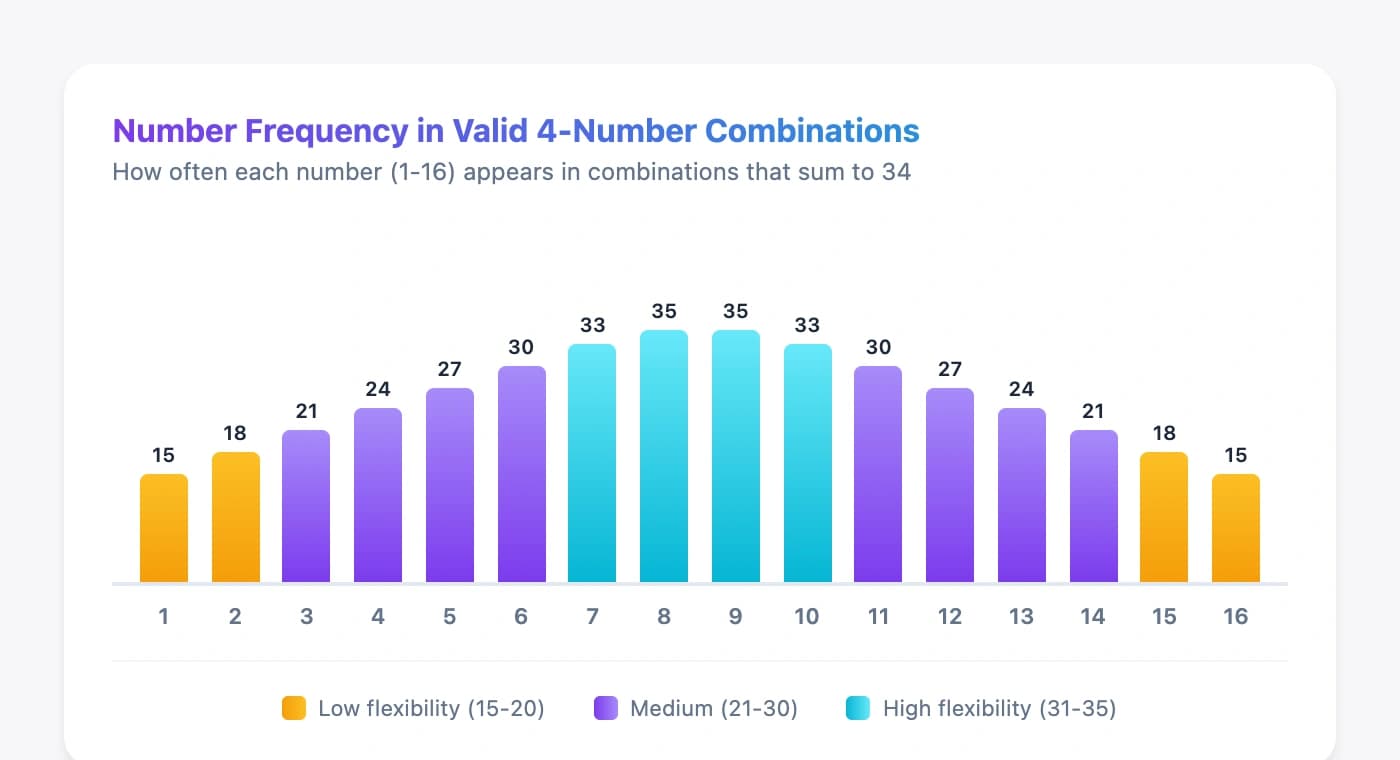
Why? Because extreme numbers "use up" more of the sum budget. If you place 16 in a row, the remaining three cells must average only 6. That limits your options. If you place 8 in a row, the remaining three cells must average about 8.67, which is much more flexible.
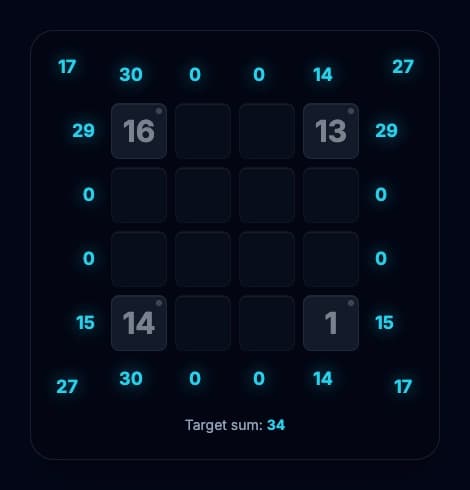
Extreme numbers (1, 2, 15, 16) often occupy corner cells due to constraint interactions.
Applying Frequency Analysis
When you are stuck, ask: "Which unfilled position has the most constraints? Which unused number has the least flexibility?"
Place inflexible numbers in highly-constrained positions first. They have fewer valid placements, so determining their position eliminates more possibilities.
Key Takeaway
Numbers near the extremes (1, 2, 15, 16) have less flexibility; place them in highly-constrained positions first to maximize deductive power.
Strategy 3: Reflective Trial and Error
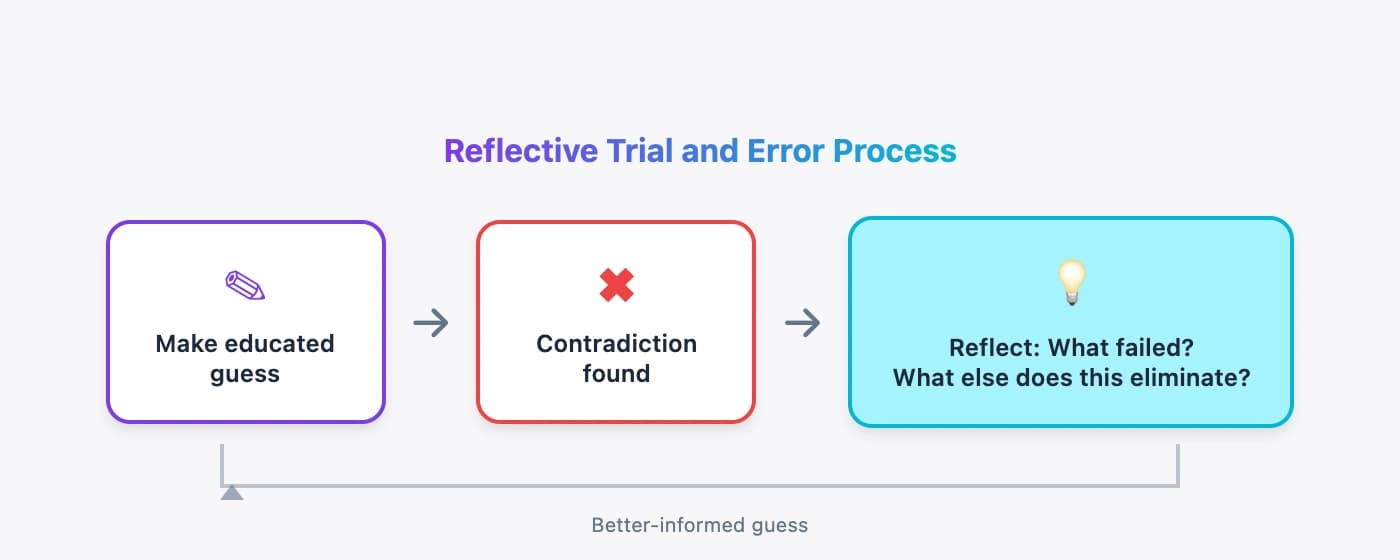
Here is an uncomfortable truth: even with advanced techniques, you will sometimes need to make educated guesses in Magic Square. The difference between frustrating guessing and productive guessing is reflection.
The Metacognitive Approach
When you place a number and it leads to a contradiction, do not simply erase it and try something else. Stop and ask:
- What specifically failed? Which constraint became impossible to satisfy?
- Why did it fail? What about that number's placement caused the cascade of problems?
- What does this tell me? Which other placements would cause the same failure?
This transforms each "mistake" into information.
The Two-Option Forcing Technique
When you have narrowed a cell to exactly two possible values, try one. If it fails, you know the answer is the other option. This is not guessing. It is systematic elimination.
Key Takeaway
Treat failed attempts as information sources. Reflect on why they failed to eliminate multiple candidates at once.
Strategy 4: The Complementary Pairs Deep Dive
You know that paired numbers sum to 17 (1+16, 2+15, 3+14, etc.). Now let us exploit this property systematically.
Pair Distribution Requirements
Complementary pairs (numbers summing to 17) are a useful tool. When you spot one pair in a row, the remaining two cells must also sum to 17, which dramatically narrows the possibilities. If you know two numbers in a row, the other two must sum to (34 minus those two), and checking whether that remainder can be split into a complementary pair is a fast way to validate or eliminate candidates.
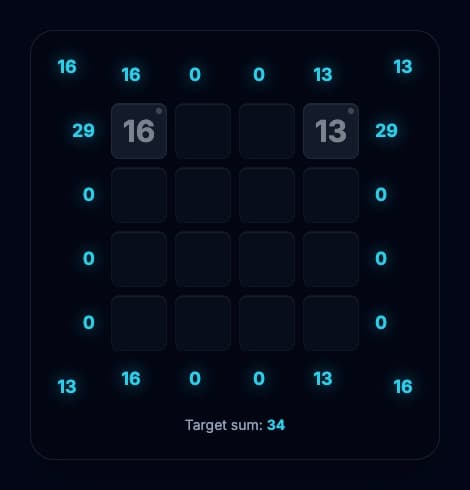
Row 0 contains 16 and 13. Since 16's pair is 1 and 13's pair is 4, positions 1 and 2 must contain {1, 4}.
Using Pair Analysis
When you know one or two values in a row, pair analysis dramatically constrains the remaining options.
Row 0 contains 16 and 13.
- 16's pair is 1 (since 16 + 1 = 17)
- 13's pair is 4 (since 13 + 4 = 17)
For Row 0 to contain two complete pairs summing to 17 each, it must also contain 1 and 4. Row 0 would be {16, 1, 13, 4} in some order, summing to 34. Verified!
Key Takeaway
When you know two values in a line, compute 34 minus their sum to find the required total for the remaining cells. Check whether that total can be formed from available numbers, and use complementary pairs (summing to 17) as a shortcut to narrow candidates quickly.
Strategy 5: Constraint Propagation Chains
This is where advanced solving becomes almost automatic. Instead of solving cell by cell, you set up chains of deductions that cascade through the grid.
Setting Up a Propagation Chain
- Anchor: Start with a known value or highly constrained cell
- Immediate implications: What does this force in intersecting rows/columns/diagonals?
- Secondary implications: What do those forced values imply for their other constraints?
- Continue until you reach cells with no further forced implications
A Detailed Example
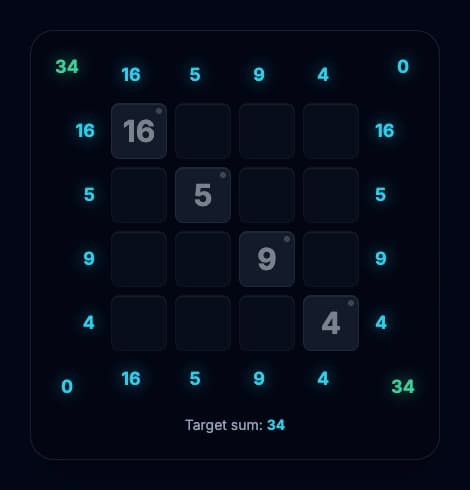
Given: Main diagonal is complete with 16, 5, 9, 4 (sum = 34).
Chain begins:
Step 1: Consider the complements of the diagonal numbers: 16's complement is 1, 5's is 12, 9's is 8, 4's is 13.
Step 2: Sum of complements: 1 + 12 + 8 + 13 = 34. These could form the anti-diagonal!
Step 3: If anti-diagonal = {1, 8, 12, 13}, determine the order using row and column constraints.
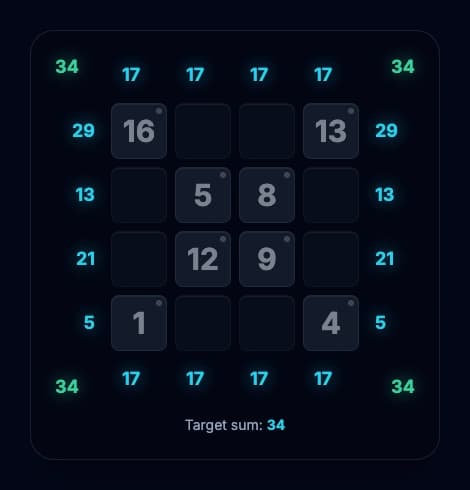
Through pure logical propagation, the entire anti-diagonal was determined without guessing.
Key Takeaway
Set up deduction chains by analyzing how one placement forces others, and let the constraints do the work.
Strategy 6: Recognizing Standard Configurations
As you solve more Magic Squares, you will encounter recurring patterns. Building a mental library of these configurations accelerates solving dramatically.
The Diagonal Start
When given values form a complete diagonal, the complementary pairs principle immediately suggests the anti-diagonal should contain the complements.
The Corner Anchor
When corner cells are given, they maximally constrain both a row and a column simultaneously. Corners also sit on diagonals, making them triple-constraint positions.
The Symmetric Start
Some puzzles give values in symmetric positions (like all four corners). These configurations often have multiple valid solutions, but the symmetry itself provides solving leverage.
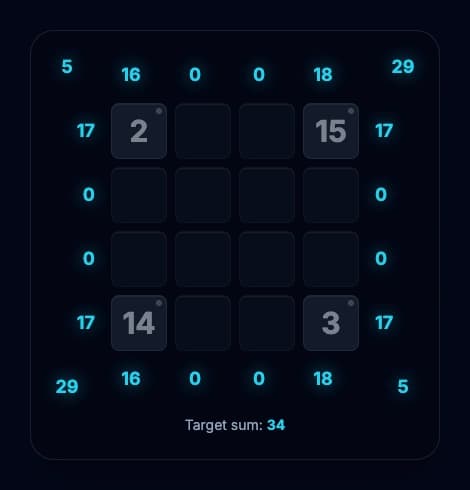
Notice: opposite corners sum to 17 (2+15=17, 14+3=17). The solution will likely preserve this symmetry.
Key Takeaway
Recognize common starting configurations to apply the right strategy immediately. Diagonal starts, corner anchors, symmetric setups, and scattered distributions each suggest different approaches.
Strategy 7: Speed-Solving Techniques
Once you have internalized the structural strategies, you can optimize for speed.
Technique 1: Scan Before Solving
Spend 5-10 seconds analyzing the given configuration before placing any numbers: Are the given values on a diagonal? Are corners filled? What is the range of given values?
Technique 2: Work Most-Constrained First
A line with three values filled has exactly one solution; find it instantly. Lines with two values have limited options. Lines with one value have many, so save these for later.
Technique 3: Running Sum Tracking
Keep a mental running tally of placed numbers. When you need "three numbers summing to 25 from the remaining set," you can quickly filter by checking the largest and smallest remaining numbers.
Technique 4: Quick Parity Check
For any cell, quickly verify: Does this number make the row sum achievable? The column? The diagonal (if applicable)? If any answer is no, eliminate immediately.
Putting It All Together: A Solving Framework
When you encounter a new Magic Square puzzle, apply this systematic approach:
Phase 1: Initial Analysis (10-15 seconds)
- Identify given value positions and their pattern
- Note which rows/columns/diagonals are most constrained
- Check for complementary pair relationships
- Determine your entry point (usually most-constrained line)
Phase 2: First Deductions
- If a diagonal is complete or nearly complete, start there
- Apply the exhaustive possibilities method to your entry point
- Cross-reference with intersecting constraints
- Place certain values; note cells with exactly two candidates
Phase 3: Propagation
- For each placed value, check what it forces in other constraints
- Build deduction chains and let placements cascade
- Revisit cells that previously had multiple candidates
Phase 4: Resolution
- If stuck at two-option cells, apply the forcing technique
- Reflect on any contradictions to eliminate additional candidates
- Complete the remaining cells
Advanced Exercise: Applying the Framework
Let us work through a challenging puzzle using all our intermediate strategies.
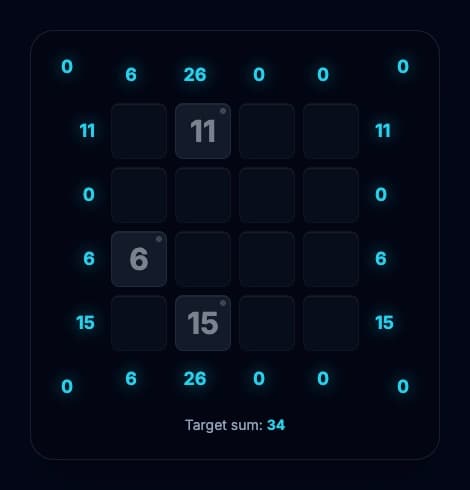
Given: Position 1 = 11, Position 8 = 6, Position 13 = 15. A scattered start with no obvious pattern.
Phase 1: Initial Analysis
This is a scattered start with no complete lines and no obvious diagonal pattern. Most constrained line: Column 1 has two values (11 and 15). Sum needed for positions 5 and 9 in Column 1: 34 - 11 - 15 = 8.
Phase 2: First Deductions
What two distinct unused numbers sum to 8? Pairs: (1, 7) and (3, 5). Positions 5 and 9 contain either {1, 7} or {3, 5}.
Cross-referencing with Row 2 (which has 6), we can narrow down further...
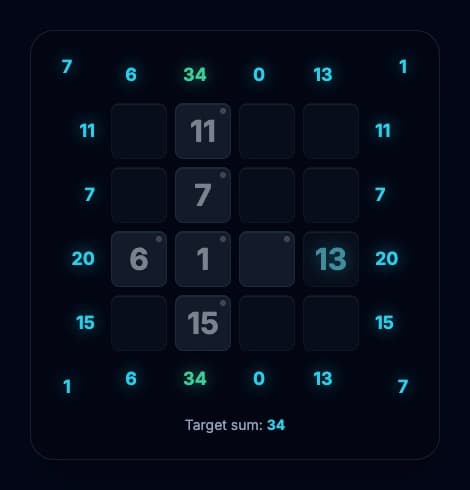
The propagation continues: each placement forces the next until the solution emerges.
Common Intermediate Mistakes
You will make these mistakes. Every intermediate solver does. The difference is whether you recognize them quickly:
Mistake 1: Ignoring Diagonal Constraints Early
You focus on rows and columns, forgetting that diagonal cells have an additional constraint. Fix: For cells on either diagonal, always check the diagonal constraint before committing.
Mistake 2: Incomplete Possibility Enumeration
You list some valid combinations but miss others, then conclude "no valid placement exists." Fix: Be systematic and work through available numbers in order.
Mistake 3: Premature Commitment
You determine a cell has two possible values, pick one without further analysis, and must backtrack. Fix: Spend 30 seconds checking if cross-referencing can eliminate one option.
Mistake 4: Losing Track of the Logic Chain
Your propagation chain becomes so long that you forget why certain values are placed. Fix: Note your key assumptions so you can backtrack efficiently.
Building Your Intermediate Skills
The strategies in this guide take practice to internalize. Here is a progression that works:
| Week | Focus | Goal |
|---|---|---|
| Week 1 | Exhaustive Possibilities | Build complete combination lists, even if slow |
| Week 2 | Cross-Reference Mastery | Always check two constraints before placing |
| Week 3 | Pair Analysis | Use complementary pairs as primary tool |
| Week 4 | Propagation Chains | Practice long deduction chains |
| Week 5 | Speed Integration | Apply techniques fluidly, time yourself |
From Patterns to Intuition
The strategies in this guide will carry you through most Magic Square puzzles you encounter. But there is always another level.
Advanced solvers develop intuitions that are hard to articulate: an instant sense for which numbers "want" to be in corners, a recognition of viable configurations before any calculation, an almost unconscious tracking of complementary pairs.
These intuitions come from volume. Solve hundreds of puzzles, and your brain starts doing the analysis automatically. The exhaustive possibilities method becomes instant pattern recognition. The propagation chains fire without conscious effort.
But here is the good news: with the intermediate strategies you have now learned, that journey becomes faster and more enjoyable. You are no longer randomly trying numbers hoping they work. You have a framework, a vocabulary, a set of tools that make each puzzle an engaging logic exercise.
Remember that puzzle we started with? The one that should have taken two minutes but stretched into ten, filled with guessing and erasing and guessing again?
That was then.
Now you see the grid differently. Where you once saw sixteen empty cells and panic, you now see constraint intersections and propagation opportunities. Where you once stumbled into contradictions, you now reflect and learn.
The numbers await. Go place them strategically.
Ready to Apply These Strategies?
The techniques are in your head. The constraint chains await. Time to transform guessing into systematic deduction.
Start Solving StrategicallyPut it into practice
Ready to solve Magic Square?
Open a free puzzle and turn the ideas from this guide into your next solve.