
You know the feeling. You're staring at a Calcudoku grid, pencil hovering, wondering where to even begin. The cages mock you with their cryptic labels—20×, 3÷, 15+—and every cell seems equally impossible. Where do confident solvers find their first foothold?
What if I told you those intimidating cages are not obstacles—they're your fastest path to the solution?
Here's the proof: That 120× cage in a 5×5 grid? It's not a nightmare—it's a gift. Only one combination works: 5 × 4 × 3 × 2 × 1 = 120. The cage is solved before you write a single digit. You know exactly which five numbers fill those five cells. The only question remaining is which cell gets which number—and the Latin square rules will answer that.
This is the secret that separates struggling solvers from confident ones: every cage has a limited set of valid combinations. Some cages have dozens of possibilities. Others have exactly one. The solver who memorizes the forced combinations and recognizes operation constraints turns intimidating cages into their fastest path to the solution.
Calcudoku—also known as KenKen, Mathdoku, or "that math Sudoku puzzle"—rewards pattern recognition as much as arithmetic. Whether you're searching for kenken strategies or calcudoku techniques, the approach is the same: division cages force specific orderings, subtraction cages reveal hidden pairs, and large multiplication products often have surprisingly few factorizations. Learn these cage puzzle strategies, and you'll solve puzzles that once seemed impossible.
Watch the Tutorial
New to Calcudoku? This tutorial covers the fundamentals.
Prerequisites: This guide assumes you understand basic Calcudoku rules—filling the grid with 1 to N, no repeats in rows or columns, and satisfying cage arithmetic. If you need a refresher on how to solve Calcudoku, start with our Calcudoku Beginner's Guide first.
The Cage Combination Mindset
Before diving into specific strategies, let me share the mental shift that accelerates solving: think of each cage as a mini-puzzle within the puzzle.
It's like an escape room where every room has its own lock. You can't just pick any room to focus on—some locks are easier than others, and solving one room often gives you the key to the next. The same principle applies here. Some cages practically solve themselves. Others need clues from their neighbors. Your job is to find the easy wins first and let them cascade into harder ones.
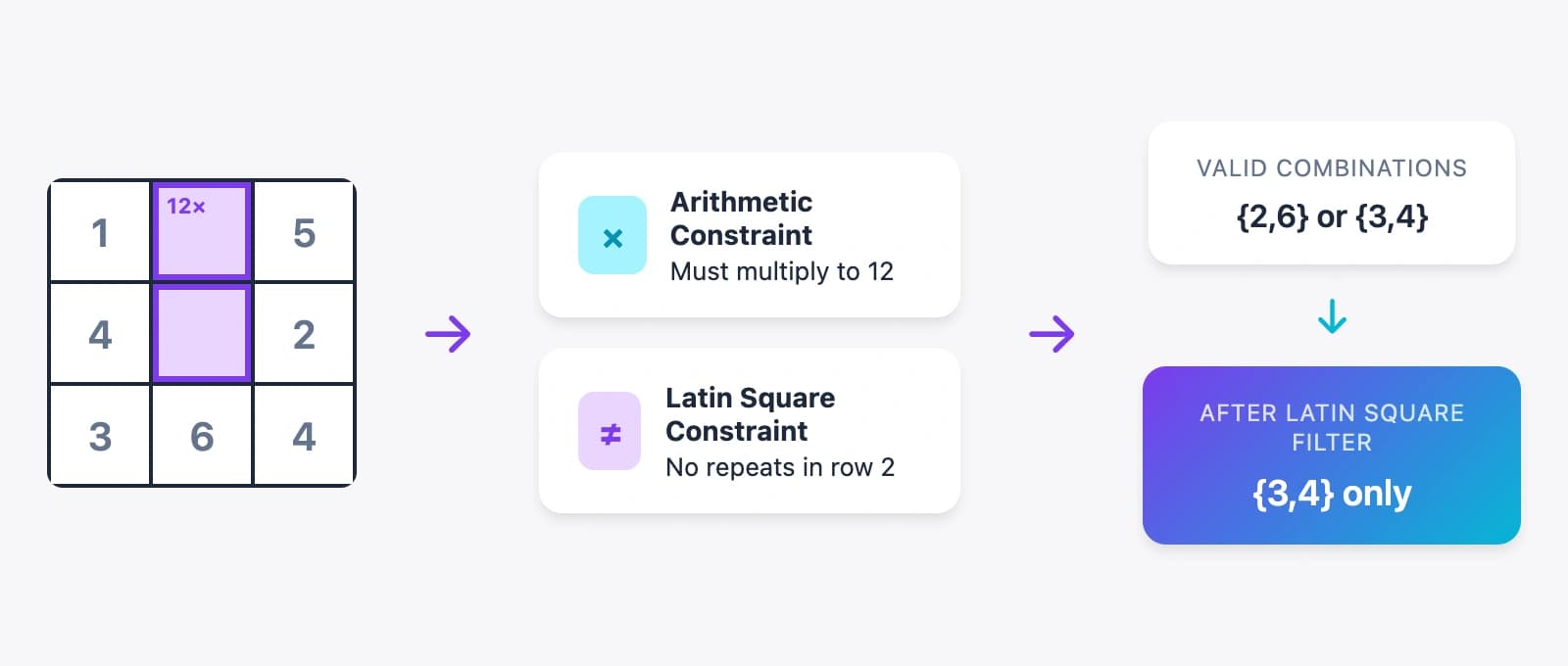
Every cage constrains its cells in two ways:
- Arithmetic constraint: The digits must combine to the target using the specified operation
- Latin square constraint: No digit can repeat within the same row or column
When these constraints overlap, possibilities collapse. A cage might mathematically allow six different digit combinations, but if five of them would force a repeat in some row, only one combination remains. That's the intersection where Calcudoku magic happens.
Single-Cell Cages: Free Information
Let's start with the easiest wins. Single-cell cages display their answer directly. A cage containing one cell marked "4" means that cell equals 4. No arithmetic required. No possibilities to analyze.
When you encounter a single-cell cage, make these moves immediately:
- Place the digit immediately
- Eliminate that digit from the cell's row and column
- Check how this affects neighboring cages
Speed tip: At the start of any puzzle, do a quick scan for single-cell cages before analyzing anything else. These free placements often simplify adjacent cages significantly.
Essential Cage Combinations: The Must-Know List
Some cage specifications have only one valid digit combination. Memorize these, and you'll recognize them instantly—no calculation required.
Two-Cell Multiplication Cages
These are your most powerful allies. Two-cell multiplication has surprisingly few valid combinations. Notice how many products have exactly one valid combination: 22 forced combinations out of 34 common products. When you see these products in a two-cell multiplication cage, you know exactly which digits belong there.
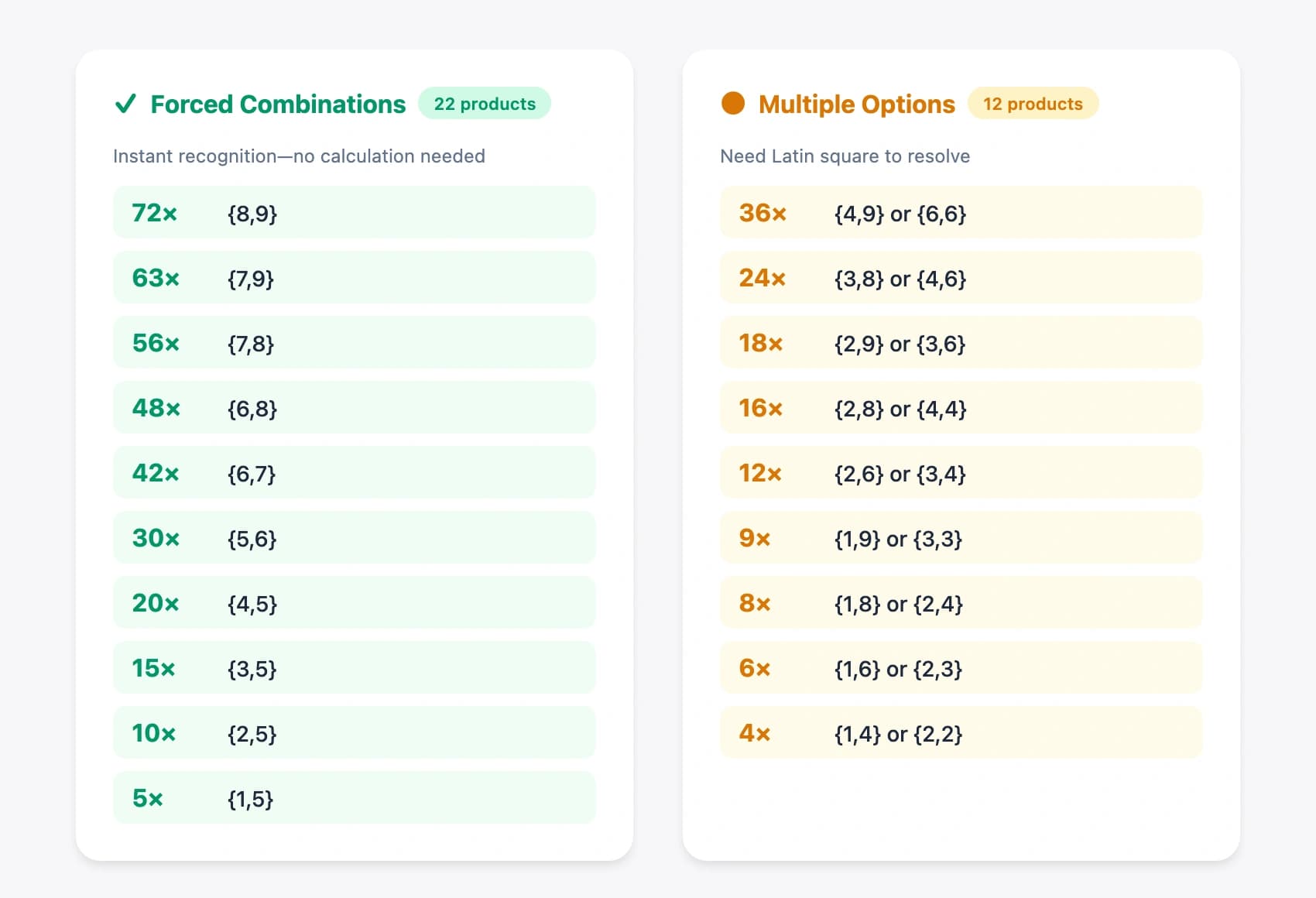
Quick challenge: What is the only valid combination for 72× in two cells? If you said {8,9}, you're building the right instincts. That number is simply too large to have any other single-digit factor pairs.
Grid Size Matters
The grid size determines your available digits, which affects valid combinations. This is one of the most important kenken tips to internalize: always filter combinations against your grid size. A combination that seems ambiguous in a 9×9 might be completely forced in a smaller grid.
| Cage | 4×4 | 5×5 | 6×6 |
|---|---|---|---|
| 12× | {3,4} only | {3,4} only | {2,6} or {3,4} |
| 20× | impossible | {4,5} only | {4,5} only |
| 30× | impossible | impossible | {5,6} only |
The Factorial Pattern
Here's something genuinely delightful about mathematics—and once you see it, you will never forget it. It's like the puzzle designer is winking at you, hiding a mathematical Easter egg in plain sight:
- 6× in 3 cells = {1,2,3} (which is 3! = 1×2×3)
- 24× in 4 cells in a 4×4 = {1,2,3,4} (which is 4!)
- 120× in 5 cells in a 5×5 = {1,2,3,4,5} (which is 5!)
- 720× in 6 cells in a 6×6 = {1,2,3,4,5,6} (which is 6!)
When you see a factorial number as a cage target, check if the cage contains exactly that many cells. If so, the digits are 1 through N—completely determined.
Division Cage Logic: Forced Pairs
Division cages always contain exactly two cells. The larger digit divided by the smaller must equal the target. This creates a very limited set of valid pairs.
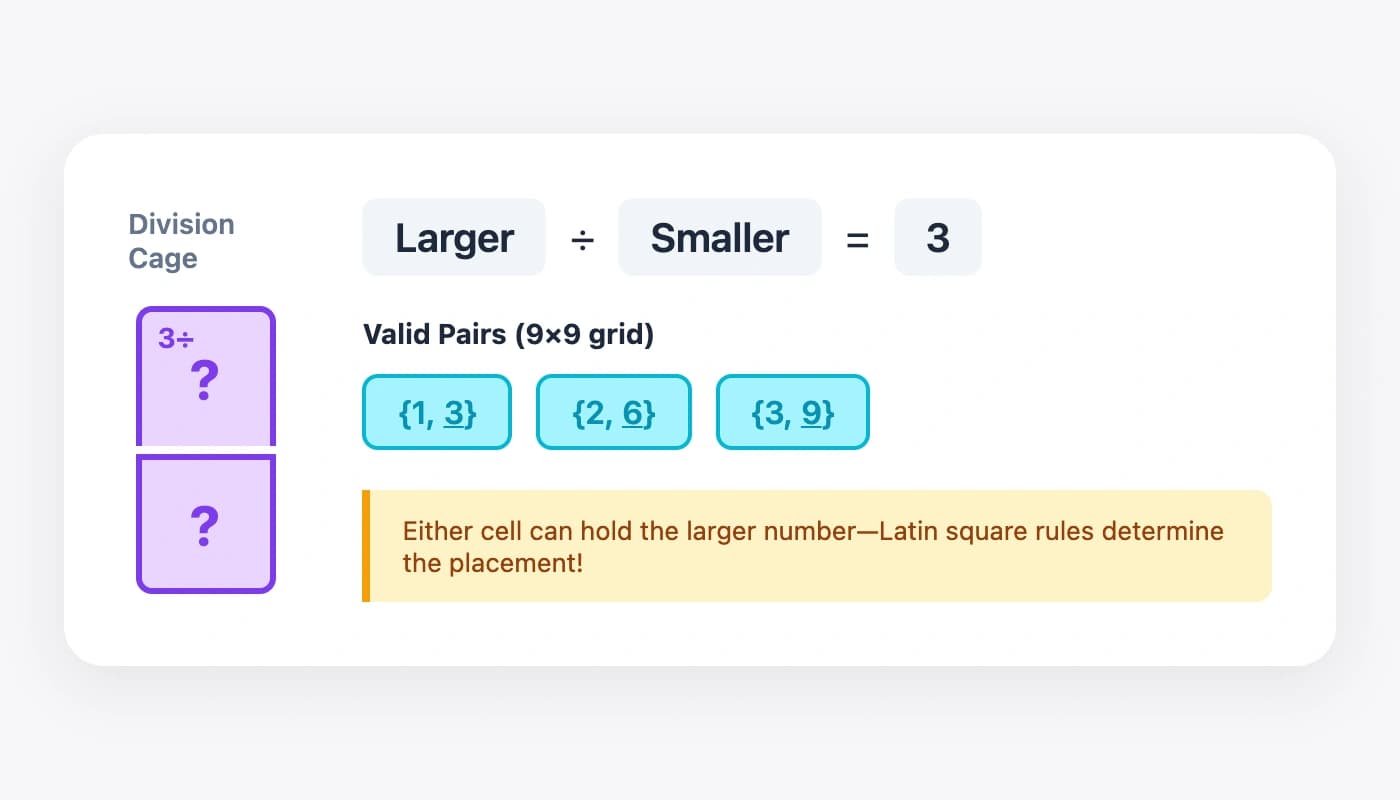
Notice the pattern: for targets 5 through 9, there's exactly one valid pair. Division by 5 means {1,5}. Division by 6 means {1,6}. These are completely determined.
Strategic use: Division cages with large quotients (5+) are among the most constrained cages in the puzzle. Find them early and use them as anchors.
Subtraction Cage Pairs: The Consecutive Secret
Subtraction cages also contain exactly two cells. The absolute difference between the digits must equal the target. This creates predictable patterns.
Key insight: A 1− cage always contains consecutive digits. In a 5×5, valid pairs are {1,2}, {2,3}, {3,4}, or {4,5}.
Subtraction cages become powerful when combined with row/column constraints. If a 1− cage spans two cells in a 5×5, and one of those cells' rows already contains 1 and 5, then the pair cannot be {1,2} or {4,5}—it must be {2,3} or {3,4}. One constraint eliminated half the possibilities!
Cross-Cage Latin Square: The Power Technique
This is where learning how to solve Calcudoku elevates from arithmetic to logic. The Latin square constraints (no repeats in rows/columns) interact with cage arithmetic to eliminate possibilities.
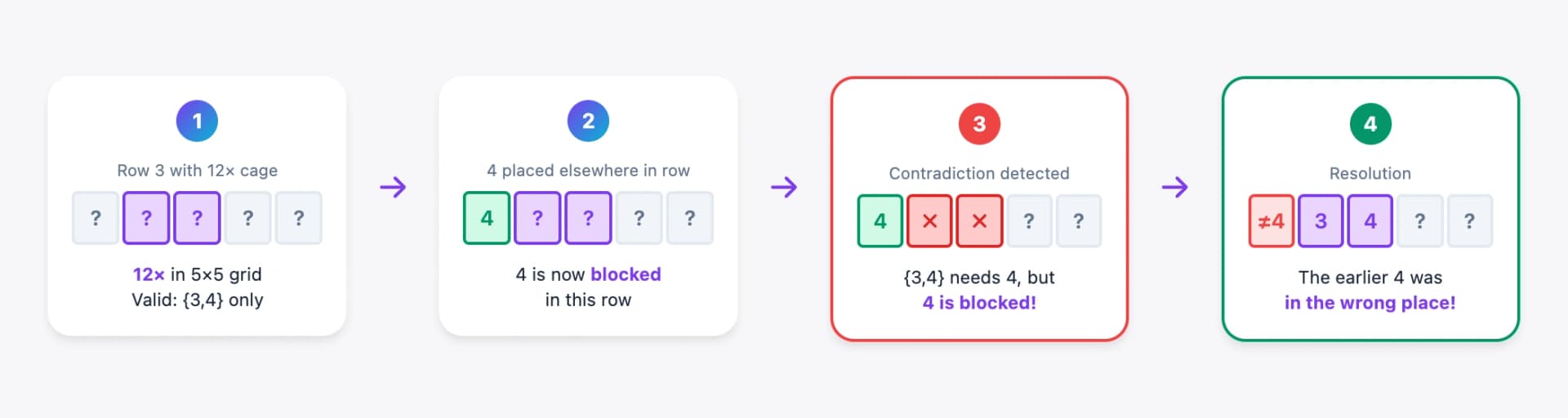
Cross-cage logic works in both directions: established digits constrain cages, and cage requirements constrain digit placements. Here's the step-by-step approach that makes cross-cage analysis work every time:
- List all mathematically valid combinations
- Check which digits in those combinations are blocked by row/column placements
- Eliminate combinations containing blocked digits
- If one combination remains, the cage is determined
Parity Analysis: Odd and Even Reasoning
Parity—whether numbers are odd or even—provides a powerful constraint for addition and multiplication cages. This is one of the more advanced calcudoku techniques, but once you grasp it, you'll wonder how you ever solved without it.
The sum is even if and only if there's an even count of odd numbers. In simpler terms: count how many odd numbers you're adding. If you have zero, two, or four odd numbers, your total will be even. If you have one or three odd numbers, it'll be odd.
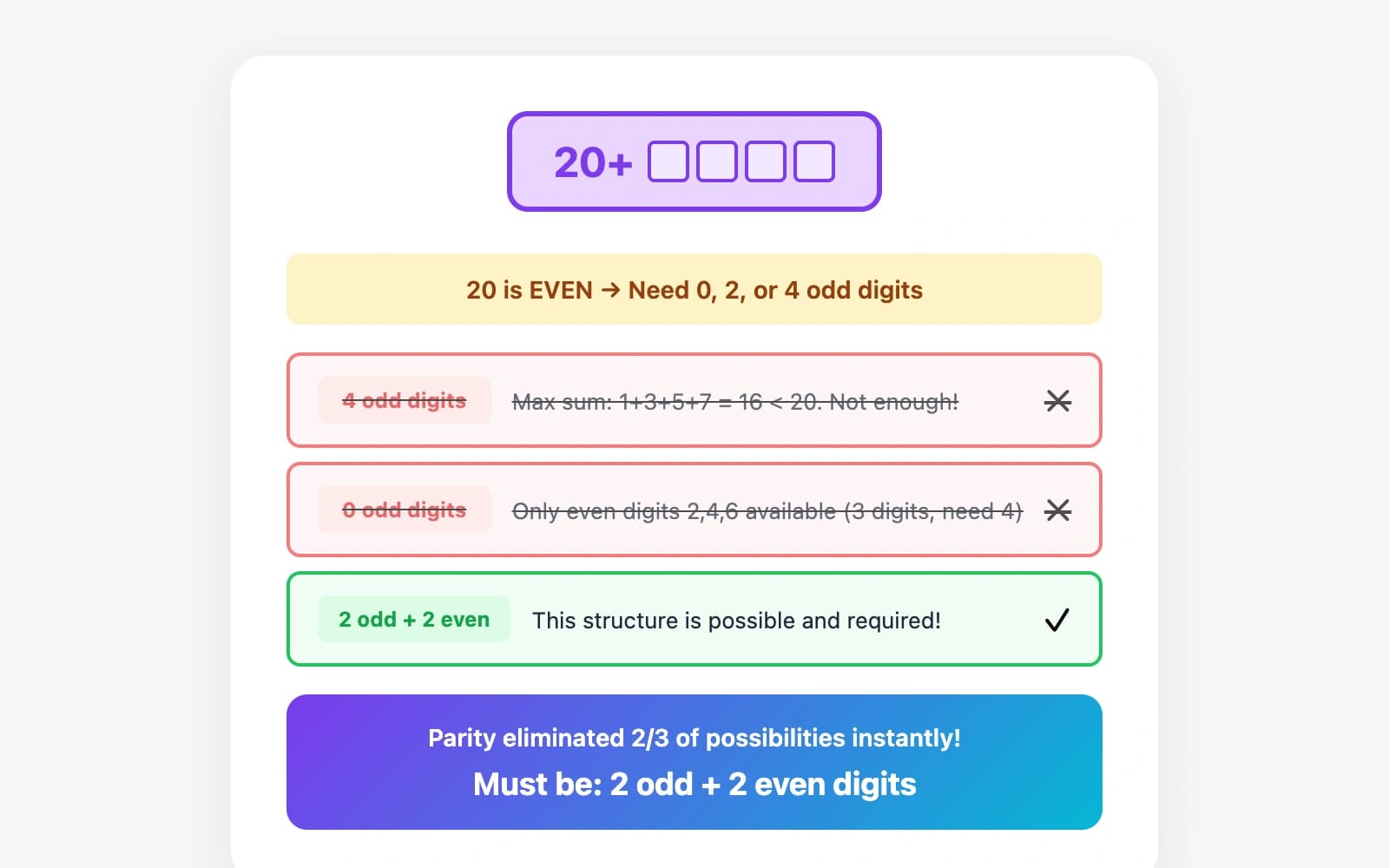
For multiplication, the rules are even simpler: any factor being even makes the product even. All factors must be odd to get an odd product. A 15× three-cell cage? 15 is odd, so all three digits must be odd—and {1,3,5} is the only combination!
L-Shaped and Large Cages: Multi-Row Strategies
Cages that span multiple rows or form irregular shapes require special handling. The key insight: digits can repeat within a cage if the repeated digits are in different rows AND different columns.
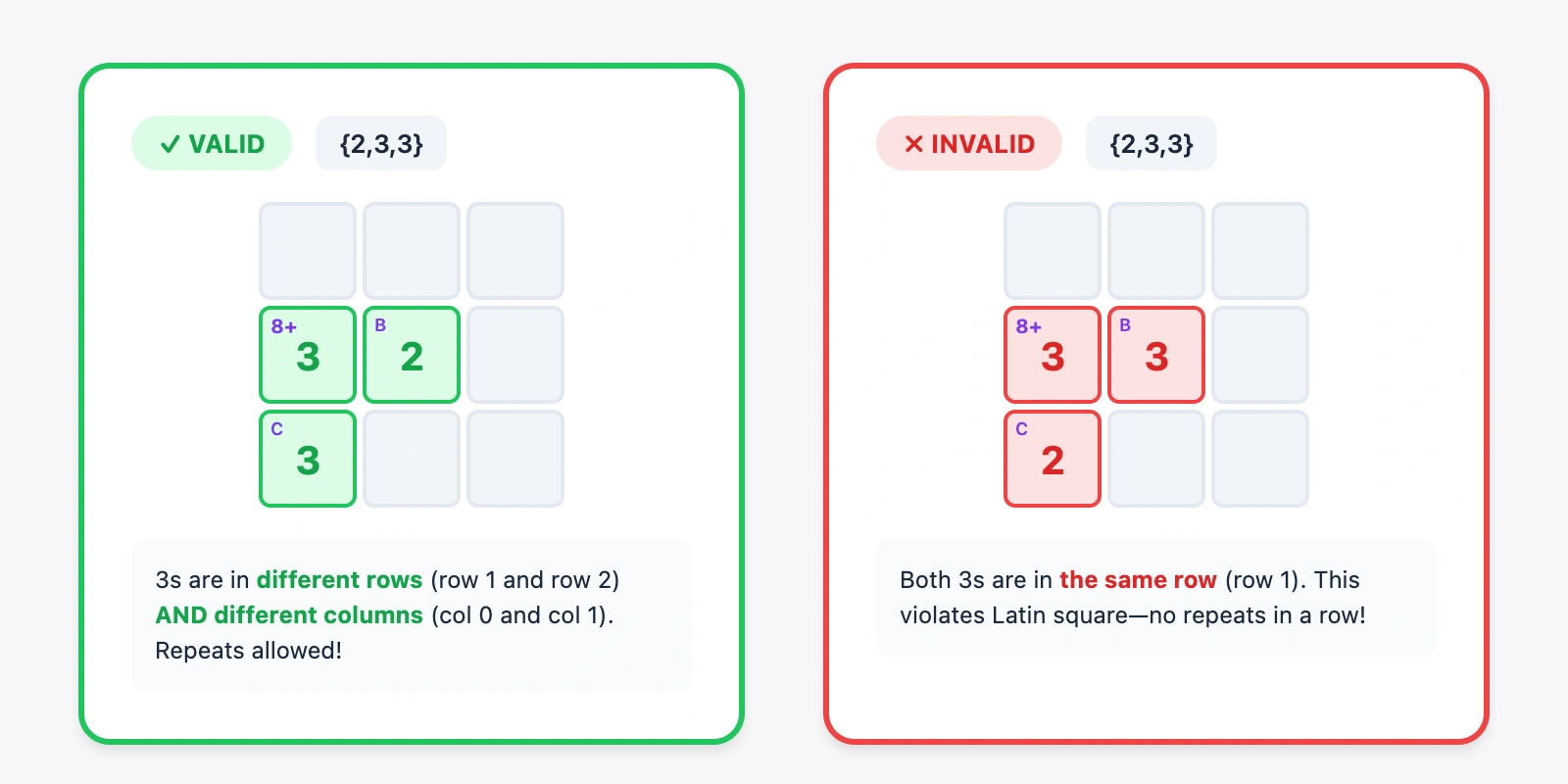
L-shaped cages can accommodate digit repeats that straight cages cannot. But straight cages (all cells in one row) never allow repeats. When a cage spans an entire row, the cage's digits ARE the row's digits—use this to your advantage.
Putting It All Together: A Worked Example
Let me walk through solving a section of a 5×5 Calcudoku using the kenken strategies we've covered.
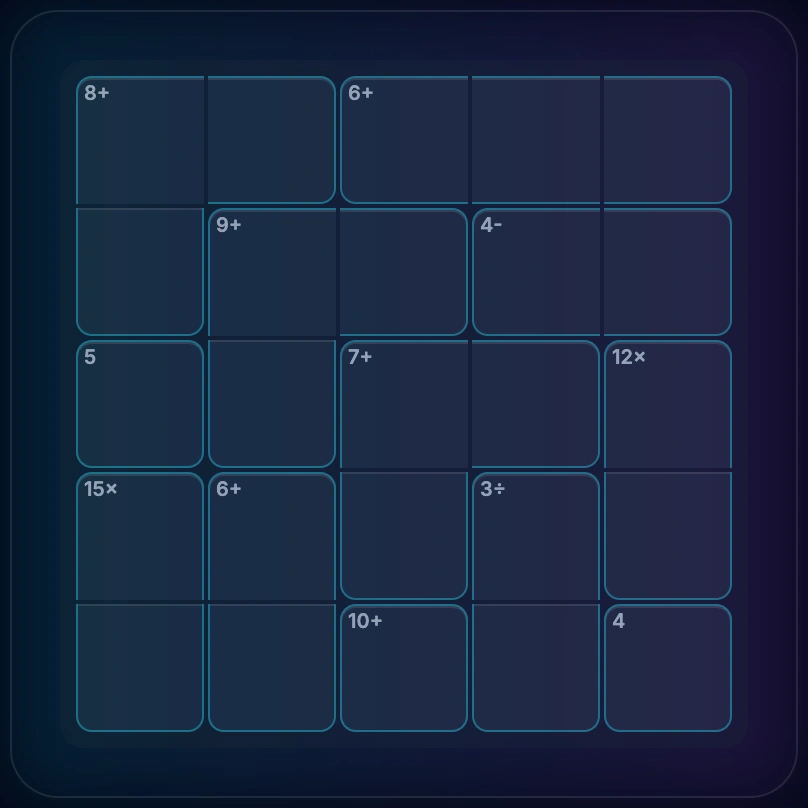
Practice puzzle showing single-cell cages (5 and 4) already placed
Phase 1: Scan for single-cell cages. Place 5 and 4 immediately—these eliminate options in their rows and columns.
Phase 2: Find division cages with large quotients. A 2÷ cage in a 5×5 has only two valid pairs: {1,2} or {2,4}.
Phase 3: Analyze multiplication cages. A 6× cage in two cells in a 5×5 can only be {2,3}—there's no 6 available for {1,6}.
Phase 4-5: Apply cross-cage resolution. Check columns against cage combinations—if a digit is blocked in a column, it narrows your options. The cascade continues until the puzzle is complete.
Common Intermediate Mistakes
We've all been there—that sinking feeling when you realize you've painted yourself into a corner. Here are the traps to avoid:
Mistake 1: Forgetting Grid Size Limits
You calculate that a 12× cage could be {2,6}, then place a 6—but you're solving a 5×5, where 6 doesn't exist. The fix: Always check your maximum digit first.
Mistake 2: Allowing Invalid Repeats
You place {3,3} in a two-cell cage that spans one row. The fix: Repeats are only valid if cells are in different rows AND different columns.
Mistake 3: Missing Cross-Cage Constraints
You solve a cage's arithmetic correctly but ignore that a digit is already placed in that cage's row. The fix: Always filter combinations against existing placements.
Quick-Reference Strategy Summary
Priority Order
- Single-cell cages (immediate placement)
- Division cages with quotient 5+ (forced pairs)
- Small multiplication cages with unique factorizations
- Subtraction cages filtered by row/column constraints
- Cross-cage Latin square analysis
- Parity reasoning for remaining cages
Must-Know Forced Combinations
- 6× in 3 cells = {1,2,3}
- N! in N cells = {1,2,...,N}
- 72× in 2 cells = {8,9}
- 5÷, 6÷, 7÷, 8÷, 9÷ all have exactly one valid pair
- 1− always means consecutive digits
The Cross-Cage Technique
- List all mathematically valid combinations
- Filter against row/column placements
- If one combination survives, the cage is solved
The Calcudoku Cascade Awaits
You now understand what separates confident Calcudoku solvers from struggling ones: the recognition that every cage is a constrained mini-puzzle, the memorization of forced combinations, and the systematic application of cross-cage logic.
That intimidating 120× cage? It's five cells containing 1, 2, 3, 4, and 5—completely determined. That 3÷ division cage? It's {1,3} in a 5×5. That sprawling L-shaped cage? It follows the same rules as every other cage, just with more geometric flexibility.
The puzzle that once seemed like pure arithmetic is actually pure logic wearing a mathematical disguise. The numbers set up constraints. The deduction delivers solutions.
Every cage has a secret. Now you know how to find it.