Logic Puzzles for Kids:
How Puzzles Build Math-Ready MindsAges 6-8
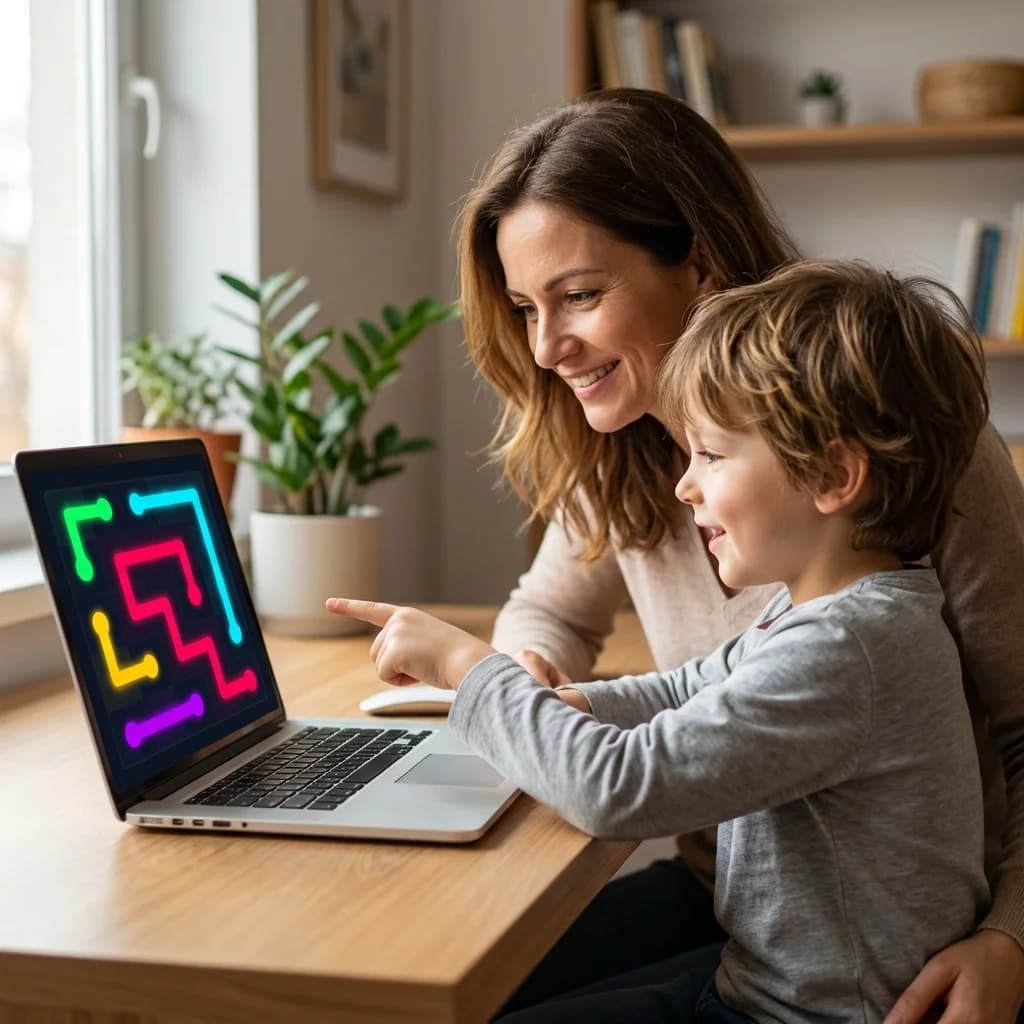
Picture this: Your seven-year-old is stuck on a puzzle. Brow furrowed, tongue poking out in concentration, they have been staring at the same grid for three minutes. Your instinct says "help them," but something stops you. And then it happens—their face lights up as the solution clicks into place.
That moment of triumph? It is literally building their brain.
Between ages six and eight, something remarkable happens inside your child's head. Neural pathways are forming at an extraordinary rate, laying the foundation for logical thinking, mathematical reasoning, and problem-solving abilities that will serve them for life. And here is what decades of research tells us: simple logic puzzles are one of the most powerful tools you have to support this development.
This is not about turning your child into a math prodigy or adding pressure to an already busy schedule. It is about giving your child the gift of playful, purposeful challenges that happen to make their brains stronger—while creating some wonderful memories along the way.
The 6-8 Window: Why These Years Matter
Developmental psychologist Jean Piaget identified ages seven to eleven as the "concrete operational stage" of cognitive development. This is when children first develop the capacity for logical operations: they can mentally reverse actions, consider multiple aspects of a situation simultaneously, and understand that changing the appearance of something does not change its fundamental properties.
But here is what makes ages six to eight particularly special: your child is at the beginning of this transformation. Their brain is primed for logical thinking but still building the neural architecture to support it. Every puzzle they solve, every pattern they recognize, every moment of productive struggle helps construct that architecture.
Think of it like learning a language. There is a window when the brain is especially receptive, when learning happens almost effortlessly compared to later years. The same principle applies to logical reasoning—and you are standing right at that window.
Research published in Psychological Science found that spatial reasoning measured in early childhood predicts mathematical ability years later. Emory University psychologist Stella Lourenco, who led the research, noted that spatial skills and mathematical development are deeply connected from the earliest ages.
The Research Says
A study by University of Chicago researchers found that children who played with puzzles between ages two and four developed significantly better spatial transformation skills by age four and a half. The researchers documented this connection even after controlling for family income, education level, and how much parents talked to their children during play.
What Happens in Young Brains During Puzzle-Solving
When your child sits down with a logic puzzle, multiple brain systems activate simultaneously. It is like a symphony where different sections of the orchestra come together to create something greater than any could produce alone.
Have you ever noticed your child getting better at waiting before acting? That pause between seeing a problem and jumping to a solution? That is working memory at work—and puzzles strengthen it.
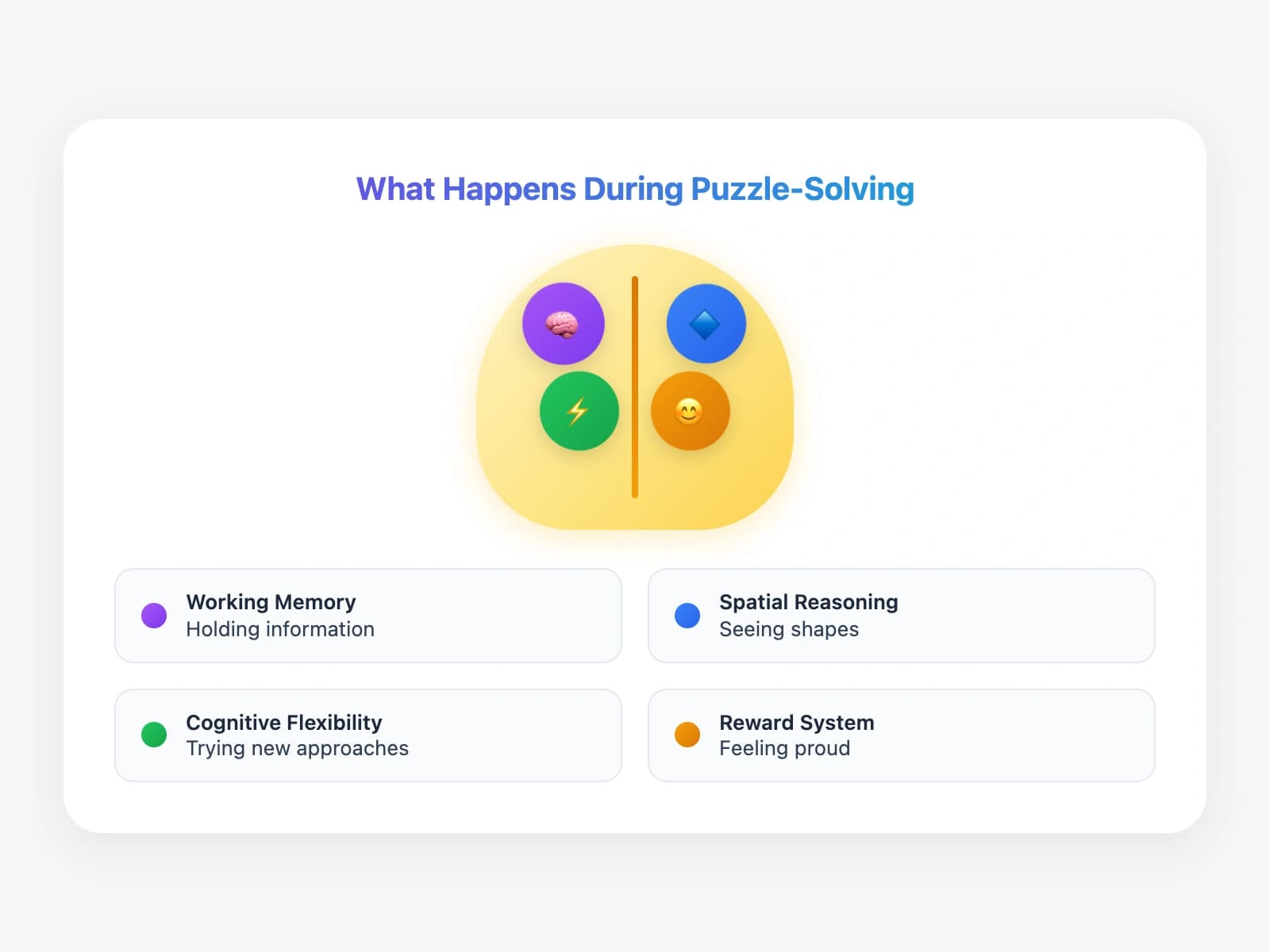
Working Memory
Your child holds puzzle rules, current progress, and possible moves in their mind simultaneously. Research suggests that working memory directly predicts problem-solving performance, with stronger working memory leading to more successful puzzle completion.
Spatial Reasoning
Children who play with puzzles develop the ability to mentally rotate and transform shapes. Stanford's DREME research network found that even a single 20-minute session of spatial puzzles improved children's math performance compared to a control group.
Cognitive Flexibility
Puzzles require children to switch between different problem-solving approaches when one strategy does not work. Research on first and second graders found that cognitive flexibility, the ability to shift between different perspectives and strategies, was essential for successful problem-solving.
Reward and Motivation
Each small victory triggers dopamine release in your child's brain, creating positive associations with problem-solving. This natural reward system makes children want to tackle harder challenges, building a love of learning.
The Four Cognitive Skills Puzzles Develop
1. Working Memory: The Mental Scratchpad
Think of working memory as your child's mental whiteboard. It is where they hold information temporarily while using it to solve problems. When your child works on a simple Sudoku grid, they need to remember which numbers are already in each row and column while testing possibilities for empty cells.
Ever watched your child try to remember their order at a restaurant while also telling you about their day at school? That juggling act is working memory in action—and puzzles make it stronger.
Research published in ScienceDirect shows a direct link between working memory capacity and mathematical achievement in children. The connection is so strong that executive function and spatial skills together predict up to 70% of the variation in early math performance.
The good news? Working memory improves with practice. Every puzzle your child completes gives their mental whiteboard a workout, gradually expanding its capacity.
2. Spatial Reasoning: Seeing What Is Not There
Spatial reasoning is the ability to visualize objects and how they relate to each other in space. It sounds abstract, but it underlies practical skills from reading maps to understanding how fractions work to eventually grasping geometry.
Researchers have found that children who play with puzzles are better able to imagine what something would look like if it were changed, rotated, or flipped. This mental manipulation ability forms the foundation for later mathematical concepts. When your child eventually learns that 1/2 equals 2/4, spatial reasoning helps them see why that is true.
Why This Matters for Math
Research has found that five-year-olds' ability to mentally rotate and combine shapes predicted their accuracy in placing numbers on a number line when they were six. Spatial skills are not separate from math skills; they are foundational to them.
3. Logical Thinking: If This, Then That
Logic puzzles teach children to follow chains of reasoning. "If this number goes here, then that number cannot go there." This if-then thinking is exactly what mathematicians use, and introducing it early gives children a huge advantage.
You might hear your child start talking through their reasoning out loud: "Wait, if I put that there, then... no, that won't work." That's the sound of a logical mind developing. It is honestly thrilling to witness.
A Korean study of third and sixth graders found that regular Sudoku practice significantly improved students' logical thinking and mathematical problem-solving abilities. The researchers found benefits from both number-based puzzles and symbol-based versions, suggesting it is the logical structure—not the numbers themselves—that builds the skill.
Here is something counterintuitive: the puzzles that frustrate your child most might be building the most important skills. That moment of struggle—when they really have to think—is when the deepest learning happens. Easy puzzles feel good, but slightly hard puzzles grow minds.
4. Persistence and Frustration Tolerance: The Hidden Superpower
Perhaps the most valuable skill puzzles develop is not cognitive at all. It is emotional: the ability to persist through difficulty without giving up.
Stanford psychologist Carol Dweck has spent over fifteen years researching what distinguishes strong learners from weak ones. Her conclusion? Children with a "growth mindset," the belief that abilities can be developed through effort and practice, consistently outperform those who believe intelligence is fixed.
Puzzles are growth mindset training in disguise. Every time your child gets stuck, tries a different approach, and eventually succeeds, they are learning that productive struggle leads to breakthroughs. Research shows that frustration tolerance skills in children predict academic achievement, with effects lasting years into the future.
"The passion for stretching yourself and sticking to it, even when it's not going well, is the hallmark of the growth mindset."
— Carol Dweck, Mindset: The New Psychology of Success
What Puzzle Progress Looks Like
Many parents report that children who initially give up after a few wrong guesses gradually build persistence over weeks of regular puzzle practice. Consider a scenario like this: a six-year-old starts puzzle time and cannot handle being stuck for more than a minute. Three months later, their teacher notices they are now volunteering for challenging math problems. Regular short sessions help children learn that being stuck is not the same as failing.
Age-Appropriate Puzzles: A Practical Guide
Not all puzzles are created equal for young learners. The key is finding the sweet spot: challenging enough to promote growth, but accessible enough to prevent frustration. Here is a progression that works well for most children ages six to eight.
| Stage | Puzzle Types | Skills Developed | Time to Master |
|---|---|---|---|
| Starter | 4x4 Sudoku, simple Connect puzzles, pattern completion | Basic logic, pattern recognition, rule following | 2-4 weeks |
| Building | 6x6 Sudoku, Nonograms (5x5), Pipes puzzles | Deductive reasoning, spatial visualization, planning | 4-8 weeks |
| Growing | 4x4 Futoshiki, Magic Square, larger Nonograms | Constraint satisfaction, number relationships, persistence | 2-3 months |
| Advanced | 9x9 easy Sudoku, Slitherlink basics, Calcudoku | Multi-step reasoning, mathematical operations, patience | 3-6 months |
Recommended Starter Puzzles
Mini Sudoku (4x4 grids)
Start with 4x4 grids using just numbers 1-4. The same rules as regular Sudoku apply, each row, column, and 2x2 box must contain each number exactly once, but the smaller grid makes the logic manageable for young minds.
Connect Puzzles
Draw paths to connect matching colored dots without crossing lines or leaving empty spaces. These puzzles build spatial reasoning and planning skills while feeling more like a game than an exercise. Children love the colorful, visual nature of these puzzles.
Nonograms (Picture Puzzles)
Use number clues to fill in cells and reveal a hidden picture. Start with 5x5 grids where simple images emerge, like hearts, stars, or animals. The visual reward of seeing a picture appear keeps children motivated to complete the logical process.
Pipes Puzzles
Rotate pipe segments to create a connected network. This puzzle type builds spatial rotation skills, the exact mental manipulation ability that research links to later math success. Children often find these satisfying because the solution "clicks" visually when complete.
How to Introduce Puzzles Without Causing Frustration
The way you introduce puzzles matters as much as which puzzles you choose. Here are research-backed strategies for making puzzle time positive and productive.
(And yes, it is tempting to just point at the answer when they are stuck. We have all been there. But resist—the struggle is where the magic happens.)
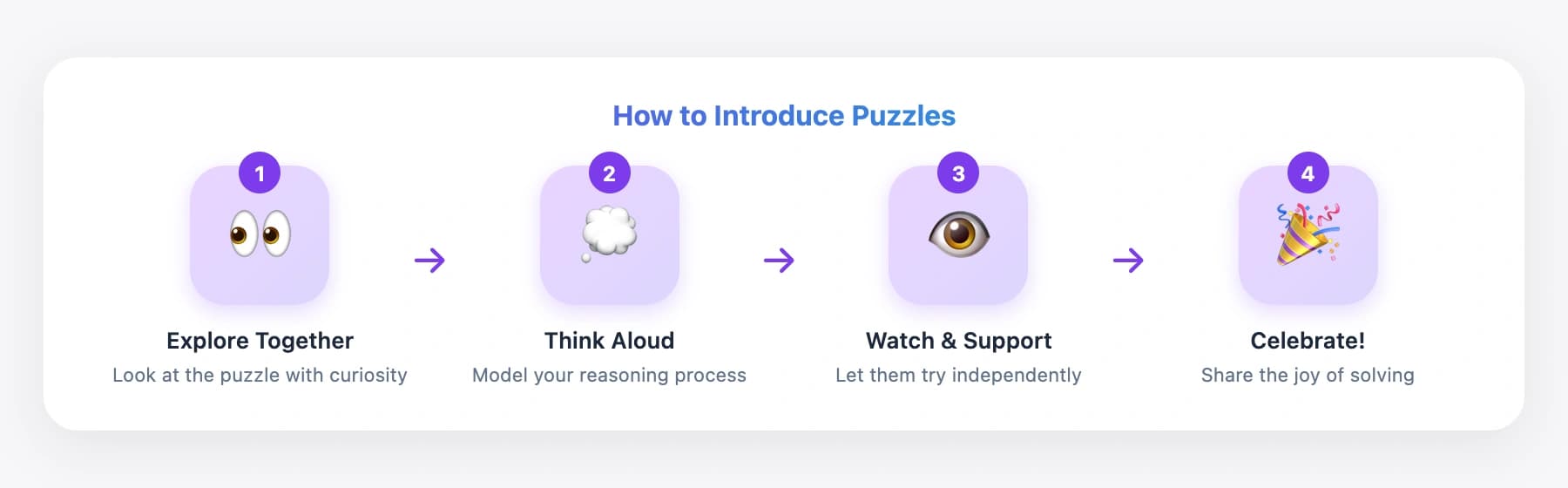
Start Easier Than You Think Necessary
Begin with puzzles your child can complete successfully. Early wins build confidence and positive associations. You can always increase difficulty later, but recovering from frustration is harder than preventing it.
What is your child's frustration trigger point? Some kids can handle being stuck for five minutes; others need a win within sixty seconds. Knowing this helps you choose the right difficulty level.
Solve Together First
Research from the University of Chicago found that children benefit most from puzzle play when parents actively engage. Work through the first few puzzles together, thinking out loud as you go: "I see a 3 here, so this row cannot have another 3..."
Use Spatial Language
Stanford's DREME research emphasizes that spatial words boost the benefits of puzzle play. Use terms like "above," "below," "next to," "diagonal," "row," and "column" as you work together. This vocabulary helps children think about spatial relationships more precisely.
Praise Effort, Not Intelligence
Say "You worked really hard on that!" rather than "You are so smart!" Research shows that praising effort encourages children to take on challenges, while praising intelligence can make them avoid anything difficult.
Keep Sessions Short
For ages six to eight, 10-15 minutes is plenty. Children at this age can typically sustain effort on a challenging puzzle for this duration. It is better to end while they are still enjoying it than to push until frustration sets in.
(Warning: You may find yourself sneaking in a Nonogram after bedtime. Puzzles are contagious.)
Normalize Getting Stuck
When your child hits a wall, resist the urge to immediately provide the answer. Instead, try: "This is a tricky spot! Let us think about what we know for sure..." Model productive struggle by thinking through challenges together.
Watch for Frustration Signs
If your child starts showing signs of frustration (sighing, wanting to quit, negative self-talk), it is time to offer a hint, switch to an easier puzzle, or take a break. Pushing through intense frustration can create negative associations with puzzles. The goal is productive challenge, not stress.
Signs of Progress to Watch For
Cognitive growth from puzzles is not always immediately obvious. Here are the subtle and not-so-subtle signs that your child is developing stronger thinking skills:
Think back to your own childhood: was there a puzzle or game that you remember mastering? That feeling of achievement is exactly what we are cultivating.
Thinking Before Acting
Your child pauses to consider moves rather than immediately guessing. This shows developing executive function and impulse control.
Explaining Their Reasoning
They can articulate why they made a choice: "I put the 2 here because there is already a 2 in that row." This verbal reasoning reflects organized thinking.
Trying Different Approaches
When stuck, they try a different strategy instead of giving up. This flexibility shows growing cognitive flexibility and resilience.
Spotting Patterns Quickly
They notice patterns without prompting: "Oh, these numbers always go in order!" Pattern recognition is a foundational mathematical skill.
Tolerating Difficulty Longer
They can work on challenging puzzles for longer periods without frustration. This growing frustration tolerance will serve them in all areas of learning.
Asking for Harder Puzzles
They want more challenge! This intrinsic motivation shows they have internalized the joy of problem-solving. (This is the moment every parent waits for.)
Which of these signs have you already noticed in your child? Sometimes the growth is happening before we even recognize it. Keep an eye out—you might be surprised by what you see.
The Connection to Future Math Success
Here is the thing: puzzles are not math homework in disguise. They are something better. They build the cognitive infrastructure that makes math learning easier when it happens.
A study by Cui and colleagues (2021) found that engagement in puzzle activities at an early age positively correlates with mathematical achievement in elementary school. The researchers concluded that spatial skills, which puzzles develop, are a strong predictor of achievement across STEM disciplines.
Here is how the skills transfer:
| Puzzle Skill | Math Application |
|---|---|
| Following multi-step rules | Following mathematical procedures and algorithms |
| Spatial reasoning from grid puzzles | Understanding fractions, geometry, graphing |
| If-then logical thinking | Word problems, proofs, algebraic reasoning |
| Working memory from holding possibilities | Mental math, multi-step problem solving |
| Persistence through difficulty | Not giving up on challenging math problems |
Addressing Common Parent Concerns
"My child gets frustrated easily. Will puzzles make it worse?"
Actually, the opposite can happen, but only if you start at the right level. Begin with puzzles that are almost too easy. The goal is building positive associations first. Once your child experiences success, they develop confidence to handle slightly harder challenges. Research shows that building frustration tolerance is like building a muscle: it requires gradual, progressive challenge, not diving into the deep end.
"My child is not good at math. Are puzzles still helpful?"
This is exactly when puzzles help most. If your child struggles with math, it often means they need more practice with the underlying cognitive skills that puzzles develop. The beauty of puzzles is that they do not feel like math practice. Your child can build spatial reasoning, logical thinking, and working memory without the anxiety that sometimes accompanies traditional math instruction.
"How do puzzles compare to educational apps?"
Many educational apps use puzzle-like mechanics, which can be valuable. However, research suggests that parent involvement amplifies the benefits significantly. The University of Chicago study found that spatial language used during parent-child puzzle play contributed to better outcomes. Whether digital or physical, puzzles work best as a shared activity rather than a solitary one.
"We do not have much time. How much is enough?"
Quality matters more than quantity. Even 10-15 minutes of focused puzzle time a few times per week can make a difference. The key is consistency and keeping it positive. A short, enjoyable puzzle session is far more valuable than a long, frustrating one.
Does any of this sound like your situation? You are not alone—these are the questions nearly every parent asks. The good news is that puzzle time can fit into almost any family's routine.
Getting Started: Your First Week
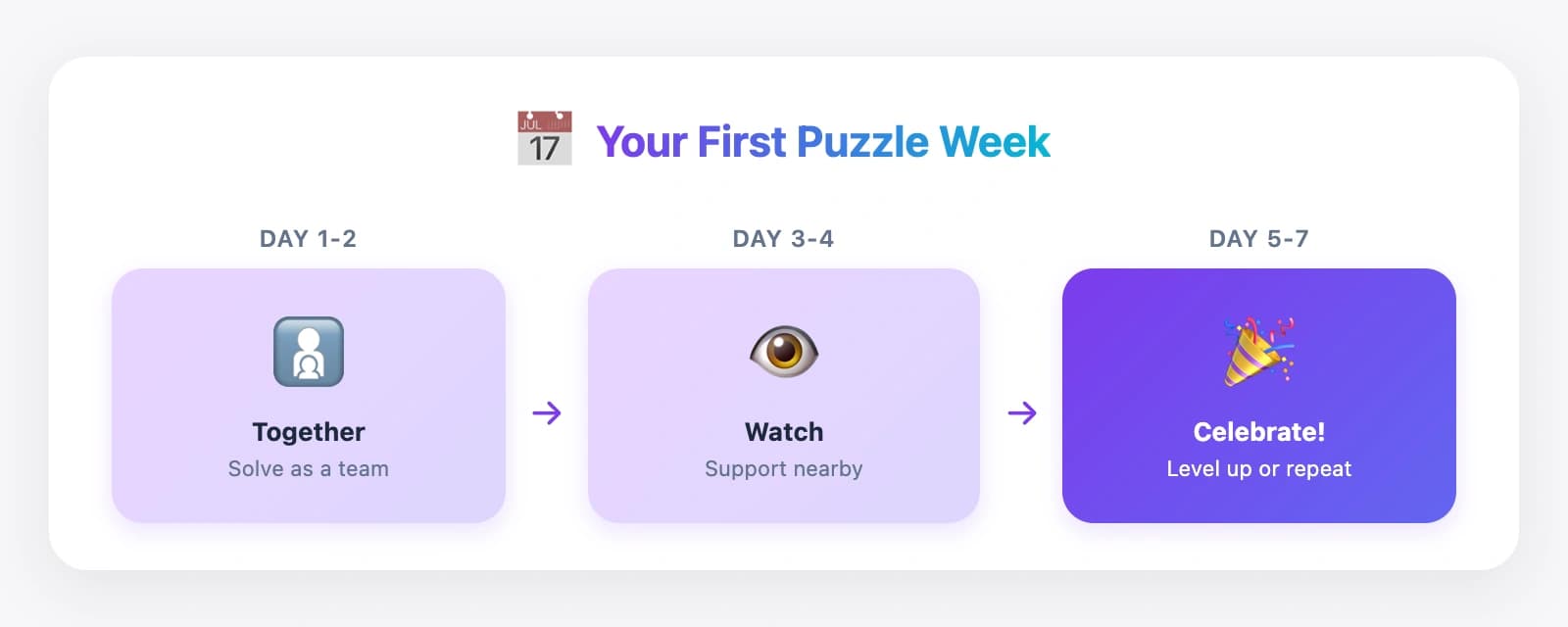
Ready to begin? Here is a simple plan for your first week of puzzle time:
Week One Schedule
Remember, there is no pressure here—this is about discovery, not drilling. Follow your child's lead and keep it fun.
Introduce one puzzle type together. Solve two or three puzzles as a team, thinking out loud.
Let your child try one puzzle independently while you watch. Offer hints only if they ask or seem stuck for more than a minute.
Celebrate progress! If they have mastered the current difficulty, try one slightly harder puzzle. If not, continue building confidence at the current level.
Start Your Puzzle Journey Today
Puzzolve offers a variety of logic puzzles perfect for young learners. Each puzzle type includes multiple difficulty levels, making it easy to find the right starting point for your child.
The Joy of Puzzling Together
The research is compelling: logic puzzles build the cognitive foundation for mathematical thinking. But let us not lose sight of something equally important. Puzzle time is quality time. It is you and your child, focused together on a shared challenge, celebrating small victories, and discovering the joy of figuring things out.
Your child will not remember the specific puzzles they solved at age seven. But they will carry forward the thinking patterns, the confidence, and the curiosity that puzzle time cultivates. And perhaps most importantly, they will remember that learning was something you did together.
So grab a puzzle. Sit down with your child. Think out loud, celebrate effort, and enjoy the journey. Their math-ready mind is already under construction—and you get to be part of building it.
Start today. That first puzzle could be the beginning of a beautiful tradition.
Research Sources
- Levine et al. (2012) - Early Puzzle Play: A predictor of preschoolers' spatial transformation skill (PMC)
- Executive functions and problem-solving in elementary school students (ScienceDirect, 2024)
- Stanford DREME - Puzzle Play: An Easy Way to Boost Early Spatial and Math Learning
- Babies' spatial reasoning predicts later math skills (ScienceDaily)
- Piaget's Concrete Operational Stage (Simply Psychology)
- The Benefits of Puzzle Games for Children's Cognitive and Emotional Growth (American SPCC)
- University of Chicago - Puzzle play helps boost learning of important math-related skills
- Carol Dweck - Mindset: The New Psychology of Success
Put it into practice
Ready to solve Connect?
Open a free puzzle and turn the ideas from this guide into your next solve.